
Sometimes the place you expect to impress you most isn’t the one that does.
I arrived with a fairly traditional list of things to do in Cheltenham: see the elegant Regency architecture, find the famous Neptune’s Fountain, wander through the gardens, take far too many photographs and eventually call it a day.
And then I found Neptune.
My first reaction was essentially: oh… I thought it would be bigger.
Perhaps I’d been deceived by particularly enthusiastic photography online. Perhaps anything described as being inspired by Rome’s Trevi Fountain is going to create unreasonable expectations. Either way, Cheltenham’s famous fountain wasn’t quite the monumental spectacle I’d imagined.
The funny thing is that it didn’t matter.
Because as the afternoon became evening, Cheltenham slowly became one of those places where I stopped worrying about what I was supposed to see and simply enjoyed being there.
The gardens were beautiful. The streets felt elegant without being stuffy. People were sitting outside, drinking, talking and enjoying themselves. The town felt lively and friendly, but not chaotic. And when darkness arrived, Cheltenham somehow became even better.
By the time we unexpectedly encountered a giant hare sitting beside a Minotaur under the trees, I’d completely forgiven the fountain.
And then I saw the fountain again after dark.
Perhaps Neptune had simply been waiting for better lighting.
A Town That Apparently Owes Quite a Lot to Some Pigeons
Before getting into the things to do in Cheltenham, there’s something wonderfully ridiculous about its history.
Cheltenham might not have become the elegant spa town we recognise today without a flock of unusually healthy-looking pigeons.
Seriously.
Around 300 years ago, local landowner William Mason noticed pigeons pecking at mineral salts deposited around a natural spring. Their apparently healthy appearance convinced him that the water might have medicinal properties. Mason enclosed the spring and began selling glasses of the water for half a penny.
His son-in-law, Captain Henry Skillicorne, subsequently developed the spring and surrounding grounds into a more sophisticated spa destination.
Then came the celebrity endorsement.
King George III visited in 1788 hoping the waters might improve his health. His visit helped establish Cheltenham as a fashionable destination for wealthy visitors, and the town expanded rapidly afterwards.
So there is a reasonable argument that the elegant Regency town we were walking around exists partly because somebody watched pigeons drinking funny water and spotted a business opportunity.
I rather like that.
Walking Through Regency Cheltenham
One of the pleasures of Cheltenham is that you don’t necessarily need to be doing anything.
We spent a lot of our visit simply walking.
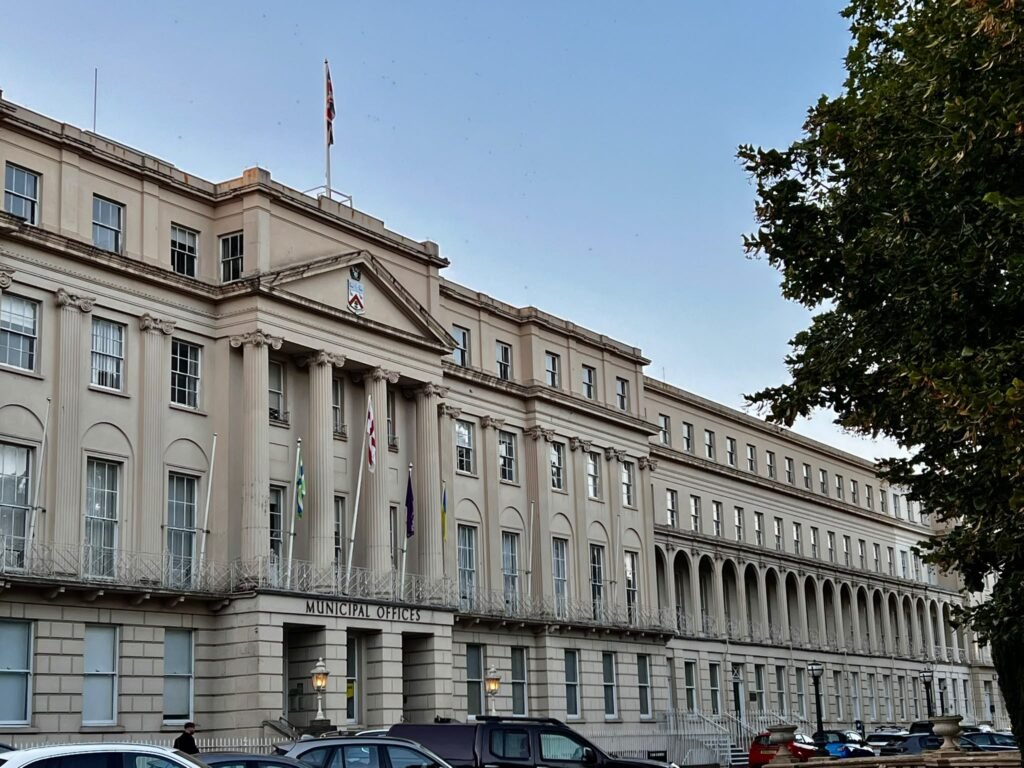
The Promenade and surrounding streets are filled with long terraces, columns, balconies, ornate ironwork and pale façades. Cheltenham’s official tourism site describes it as Britain’s most complete Regency town, and once you start wandering around the centre, it’s easy to understand why.
The Promenade itself dates to 1818. It developed as a tree-lined avenue connecting the town with the fashionable Sherborne Spa, and in its early days access was restricted to subscribers. It was quite literally somewhere to promenade—to walk, socialise and, presumably, make sure everyone else noticed that you were there.
Two centuries later, we were essentially doing the same thing.
Although with iPhones.
And considerably less impressive clothing.
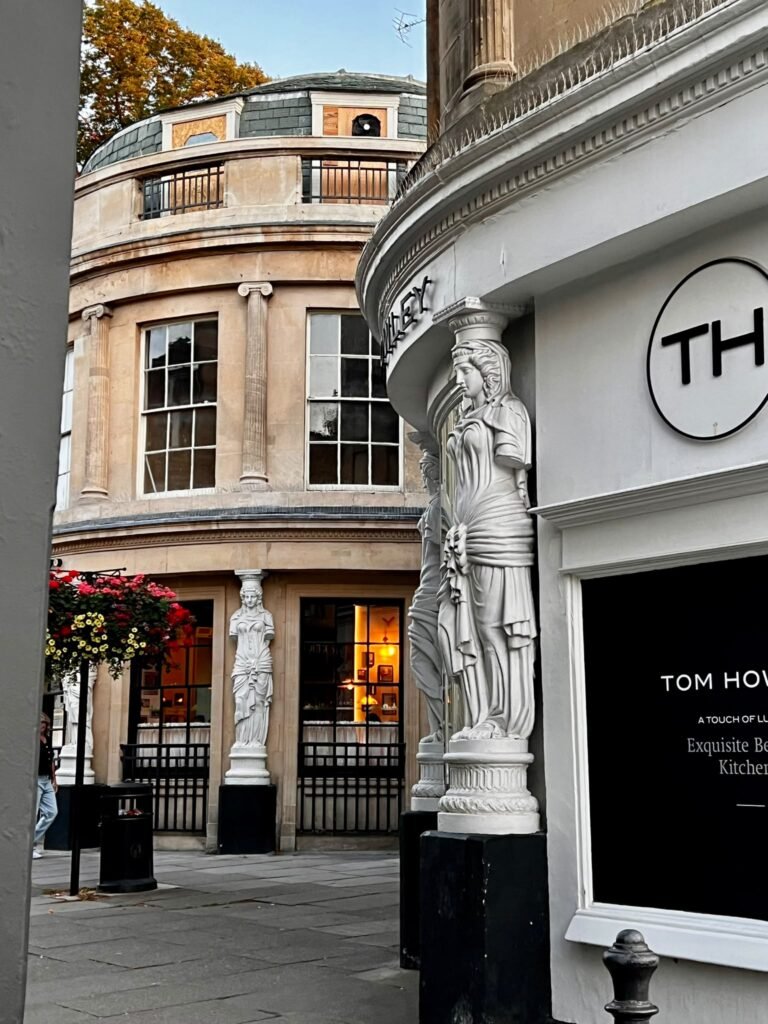
One architectural detail in particular kept catching my eye around Montpellier: the rather extraordinary female figures appearing to carry entire buildings on their heads.
They’re caryatids, one of Cheltenham’s most distinctive architectural details.
This was exactly the sort of thing I enjoyed here. There wasn’t constant pressure to reach the next major attraction. Interesting details kept appearing simply because we were walking.
Neptune’s Fountain: Slightly Smaller Than Expected 😅
And eventually, there he was.
Neptune.
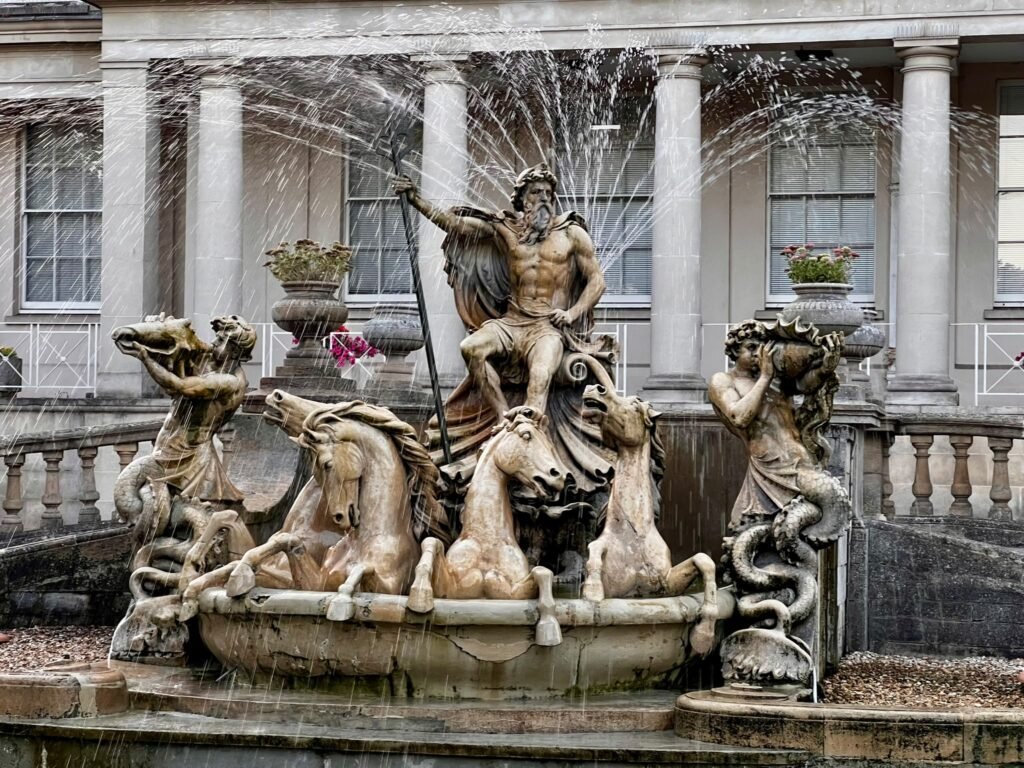
The fountain was unveiled in 1893 and designed by borough engineer Joseph Hall, with the sculpture carved from Portland stone by Richard Lockwood Boulton and his sons. Neptune rides in a shell chariot drawn by four sea horses, accompanied by a merman blowing a conch shell.
It is often said to have been inspired by Rome’s Trevi Fountain, although the historical evidence for that connection apparently isn’t conclusive. Another suggested influence is the Fountain of Neptune in Florence.
Whatever inspired it, photographs had convinced me it was going to be enormous.
It isn’t. 😂
That isn’t really a criticism. It’s detailed, theatrical and certainly worth stopping for. It was simply one of those occasions when the version I’d constructed in my imagination had acquired several additional metres.
But here’s the genuinely fascinating bit.
The water comes from the River Chelt, which runs beneath this part of the town through a culvert. When the fountain is running, it’s actually one of the few places in central Cheltenham where you get a glimpse of that hidden river.
And I hadn’t yet seen Neptune at his best.
More on that later.
Imperial Gardens Was Where Cheltenham Really Started Winning Me Over
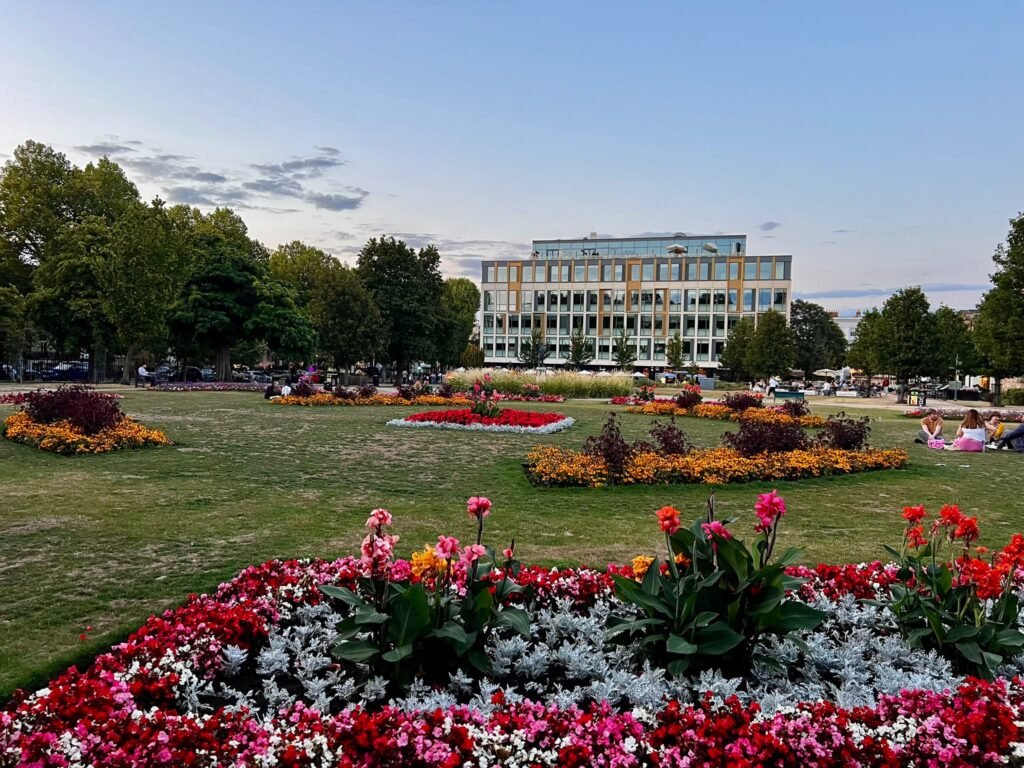
If Neptune was slightly smaller than I’d expected, Imperial Gardens was considerably lovelier.
This was one of my favourite parts of Cheltenham.
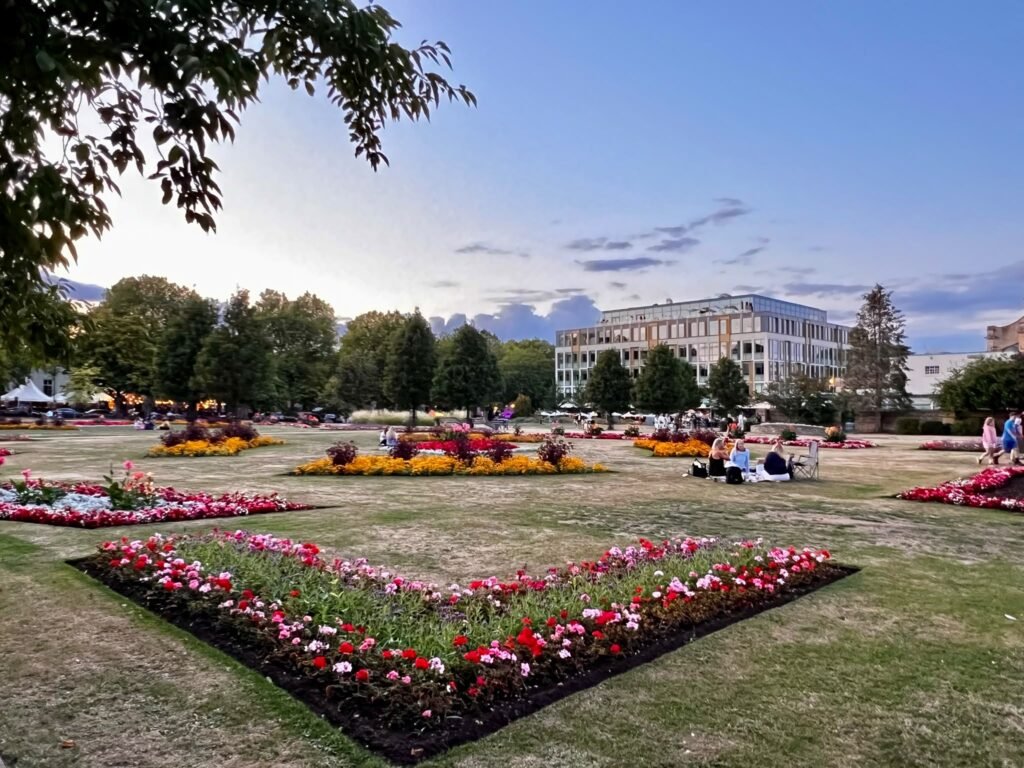
Colourful flower beds spread across the lawns, people were sitting around talking and relaxing, and the grand architecture surrounding the gardens gave the whole place a wonderfully elegant backdrop.
It didn’t feel like an attraction we had to inspect.
It felt like somewhere we could simply stay for a while.
And that is exactly what we did.
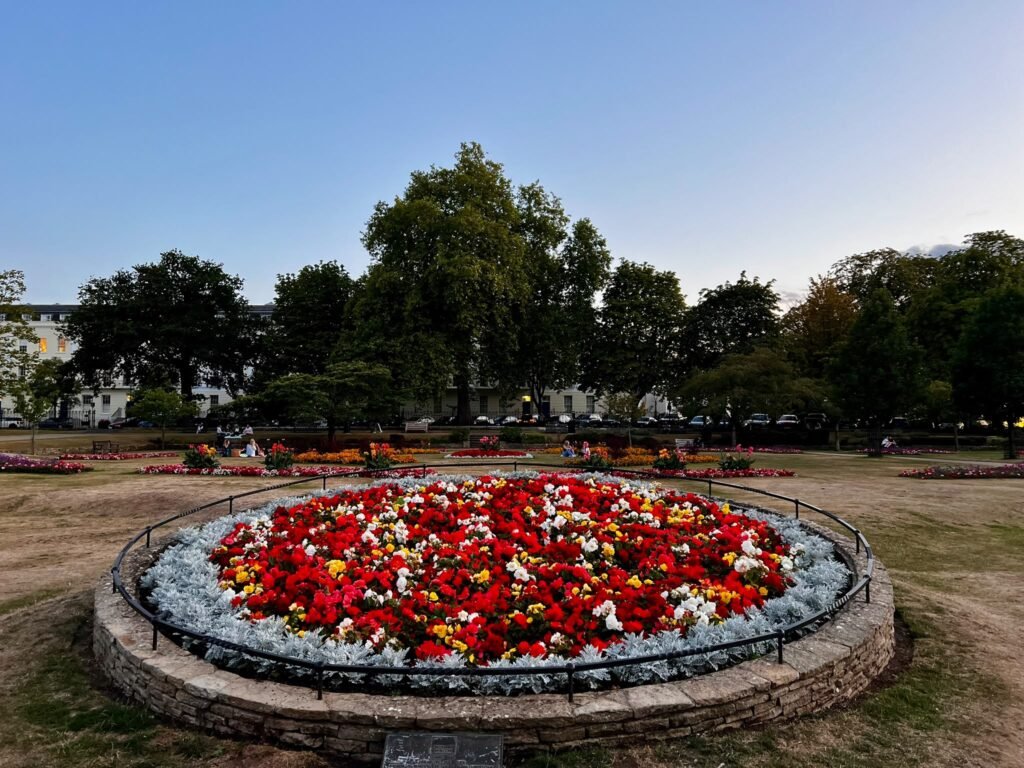
The gardens have their own connection to Cheltenham’s spa story. They were originally landscaped as pleasure gardens for wealthy visitors using the Sherborne Spa, later known as the Imperial Spa, which opened in 1818. Some Regency features survive, although the formal layout visitors see today was established just after the Second World War.
The floral displays are a major feature of the gardens; official visitor information says approximately 25,000 bedding plants have traditionally been used for them each year.
Looking at our photographs, I can believe it.
But again, the flowers aren’t really what I remember most.
It’s the atmosphere.
Sometimes Getting Away Is the Attraction
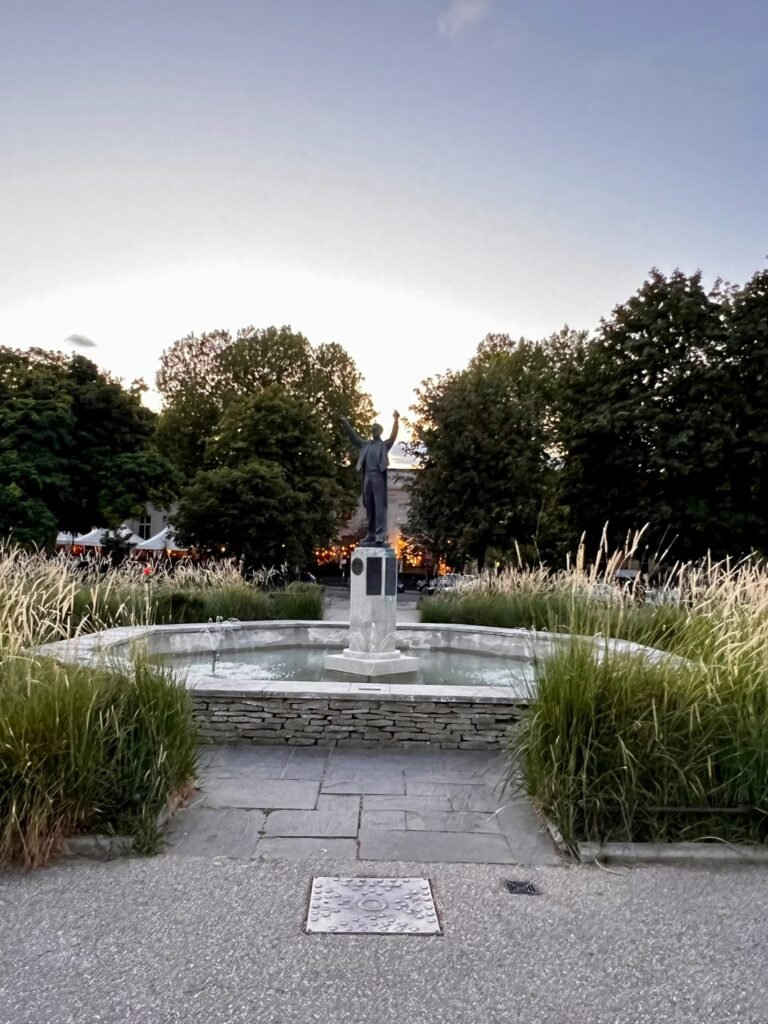
There’s a reason I increasingly enjoy trips like this.
Not every journey needs a life-changing landmark at the end of it.
Sometimes it’s enough to get away from your normal surroundings, walk somewhere you’ve never walked before and give your mind something completely different to look at for a few hours.
I think that’s partly why Cheltenham worked so well for me.
There wasn’t one enormous attraction that defined the visit. I wasn’t racing around desperately trying to complete a checklist.
We wandered.
We looked at buildings.
We stopped in the gardens.
We watched the town gradually change as daylight disappeared.
And I felt comfortable there.
That might sound like a small thing, but when you’re exploring somewhere unfamiliar, it isn’t. Cheltenham felt pleasant to walk around, relaxed and—during our visit—safe.
Then evening arrived.
And instead of feeling as though our sightseeing day was ending, it felt as though Cheltenham was starting another one.
Don’t Leave Cheltenham Too Early
This is probably the biggest piece of advice I can give from our visit:
If you can, stay into the evening.
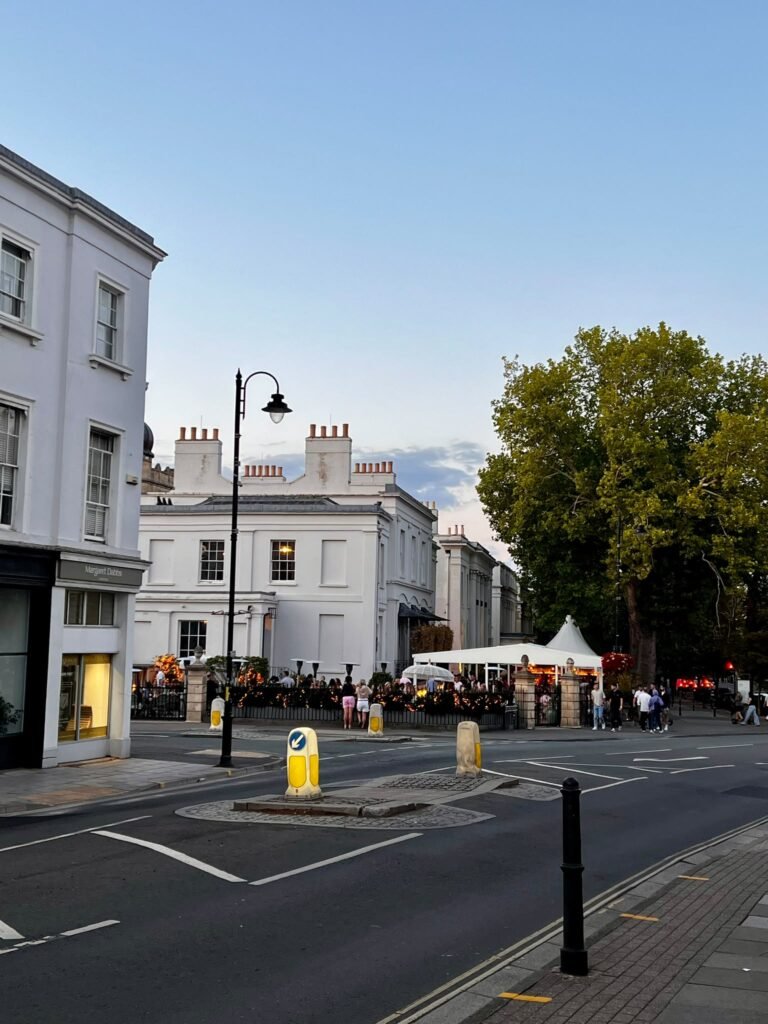
Restaurants and outdoor terraces filled up. Groups of friends appeared. There was music and conversation around us, but the atmosphere never felt unpleasant or intimidating.
It felt sociable.
Friendly.
Alive.
The contrast with the formal Regency buildings surrounding all of this made it even more enjoyable.
Cheltenham has a reputation for festivals, and the banner visible in one of my photographs rather appropriately reads “THE FESTIVAL TOWN.” Even on an ordinary evening, I could understand why that identity works.
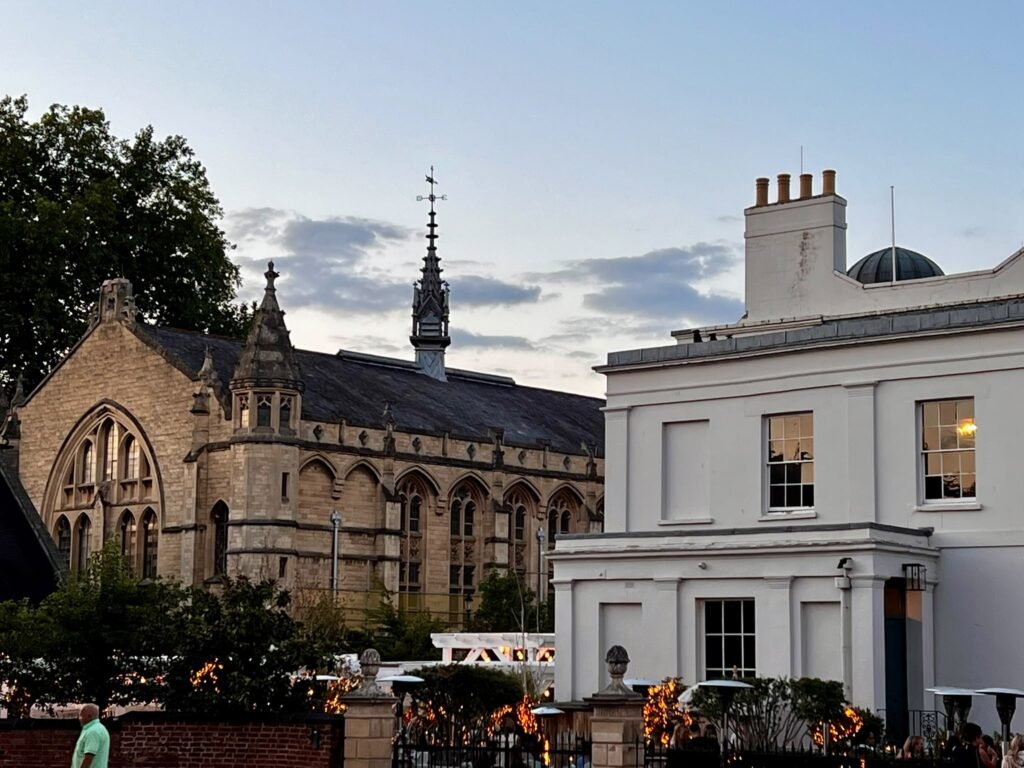
And this is where my photographs start changing too.
The daylight sightseeing pictures gradually become evening photographs: illuminated windows, garden lights, deep blue skies and people enjoying themselves outside.
Cheltenham looked really good after dark.
Then things became slightly stranger.
The Night We Found a Hare and a Minotaur
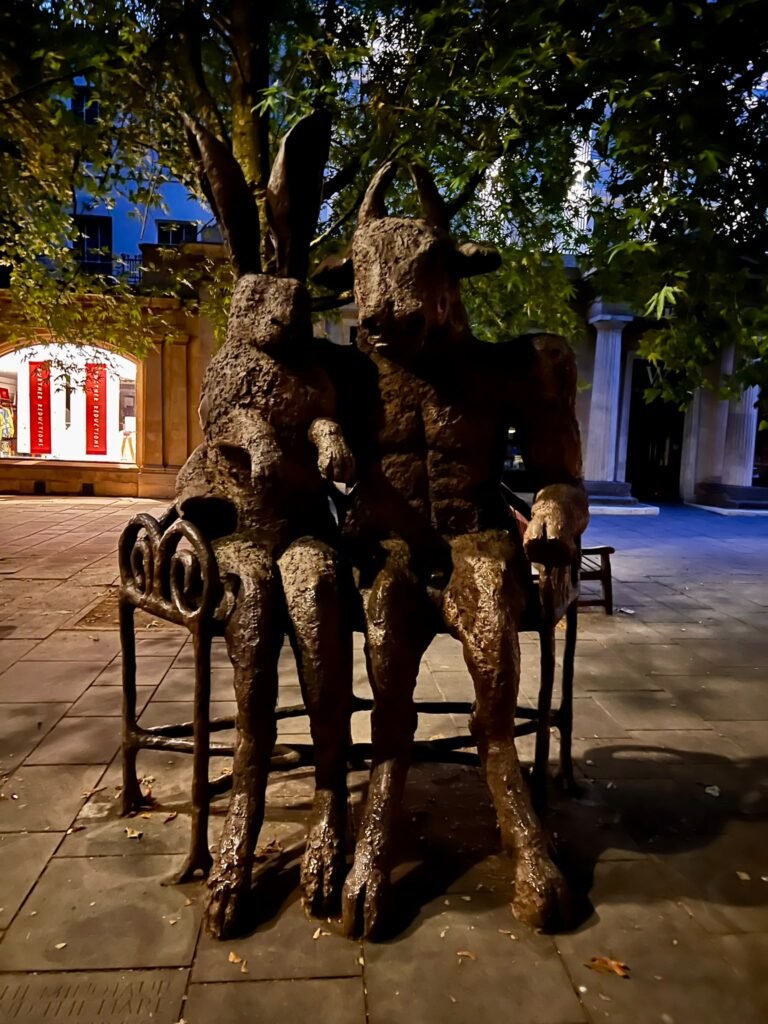
Walking along the Promenade after dark, we encountered these two.
A giant female hare.
A male Minotaur.
Sitting together on an oversized bench.
As you do.
The sculpture is called The Hare and the Minotaur, created by Gloucestershire-based artist Sophie Ryder in 1995. It originally appeared as part of a temporary exhibition at Cheltenham Museum and Art Gallery. Public reaction was strong enough that a campaign followed to keep one of Ryder’s works in the town, and the sculpture was eventually acquired by public subscription in 1998.
There’s another detail I wish I’d known while standing in front of it.
It’s made from reclaimed scrap metal.
Get close enough and you can apparently identify screws, cogs, cooker hobs and other discarded objects incorporated into its textured surface.
So if you find it, don’t just photograph it from a distance like a normal person.
Go and inspect the Minotaur for kitchen appliances.
That’s precisely the sort of useless-but-brilliant detail I want to remember on a trip.
And Then Neptune Redeemed Himself
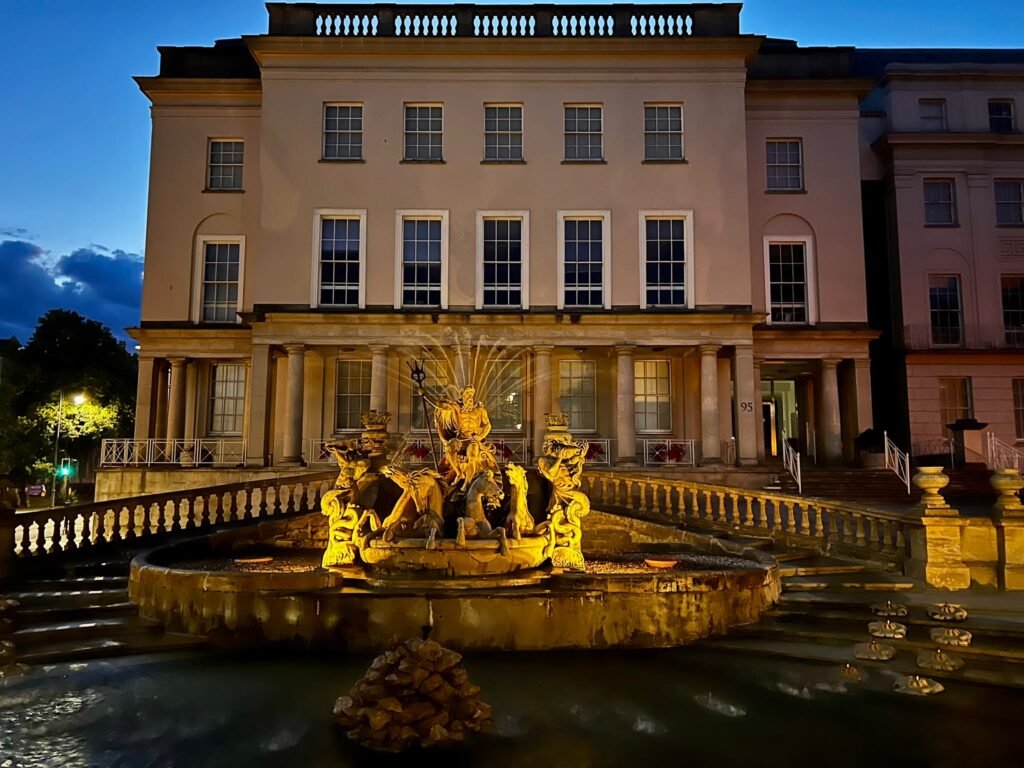
Remember my slightly underwhelmed first encounter with Neptune?
Well…
this is why you stay after dark.
Once illuminated against the Regency buildings behind it, the fountain looked completely different.
The sculpture stood out in warm golden light, the surrounding buildings glowed, and that deep evening-blue sky transformed the whole scene.
Suddenly I wasn’t thinking about whether the fountain was smaller than I’d imagined.
I was just taking photographs of it.
Lots of them.
Apparently Neptune hadn’t needed to be bigger.
He’d needed lighting. 😂
Things to Do in Cheltenham: The Walk I’d Recommend
Here’s my short video from the visit — from the daytime sights to the town coming alive in the evening.
If you’re planning your first visit, I wouldn’t treat Cheltenham as a frantic checklist.
My version would be much simpler: start around The Promenade and Montpellier, look properly at the Regency architecture and its strange little details, find Neptune’s Fountain, wander through Imperial Gardens, stop somewhere rather than constantly moving, and then give the town enough time for daylight to fade.
Of course, there are plenty of other things to do in Cheltenham that we didn’t cover on this particular wander—Pittville Pump Room alone deserves proper attention on another visit—so this isn’t pretending to be an exhaustive guide to everything in town.
It’s the route and experience that made us enjoy Cheltenham.
And I’d happily go back.
Cheltenham felt very different from the smaller Cotswolds stops we’d been exploring. Earlier in the trip, Broadway Tower had delivered the sweeping countryside views; here, it was the architecture and atmosphere that kept us wandering.
The Cheltenham I Remember
Before visiting, I associated Cheltenham with Regency architecture, horse racing, festivals and an apparently enormous fountain.
Afterwards, I remembered something different.
Flowers glowing in the last of the evening light. Beautiful pale buildings turning gold under street lamps. Groups of people laughing outside bars and restaurants. A town that felt comfortable enough for us to keep wandering without much of a plan.
A bizarre Minotaur and his hare.
And yes, a perfectly respectable fountain that I owe an apology for judging prematurely. 😅
Cheltenham didn’t win me over because one attraction blew me away.
I loved how the place felt.
And sometimes that’s a better reason to remember somewhere.
If You Only Have a Few Hours in Cheltenham
Don’t spend all of them rushing between attractions. Walk the Promenade, explore Montpellier, give yourself time in Imperial Gardens and—if your schedule allows—stay until after dark. The change in atmosphere was one of the best parts of our visit.
For current visitor information, events and more ideas for planning your trip, the official Visit Cheltenham website is a useful place to check before you go.
See all my photographs in the Cheltenham photo gallery