
Sherborne Old Castle is the sort of place that gets bigger the longer you walk around it. From a distance, you see a collection of romantic ruins scattered across a green field. Then you start exploring and discover gateways, staircases, enormous sections of wall, decorative arches and fragments standing so far apart that one thought keeps returning: how huge must this place have been when all of it was connected?
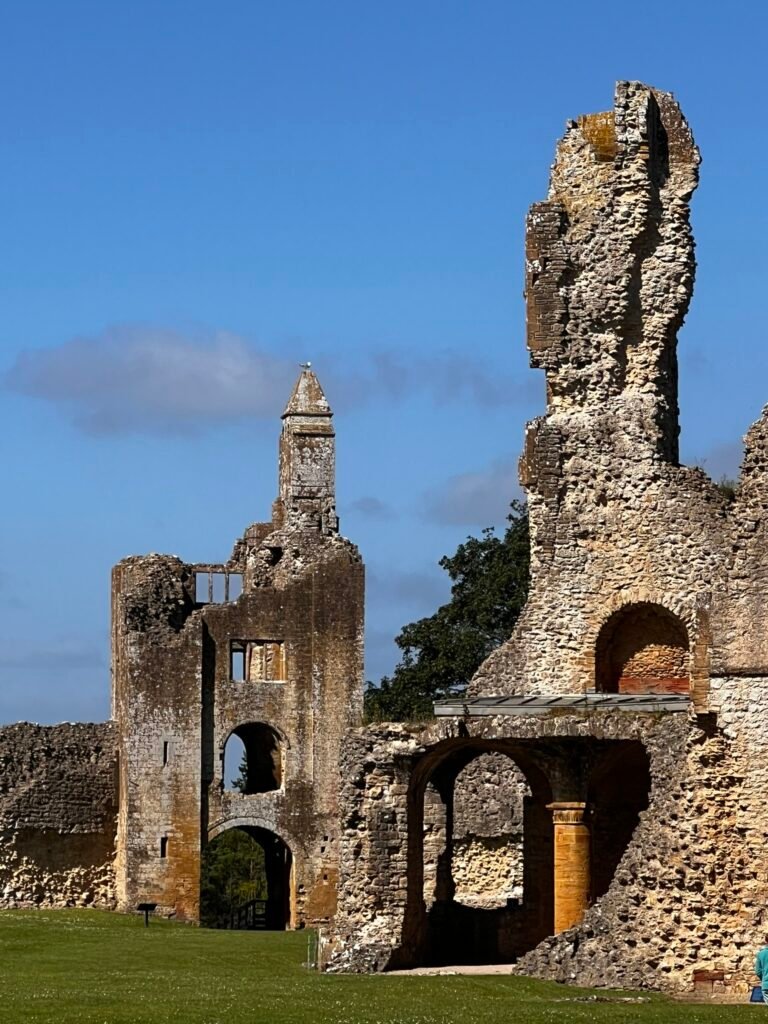
I visited on one of those suspiciously perfect Dorset days when the sky was bright blue, the grass was vivid green and even 400-year-old battle damage was doing its best to look photogenic. The ruins are spread across a surprisingly large site, so rather than walking around one recognisable castle shell, you move from one surviving piece to another and gradually try to rebuild the missing bits in your head.
That is probably the most important thing to know before visiting. Sherborne Old Castle requires some imagination. There are useful interpretation boards with illustrations showing how parts of the castle once looked, and enough substantial masonry remains to give you plenty to work with, but you will not immediately understand every room and wall simply by standing in front of it.
Personally, I quite enjoyed that. It turns the visit into a bit of historical detective work — admittedly historical detective work conducted in sunshine while taking far too many photographs of broken stone.
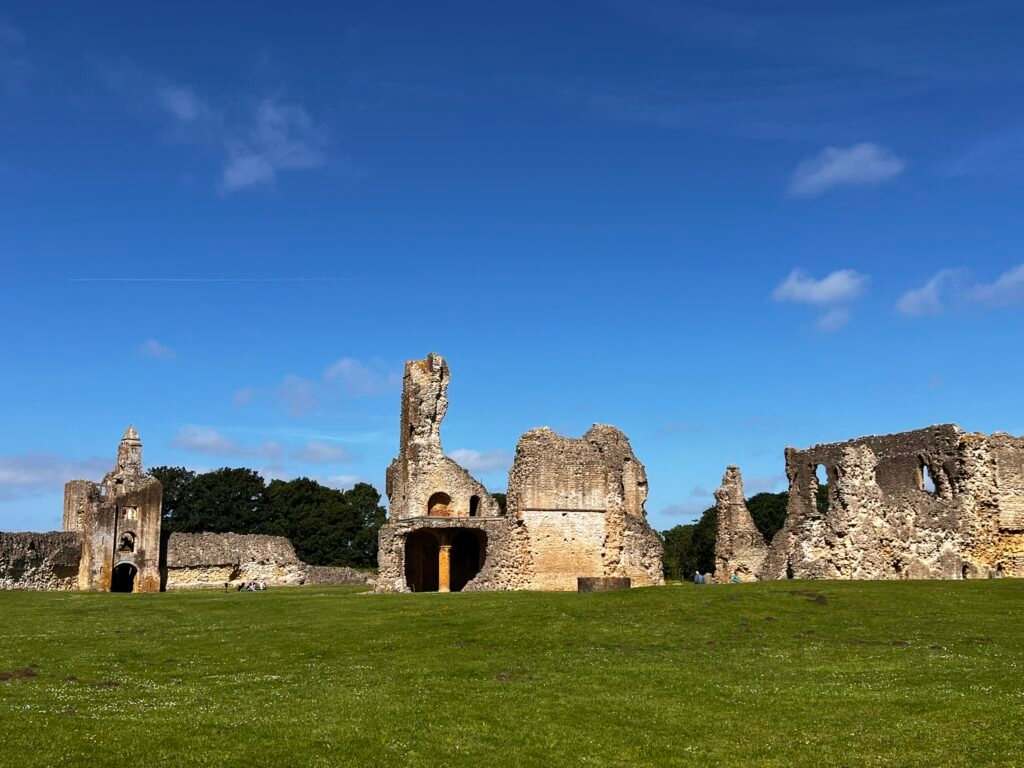
A medieval castle built for a remarkably powerful bishop
Sherborne Old Castle began in the early 12th century with Roger of Caen, Bishop of Salisbury. Calling Roger simply “a bishop”, however, rather undersells him. He was one of King Henry I’s most important advisers and became powerful enough to act on the king’s behalf while Henry was abroad.
A man like that was apparently not going to settle for a modest little retirement bungalow.
Roger created a major fortified residence at Sherborne, combining the defensive features of a castle with the accommodation and administrative buildings expected by one of medieval England’s most powerful churchmen. Historic England describes an enclosure castle with a large bailey, a central complex arranged around a courtyard, a great tower and substantial surrounding defences. It considers Sherborne one of Dorset’s best surviving examples of 12th-century castle architecture.
There is even history underneath the castle’s history. Archaeology has uncovered evidence of an earlier Christian cemetery dating from around the ninth century on the hilltop, meaning people were using this site centuries before Roger arrived with his extremely ambitious building plans.
The scale is much easier to appreciate when you are actually walking around. The surviving structures are not clustered neatly together for the convenience of modern visitors; you keep leaving one piece of masonry and discovering another farther across the grass.
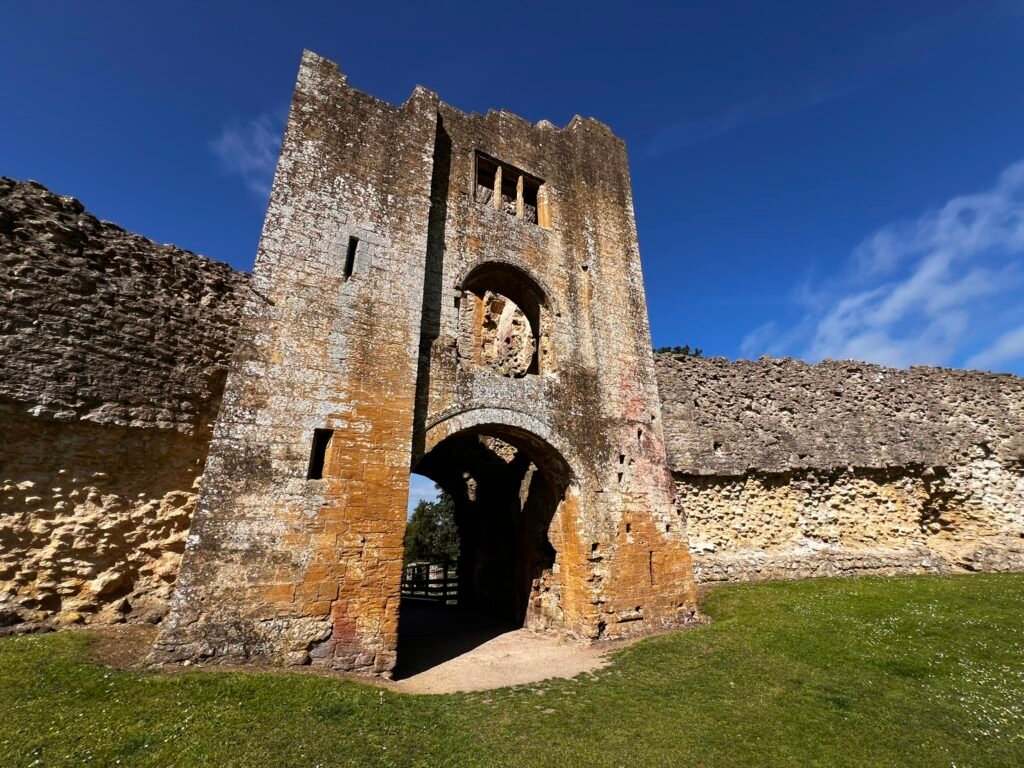
The southwest gatehouse is one of the easiest parts to understand immediately. It still looks unmistakably like an entrance, complete with its large arch and substantial upper masonry. Walking through it gives you one of those satisfying moments at a ruin where you do not need an information board to tell you what you are looking at.
Roger’s political fortunes eventually collapsed after Henry I died. In 1139, King Stephen seized Sherborne along with Roger’s other castles. The property later returned to episcopal use and continued serving the bishops of Salisbury as both a residence and an administrative centre.
That is worth remembering while looking at what survives today. This was never merely a military outpost perched in the countryside. It was somewhere important people lived, worked, entertained and governed a large estate.
Look closely and the rubble starts becoming architecture
At first glance, some areas of Sherborne Old Castle can look like enormously impressive piles of damaged stone. Look more carefully and the sophistication of the original building begins to emerge.
There are shaped arches, dressed stone, window openings, columns and pieces of decoration surviving among the rougher masonry. They are the details that help transform the castle in your imagination from a defensive grey fortress into somewhere built to display wealth and status as well.
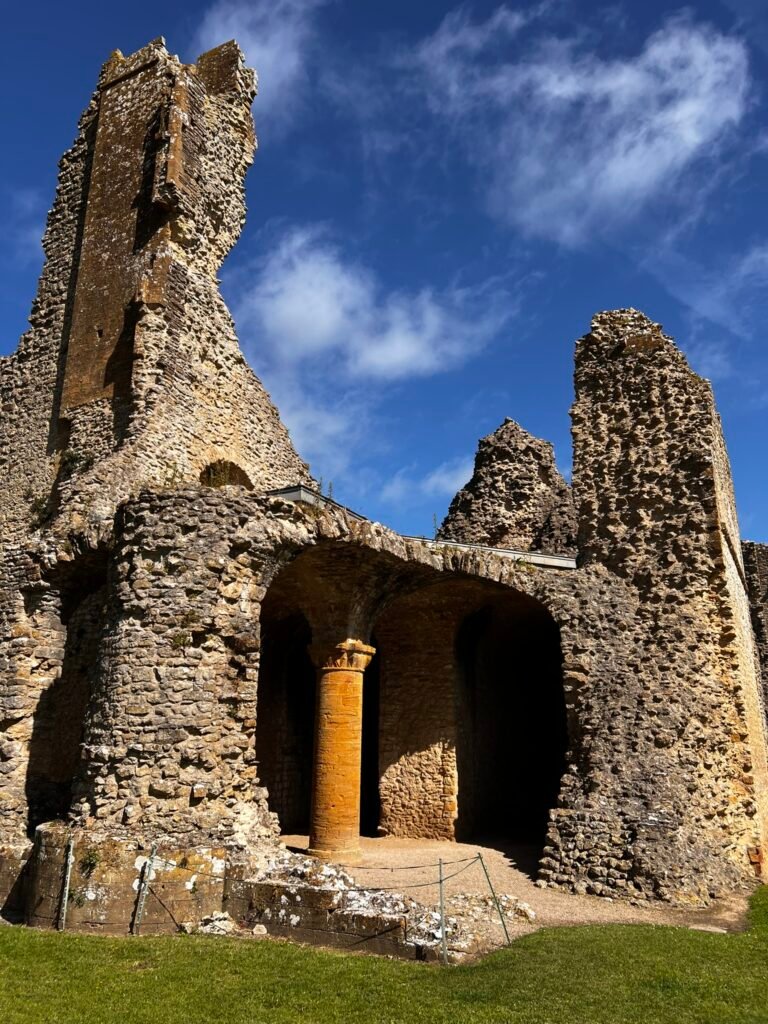
This columned section was one of my favourite survivors. Against all the battered walls around it, the elegant stonework feels almost strangely delicate.
Historic England records remains associated with the castle’s great tower, chapels, halls, gateways and other domestic ranges. The great tower formed part of an unusual central group of buildings arranged around a courtyard, a layout that Historic England compares with a cloister and suggests may reflect Roger’s ecclesiastical background.
In other words, Bishop Roger appears to have looked at the basic concept of a castle and thought it could do with considerably more architecture.
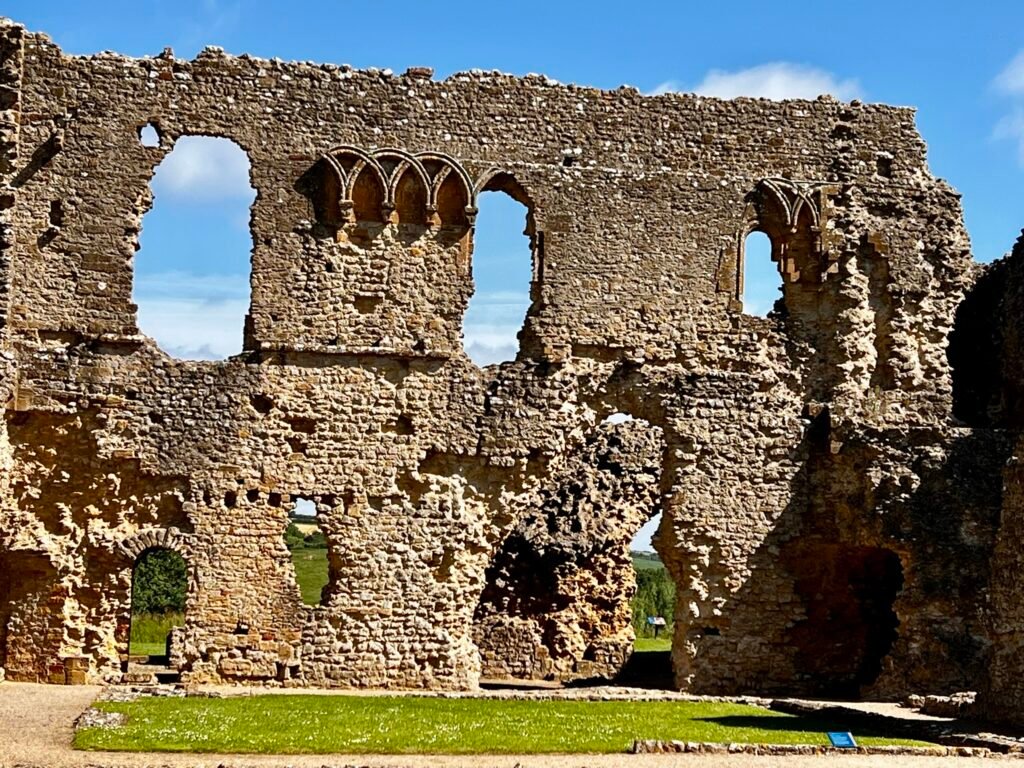
Those surviving arches are particularly good at helping you visualise the missing building. You do not need a degree in medieval architecture to recognise that these were once part of something far more refined than the exposed ruin standing here now.
And then, several centuries later, a rather famous Elizabethan arrived and made Sherborne considerably more confusing for modern visitors.
Sir Walter Raleigh and the problem of having two Sherborne Castles
Sir Walter Raleigh gained possession of the medieval castle in 1592 and began trying to modernise it.
He apparently changed his mind.
Instead of continuing to transform the old fortress, Raleigh developed a hunting lodge in the neighbouring park into a new residence. That house eventually became Sherborne Castle, while the medieval building acquired the extremely useful word “Old”. If those names sound unnecessarily confusing, I’ve untangled the difference between the two castles, because arriving at one expecting the other would be quite a surprise.
I visited both, and they could hardly feel more different. Here, you need a little imagination to piece together the missing rooms and walls, while the later castle still has its furnished interiors and grand surroundings. Seeing both on the same day made Raleigh’s decision to move from one residence to another much easier to understand.
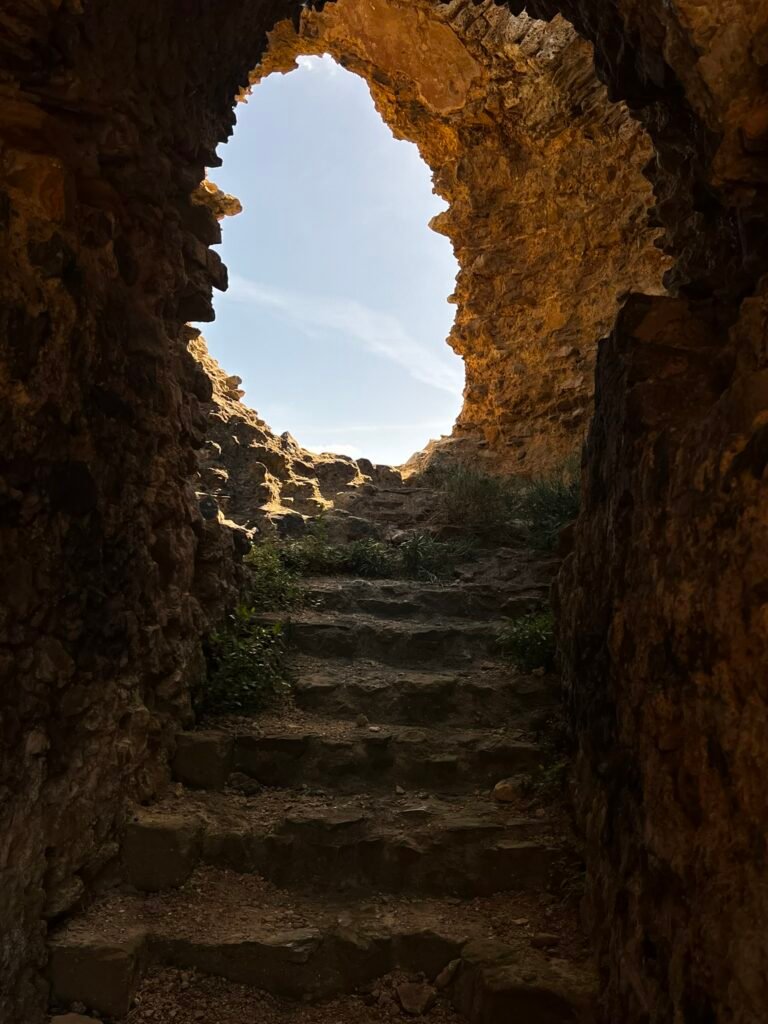
Raleigh’s connection therefore gives Sherborne Old Castle another layer of interest without turning it into “Raleigh’s castle”. By the time he arrived, the medieval fortress already had centuries of history behind it.
Unfortunately, its most destructive chapter was still to come.
Then the Civil War arrived
Sherborne Old Castle remained strong enough to become an important Royalist base during the English Civil War.
Parliamentarian forces attacked it in 1642, but the castle survived. They returned in 1645, and this time the result was very different.
According to English Heritage’s official history of Sherborne Old Castle, the fortress finally fell after a fierce 11-day siege. Parliamentarian forces captured it in 1645, and the defences were subsequently deliberately damaged so the castle could not simply be occupied and fortified again. This process of deliberately disabling a castle was known as slighting.
Oliver Cromwell even described Sherborne as “malicious and mischievous, like its owner”, which seems impressively hostile language to direct at a building.
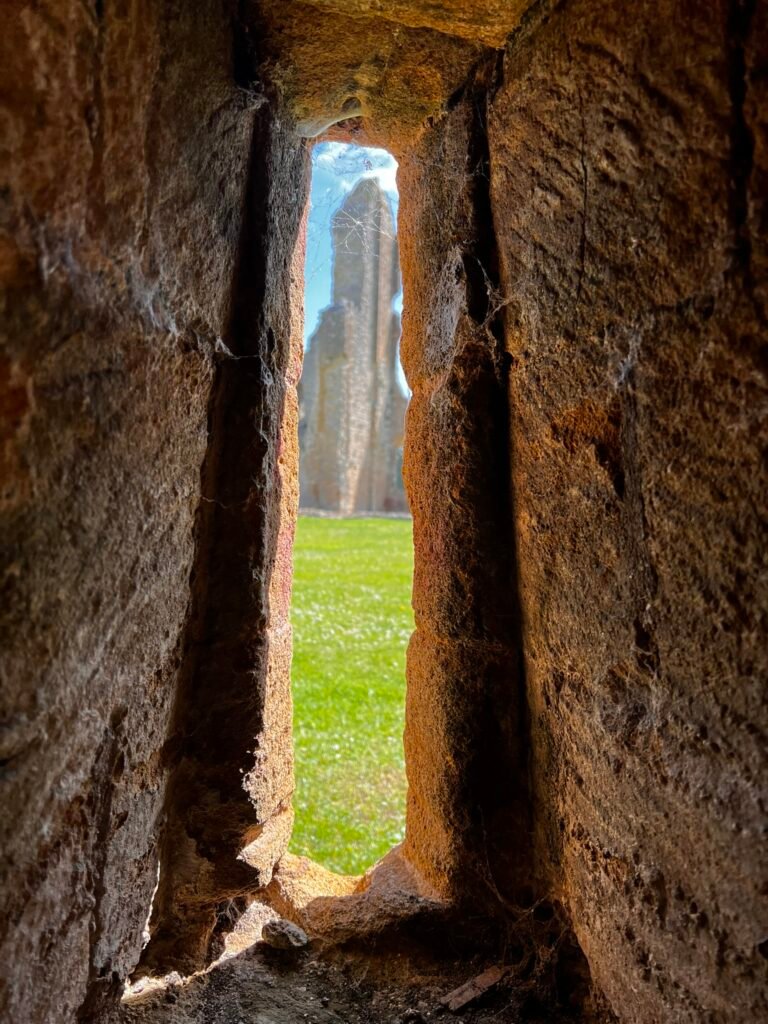
Once you know what happened in 1645, the condition of the site becomes much easier to understand. This is not simply a castle that slowly lost its roof and crumbled through neglect. Its military usefulness was intentionally destroyed.
Standing there now, I did feel slightly sorry for it.
There are enough enormous fragments left to make it obvious that this must once have been magnificent, while simultaneously showing you exactly how much was lost. If historical sites came with an “undo” button, this would be a very tempting place to press it.
Sadly, English Heritage appears to have spent its conservation budget on considerably more practical things.
What is Sherborne Old Castle actually like to explore?
This is where expectations matter.
If Old Wardour Castle is at one end of the ruin spectrum — with enough surviving structure to walk through recognisable rooms and understand much of the building fairly easily — Sherborne Old Castle requires more reconstruction in your head.
But I found it noticeably easier to picture than Old Sarum.
There is simply more vertical architecture here. Large sections of wall survive to considerable height, gateways still feel like gateways, staircases disappear between masonry, and individual architectural details give you clues about the rooms that once surrounded them.
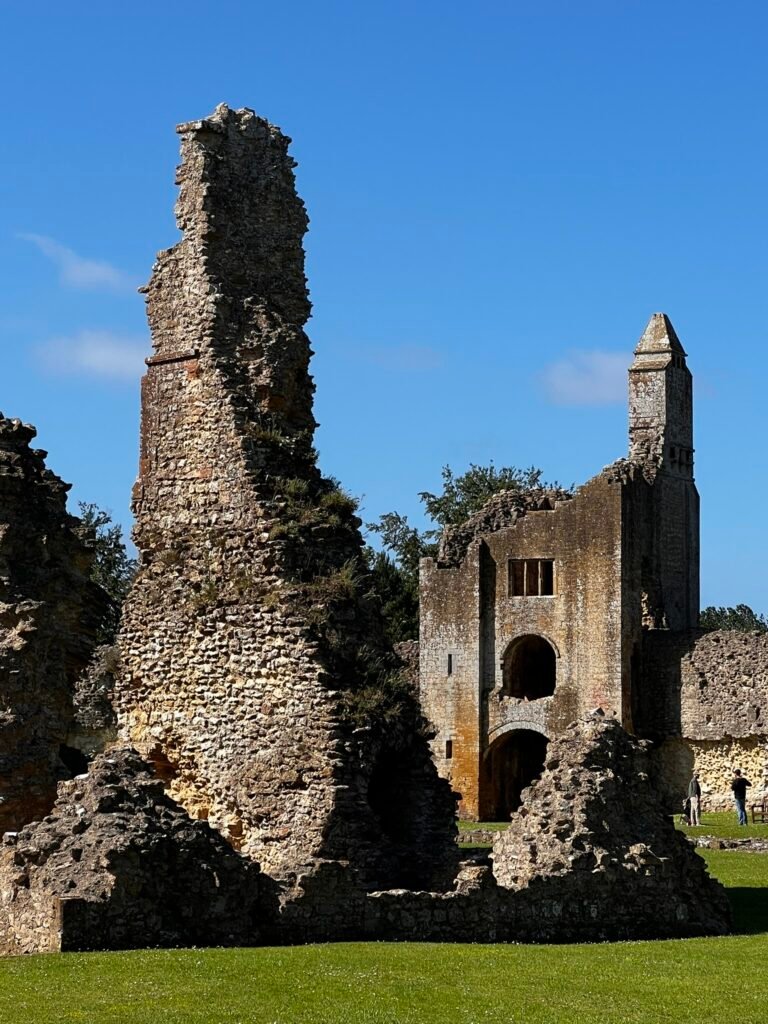
The interpretation boards help enormously because reconstructed drawings give the surviving fragments some context. I would definitely stop and look at them rather than rushing from photograph to photograph. Once you have seen an illustration of the complete castle, that lonely wall across the grass suddenly stops being a random wall.
What I particularly liked was the feeling of discovery as we walked around. The site unfolds rather than presenting everything at once. You pass through one surviving section, turn around and suddenly another tower or piece of masonry lines up behind it.
It is also remarkably peaceful for somewhere that experienced an 11-day siege.
The countryside is part of the experience too
The castle occupies an open site above the surrounding landscape, and some of the best moments come when you stop concentrating on the masonry and look through it.
Windows frame fields. Stairways descend towards open countryside. Grass grows where medieval rooms once stood.
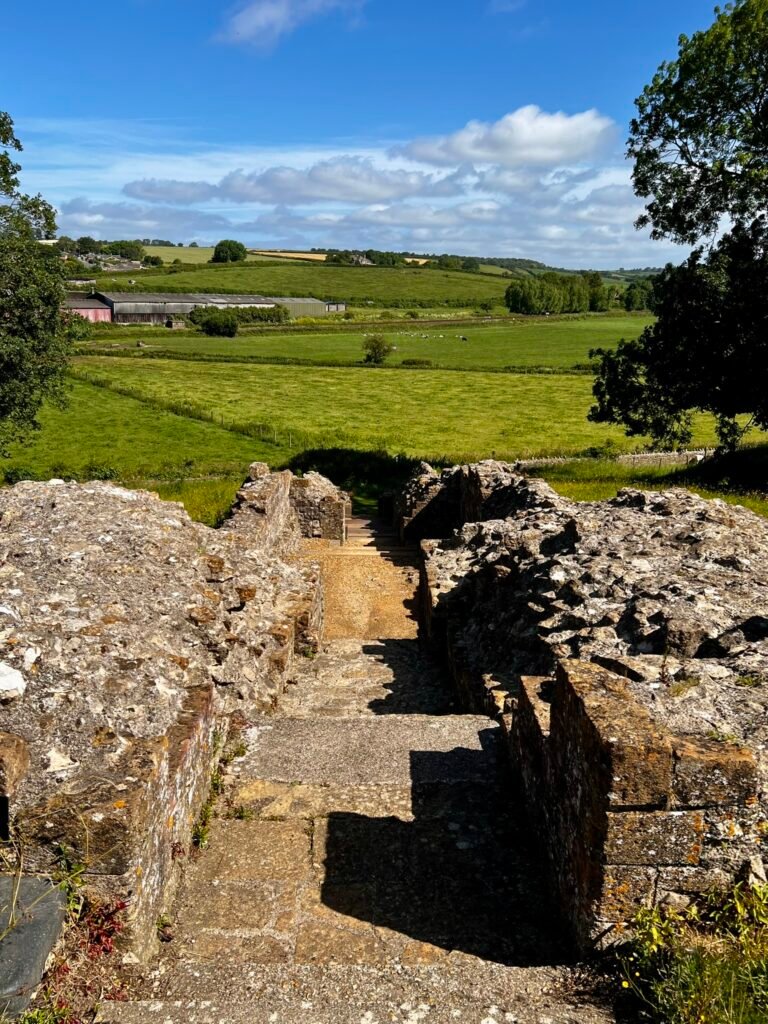
English Heritage describes the grounds as a haven for wildlife and birds, and the open setting certainly gives the ruins plenty of breathing room.
On the bright day we visited, the contrast was particularly lovely: ancient grey stone, ridiculously green grass and a huge blue sky. Obviously I cannot guarantee that Dorset will reproduce those exact conditions for your visit. Dorset weather has not signed that contract.
The site is also very exposed, which English Heritage specifically warns visitors about. There is little shelter, much of the ground is grass or gravel, surfaces can be uneven and there are steps and drops around the ruins.
So this is one historic site where checking the weather before leaving home is not merely British small talk.
Free entry makes Sherborne Old Castle very easy to recommend
One of the best things about Sherborne Old Castle is that entry is completely free.
You do not need English Heritage membership to visit, which makes it a very easy addition to my guide to free things to do in Dorset.
The current English Heritage visitor information asks for a £3 parking donation, payable by text, while its directions page states that parking is free for English Heritage members displaying a valid car sticker. Parking is limited, with additional roadside parking available along Castleton Road.
I already had English Heritage membership when I visited, so there was no admission saving to celebrate here. The membership simply meant I did not have to pay for parking.
And weirdly, that did not make the membership feel pointless at all.
It actually reminded me of something I mention in my English Heritage membership experience: membership is not only about repeatedly calculating how much money you personally saved at ticket barriers. Part of the fee supports an organisation caring for historic places, including sites like this that anyone can explore without buying an admission ticket.
I am quite happy with that arrangement. I got a sunny walk around an extraordinary medieval ruin; somebody else can come tomorrow without needing a membership at all; and the place is still being looked after.
That feels like a decent use of a few pounds of my annual fee.
For current opening arrangements, access and parking information, I would still check the official English Heritage Sherborne Old Castle visitor page before travelling. At the time of writing, English Heritage lists the castle as open daily from 10am to 5pm. There are no toilets on site, although Sherborne town centre is less than a mile away, and dogs on leads are welcome.
Do not visit the castle and then leave Sherborne
If you’re visiting the ruins, I’d definitely allow time to explore more of Sherborne. We started by wandering through the historic town centre, with its honey-coloured buildings, little passages, old shopfronts and rather charming mix of medieval history and everyday life. There’s plenty to admire without paying an admission fee or even having a particular destination in mind.
We also stopped at Sherborne Abbey, where the extraordinary fan-vaulted ceiling made quite an impression. After seeing so much elaborate stonework still intact, arriving at the Old Castle and finding huge sections of its architecture missing felt like a striking contrast. Both places are fascinating, but for very different reasons.
Our day also included Sherborne Castle and Gardens, the later house surrounded by landscaped grounds. Exploring the Old Castle first made that visit particularly interesting, because by then I understood what Sir Walter Raleigh had left behind. It’s one of the reasons I wouldn’t treat these ruins as an isolated stop: the rest of Sherborne helps bring their history to life.
Is Sherborne Old Castle worth visiting?
Yes — as long as you understand what kind of castle you are visiting.
Do not come expecting furnished rooms, intact towers and a neatly preserved medieval floor plan. This is a ruin in the proper sense of the word. Large pieces are missing, some surviving sections stand disconnected from one another, and occasionally you will need an illustration and a bit of imagination to understand what you are looking at.
But there is plenty left to reward that effort.
You can still walk through the gatehouse, climb between surviving walls, find decorative medieval stonework, look through ancient openings towards the countryside and stand among the remains of a castle that witnessed more than 900 years of history.
For me, the destruction is both the disappointing part and the reason the place is so interesting. I kept wishing more had survived precisely because what remains makes the original scale so obvious.
Sherborne Old Castle was built for one of medieval England’s most powerful bishops, passed through royal and episcopal hands, attracted Sir Walter Raleigh, survived one Civil War siege and was finally battered into submission during another.
Now you can wander around it in the sunshine for free.
History has certainly given Sherborne Old Castle a rough time. As days out go, however, it is difficult to complain.
One journey. One story. One more stop.