
Some towns make you work quite hard to find the interesting bit. Sherborne in Dorset, does not.
You arrive, look around and realise that somebody has apparently built half the town from honey-coloured stone, added medieval gateways, timber-framed houses and an Abbey with more than 1,300 years of history, then filled the remaining gaps with cafés, independent shops and normal everyday life.
It really shouldn’t fit together as neatly as it does.
I visited Sherborne with a friend before continuing to its two castles later that day. The original plan was simply to have a wander around the town centre and visit the Abbey. Instead, we spent rather a lot of time stopping, looking upwards, disappearing into side streets and trying to photograph buildings without accidentally producing a group portrait of half of Dorset.
Sherborne is a historic market town, but that description feels slightly inadequate once you are actually walking through it. The centre is compact, easily explored on foot and packed with buildings that seem to have accumulated rather than been planned. Saxon history, medieval stonework, Georgian façades, timber framing and modern shopfronts all sit within a few minutes of one another.
And somehow it feels completely natural.
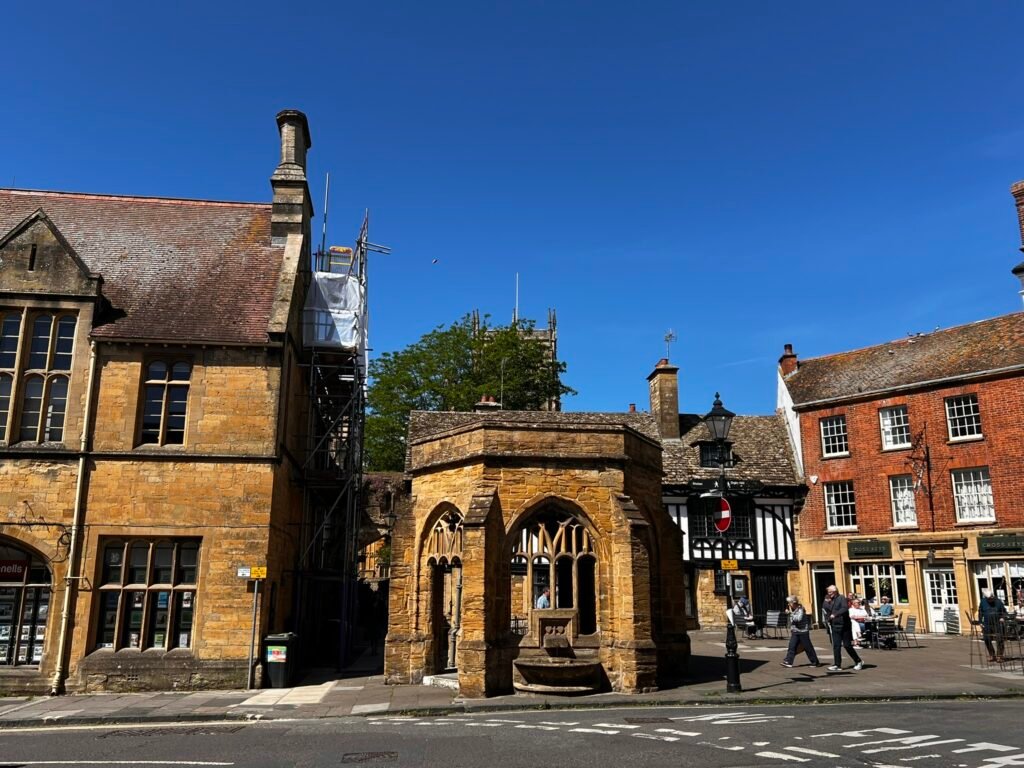
First impressions: Sherborne has apparently chosen a colour scheme
The first thing I noticed was the stone.
Much of Sherborne has that warm, creamy, almost honey-coloured appearance that immediately makes the town recognisable. Visit Dorset notes that much of the historic centre was built using locally quarried stone, which helps explain why so many completely different buildings somehow belong together visually.
It is the sort of place where even an ordinary street can suddenly make you stop.
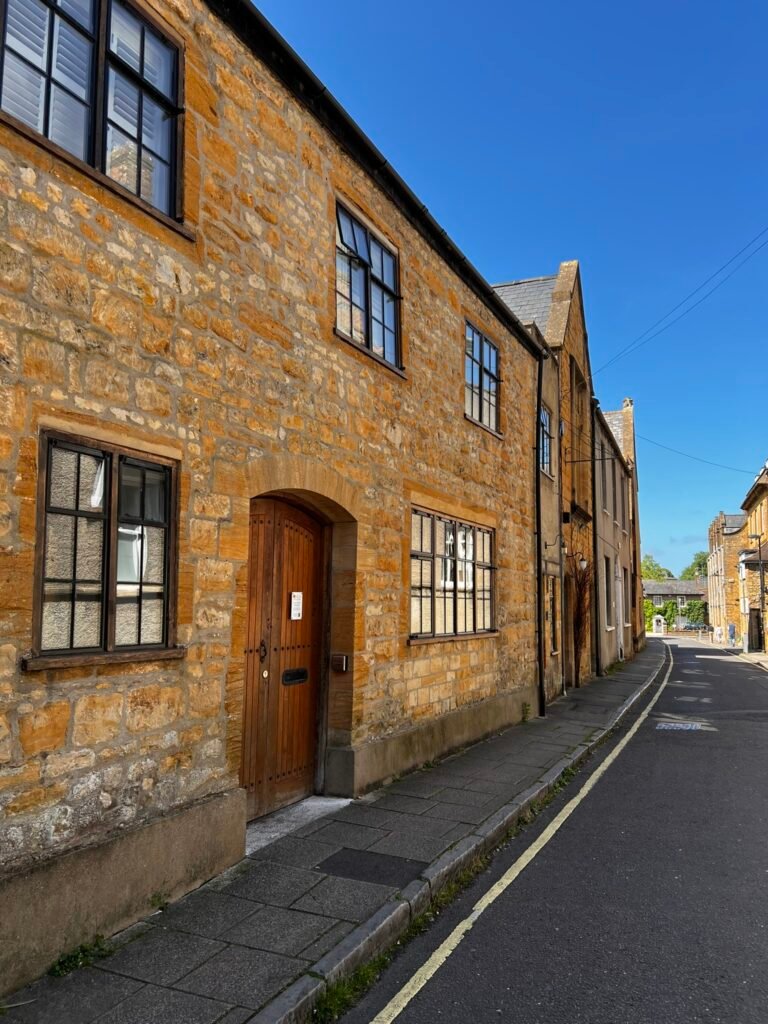
Sherborne was also busy when we visited, which created one slight photographic problem.
Apparently everybody else had also decided that a sunny day in a beautiful Dorset town sounded like a good idea.
That explains why some of my photographs effectively say:
Here is the magnificent upper half of a historic building. Please imagine the lower half underneath approximately twenty people.
It did at least force me to look upwards, which in Sherborne is worth doing.
Cheap Street is the main shopping area, with independent shops, galleries, antique dealers, cafés and delis mixed among more familiar names. Regular markets are still held here too, so this is not a historic street surviving purely for visitors; it remains one of the busiest parts of the town.
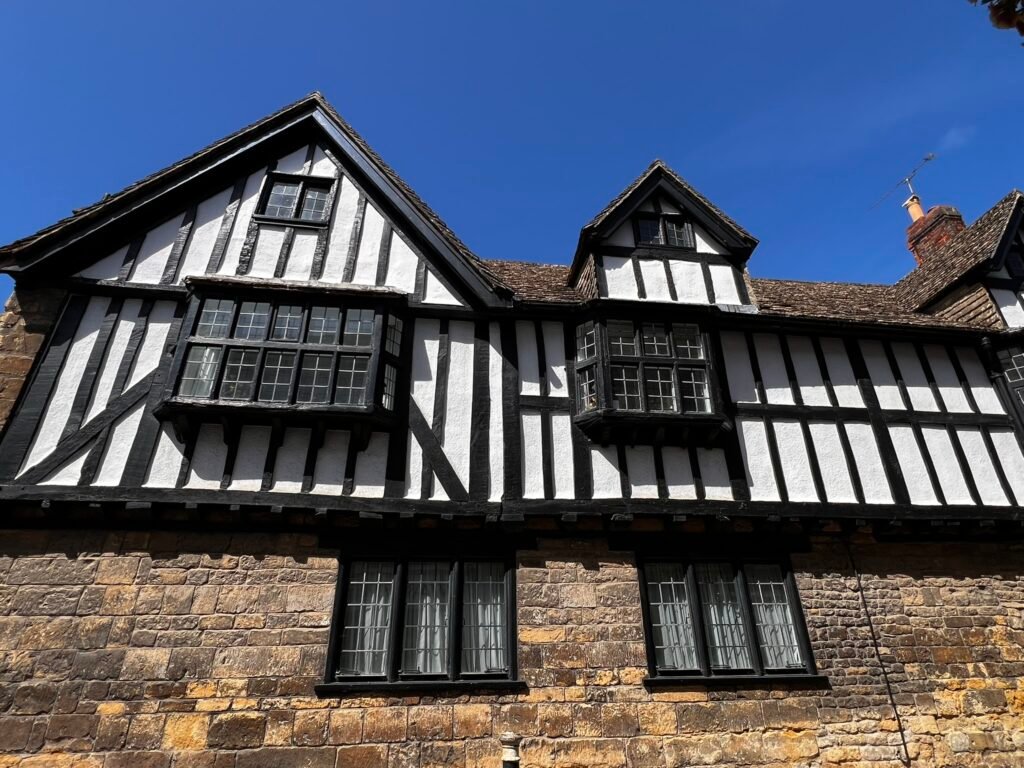
That black-and-white timber-framed building was one of the reasons looking above the shopfronts became part of the walk.
The honey-coloured stone may dominate Sherborne, but it is the interruptions that make the streets interesting: dark timber, red brick, carved details, old windows and buildings that lean into the street as though they have been listening to local gossip for several centuries.
The easiest way to explore is simply to wander.
Cheap Street gives you the obvious route, but the little lanes and passages around it are where the town begins to feel much older.
And sitting right in the middle of all this is one of Sherborne’s strangest little survivors.
The Conduit: a tiny building with an unexpectedly busy CV
The Conduit looks almost as though somebody built a miniature medieval monument in the middle of the town purely to improve everybody’s photographs.
Its actual history is far better.
The structure originally stood in the Abbey cloister and was built in the early 16th century as part of the monks’ lavatorium — essentially their washing place. After the Dissolution it was moved to its present position in 1560. It later became a reading room, spent time as a police station and was being used as a penny bank by the 19th century. Today it is both Grade I listed and a scheduled monument.
So its CV is approximately:
monastic washing place → relocated town landmark → reading room → police station → bank.
An ambitious professional history for something considerably smaller than my flat.
Close to The Conduit we also found a very good bakery, which briefly interrupted the historical research. We had coffee and tea with fresh pastries and bought two chocolate-and-vanilla rolls to take home.
That is the entire bakery story.
They were excellent.
Moving on. 😂
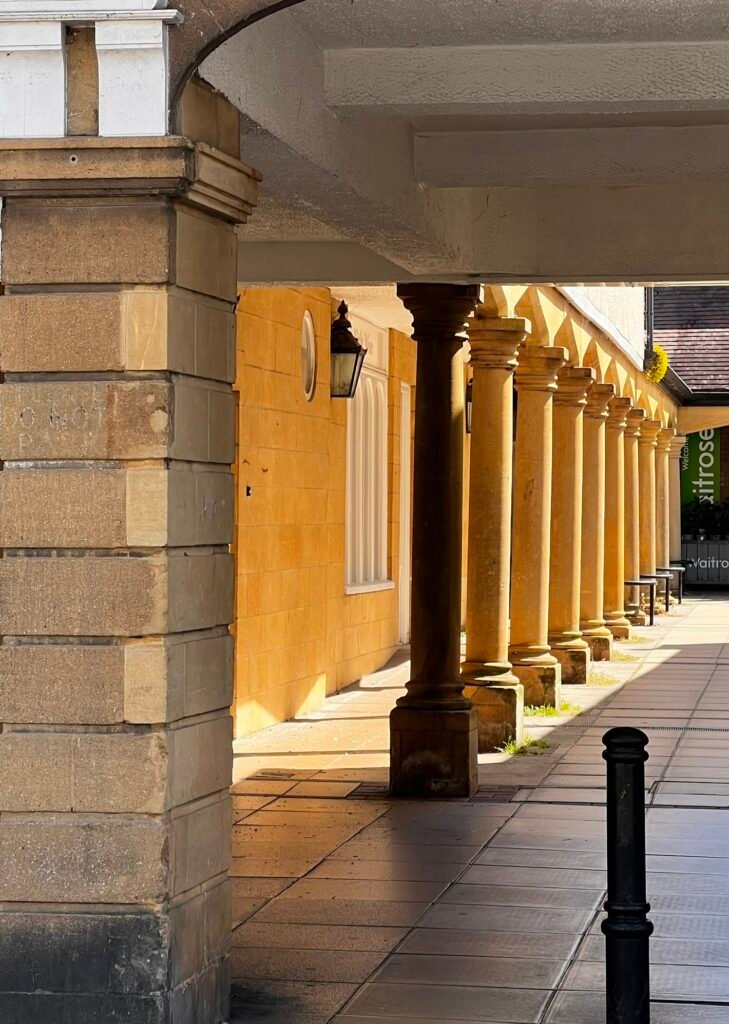
The covered colonnade was another favourite.
Elegant stone columns, repeating shadows, historic buildings…
…and, tucked discreetly behind them, a Waitrose sign.
Medieval-looking Sherborne, meet the weekly shop.
Somehow it works.
Rather than staying on the main shopping street, we gradually headed towards the Abbey. That is where the character of the walk changes again.
From shopping street to medieval Sherborne
As the busier streets fall behind you, the route towards the Abbey becomes narrower and much more atmospheric.
The best example is the Cemetery Gate on Church Lane.
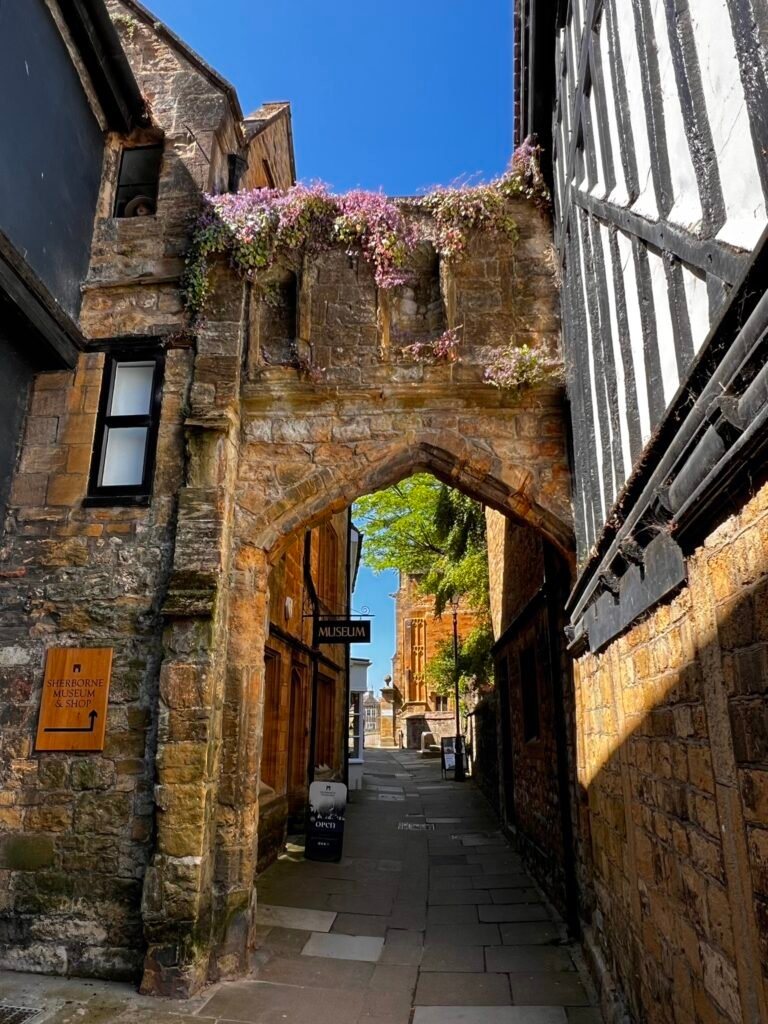
The gate dates from the 15th century and once formed an entrance to the Abbey precinct. It is now Grade I listed by Historic England, but the most interesting thing about it is simply walking underneath it.
For a moment, you are no longer standing outside looking at an old building.
You are walking through one.
The pointed arch frames Church Lane beyond, with historic buildings squeezed along either side and the Abbey increasingly difficult to ignore.
This was probably the point where Sherborne stopped feeling like a collection of attractive old buildings and started making sense as one historic place.
The streets, Abbey precinct, gateways and surrounding buildings all connect.
You can almost see one century leaning against the next.
St John’s Almshouse: medieval history that never actually stopped
Just before the Abbey stands St John’s Almshouse, another building that looks as though it ought to have been turned into a museum several generations ago.
It hasn’t.
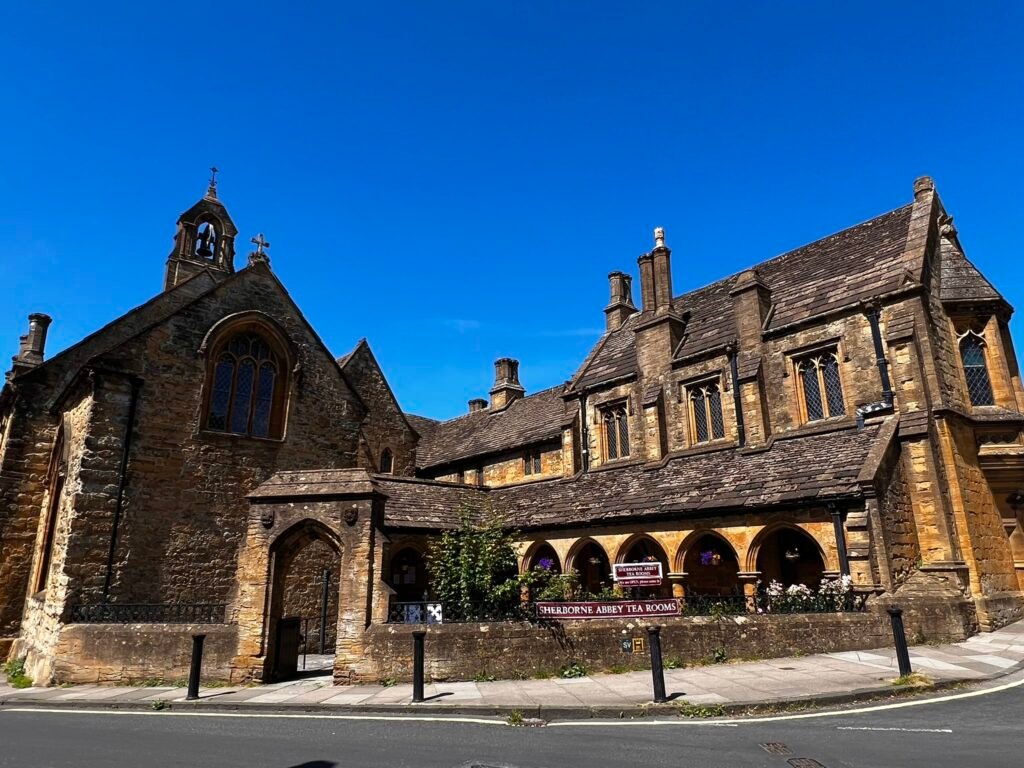
Its foundation deed dates from 1437, and the building was established to care for elderly people in need. The medieval complex, including its chapel and hall, was completed during the following decade. Most remarkably, the organisation behind it still exists: the governing body operating today traces its origins directly back to that 1437 foundation.
That is the sort of history I find much more interesting than being given twenty architectural terms and expected to remember seventeen of them.
Nearly six centuries ago, somebody established a place to care for local people.
It is still doing that.
The Abbey Tea Rooms are tucked into this historic area too, although we carried on towards the Abbey itself.
By this point it had become impossible not to.
Sherborne Abbey: suddenly everything gets bigger
Then you reach the Abbey.
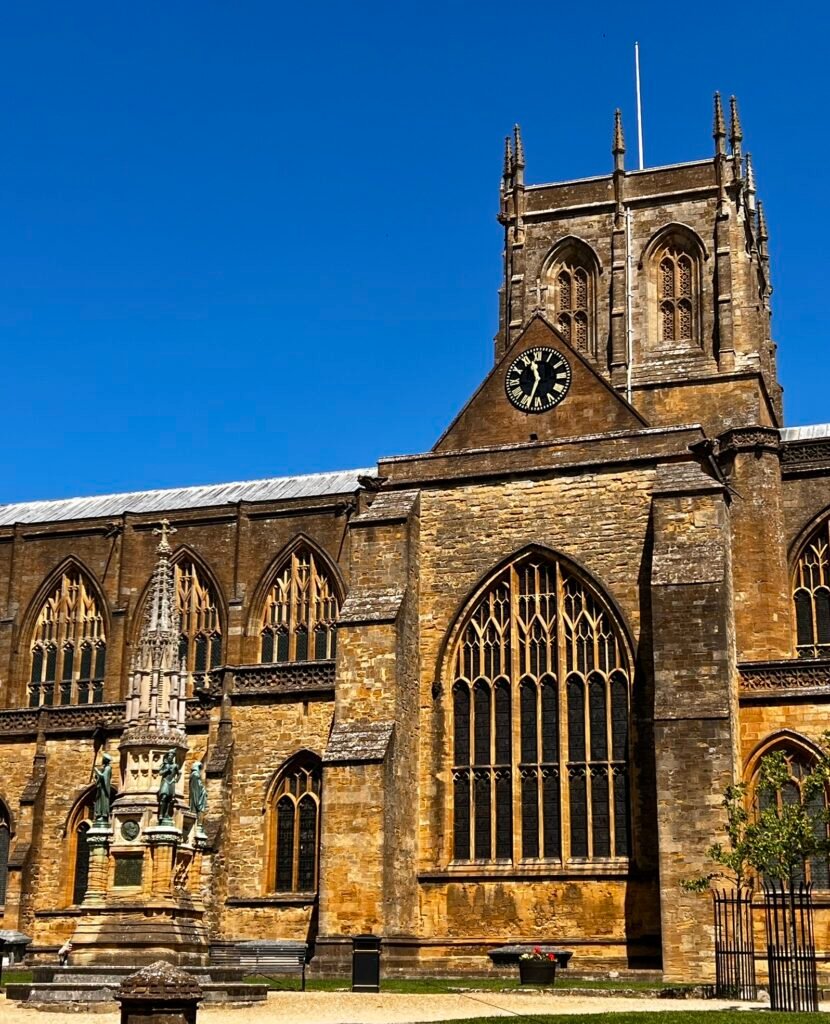
Sherborne contains plenty of beautiful buildings, but the Abbey changes the scale completely.
The tower rises above the surrounding streets, enormous Gothic windows dominate the walls and all that warm stone you have been following through town suddenly becomes monumental.
Its history is equally oversized.
Sherborne became an important religious centre in AD 705, when Aldhelm became the first bishop of the western part of Wessex. A monastic community later followed the Benedictine rule, and the church eventually developed into the great Abbey whose surviving fabric contains Saxon, Norman and later medieval work. The bishop’s seat moved to Old Sarum in the 11th century, but Sherborne continued as a major monastic centre until the Dissolution in 1539.
That would already give the building enough history for a perfectly respectable article.
Sherborne Abbey, however, also had a riot.
The monks, the townspeople and a font that caused absolute chaos
For somewhere that feels so peaceful today, the relationship between Sherborne’s medieval monks and townspeople became impressively hostile.
The townspeople worshipped in the adjoining church of All Hallows but still depended on the monks when they needed access to the Abbey font for baptisms.
Eventually they became fed up with the arrangement.
In 1437, they installed a font of their own.
The Abbot reacted with what might generously be described as poor conflict-resolution skills.
According to the Abbey’s own history, he sent a “stout butcher” carrying a hammer to destroy it.
Predictably, this did not improve community relations.
A riot followed. During the disturbance a burning arrow was fired into the Abbey while wooden scaffolding was in place, causing a serious fire. The damage permanently reddened stonework in parts of the church, traces of which can still be seen inside today.
Eventually the dispute became significant enough for the Pope to intervene.
There are neighbour disputes.
There are parish disagreements.
And then there is:
We have reached the stage where Rome needs to know about the font.
Sherborne committed fully.
The surviving interior — including the famous fan vaulting, stained glass and visible evidence of the fire — is spectacular enough to deserve a closer look inside the Abbey. That ceiling alone is worth an article of its own, although I’m still not entirely convinced medieval builders were operating under the same laws of gravity as the rest of us.
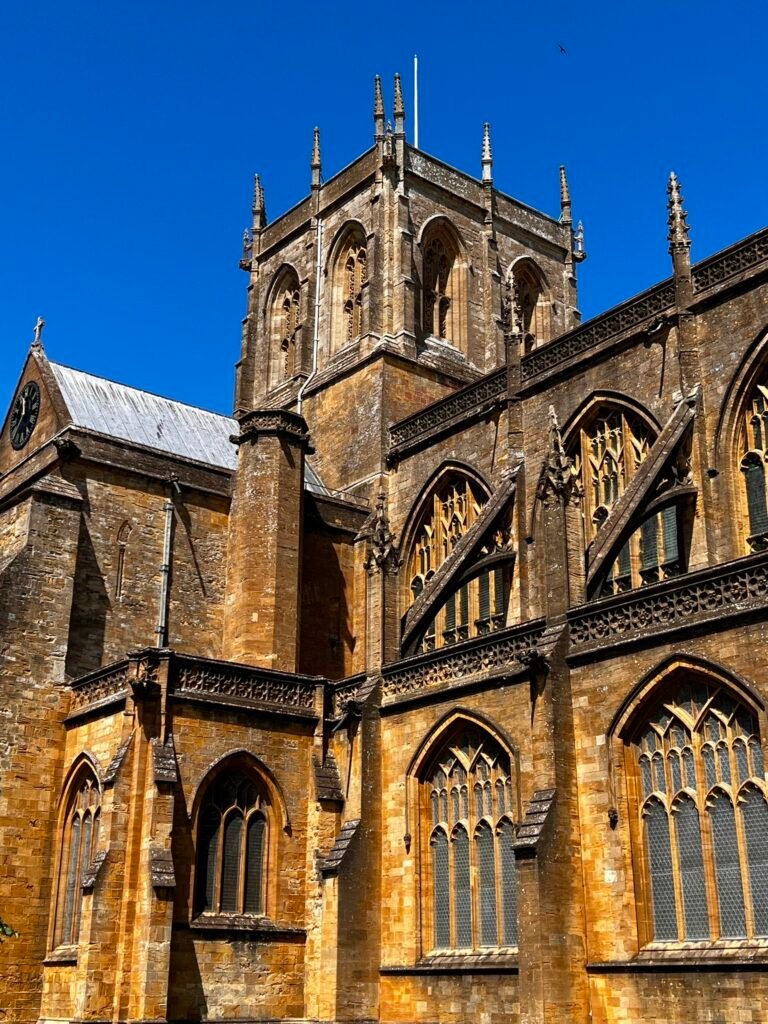
Even outside, there is enough detail to keep you circling the building: huge traceried windows, buttresses, carved stonework and the central tower rising over the whole lot.
Historic England’s listing reveals just how many periods are visible in the building, from surviving Norman work to major 15th-century rebuilding and later restoration.
And then comes the part of the story I half-remembered from visiting.
The townspeople really did end up buying the Abbey church.
Yes, the townspeople really did buy the Abbey
The monastery was dissolved in 1539, and much of its property passed to Sir John Horsey.
In 1540, Horsey sold the Abbey church to the townspeople of Sherborne. Dorset’s Historic Environment Record and Historic England both record the sale, after which the Abbey continued in use as the parish church.
That gives the earlier riot an almost ridiculous historical epilogue.
The townspeople had spent the previous century arguing with the monks about access to the church.
The monastery disappeared.
The townspeople bought the church.
End of dispute.
Today Sherborne Abbey remains an active parish church and visitors can enter without an admission charge, although donations are encouraged. If you are planning a visit, the official Sherborne Abbey website is the sensible place to check current opening information, services and tours before travelling.
And I would absolutely go inside.
The exterior is impressive.
The interior is where things become ridiculous.
In the best possible way.
The Digby Memorial: one final piece of elaborate stonework
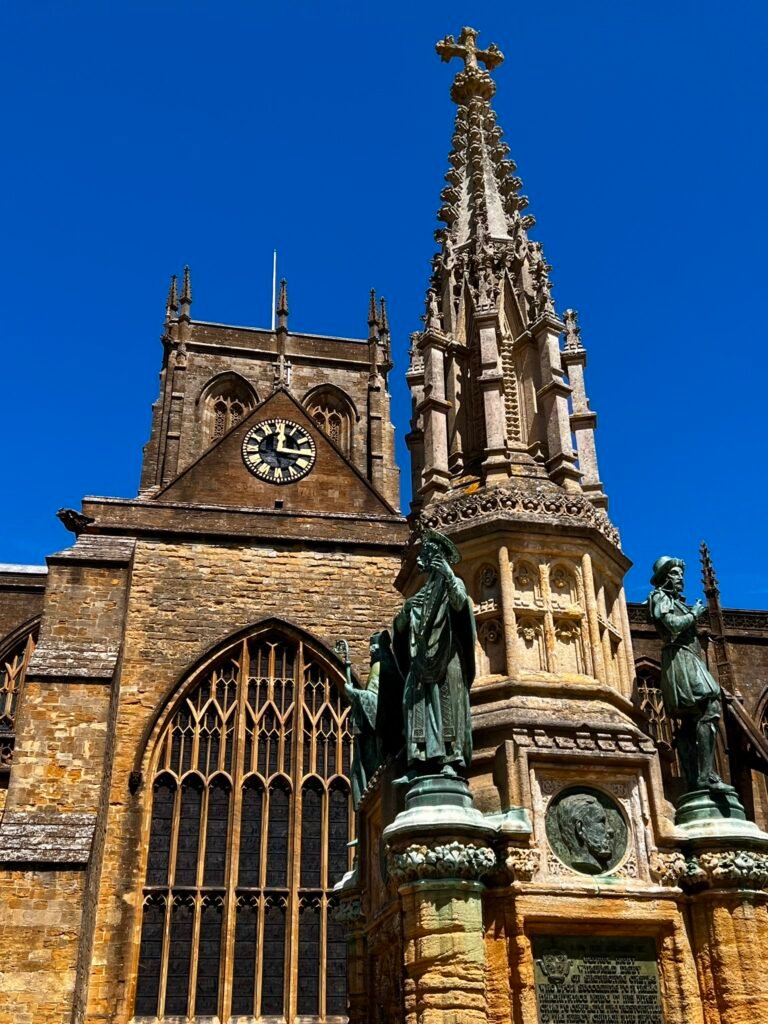
Standing outside the Abbey is the ornate Digby Memorial, erected in 1884 in memory of George Digby Wingfield Digby of Sherborne Castle.
Historic England records that the memorial was designed by R. H. Carpenter and Benjamin Ingelow and includes bronze figures of St Aldhelm, Bishop Roger, Abbot Bradford and Sir Walter Raleigh.
Which is quite a cast for one monument.
It also provides a neat bridge into the other big part of Sherborne’s story.
The castles.
Plural.
Because apparently one castle would have made the naming system far too easy.
Sherborne Old Castle and Sherborne Castle are not the same place
We visited both later that day.
Sherborne Old Castle is the ruined medieval castle: originally a fortified palace of the bishops of Salisbury, later associated with Sir Walter Raleigh and eventually heavily damaged after a Civil War siege. It is now in the care of English Heritage.
The later Sherborne Castle and Gardens is something completely different. Sir Walter Raleigh built the house in 1594, and it has been the home of the Digby family since 1617. The estate also includes the landscape garden associated with Capability Brown.
Calling a building from 1594 the new castle feels slightly ridiculous until you remember what it is being compared with.
If the names are already becoming confusing, I’ve untangled the difference between the two castles, because turning up at the wrong one could produce a rather spectacular misunderstanding. For a closer look at the medieval ruins themselves, I’ve also written about exploring the Old Castle, including its remarkable surviving architecture and rather violent Civil War history.
The later castle was one of my favourite parts of the day. We visited using my Historic Houses membership, and although photography wasn’t permitted inside, the guided tour was excellent. The dining room in particular has stayed in my memory, even if most of the historical dates have quietly escaped. I’ll cover that experience, along with the beautiful landscaped grounds, in my visit to Sherborne Castle and Gardens.
Shopping, markets and a town that is still very much alive
One thing worth allowing time for is Sherborne itself.
Cheap Street is not merely the road you use to reach the Abbey. The town still has a strong independent-shopping scene, with boutiques, art galleries, antiques, delis and cafés. There is a pannier market on Thursdays and Saturdays, alongside other regular farmers’, vintage and monthly markets. Visit Dorset’s Sherborne shopping and markets guide is useful if you want to time a visit around one of them.
That helps explain why the centre felt so busy on our visit.
People were not simply moving from attraction A to attraction B.
They were shopping, meeting friends, sitting outside cafés and getting on with whatever people normally do while I am standing in the road trying to photograph the top half of their building.
And that atmosphere matters.
You could visit Sherborne purely for its history, but it would be a shame to treat the centre as something to hurry through between the Abbey and the castles.
The wandering is part of the visit.
Getting to Sherborne and where to park
Sherborne is one of those places where you can park once and explore most of the town centre on foot.
Visit Dorset describes the town as small enough to walk around easily, and Sherborne also has its own railway station on the edge of the centre. Their official Sherborne visitor information includes a town map, transport details, accessibility information and current parking guidance.
If you are driving, there are both short- and long-stay options.
For a shorter town-centre visit, Old Market Yard car park (DT9 3HR) currently allows up to four hours. As of October 2026, Dorset Council lists the charges as 70p for 30 minutes, £1.20 for one hour, £1.70 for two hours, £2.40 for three hours and £3.70 for four hours. Charges apply between 8am and 6pm.
If you are planning the Abbey, town and castles in the same day, a long-stay option makes much more sense. Culverhayes (DT9 3ED) currently has 267 spaces and allows up to ten hours for £6.30; Coldharbour (DT9 4HA) offers the same £6.30 ten-hour tariff. These are current October 2026 prices, so check Dorset Council’s Sherborne parking information before relying on them for a future trip.
That is particularly important if you are planning all three major historic stops.
Town + Abbey + Old Castle + Sherborne Castle is entirely possible.
But give yourself most of the day.
Otherwise it becomes less exploring 1,300 years of history and more competitive heritage.
Is Sherborne worth visiting?
For me, absolutely.
What stayed with me afterwards was not one individual building.
It was the walk as a whole.
The warm stone. The narrow streets. The timber framing above busy shopfronts. The strange little Conduit sitting in the middle of town. Passing through a medieval gateway and suddenly finding yourself beside an almshouse founded in the 1430s. And then the Abbey appearing at a scale that makes everything around it seem smaller.
Sherborne is easy to enjoy without knowing very much about its history beforehand.
But once you start discovering the stories, it becomes considerably stranger and more interesting.
A monastic washhouse became a bank.
A disagreement over a baptismal font escalated into a riot and a fire.
The townspeople eventually bought the Abbey church.
Sir Walter Raleigh managed to become associated with two different castles in the same town, ensuring that travel writers would still be explaining the distinction hundreds of years later.
And all of that sits inside a place where you can still wander into shops, stop for coffee or simply walk around without needing every minute of the day planned in advance.
If you want the official overview before visiting, Visit Dorset’s Sherborne destination guide brings together the town’s attractions, current events, food, shopping and visitor information.
We went on to visit both castles that day, but I am glad we gave the town centre and Abbey their own time rather than treating them as something to rush through on the way.
Sherborne deserves the wander.
And if your camera roll ends up containing several photographs of beautiful upper floors because there were too many people underneath them, apparently you visited properly.
One journey. One story. One more stop.