
There is something particularly frustrating about visiting Sherborne Castle and Gardens, discovering some of the most beautiful historic interiors you’ve ever seen, reaching instinctively for your camera, and remembering that photography isn’t allowed. The rooms were magnificent, the history was fascinating, and my phone had to remain firmly unemployed throughout the guided tour.
I visited with a friend during a much bigger day exploring Sherborne. We had already admired the historic streets, stepped inside the magnificent Abbey and investigated the ruins of the medieval castle. By the time we arrived at this later residence, I thought I had a fairly good idea of what to expect from another historic building.
I was wrong. The gardens were beautiful and the house looked impressive from outside, but the interiors were on an entirely different level. The dining room and Red Drawing Room in particular stayed with me long after we left. And while I have plenty of photographs of the exterior and landscaped grounds, the most remarkable parts of the visit exist only in my memory.
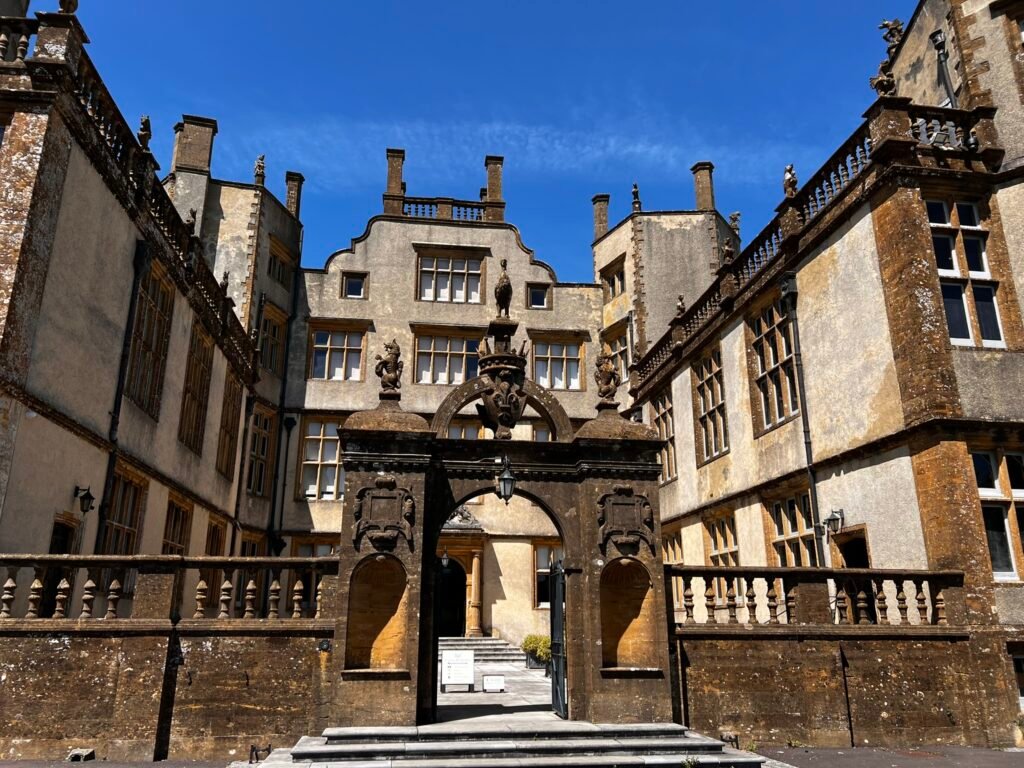
The castle Sir Walter Raleigh built when the old one wasn’t good enough
The story begins with Sir Walter Raleigh, who acquired the medieval Sherborne Old Castle in 1592. He initially considered modernising the existing fortress but eventually decided to create a new residence in the neighbouring deer park.
Apparently, even an Elizabethan courtier with royal connections could look at a major renovation project and decide it was going to be rather too much trouble.
By 1594, Raleigh had completed a new house incorporating the site of an earlier hunting lodge. It was a four-storey residence with large windows, quite a different proposition from the thick defensive walls and medieval accommodation of the original castle. Around 1600, he added hexagonal corner turrets topped with heraldic beasts, giving the building some of the distinctive architectural features visitors can still admire.
The property eventually passed to Sir John Digby in 1617. He enlarged Raleigh’s original building with four additional wings, creating the H-shaped layout that survives today. Later generations introduced Georgian windows, fireplaces, furnishings and Victorian alterations, producing a house that contains more than four centuries of changing architectural and decorative tastes.
Rather than looking like several completely unrelated building projects, however, much of the exterior blends together remarkably well. The towers, balustrades, stonework and windows give the impression of a grand historic residence that has gradually grown into its surroundings.
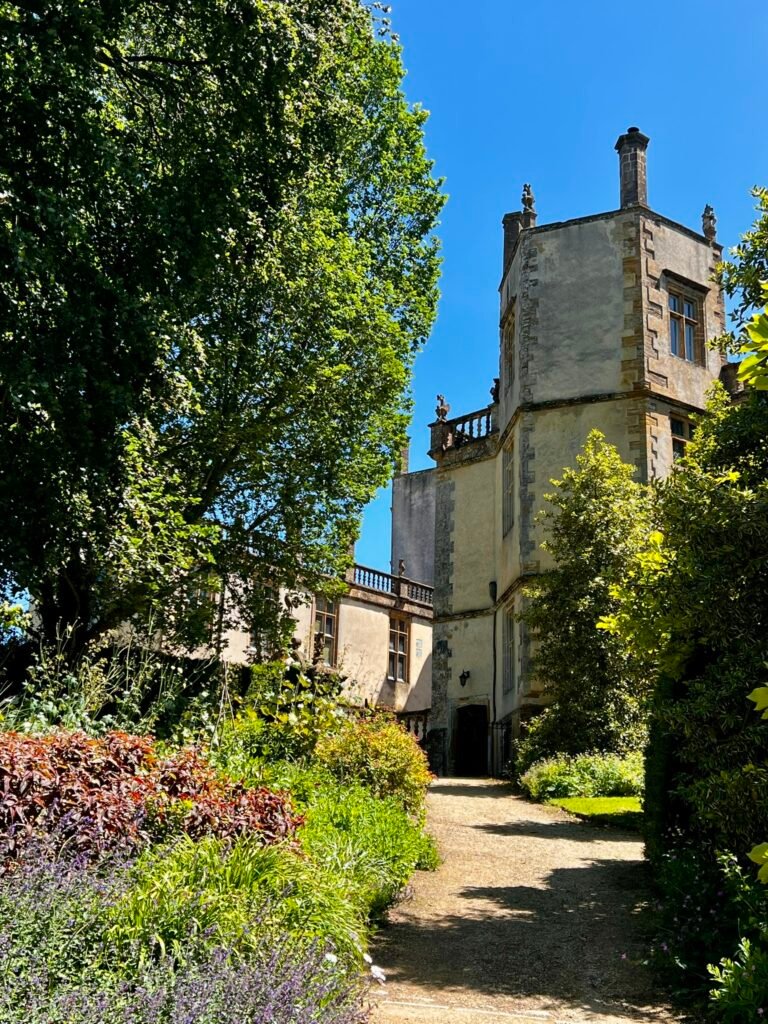
The original medieval fortress still stands nearby, although its Civil War history left it in a considerably less comfortable condition. If the names are confusing, I’ve explained how Sherborne ended up with two different castles, because visiting the wrong one could produce a spectacular misunderstanding.
The important distinction here is that Raleigh’s later house survived as a home. And it is that lived-in history, rather than simply its age, that makes the experience so interesting.
Behind the doors: a guided tour worth putting the camera away for
Sherborne Castle remains the private family home of the Wingfield Digby family, and the interiors are visited on a guided tour.
I generally enjoy exploring historic buildings at my own pace, particularly when something catches my eye and I want to spend longer studying it. But a guided tour offers something photographs and information boards sometimes struggle to provide: the stories connecting individual rooms, objects and generations of people.
The castle contains nationally important collections of paintings, furniture and porcelain. Yet what impressed me wasn’t simply the quantity of beautiful things. It was the atmosphere of the rooms themselves and the extraordinary variety of styles accumulated over centuries.
This isn’t a house where everything has been arranged to represent one particular year in history. Tudor origins sit alongside later decoration, Georgian elegance and family collections that reflect different owners and periods. There is a wonderful sense of continuity, even though the people who created these interiors lived in very different worlds.
Naturally, I would have loved to photograph everything.
I can spend an unreasonable amount of time finding the best angle for an old doorway, so you can imagine what a room filled with historic furnishings, intricate decoration and centuries-old architectural details does to my photography ambitions.
Unfortunately, the rules are clear: no photography inside.
A tragedy for my camera, although probably excellent news for everyone who didn’t want me stopping in every doorway.
Instead, I concentrated on the tour, listened to the stories and tried to absorb as much as possible. In retrospect, I suspect that made the experience more memorable.
Especially when we reached the dining room.
The dining room I genuinely wish I could show you
Of all the spaces we visited, the dining room made one of the strongest impressions on me.
I love historic interiors where the overall effect is just as impressive as the individual objects. Beautiful furniture is one thing, but a room where the proportions, decoration and atmosphere seem to work together is something else entirely.
This was one of those rooms.
It had the richness and grandeur that makes you understand why historic houses were designed not only as comfortable places to live, but also as statements of wealth, status and family importance.
You know those dining rooms in period dramas where somebody is about to announce an inheritance, reveal a family scandal or dramatically refuse to marry the person selected by their parents? It had that sort of atmosphere, although thankfully our guided tour remained considerably more civilised.
And Sherborne Castle has hosted some genuinely distinguished guests.
In 1789, King George III visited with Queen Charlotte and three of their daughters. The royal party toured the park and dined with Lord and Lady Digby. It is one of the fascinating episodes recorded in the castle’s own historical timeline.
Knowing that the house played host to royalty gives its grand interiors another dimension. These rooms weren’t created simply to be admired by future visitors; they were part of a working household where important guests were received and entertained.
I won’t pretend that my description can replace seeing the dining room yourself, and I certainly won’t claim to remember every decorative detail without a photograph to check.
What I remember is the impression it made. The richness, the elegance and that wonderful feeling of being somewhere genuinely special.
Even if I did spend part of the visit quietly wishing I could take just one photograph.
The Red Drawing Room: when four centuries of history are still on the ceiling
The Red Drawing Room was another highlight, and its importance goes well beyond its appearance.
According to Historic England’s official listing, the room retains an elaborate 17th-century plaster ceiling and a historic fireplace decorated with the Digby family’s coat of arms.
These aren’t later additions installed to make the room look suitably old for visitors. They are surviving elements of the house’s history, created when the family was establishing and developing its residence.
That makes a remarkable difference to the experience.
It’s one thing to admire beautiful historic-style decoration. It’s quite another to realise that details above your head have survived for centuries, through changing fashions, different generations and enormous changes in the world outside.
The house contains other significant interiors too. Historic England records elaborate plasterwork in several drawing rooms, early 17th-century panelling and a library with decorative Gothic-style fittings.
Each space reflects another period of the building’s development, so the tour becomes something of a journey through changing tastes. One generation introduces something magnificent, another decides it needs improving, and centuries later we arrive to admire the result.
I imagine the family members responsible for all those alterations might have had some spirited discussions about interior design.
Some things about home ownership apparently never change.
The Red Drawing Room and dining room were my personal highlights. They’re also the reason I would never recommend visiting the gardens alone if you’re particularly interested in historic interiors and the castle is open for tours.
The grounds are wonderful, but they cannot prepare you for what is inside.
Royal visitors, wartime soldiers and a surprisingly personal collection
It’s tempting to imagine the history of a grand country house as an endless procession of expensive dinners, family portraits and people wearing increasingly impractical clothing.
Sherborne Castle has experienced plenty of grandeur, but its history contains some considerably more unexpected chapters.
During the First World War, part of the house was used as a Red Cross Voluntary Aid Detachment hospital for wounded soldiers. It had 27 beds and treated 192 patients, a striking change from its earlier role as a family residence and place of entertainment.
The transformation must have been extraordinary. Rooms associated with country-house life became part of the effort to care for men returning from war, while the wider world outside was undergoing changes that would permanently alter the lives of families across Britain.
During the Second World War, Commandos were stationed at the castle between 1942 and 1943. Once again, the building was being used for purposes very different from those Raleigh or the early Digbys could ever have imagined.
There are more intimate details too. The family museum includes historical curiosities and personal possessions, among them an object mentioned by Historic Houses that particularly caught my attention: Lord Digby’s false teeth.
Yes, really.
Imagine inheriting centuries of valuable paintings, historic furniture, porcelain and family treasures, and deciding the dental arrangements also deserve a place in the collection.
And yet I rather like that. Objects like these remind us that the people who lived in grand houses were still human beings, dealing with ordinary problems alongside their rather extraordinary circumstances.
It’s those personal details that stop history becoming nothing more than a collection of important names and dates.
But after exploring the house and its stories, there was another remarkable part of the estate waiting outside.
Capability Brown’s extraordinary landscape
You could visit Sherborne purely for the gardens and still have a wonderful day out.
The estate has around 42 acres of gardens and pleasure grounds surrounding a 50-acre lake, with rolling lawns, mature trees, flower borders and views extending across the surrounding parkland.
From certain viewpoints, the landscape looks so natural that you could almost imagine someone simply built a castle beside a particularly beautiful lake and left everything else alone.
The reality is considerably more interesting.
Much of what visitors admire today was shaped by Lancelot ‘Capability’ Brown, one of Britain’s most celebrated landscape designers. He was commissioned to work here in 1753 and returned in the 1770s to make further improvements.
Brown’s approach was very different from the rigidly geometric gardens that had been fashionable before him. Instead of emphasising straight lines and obvious symmetry, he created sweeping lawns, carefully arranged trees, curved water and views that appeared beautifully natural.
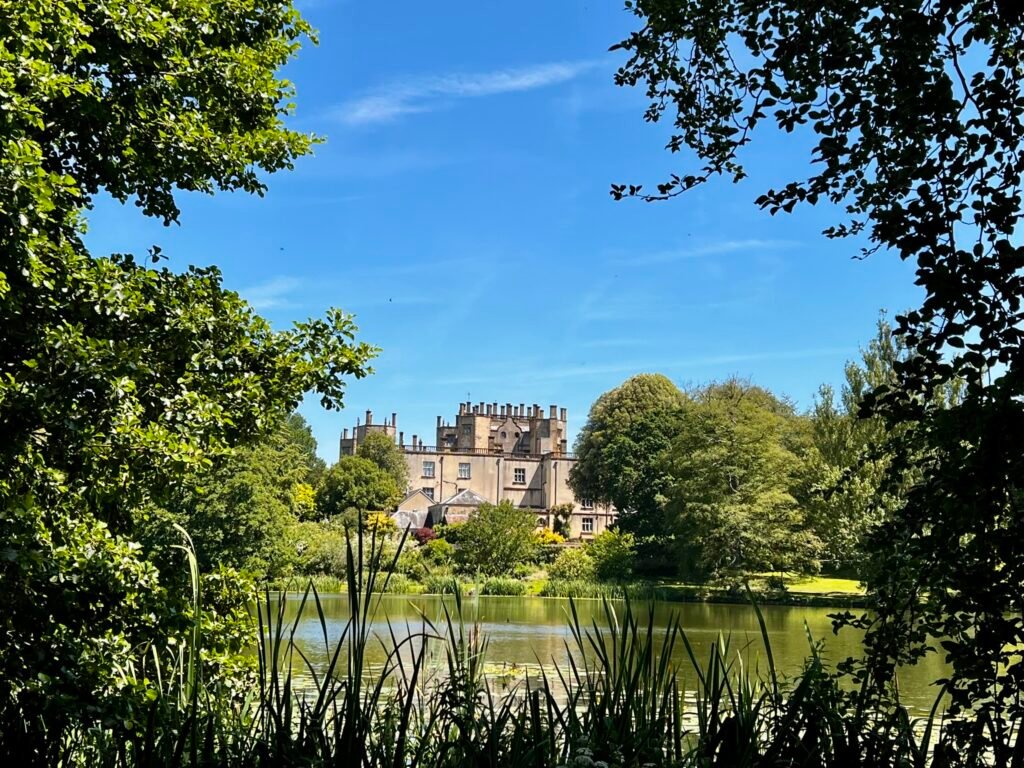
There is something wonderfully ambitious about employing somebody to redesign your entire landscape so convincingly that future visitors assume nature deserves all the credit.
Brown’s work here included the enormous lake, changes to the lawns and pleasure grounds, and carefully composed views connecting the house with the surrounding countryside.
The effect is impressive even if you know nothing about landscape architecture. You find yourself walking along a path, looking across an open lawn or through a gap between trees, and suddenly the whole scene seems arranged perfectly.
Which, of course, is rather the point.
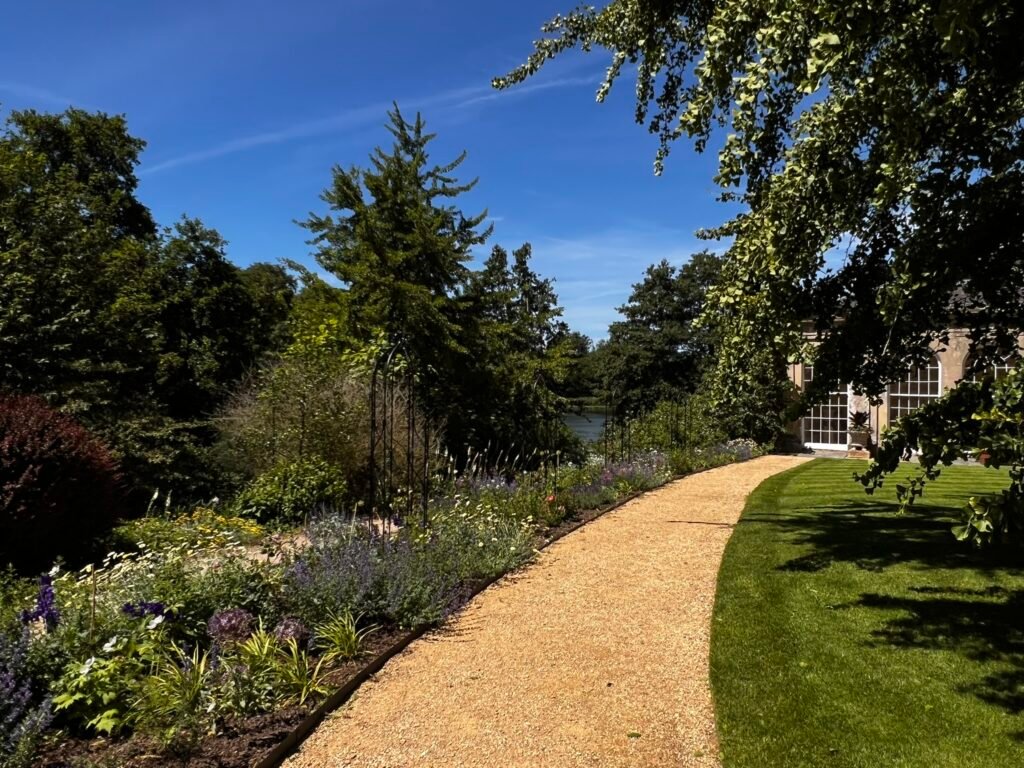
I particularly enjoyed the contrast with the house. Inside, the beauty came from elaborate decoration, historic furnishings and carefully designed rooms. Outside, it came from space, light, planting and the relationship between the buildings and their setting.
The two experiences complement each other beautifully.
And the history of the lake turns out to be much more complicated than its peaceful appearance suggests.
The beautiful lake with a surprisingly dramatic history
The lake is one of the estate’s most memorable features, but creating it involved rather more than digging a large hole and waiting for the rain.
Brown transformed the existing landscape by damming the River Yeo, flooding parts of an earlier formal garden and reshaping the surrounding grounds. Trees were removed, previous water features disappeared and substantial earthworks were undertaken to create the new setting.
The estate’s surviving account books make this project especially fascinating. They record the costs of removing old features, purchasing plants and fish, and carrying out the extensive work needed to transform the landscape.
By the time the lake was completed in 1755, the project had cost almost £550, a substantial sum in the 18th century. Lord Digby was so pleased with the result that he awarded Brown an additional bonus.
The records also preserve a much sadder detail.
According to research published by the Capability Brown project at the Landscape Institute, two men drowned during construction. The final accounts included funeral expenses and financial support for their families.
It’s an important reminder that landscapes like this were created by real people doing difficult, sometimes dangerous work. Behind the elegant views and famous designer were labourers whose contribution is easy to overlook.
Today, the lake is a peaceful place to explore, with wildlife, trees and reflections creating constantly changing scenes.
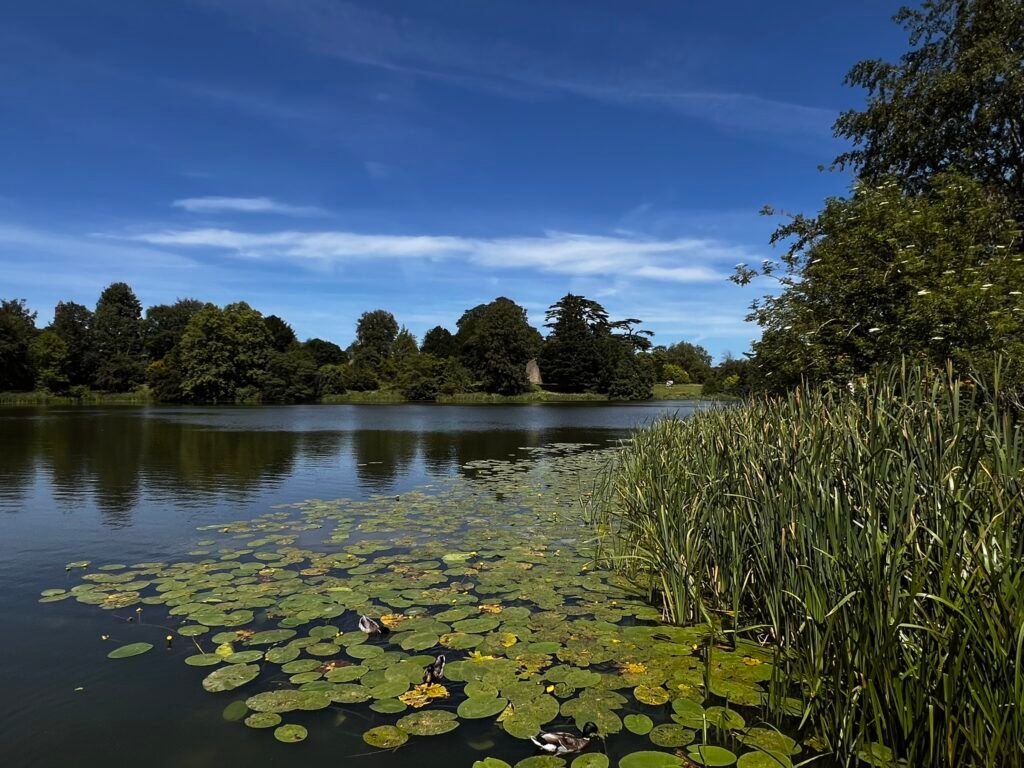
On our visit, the water lilies and ducks made the scene particularly photogenic. It was one of those places where there was absolutely no need to hurry, especially with so much to look at along the shoreline.
And there is one particularly clever feature of the landscape that connects directly to the rest of our Sherborne adventure.
How the Old Castle became part of the garden scenery
One of Brown’s most ingenious decisions was to incorporate the medieval castle ruins into views across the new lake.
By the 18th century, the Old Castle was already a ruin, having been deliberately damaged following its capture during the English Civil War. But rather than treating those remains as an inconvenient collection of broken walls, the landscape designers turned them into a picturesque feature.
Additional planting and architectural alterations helped create carefully composed views towards the ruins. A mock ruined tower was even constructed in 1755 to enhance the romantic effect.
Apparently, the genuine medieval ruins weren’t quite ruined enough for the fashionable landscape.
I find that wonderfully British.
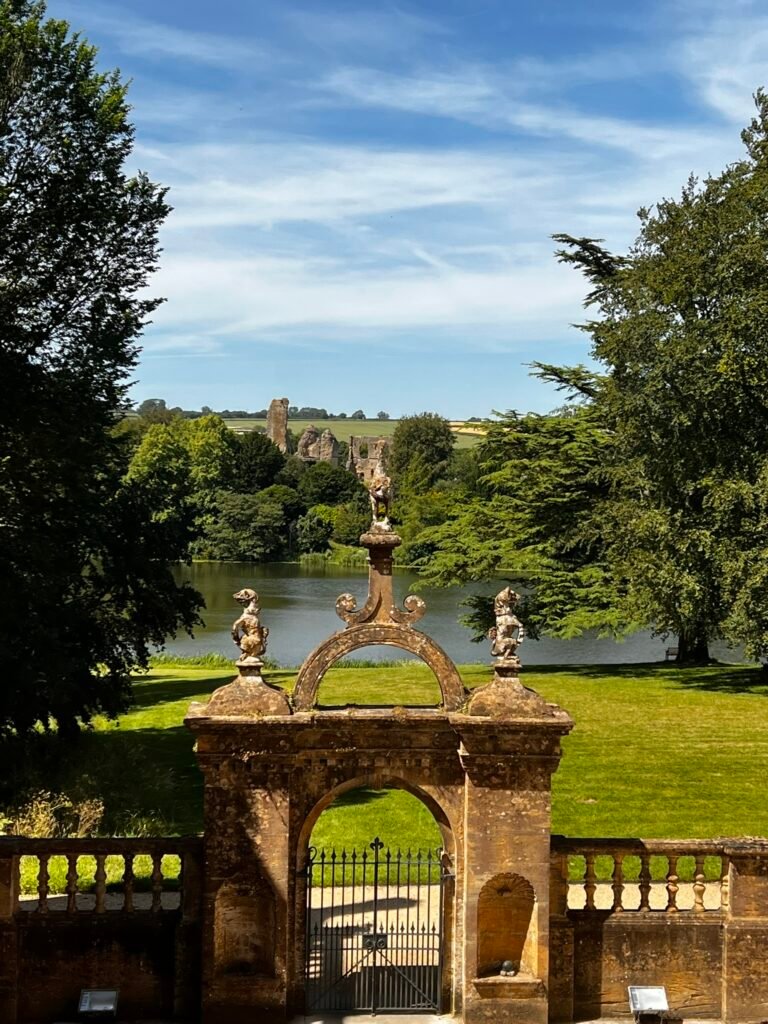
This is one of my favourite photographs from the visit because it shows how the different parts of Sherborne’s history overlap. In the foreground stands an elaborate garden gateway, beyond it lies the lake, and in the distance you can make out the remains of the medieval castle.
Having explored those enormous ruined walls earlier in the day, I found this view especially satisfying.
It is a remarkable change of purpose for a medieval fortress. A building originally created to demonstrate power and provide security had become part of an 18th-century landscape designed to be admired from a comfortable country house.
The castle had effectively been given a new job.
Scenery.
The Orangery and the pleasure of taking the long way around
There is much more to the gardens than the lake and distant views.
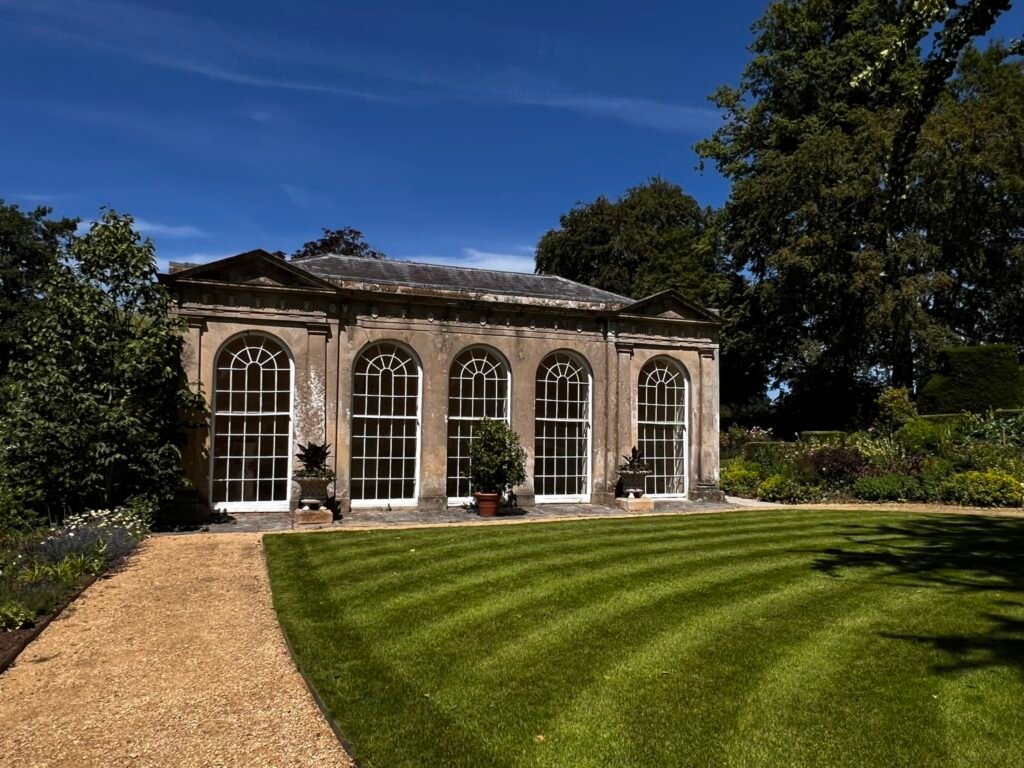
Paths lead through planted borders, lawns and groups of mature trees, with smaller garden structures appearing as you explore. Among the most attractive is the Orangery, an elegant building with tall arched windows and a wonderfully formal appearance.
The architectural history is interesting too. Henry Holland Junior, who was Capability Brown’s son-in-law, is thought to have designed the Orangery, linking the building to the wider landscape improvements.
It makes a lovely contrast with the older castle. Instead of towers, heraldic beasts and centuries of alterations, the Orangery has an elegance of its own, with its repeated windows and carefully maintained setting.
The gardens also contain features such as a cascade, Fossil House, historic viewing places and other structures that help explain how the landscape was designed to be explored.
The estate suggests two walking routes of approximately 1.6 and 2.1 kilometres, which can be combined for a more extensive visit.
I particularly enjoyed the way the garden paths kept opening onto different views. Some areas feel spacious and open, while others are enclosed by trees and colourful planting. The changes are subtle enough that you don’t always realise how carefully the landscape is guiding you.
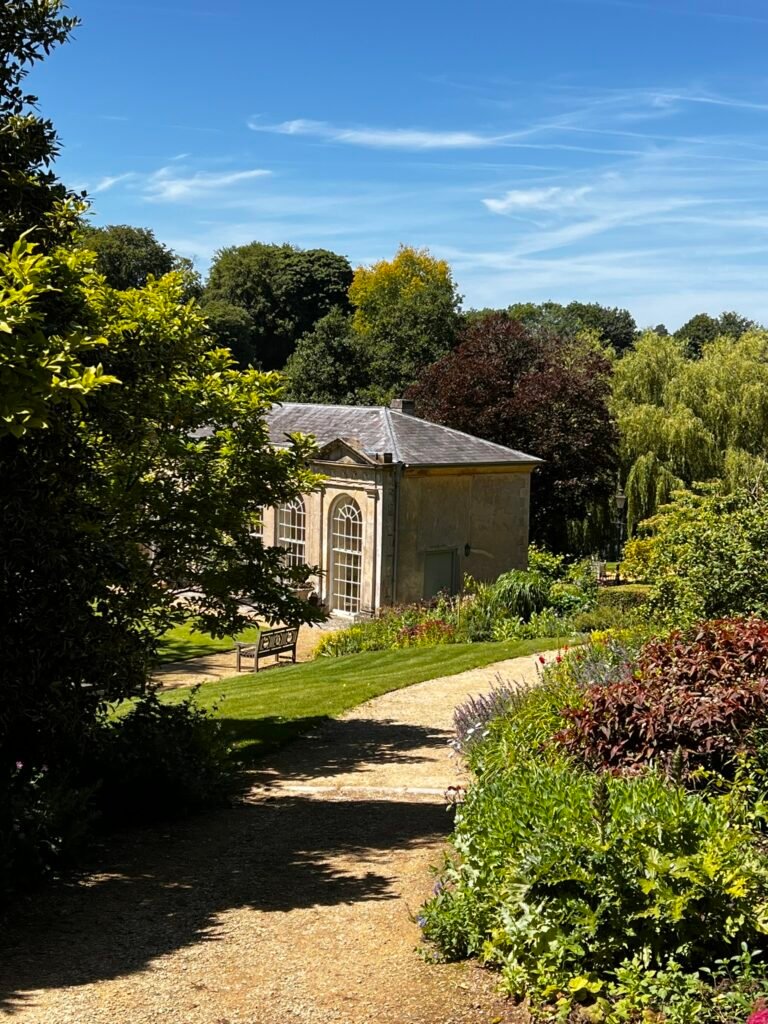
This is somewhere I could happily return to at another time of year. Spring flowers, summer borders and autumn colours would each create a different experience, especially around the lake and mature trees.
A garden like this doesn’t need to be filled with spectacular monuments at every turn. Part of its appeal is simply being able to walk, look around and enjoy how everything fits together.
Although I would still recommend keeping your camera ready.
Unlike inside the house, there are plenty of opportunities to use it here.
Historic Houses membership: exactly the sort of place I joined for
Sherborne Castle is one of those properties that reminds me why I enjoy having Historic Houses membership.
The appeal isn’t simply getting through an entrance without buying another ticket. It’s the opportunity to visit places that are still private family homes, with interiors and collections that reflect generations of ownership rather than a single carefully recreated historical period.
Some properties are remarkable for their architecture. Others have spectacular gardens, fascinating collections or compelling family stories.
Sherborne manages to combine all of those.
The guided tour was the highlight of my visit, particularly the dining room and Red Drawing Room, while the gardens and lake offered an entirely different experience afterwards.
We entered using our Historic Houses memberships, which covered the castle tour and gardens. In 2026, the normal adult combined ticket costs £20, while garden-only admission is £15.
Of course, I wouldn’t suggest joining Historic Houses purely because one particular property looks impressive. Whether the annual membership represents good value depends on how many participating properties you actually visit and which ones interest you.
But Sherborne is an excellent example of what makes the scheme appealing to me. Without the membership, I might have looked at the admission price and wondered whether to fit another paid attraction into an already busy day. With it, we had a compelling reason to experience both the house and its gardens properly.
I’ve written more about how I’ve been using my Historic Houses membership and whether it’s worth the money, based on the places I’ve actually visited.
This one certainly helped justify my decision to join.
Planning your visit: opening times, tickets and practical advice
The most important thing to know before visiting is that the castle interiors and gardens have different opening seasons.
The guided castle tours generally operate from May to September, while the gardens have a longer season extending into autumn. At the time of writing in October 2026, the house has already closed for the season, although the gardens remain open on selected days through early November.
If the rooms are your main reason for visiting, don’t make the mistake of assuming that an open garden means an open castle.
The house tour lasts approximately one hour, and timed slots are available subject to capacity. Historic Houses members receive included admission with a valid membership card, but should obtain their tour slot at the visitor entrance on arrival rather than assuming they can book a complimentary online ticket in advance.
For 2026, standard adult tickets are £20 for the house and gardens together or £15 for the gardens alone. English Heritage members also qualify for a reduced admission price. Special events may have separate arrangements.
The estate recommends allowing four to five hours for a visit that includes the guided tour and a proper exploration of the gardens. That might sound generous, but there’s plenty to enjoy if you’re interested in both the interiors and landscape.
Visitors arriving by car can use the estate parking, and the castle is also within walking distance of Sherborne railway station. There are gravel paths and benches around the gardens, although the historic building itself has accessibility limitations, with wheelchair access restricted to the ground floor.
Dogs are welcome in the gardens on short leads, but not inside the castle, except for assistance dogs. Amateur photography is permitted in the gardens and grounds, while photography and filming inside the house are prohibited.
For the latest dates, prices, tour availability and accessibility information, check the official Sherborne Castle visiting guide before travelling.
My biggest practical recommendation is to organise your day around the house tour if you want to see the interiors. The gardens can be enjoyed before or afterwards, but missing the final tour means missing what I found to be the most extraordinary part of the property.
Don’t visit the castle and miss the rest of Sherborne
One of the reasons our day worked so well was that we explored several historic places rather than treating the castle as an isolated attraction.
Earlier, we had spent time wandering through Sherborne’s lovely old streets, admiring the honey-coloured buildings, medieval gateways and independent shops. There was also an excellent bakery stop, because apparently my historical curiosity works considerably better when accompanied by fresh pastries.
We visited Sherborne Abbey too, where the extraordinary fan-vaulted ceiling provided another architectural highlight of the day. The elaborate Digby Memorial standing outside also creates a historical connection to the family who have occupied the castle for centuries.
Seeing these places together made the wider story much easier to appreciate. The town, Abbey, medieval ruins and later family residence all represent different aspects of Sherborne’s past, yet their histories frequently overlap.
You could easily dedicate more than one day to the area, particularly if you wanted to give the castle gardens several hours without rushing.
We managed to see an enormous amount in one visit, but Sherborne is definitely somewhere I would return to. There is simply too much history packed into a relatively small area to absorb everything the first time.
And, quite frankly, there are probably more pastries to investigate.
Is Sherborne Castle and Gardens worth visiting?
For me, absolutely — especially if you enjoy historic houses and have the opportunity to join the guided tour.
I’ve visited plenty of remarkable places where the photographs are almost as memorable as the experience itself. Sherborne Castle was different.
I have photographs of the architecture, the gardens, the lake and the beautiful views towards the medieval ruins. They remind me of a wonderful day, and I’m delighted I captured them.
But the most impressive parts of the house are missing from my camera roll.
The dining room, the Red Drawing Room and the richness of those historic interiors are things I have to remember rather than scroll through. And although I would still have loved to photograph them, I think that says something about how special the visit was.
The guided tour brought the house to life, the gardens were a beautiful contrast, and the stories behind both gave me much more to think about than I expected when we first arrived.
For anyone who loves history, interiors, gardens or discovering privately owned houses that still feel connected to the people who live in them, Sherborne Castle is well worth considering. Historic Houses members have an especially good opportunity to experience everything without paying another standard admission charge.
Just make sure you visit when the house itself is open.
The gardens are lovely. The views are beautiful. The architecture is impressive.
But those rooms are the reason I’m still talking about this place.
Some things really are better seen with your own eyes.
One journey. One story. One more stop.