
We had already spent a fair amount of the day wandering through Sherborne’s historic streets, admiring the honey-coloured buildings and discovering that apparently the town had collectively decided normal-looking stone simply wasn’t good enough. There were medieval gateways, old shopfronts and enough beautiful architecture to keep my camera busy long before we even reached the Abbey.
Sherborne Abbey fitted into the town so naturally that at first we were simply taking photographs of it from outside. The same warm golden stone seemed to continue from building to building until suddenly one of them had an enormous tower, Gothic windows and more than 1,300 years of history attached to it.
Naturally, we wandered closer.
Then we discovered that Sherborne Abbey was free to enter.
That changed “let’s have a quick look” into “well, obviously we’re going inside.”
What I wasn’t expecting was to walk through the door, look upwards and basically forget what I had been doing for the previous thirty seconds.
That ceiling.
Honestly. Wow.
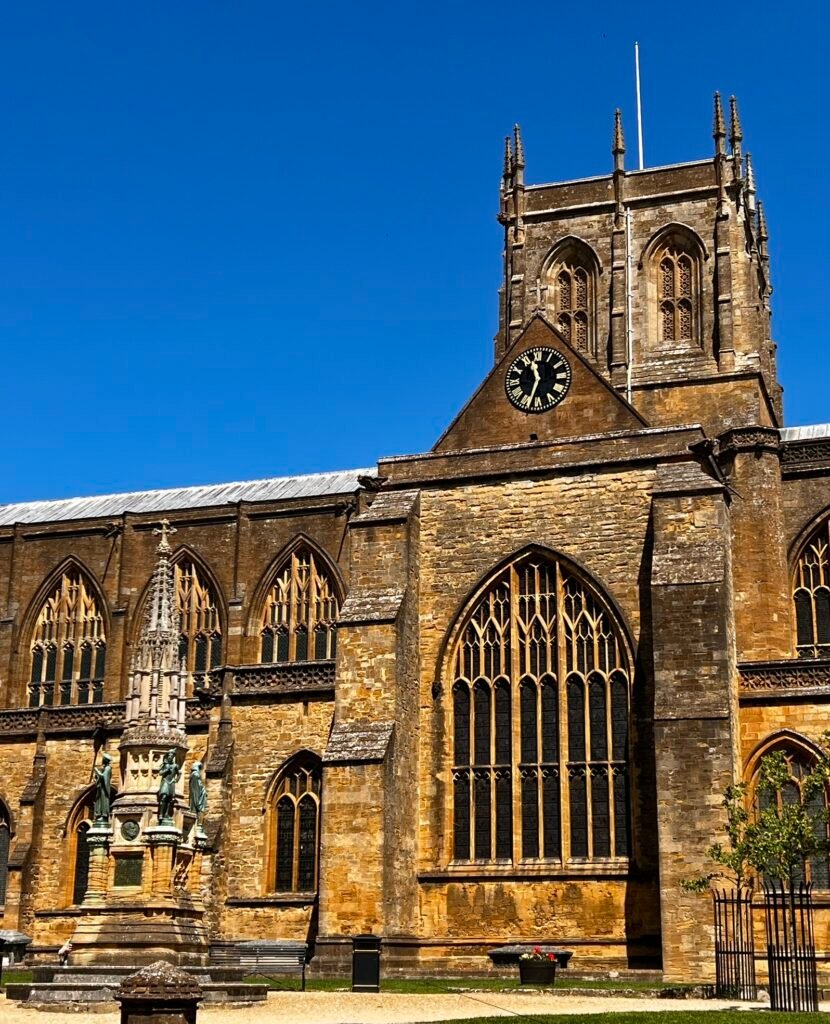
Sherborne Abbey: beautiful outside, absolutely ridiculous inside
From outside, Sherborne Abbey already looks important. Its central tower rises above Abbey Close while huge Gothic windows, buttresses, carvings and memorials compete for your attention at ground level.
The stone is particularly beautiful in strong sunlight. It has that warm golden colour that appears all over historic Sherborne, making parts of the town look as though somebody designed the entire place using one extremely expensive medieval colour palette.
But the exterior doesn’t really prepare you for the scale inside.
Sherborne Abbey began as a cathedral in AD 705, when Aldhelm was appointed the first Bishop of the West Saxons and chose Sherborne as the seat of the new diocese. It served Aldhelm and another 26 Saxon bishops, and elements of that early church survive within the building visitors see today.
That means people have been worshipping on this site for more than thirteen centuries.
Thirteen.
Centuries.
And somehow the building has survived bishops, Benedictine monks, angry townspeople, fire, Henry VIII and Victorian restoration. Frankly, I struggle to keep a houseplant alive.
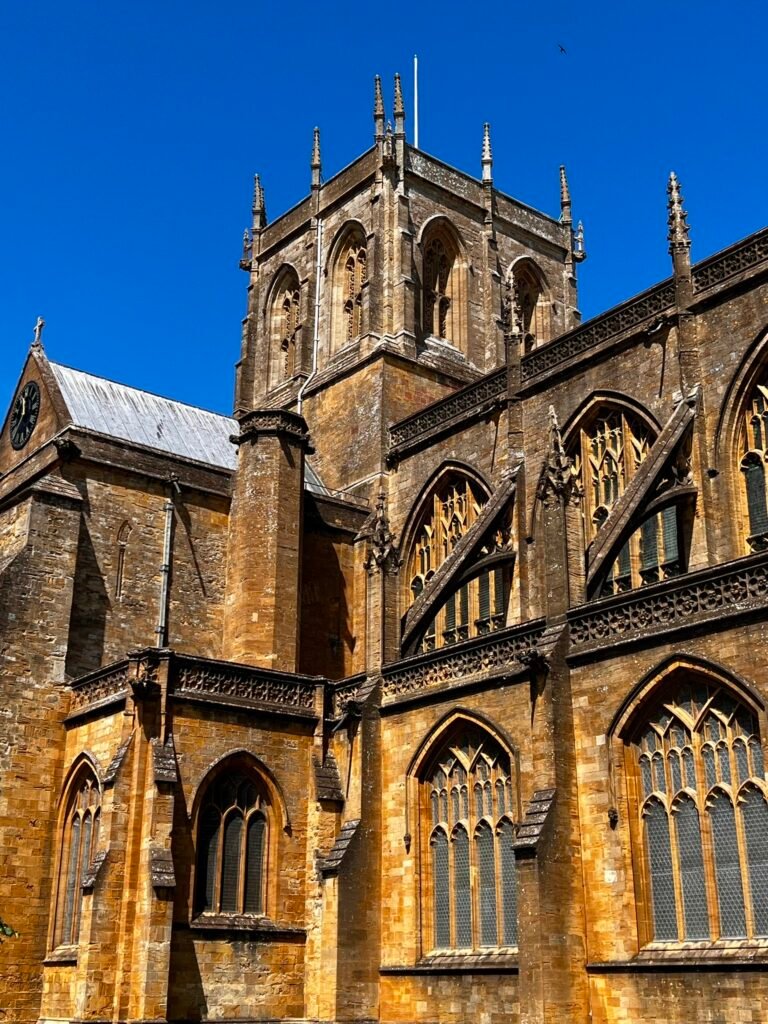
From Saxon cathedral to Benedictine abbey
Sherborne’s religious importance came very early. The cathedral established here in 705 remained the seat of the local bishops until after the Norman Conquest, when the episcopal centre moved to Old Sarum and ultimately Salisbury.
By then, another major change had already happened. In 998, St Wulfsin replaced the community of secular canons with Benedictine monks, beginning the monastic chapter of Sherborne’s story. The site developed through successive Saxon, Norman and later medieval building campaigns, which helps explain why walking around it feels like several centuries of English architecture have been layered on top of one another.
Two Saxon kings are buried here. Tudor poet Sir Thomas Wyatt has his grave here. Sir Walter Raleigh worshipped here. The Abbey’s own history is full of people whose names normally appear several chapters apart in a textbook suddenly sharing the same building.
And then we get to my favourite part of the story.
Because relations between the monks and the people of Sherborne were, to put it politely, not always neighbourly.
The argument over a font that ended with a burning Abbey
This is where Sherborne Abbey history stops behaving like respectable church history and starts sounding like somebody needs to call security.
The monks had constructed a separate church called All Hallows, physically attached to the Abbey, for the townspeople to use. The problem was that the parishioners still had to use the Abbey’s font when they wanted a child baptised.
By 1437, the people of Sherborne had apparently had enough of asking the Abbot for permission, so they installed their own font in All Hallows.
The Abbot did not take this well.
According to the Abbey’s own account, he sent a “stout butcher” armed with a hammer to destroy it.
Which seems a surprisingly dramatic response to church furniture.
Unsurprisingly, things escalated.
A riot followed, somebody fired a burning arrow into the Abbey, and the arrow hit wooden scaffolding being used during construction work. The resulting fire badly damaged the east end and permanently reddened stonework around the quire and crossing. Eventually even the Pope became involved in settling the dispute — and the townspeople were required to contribute towards the repairs.
So yes: one of England’s most spectacular medieval churches was partly set on fire because of an argument about who controlled the baptismal font.
Modern parish meetings suddenly seem quite restrained.
And somehow the disaster helped create something extraordinary
Sherborne Abbey’s magnificent interior owes much of its present character to the major rebuilding campaigns of the fifteenth century. Historic England dates the spectacular fan vaulting to the late 1400s, while the National Churches Trust describes Sherborne’s vaults as among the great architectural achievements of the period.
None of that was going through my head when I entered.
My response was considerably less scholarly.
It was approximately:
Oh. Wow. Look at that.
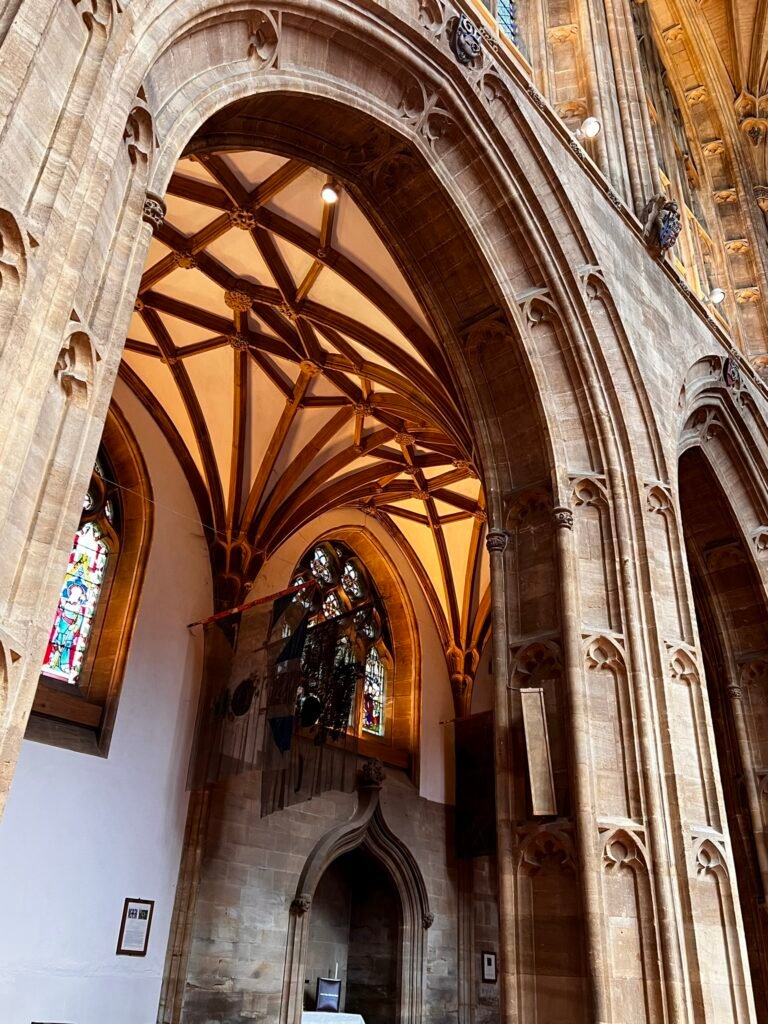
Walking inside Sherborne Abbey
The first thing I noticed was the space.
The exterior looks substantial, but once you step inside the building seems to expand upwards. Huge stone columns rise into pointed arches, windows pull light into the nave and suddenly the town outside feels much further away than the few metres you have actually walked.
Then your eyes follow the columns upwards.
And that is where Sherborne Abbey really gets you.
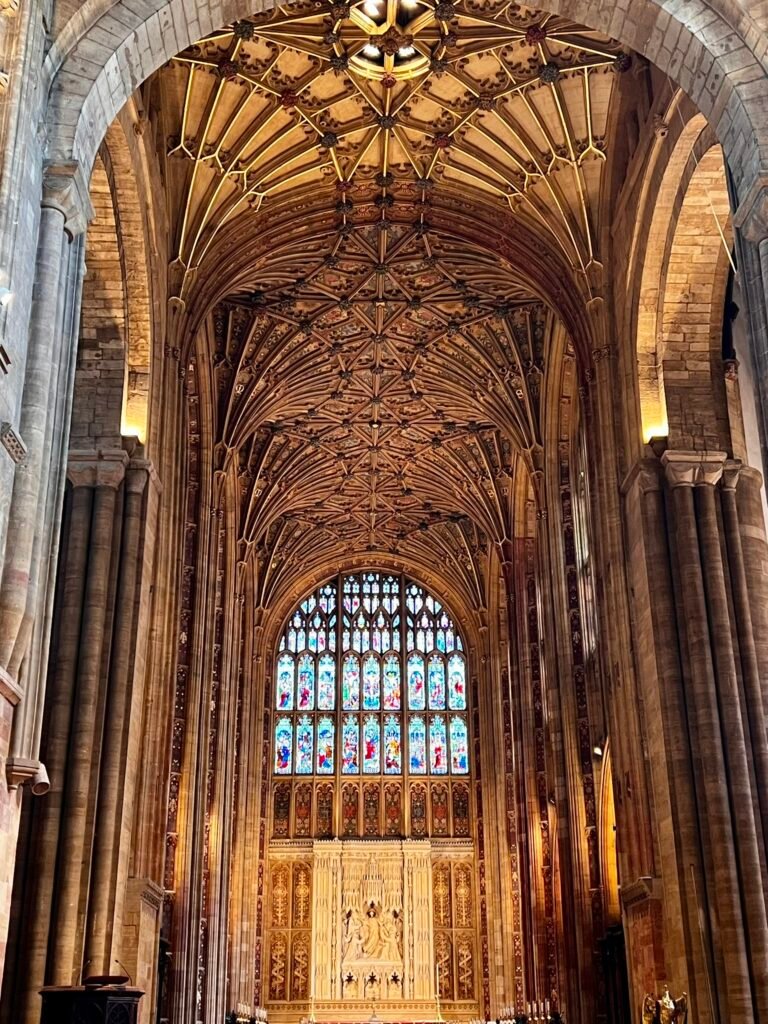
The ceiling almost looks woven.
I know it is stone. My brain knows it is stone. But visually, the ribs seem to spread and overlap like some enormous piece of lacework suspended impossibly high above the floor.
Except somebody made the lace out of rock.
How?
Why?
And how did nobody halfway through construction say, “You know what, a flat ceiling would probably be fine”?
That fan-vaulted ceiling
The technical name is fan vaulting, but the terminology doesn’t really communicate what it feels like standing underneath it.
Stone ribs spread outward from their supports in repeated fan-shaped patterns, intersecting with carved details and bosses until the entire roof seems to form one enormous geometric canopy.
The fact that it is so high makes it even harder to process.
You are standing at floor level looking at something unbelievably complicated that medieval craftspeople somehow designed, carved, lifted and assembled hundreds of years before cranes, laser levels or somebody on YouTube could explain the whole thing in twelve minutes.
Sherborne’s late-medieval fan vaulting is specifically recognised in the Abbey’s Grade I Historic England listing, alongside surviving Norman walls and work from numerous other periods.
It is easily the feature I remember most strongly from the visit.
There are buildings where you politely admire the architecture because you know you are supposed to.
This wasn’t one of those.
We genuinely just stood there looking upwards.
Look beyond the ceiling
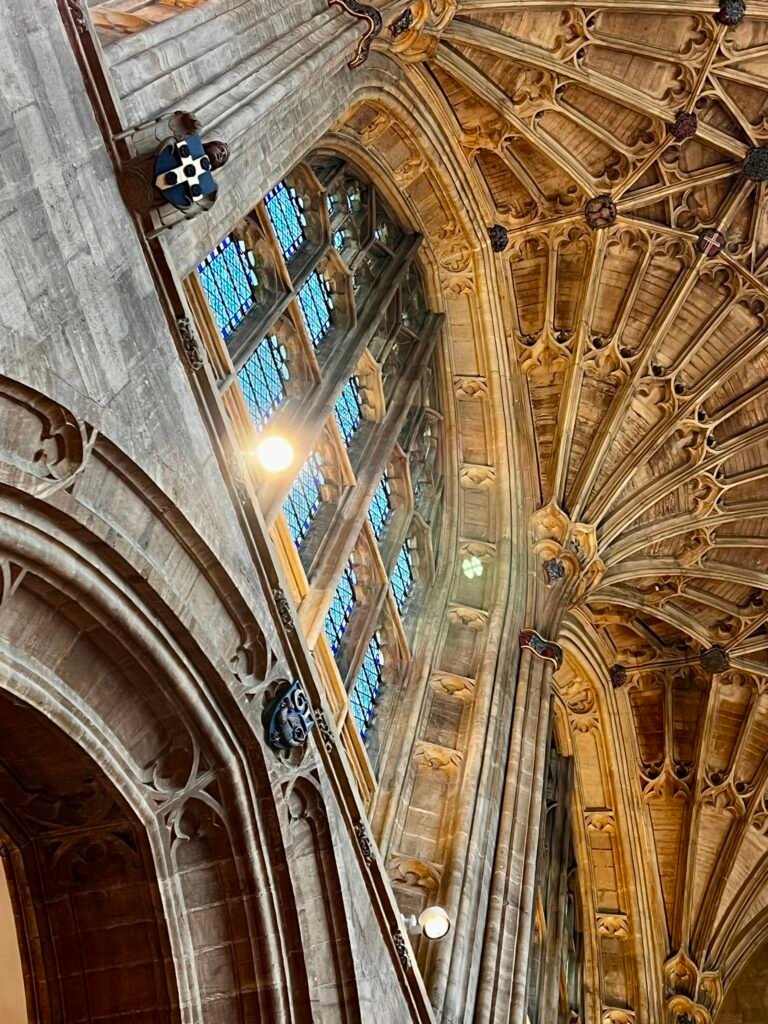
The ceiling naturally steals attention, but once I had finished staring vertically upwards like a confused tourist, there was plenty more to notice.
The Abbey contains layers of arches, stained glass, chapels, carved stonework, memorials and architectural fragments from different periods of its history. Norman fabric survives alongside later medieval rebuilding, Victorian restoration and twentieth-century additions.
It is one of those interiors where looking straight ahead really isn’t enough.
Look up at the vaults. Look into the side chapels. Look at the bosses and heraldry. Look at how the light changes the colour of the stone.
Then look behind you because you have probably missed something.
The building still functions as an active parish church, rather than having become a preserved historic attraction, which also changes the atmosphere. You are visiting somewhere that has survived precisely because it continued to have a purpose.
And that brings us to another remarkable part of the story.
Henry VIII closes the monastery — and Sherborne buys its church
The Benedictine community lasted until 1539, when Sherborne Abbey surrendered during Henry VIII’s Dissolution of the Monasteries. The Abbey property subsequently passed to Sir John Horsey.
Then something rather wonderful happened.
In 1540, Horsey sold the Abbey church to the people of Sherborne, allowing them to use it as their parish church. Dorset’s heritage record and Historic England both confirm that the townspeople purchased the building following the Dissolution.
Think about the irony.
A century earlier, the townspeople had been fighting with the monks because they had effectively been pushed into the neighbouring All Hallows church.
They argued over a font.
They accidentally set part of the Abbey on fire.
They had to contribute towards repairing it.
Then the monasteries were dissolved and, eventually, the people of Sherborne bought the Abbey itself.
History does occasionally deliver a very satisfying ending.
All Hallows was demolished, while the Abbey became Sherborne’s parish church and remains so today.
That probably explains part of why the building survived in such extraordinary condition. It did not simply become an abandoned monastic ruin after 1539; the town gave it another life.
The Digby Memorial and another chapter of restoration
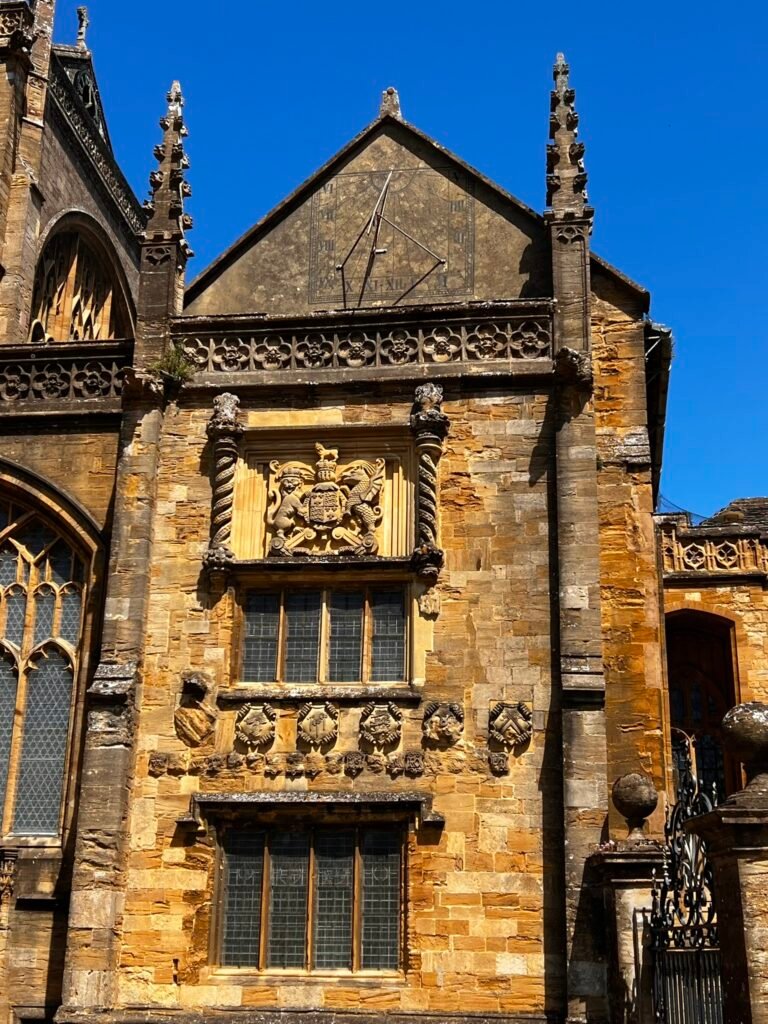
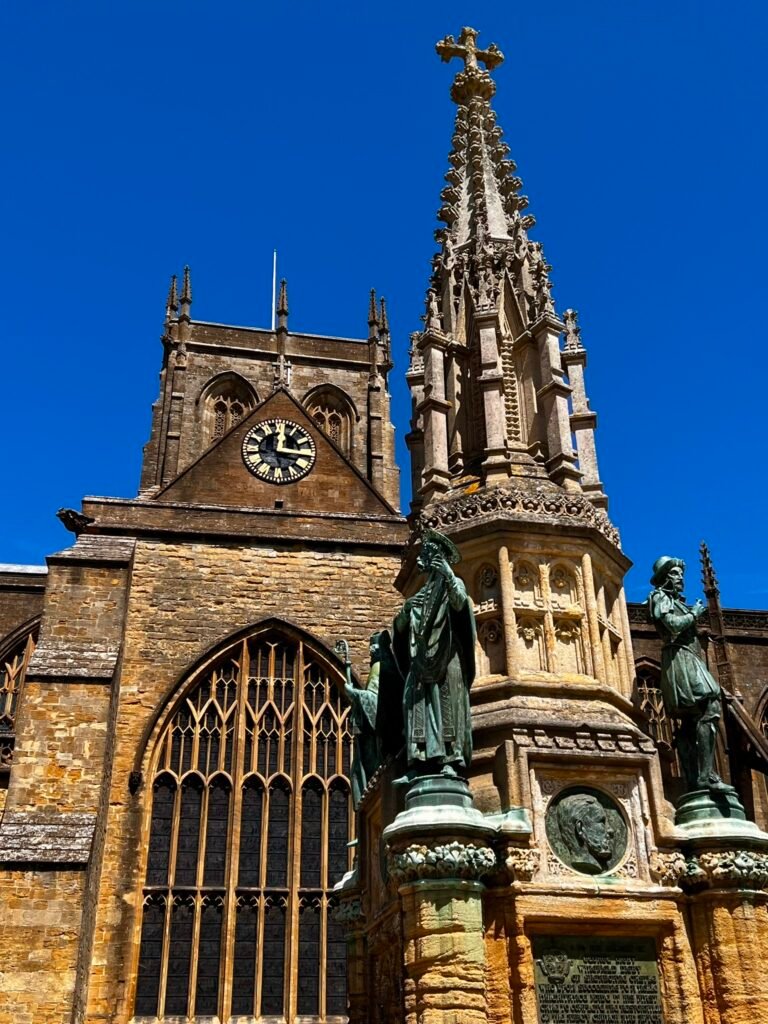
Outside the Abbey stands the elaborate Digby Memorial, erected in 1884 in memory of George Digby Wingfield Digby of Sherborne Castle.
The memorial includes bronze figures representing St Aldhelm, Bishop Roger, Abbot Bradford and Sir Walter Raleigh — four names tied to different chapters of Sherborne’s history. Historic England records that Digby had helped support the restoration of the Abbey before his death.
It also creates one of the most recognisable views of the Abbey, with the memorial rising in front of the medieval church and its tower behind.
The Digby connection carries on beyond the Abbey. Later that day, we visited Sherborne Castle and Gardens, the historic house associated with the Digby family. It was a completely different experience, swapping medieval church architecture for elegant furnished rooms and beautifully landscaped grounds. The estate is also part of Historic Houses, and I’ve written about whether that membership has been worth it for me.
That property is part of Historic Houses, and if you are considering visiting several independently owned historic homes, I’ve written about my experience in Is Historic Houses Membership Worth It?.
Sherborne Abbey is still free to visit
One of the best surprises of our visit was finding that we could simply walk inside.
That is still the case.
At the time of writing, Sherborne Abbey does not charge admission, although donations are welcomed. It is normally open to visitors from 8:00am to 5:00pm Monday to Saturday and 11:00am to 5:00pm on Sundays, except when services, weddings, funerals or other events affect access. The Abbey also offers regular free guided tours between spring and autumn. Always check the official Sherborne Abbey visitor information before making a special journey.
There is something particularly satisfying about wandering into a building this impressive without first being funnelled towards a ticket desk.
Obviously, maintaining a Grade I-listed building that has been standing here since medieval builders considered “let’s make the entire ceiling out of intricately carved stone” a perfectly reasonable project is not free, so donating if you can feels fair.
If free historic stops are your thing, I’ve also collected more ideas in my guide to Free Things to Do in Dorset.
Make Sherborne Abbey part of a full day
One of the best things about visiting Sherborne Abbey is that the experience doesn’t end when you walk back outside. You’re immediately surrounded by the same old buildings, independent shops and beautiful little streets I enjoyed exploring earlier. It seems almost a shame to visit the Abbey and then head straight back to the car when there’s so much worth seeing on its doorstep.
Later that day we visited Sherborne Old Castle, where spectacular ceilings gave way to broken walls, medieval gateways and a considerable amount of imagination. It couldn’t have felt more different from the Abbey. The nearby Sherborne Castle and its gardens [COMING SOON] offered yet another experience, this time with a historic house rather than a ruined fortress. And if you’re wondering why two completely different buildings share almost exactly the same name, I’ve explained how the two castles ended up connected.
That’s what makes Sherborne such a rewarding place to explore. You can arrive expecting a pleasant walk around a pretty old town and somehow find yourself several centuries deep in English history before you’ve even decided where to stop for lunch.
Watch: Sherborne Abbey inside and out
The reel above follows our visit from the historic streets around the Abbey into the building itself, finishing beneath that spectacular fan-vaulted ceiling.
And yes, it looks impressive on video.
No, the video still does not quite explain what it feels like standing underneath it.
Is Sherborne Abbey worth visiting?
Absolutely — and I say that as somebody who originally wandered over mainly because the building looked good in photographs.
The free entry was a lovely surprise. The history turned out to be far more dramatic than I expected. But it is the interior that stayed with me.
You step through the door, the space opens up, your eyes travel upwards and suddenly you are staring at a medieval stone ceiling that looks as if somebody hand-wove it across the top of the building.
Then you learn that this place has survived more than 1,300 years of bishops, monks, royal politics, riots, fire, dissolution, rebuilding and restoration — and that the people of Sherborne eventually bought the church that had once caused so much friction between town and monastery.
That makes it more than a beautiful building.
It feels like part of the town’s story that simply refused to disappear.
And considering we only walked over because it looked nice from outside, that turned into quite a stop.
One journey. One story. One more stop.