
There’s an unwritten rule in Bournemouth: if you can see the sea, you’re supposed to admire it.
The Russell-Cotes Gardens Bournemouth make that surprisingly difficult. Not because the sea view is disappointing — quite the opposite — but because there’s so much else competing for your attention.
A fountain tucked beneath a grand Victorian mansion. Palm trees that look as though they’ve taken a wrong turn somewhere in the Mediterranean. Shaded pathways, ornamental arches and a little red bridge that could have wandered out of a Japanese garden.
And all of this is perched above Bournemouth Bay.
When I visited the Russell-Cotes Art Gallery & Museum, I was already thoroughly impressed by the spectacular house and its extraordinary art. But outside, I discovered something rather different: a garden that feels like an extension of its owners’ imagination.
Apparently, Annie and Merton Russell-Cotes weren’t satisfied with having one of Bournemouth’s most extravagant homes.
They wanted the garden to be extraordinary too.
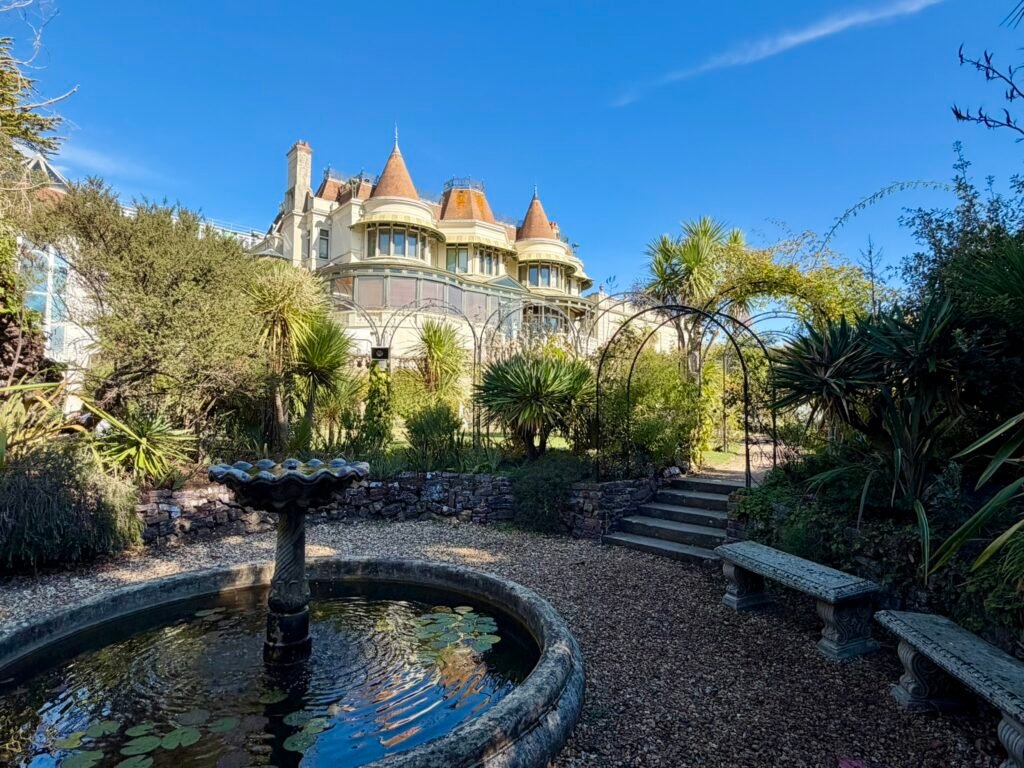
Turning Wild Sand Dunes into a Tropical Paradise
The most entertaining thing about these gardens is imagining what this spot looked like before anyone began planting it.
Because the elaborate landscape you see today began with something considerably less glamorous: wild sand dunes on Bournemouth’s clifftop.
Merton Russell-Cotes had a very particular ambition. He wanted to transform the site into a tropical garden, creating the sort of beautiful retreat that would impress even an enthusiastic English gardener.
Quite a challenge, considering the exposed coastal position, sandy ground and occasional enthusiasm of the British weather.
But Merton wasn’t exactly famous for modest ambitions.
The original garden was designed as a private retreat for the family, with lawns surrounded by fragrant flowerbeds, elaborate planting and classical sculptures. Life-sized marble figures once stood among the greenery, while secluded summerhouses offered places to sit and enjoy the surroundings.
It must have been quite a scene: an extravagant Victorian villa, tropical-looking plants and classical sculptures, all overlooking the English Channel.
The Romans had their villas. The Russell-Cotes had Bournemouth.
What makes the story even more interesting is that the garden wasn’t simply another decorative feature. It reflected the same adventurous tastes that shaped the house, providing a peaceful outdoor setting for a family fascinated by travel, art and beautiful things.
I’ve explored those personalities and ambitions in Annie and Merton Russell-Cotes: The Story Behind Bournemouth’s Museum.
The Garden That Likes to Keep Secrets
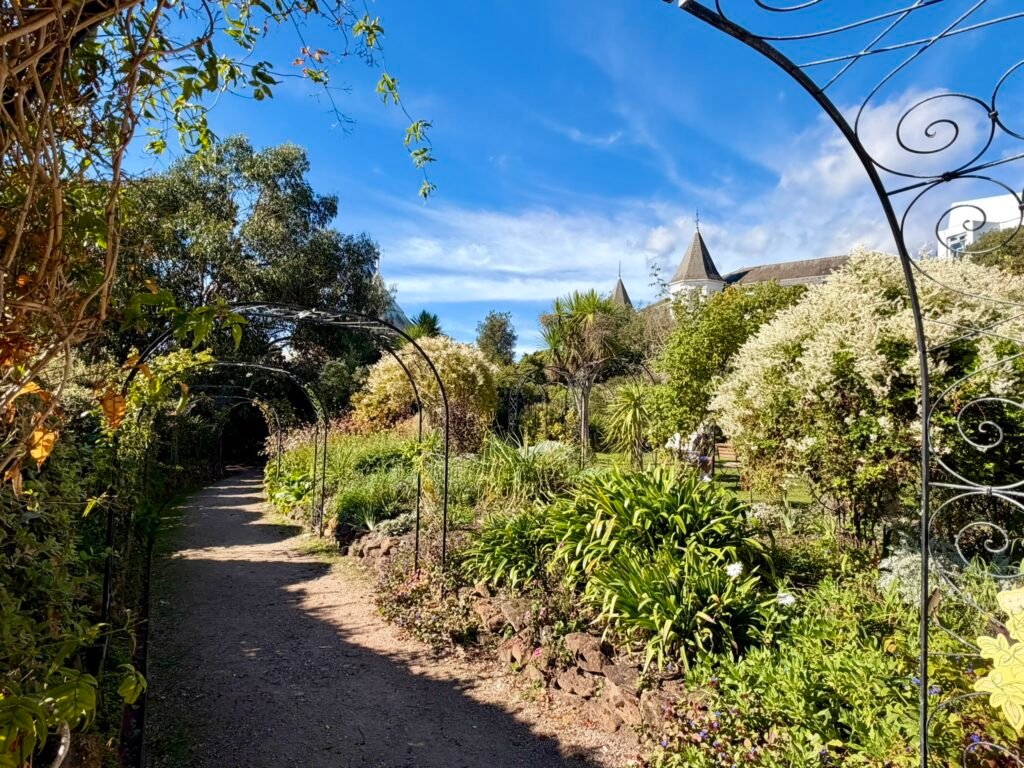
One of my favourite things about the garden is that it doesn’t reveal everything at once.
Instead of one enormous open space where you can see the entire layout immediately, there are pathways, curved iron arches and planted areas that invite you to explore a little further.
It’s the gardening equivalent of a good mystery novel.
You turn a corner, and there’s another view. Follow the path, and the house appears through the greenery at a completely different angle.
The original Victorian design was deliberately arranged to create a series of enclosed spaces. These smaller areas gave the impression of discovering something new as visitors moved through the grounds.
There was even a secluded stone grotto — a wonderfully Victorian idea.
A grotto is an artificial cave or rocky retreat built into a landscaped garden. In nineteenth-century Britain, grottos were fashionable features, intended to introduce mystery, drama and the appearance of a natural discovery into carefully designed surroundings.
Essentially, the Victorians invented an elaborate way of making a garden look as though nature had done all the work.
The Russell-Cotes’ stone grotto still survives, along with other historic garden features.
I love the contrast between the carefully planned design and its slightly wild appearance. The planting softens the architecture, while the arches and winding pathways make even a relatively compact garden feel full of possibilities.
Palm Trees in Bournemouth? Why Not?
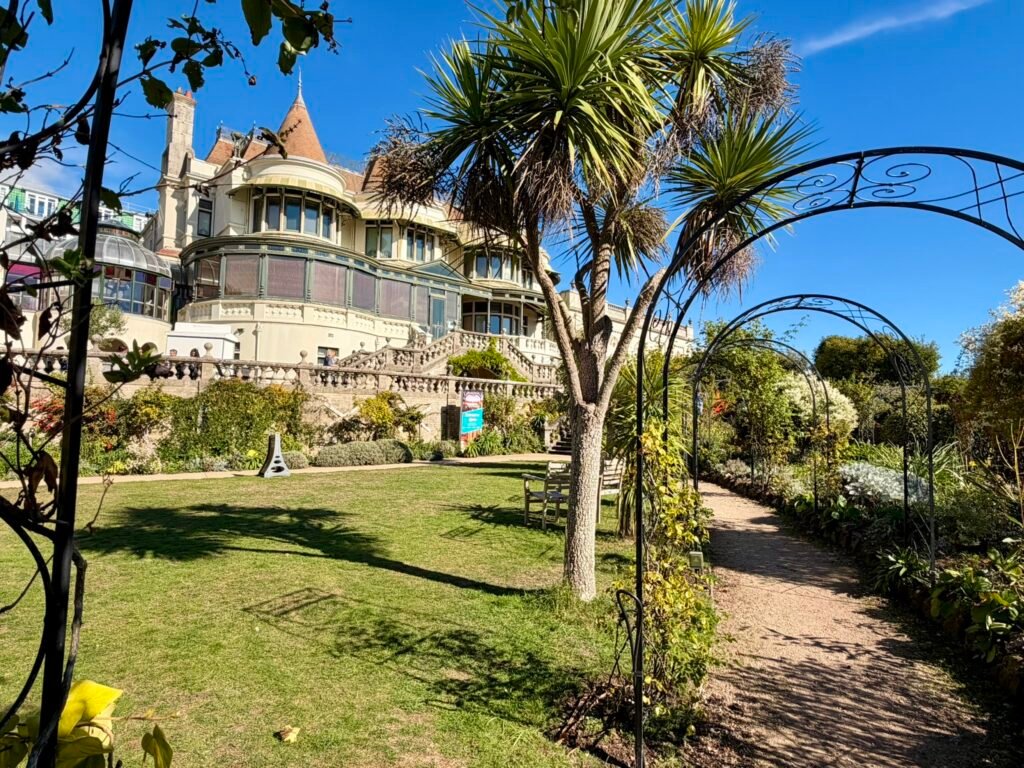
Bournemouth has always enjoyed a reputation for its relatively mild coastal climate, and the Russell-Cotes gardens make excellent use of that seaside character.
Palm trees, lush planting and ornamental pathways give the grounds an almost subtropical atmosphere.
For a moment, you could almost forget you’re on the Dorset coast.
Then the wind reminds you.
The garden’s mixture of plants reflects a style that became particularly fashionable during the Victorian and Edwardian periods, when wealthy gardeners experimented with species from different parts of the world.
Exotic-looking foliage was a way of bringing distant landscapes closer to home — rather like the paintings, ceramics and curious objects that wealthy travellers collected indoors.
Of course, not every palm or tropical-looking plant actually comes from the tropics. Some of the most successful plants in coastal British gardens are hardy species that simply happen to look wonderfully exotic.
That’s part of the cleverness of this kind of planting: creating the impression of a much warmer climate without requiring Bournemouth to relocate several hundred miles south.
And with the elaborate house rising behind the greenery, the whole setting feels wonderfully theatrical.
A Little Red Bridge and a Japanese Connection
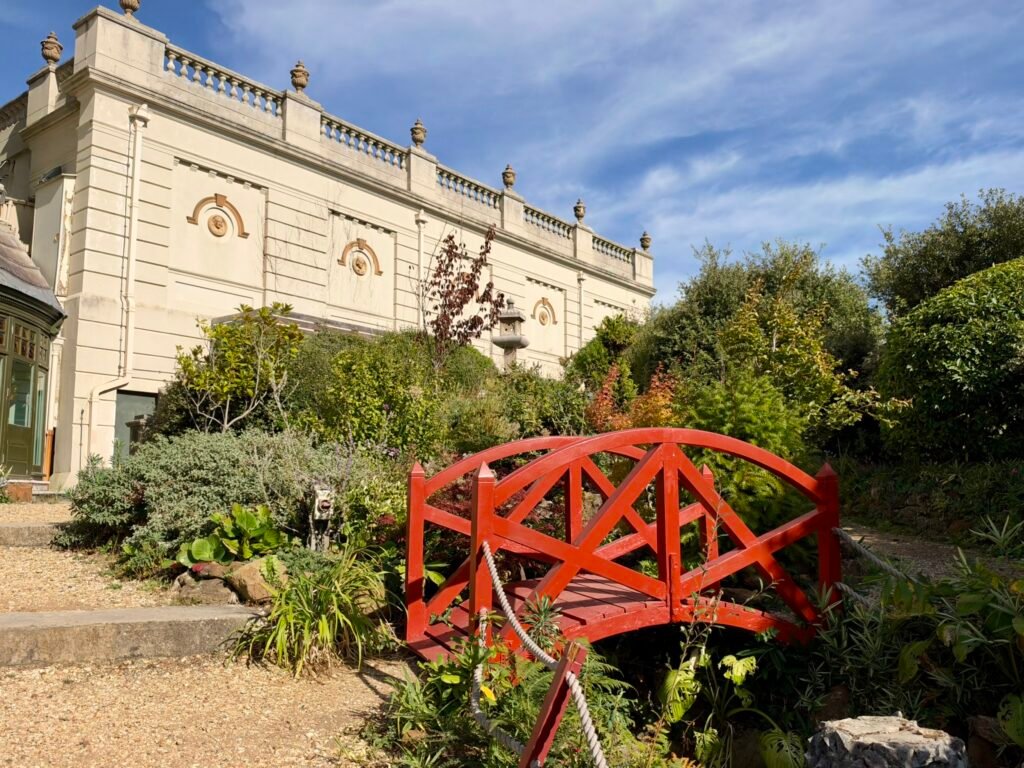
Then, among the greens and creams of the planting and architecture, there’s a delightful splash of bright red.
A small ornamental wooden bridge.
It’s one of those details that immediately makes you smile. It’s charming, a little unexpected and almost impossible to overlook.
The Japanese influence here is no accident.
The original Russell-Cotes garden incorporated Japanese-inspired features, including bridges, ornamental ponds and a fountain. The family’s fascination with Japan formed an important part of their collecting interests and their approach to decoration.
In traditional Japanese garden design, water, rocks, bridges and planting can be arranged to create symbolic miniature landscapes. A bridge may represent a journey or transition, while ponds introduce reflections and movement.
The Russell-Cotes version is a European interpretation of those ideas, rather than a traditional Japanese garden transplanted unchanged to Bournemouth.
And that’s an important distinction. It tells us as much about Victorian enthusiasm for Japanese art and design as it does about Japanese gardening itself.
The original grounds included goldfish ponds, although that historical description doesn’t necessarily mean visitors today will find fish swimming beneath the bridge.
It’s a small feature, but it connects the outdoor garden with the international influences found inside the museum.
You can discover more of those unusual collected objects in Russell-Cotes Art Gallery: Paintings, Drama and Unexpected Treasures.
When the House Becomes Part of the Garden
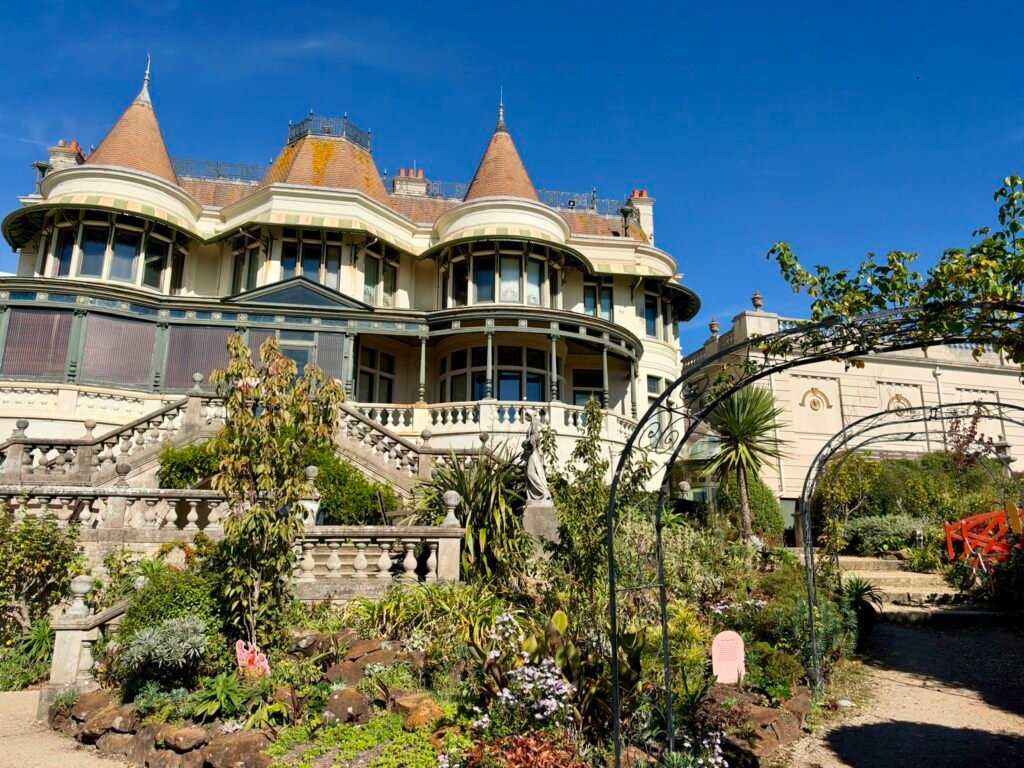
Here’s something that becomes particularly obvious when you explore the garden: East Cliff Hall was designed to be admired from outside as much as from within.
From the garden pathways, its turrets, curved balconies, verandas and sweeping stone staircases form an extraordinary backdrop.
The building almost seems to be performing.
One angle reveals an elegant veranda. Another brings the towers into view. Look across the terraces, and the entire house begins to resemble a fantastical seaside palace.
And despite all that grandeur, the garden prevents the architecture from becoming overwhelming. Trees, shrubs and planted borders frame the building, creating views that change as you move around.
The glass conservatory is another clever part of that relationship between house and garden.
Designed as part of the original building plans in 1898, it allowed Annie and Merton to enjoy their garden and coastal views from indoors, even when the weather wasn’t cooperating.
The historic conservatory underwent a major restoration and reopened in April 2025. Remarkably, paint analysis helped identify its early colour scheme, including pink, peacock blue and mushroom-grey tones.
Even the glasshouse apparently needed a fashionable Victorian wardrobe.
The museum explains the restoration in its official conservatory history.
For more of the extraordinary decoration inside the house, explore Inside Russell-Cotes Museum: Bournemouth’s Extraordinary Victorian Rooms.
A Historic Garden That Hasn’t Stood Still
Although much of the original garden’s character survives, what we see today isn’t an untouched landscape frozen in 1901.
The grounds have changed as the museum developed. Some original garden areas were used for additional gallery buildings, while other parts were restored or adapted over time.
The surviving grotto, Japanese-inspired features and ornamental planting preserve important elements of the founders’ vision.
And maintaining a garden like this takes considerably more than the occasional afternoon with a watering can.
The museum has a volunteer gardening programme, helping care for the planted areas and maintain the grounds as a welcoming space for visitors.
It’s worth remembering that a historic garden is a living collection. Paintings can remain on a wall for decades, but plants grow, flower, decline and sometimes need replacing.
That means the Russell-Cotes gardens will never look exactly the same from one visit to the next.
A rather lovely reason to return.
The National Garden Scheme’s Russell-Cotes garden profile explains more about the surviving historic design and planting.
And Then, Finally, the Sea Steals the Show
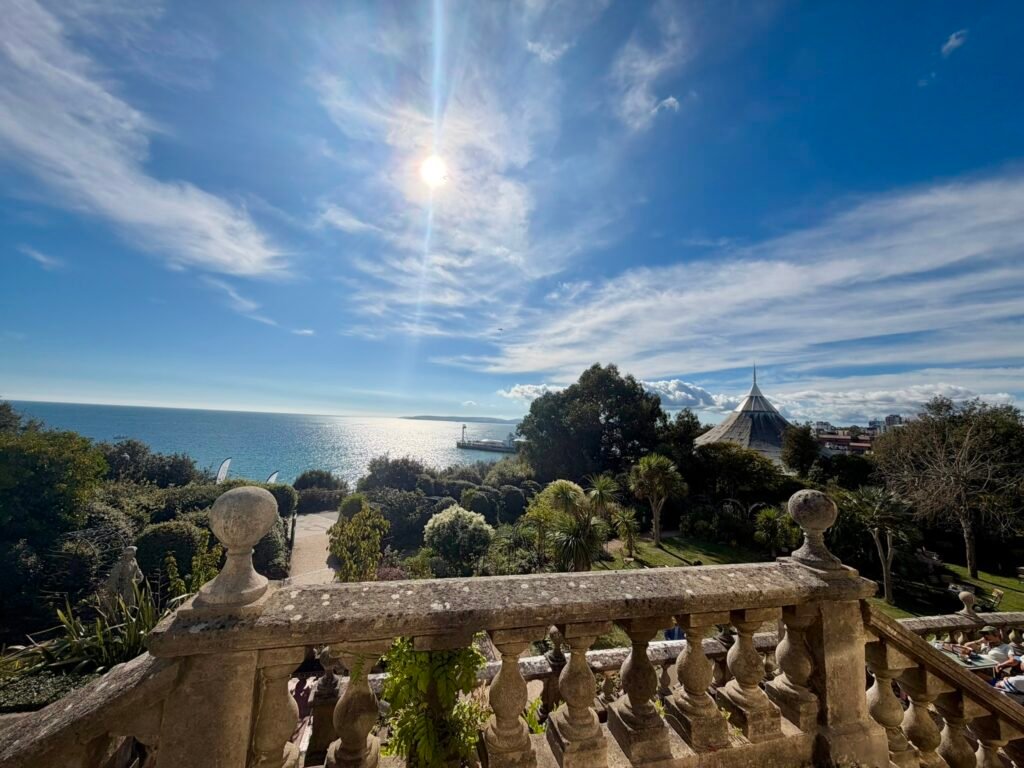
There’s one final element that no Victorian gardener could have designed, commissioned or imported.
The view.
Beyond the stone terrace, Bournemouth Bay stretches towards the horizon, with the pier reaching out into the water and the gardens descending below.
It’s a magnificent setting for a historic house.
And I think it’s this combination that makes the Russell-Cotes gardens so special. You have the intimacy of a private Victorian garden, the drama of an extravagant house and the openness of an enormous coastal panorama.
The garden feels sheltered and enclosed in one direction, then suddenly the landscape opens up towards the sea.
It’s almost like discovering two completely different places at once.
For anyone who enjoys photography, there are some wonderful opportunities to frame the architecture through planting, use the iron arches to create perspective, or capture the contrast between the garden’s greenery and the bright blue bay.
But my favourite advice is simple: don’t spend the entire visit looking through your camera.
Some views deserve a moment without a screen between you and them.
A Garden That Deserves More Than a Passing Glance
It would be easy to treat the Russell-Cotes gardens as a pleasant little extra after exploring the house and art galleries.
I think that would be a mistake.
They’re part of the same extraordinary vision: a family determined to surround themselves with beautiful things, drawing inspiration from gardens, art and architecture encountered far beyond Bournemouth.
Except here, rather than placing those influences inside display cabinets, they arranged them around ponds, pathways and a clifftop villa.
The result is charming, slightly eccentric and wonderfully photogenic.
I came away thinking that if I ever manage to create a garden with even a fraction of this atmosphere, I’ll consider it an achievement.
Although I’ll probably have to settle for one palm tree and a considerably smaller fountain.
Planning a visit? My Russell-Cotes Museum Bournemouth Quick Stop contains the practical information, including opening hours, admission, parking, accessibility and visitor facilities. You can also explore the museum’s official garden information.
I visited the museum using Historic Houses membership; if you’re interested in that option, you can read my Historic Houses membership review.
For more beautiful and unusual places nearby, explore the One More Stop Dorset archive.
And the next time you’re in Bournemouth, remember: sometimes the best part of a seaside visit isn’t the beach at all.
One journey. One story. One more stop.