
Some museums are full of beautiful things. The Russell-Cotes Art Gallery in Bournemouth is full of beautiful things, mysterious things, slightly alarming things and objects that make you wonder what on earth possessed somebody to bring them home.
One moment you’re admiring a monumental Victorian painting. The next, you’re looking at a bronze lion attacking a horseman, an elaborate decorative sledge or a woman apparently performing witchcraft beside a glowing cauldron.
It’s quite a collection. And I absolutely loved it.
During my visit to the Russell-Cotes Art Gallery & Museum, the artwork genuinely left me speechless. The rooms themselves are spectacular, but the collections are something else entirely. Every time I thought I’d found the most extraordinary object, another one appeared.
If my future home ever looks anything like this, I’ll either have won the lottery or developed a very serious antiques-shopping problem.
The Painting That Once Had People Queuing to See It
Imagine paying to stand in a queue just to look at one painting.
Not an entire exhibition. Not a famous celebrity. One enormous painting.
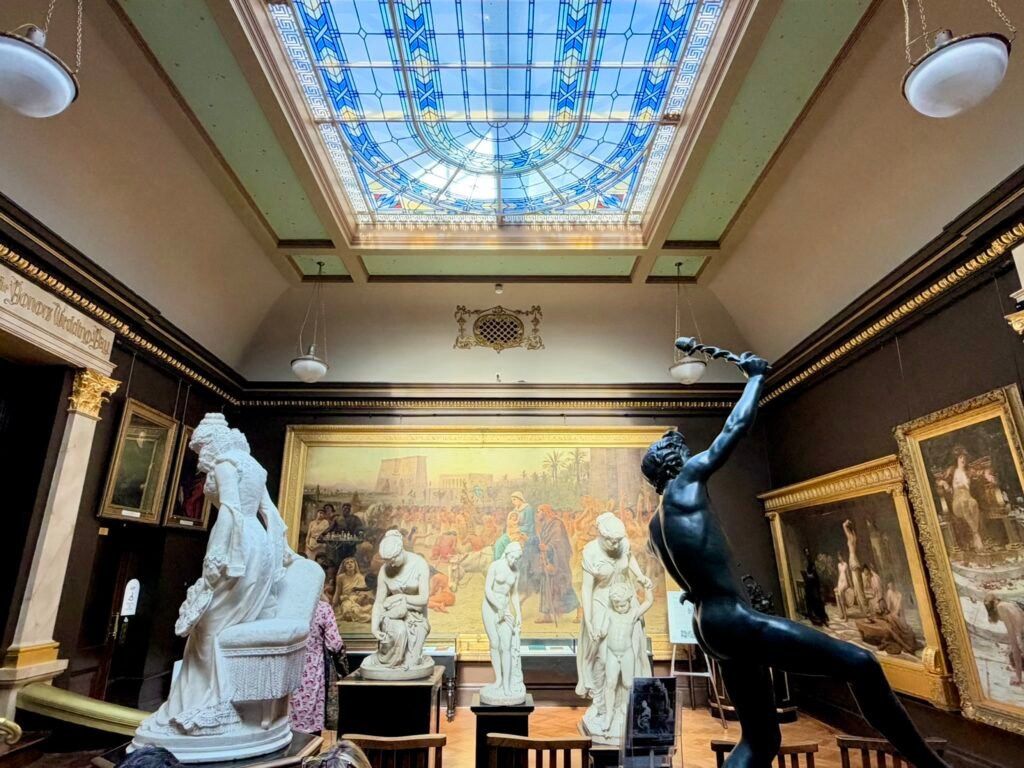
That’s exactly the kind of excitement Edwin Long’s Anno Domini, also known as The Flight into Egypt, created when it was exhibited in London in 1883.
The canvas was commissioned for the Lawrence Gallery in New Bond Street, and visitors queued to see it, paying for the privilege. Victorian blockbuster entertainment, long before cinema queues and concert tickets.
The painting depicts the Holy Family fleeing to Egypt after King Herod’s order to kill the infants of Bethlehem.
But Long didn’t simply paint Mary, Joseph and the baby Jesus against an anonymous background. He created an elaborate ancient Egyptian street scene, filled with people, trade, religious objects and remarkable historical details.
Look carefully and you’ll notice merchants selling shabtis — small funerary figurines associated with ancient Egyptian tombs. Elsewhere, people use charms in an attempt to heal a sick child. In the background, worshippers carry an image of the Egyptian goddess Isis with her son Horus.
There’s a fascinating parallel between the mother and child of Christian tradition and the older Egyptian imagery. Long carefully constructed the composition to make those contrasts part of the story.
It’s also a reminder that nineteenth-century European artists often represented the ancient Middle East through their own religious beliefs and ideas about other cultures.
The picture is beautiful, but it’s also a window into how Victorian Britain imagined the ancient world.
And somehow, seeing such an enormous work in person is entirely different from looking at it on a screen.
You can explore the painting in more detail through the museum’s official Anno Domini collection record.
A Lion That Looks Ready to Leave Its Frame
Not every memorable artwork needs to be enormous or crowded with historical figures.
Sometimes a lion looking directly at you is quite sufficient.
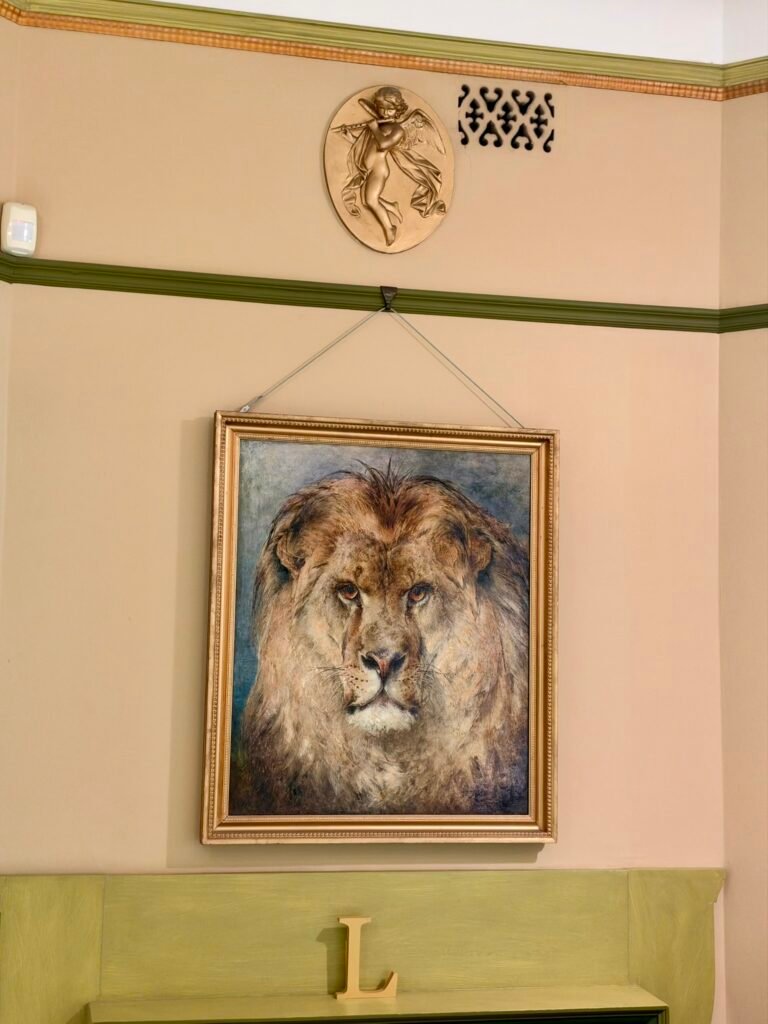
Among the objects displayed in the Green Room is this wonderfully expressive lion portrait. The magnificent animal looks so alert that I half expected it to turn its head and demand to know why I was staring.
Victorian collectors had a particular enthusiasm for animal painting. It offered artists the opportunity to explore character, movement, strength and emotion, sometimes in ways that felt almost human.
A well-painted lion doesn’t need a dramatic landscape or complicated story. Its expression does most of the work.
The artist and original catalogue title of this particular portrait haven’t been securely identified, so I won’t invent an attribution. But it certainly has presence.
And speaking of lions…
A Bronze Sculpture With a Rather Unfortunate Situation
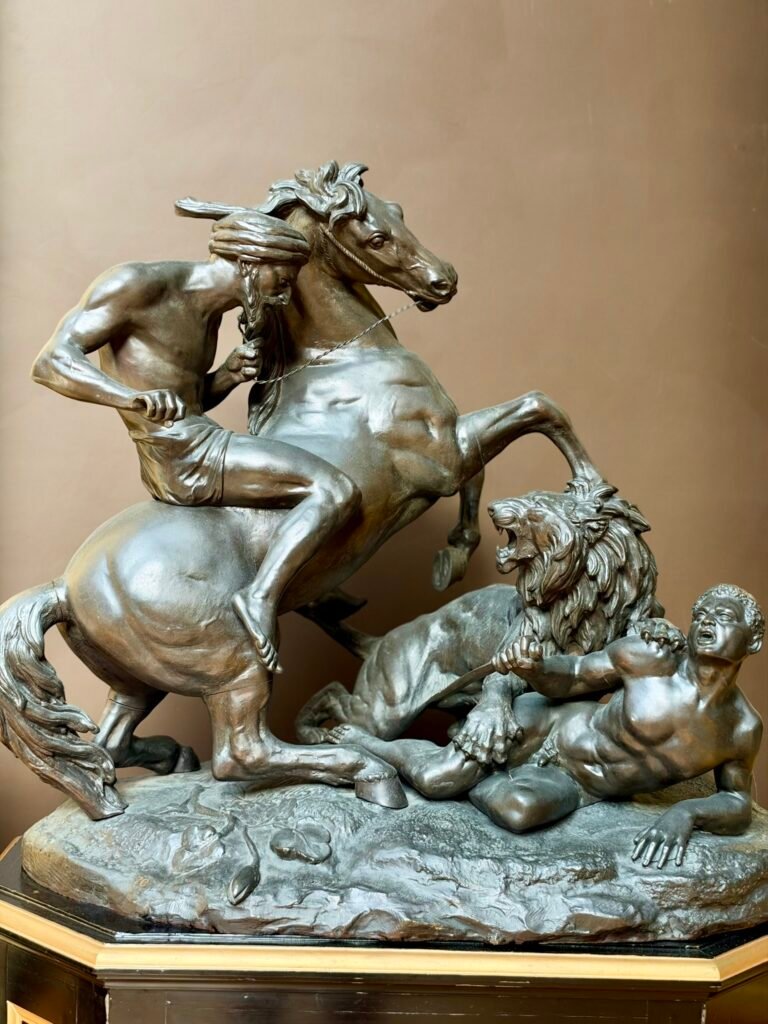
This dramatic bronze sculpture is called Lion Hunt, created by the French sculptor Aimé Millet, who lived from 1819 to 1891.
At first, it might look like a triumphant hunting scene. A horse, a rider, a lion — all the ingredients for an impressive nineteenth-century sculpture.
Then you notice what’s actually happening.
One man is down, the lion is attacking, and the mounted rider is desperately reaching towards his fallen companion.
Suddenly, it isn’t a celebration of hunting at all. It’s a rescue attempt that appears to be going very badly.
The sculpture captures several movements at once: the horse’s energy, the lion’s attack, the rider’s outstretched arm and the vulnerability of the fallen man.
That’s particularly impressive when you remember that every part of the scene is made from solid bronze.
Nothing is actually moving, yet your imagination does the rest.
Millet was especially well known for public sculptures in France, but here the drama is concentrated into a comparatively small work.
It’s a brilliant reminder to walk around sculptures rather than looking from only one angle. A different viewpoint can reveal an entirely different part of the story.
The museum has an excellent collection record for Lion Hunt.
A Beautiful Painting About a Very Ugly Chapter of History
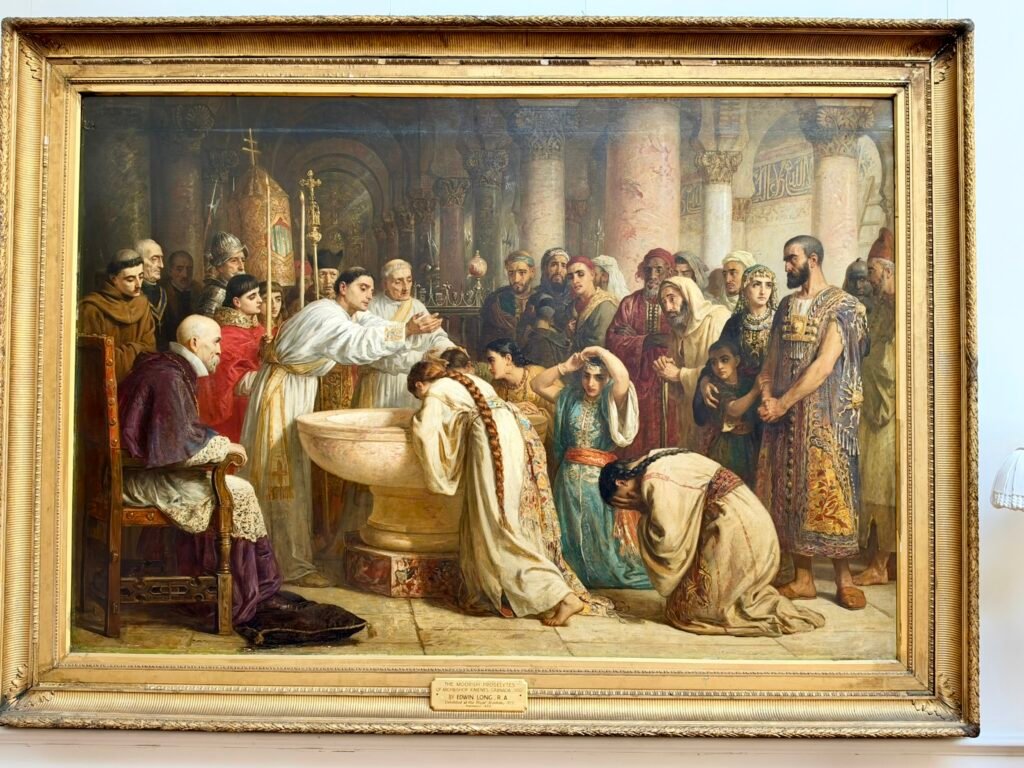
Another enormous Edwin Long painting stopped me in my tracks: The Moorish Proselytes of Archbishop Ximenes, Granada, 1500, painted in 1873.
The title might sound rather academic, but the subject is anything but dull.
The painting depicts the aftermath of the Christian conquest of Granada, which brought Muslim rule in the region to an end in 1492.
Although Muslim residents were initially promised protection, Archbishop Francisco Jiménez de Cisneros, also known as Ximenes, imposed a brutal religious policy. By 1500, Muslims faced conversion to Christianity or expulsion.
Long places the Archbishop prominently in the scene, while a queue of people waits to be baptised.
Their expressions tell much of the story. Some appear exhausted, resigned or deeply unhappy.
This isn’t an image of people joyfully celebrating a new faith. It’s a scene about power, coercion and the loss of religious freedom.
What’s especially interesting is how the painting’s meticulous details draw you in before you fully appreciate what you’re looking at.
Long was fascinated by historical subjects and spent time studying Spanish art and culture. His paintings were hugely popular with Victorian audiences, and Merton Russell-Cotes admired his work enormously.
But paintings like this also deserve to be questioned. They tell us about the historical events being depicted, while simultaneously revealing something about the assumptions and interests of the nineteenth-century artist.
I think that’s when art becomes especially fascinating: when something visually beautiful makes you think about something genuinely uncomfortable.
See the museum’s interpretation of The Moorish Proselytes.
A Little Witchcraft, Anyone?
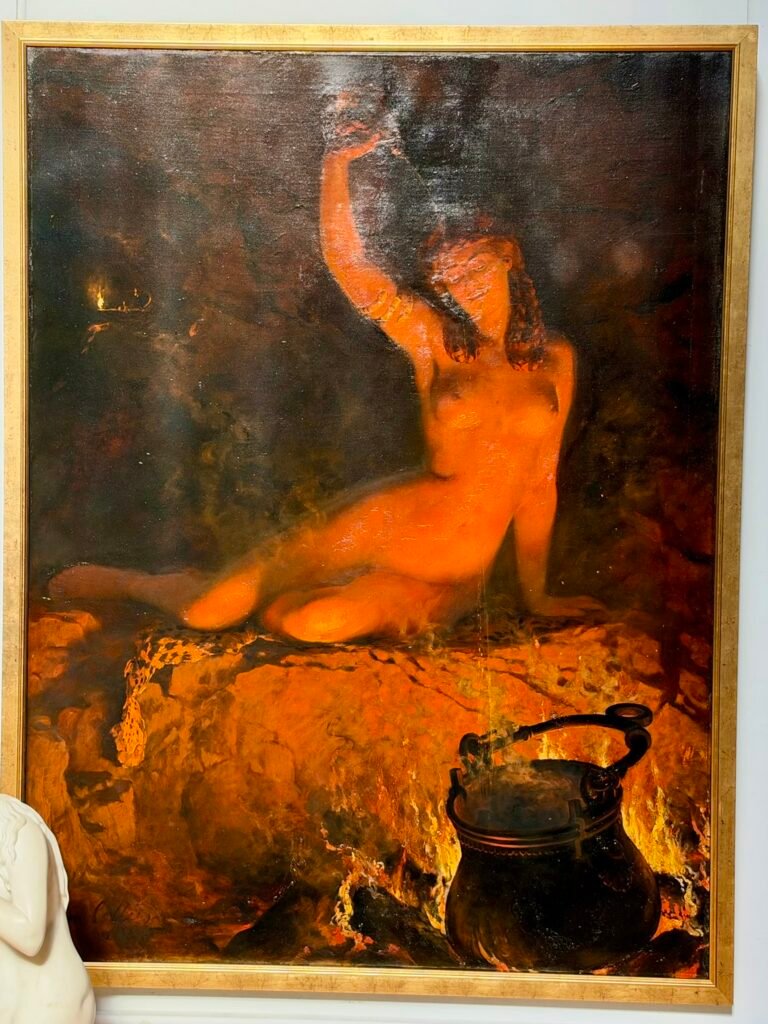
Now for something completely different.
An Incantation, painted in 1887 by John Collier, shows a nude woman in a dark, cave-like setting, apparently performing a mysterious ritual beside a glowing cauldron.
And honestly, she looks rather committed to whatever she’s doing.
Her raised arm, the firelight and the deep shadows make the scene feel almost theatrical. The warm orange glow illuminates her figure while the rest of the setting disappears into darkness.
The subject is intriguing, but the painting is also a technical achievement.
Firelight is notoriously difficult to paint convincingly. The colour and intensity change across different surfaces, and the human body reflects light in complicated ways.
Collier used those challenges to his advantage.
The result is a picture that feels mysterious without needing to explain precisely what’s happening. Is she casting a spell? Preparing a potion? Performing an ancient ceremony?
The painting leaves room for the imagination.
Interestingly, An Incantation entered the museum’s collection as a gift in 1941, long after Annie and Merton had died. That matters because the Russell-Cotes collection isn’t simply frozen at the moment its founders left it behind.
It has continued to develop through later gifts and acquisitions.
If you’re curious, Art UK identifies the work and its artist.
The Curious Case of a Very Elaborate Sledge
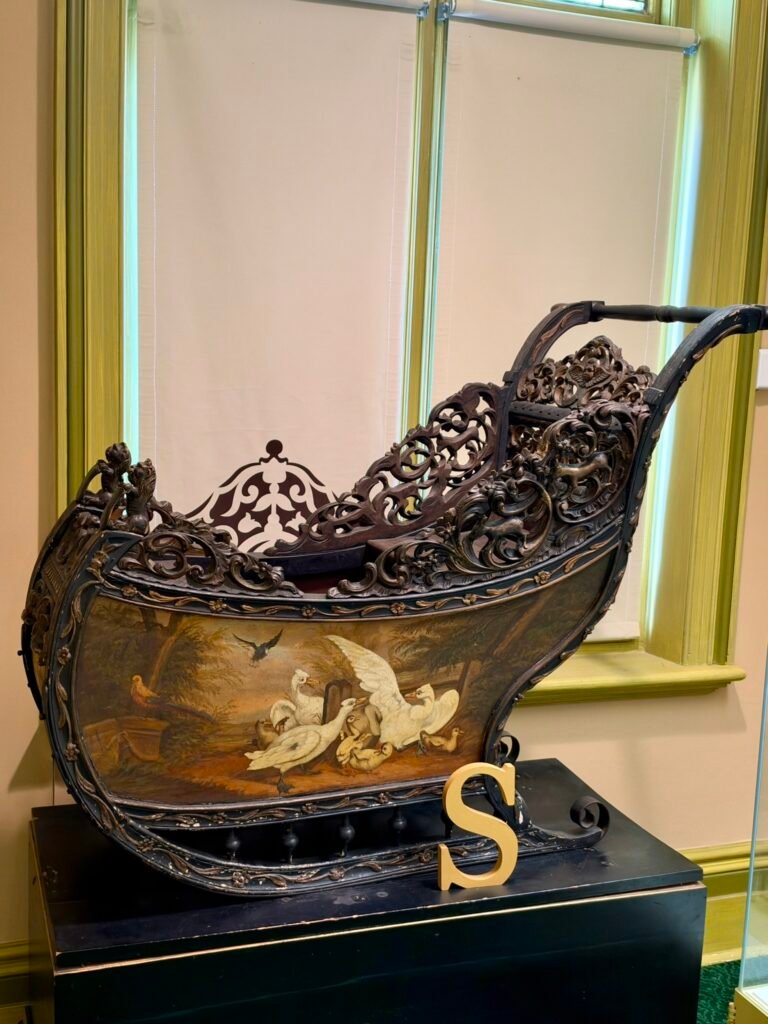
One of the joys of the Russell-Cotes collection is that it refuses to behave like a conventional art gallery.
Just as you’re becoming accustomed to grand paintings and classical sculptures, you encounter an elaborate historical sledge.
Yes, a sledge.
Not exactly what I expected to find in a Victorian seaside mansion overlooking Bournemouth Beach.
This beautifully decorated object features intricate carving and painted waterbirds, turning something associated with practical winter transport into a piece of elaborate craftsmanship.
It appears among the objects in the Green Room’s A–Z display, which introduces different aspects of the Russell-Cotes collections and the couple’s lives.
I particularly enjoy objects like this because they make me reconsider what counts as art.
We tend to separate paintings and sculptures from practical everyday objects, but the distinction isn’t always sensible. Furniture, clothing, vessels and transport could all become opportunities for extraordinary decoration.
Whoever made this sledge clearly wasn’t satisfied with something that merely worked.
It needed to look impressive too.
The object’s precise provenance hasn’t been independently confirmed, so I’m not going to invent a country of origin or a romantic backstory. Its remarkable workmanship is interesting enough without one.
Japanese Treasures — Including the Footwear
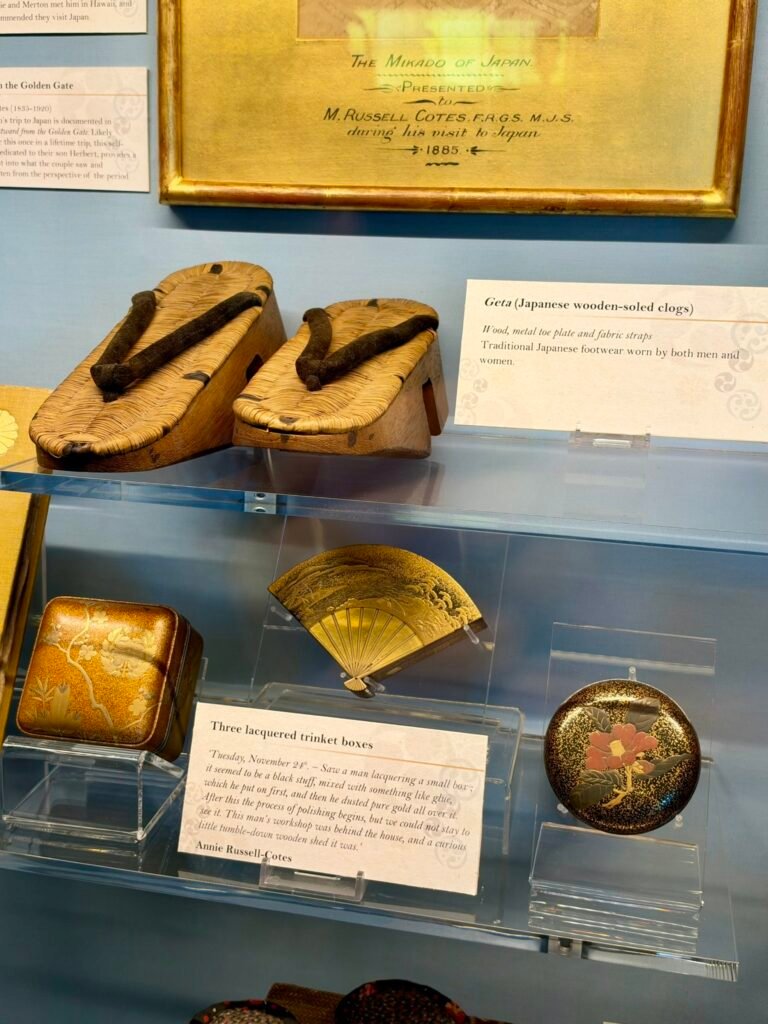
The Japanese objects in the collection are among the most fascinating, partly because they range from beautiful decorative pieces to items that might once have belonged to everyday life.
Take the traditional Japanese geta footwear.
These wooden sandals have raised supports underneath, keeping the wearer’s feet away from mud, moisture and uneven ground. They’re wonderfully practical objects, although I suspect I’d need some practice before attempting to walk around in them.
Then there’s the lacquerware.
Traditional Japanese lacquer is applied in successive layers to create a durable, polished surface. Craftspeople could decorate objects with painted designs, metallic powders, inlay and other highly skilled techniques.
What might look like a simple little box can represent an extraordinary amount of labour.
The folding fan in the display is another reminder that useful objects can also be beautifully designed.
These pieces help explain why Japanese decorative arts fascinated many European collectors during the nineteenth century.
But their presence also raises interesting questions about cultural exchange. Were visitors collecting objects because they understood their significance, because they admired the craftsmanship, or because they seemed unusual and exotic?
Probably a mixture, depending on the individual and the object.
And that’s one reason I prefer museums that explain the collections rather than simply displaying everything as beautiful decoration.
Portraits With Stories Behind the Faces
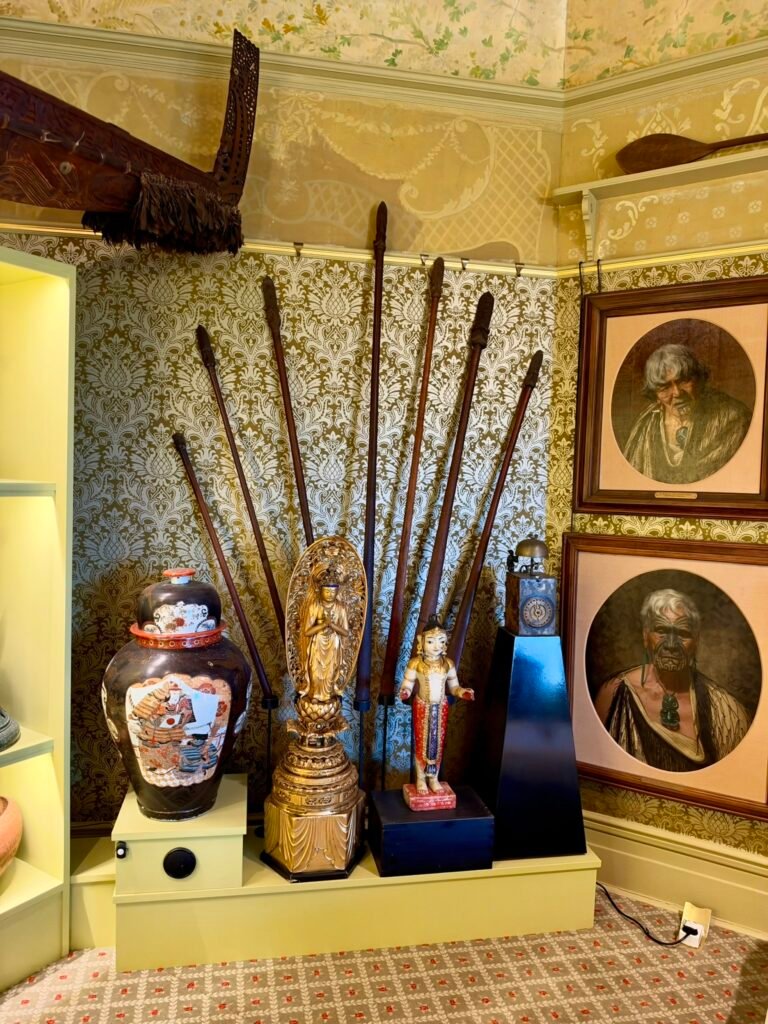
The Yellow Room contains some of the museum’s most thought-provoking displays, including portraits of Māori people and objects associated with different cultures.
Among the collection’s important paintings are portraits by Charles Frederick Goldie, a New Zealand artist known for depicting Māori elders and leaders.
One particularly moving work shows Harata Rewiri Tarapata, a woman of the Ngāpuhi people who lived from 1831 to 1913.
Painted in 1906, the portrait includes details revealing her identity and status: a greenstone hei-tiki pendant, a shark’s tooth earring and traditional facial tattooing.
Those details aren’t merely decorative.
In Māori culture, pounamu (greenstone) can carry ancestral meaning, while tā moko is connected with identity, genealogy and social standing.
The museum’s information identifies Harata as a descendant of two chiefs who signed the Treaty of Waitangi in 1840.
That completely changes how the portrait should be approached.
You’re not just looking at a beautiful Victorian-era painting of an unfamiliar person. You’re looking at an individual with a name, a family, a culture and a history.
Goldie’s work has also been debated because of the colonial context in which his portraits were created and sold. At the same time, some Māori communities have valued these images as important records of ancestors.
Both perspectives matter.
The museum’s collection record for Harata Rewiri Tarapata provides a fascinating introduction.
A Buddha, a Moment of Calm and a Different Way of Looking
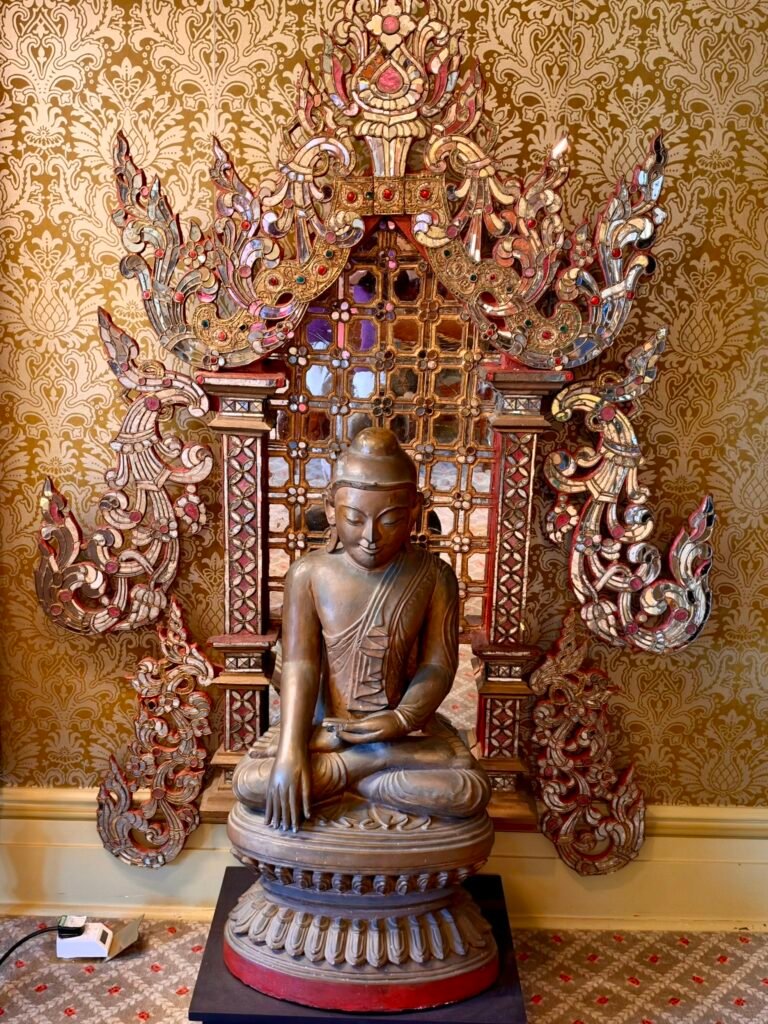
After so many dramatic paintings, expressive portraits and intricate objects, the seated Buddha figure offers a striking change of atmosphere.
There is something wonderfully calm about the sculpture and its decorative surroundings.
And it provides another opportunity to think about how we look at objects in museums.
To one visitor, a Buddha figure might be admired as sculpture. To another, it represents a religious tradition with profound spiritual meaning.
Both visitors might appreciate the craftsmanship, but they aren’t necessarily seeing the same thing.
The museum includes Buddhist objects within its wider international collections, although I haven’t been able to establish the precise provenance of this particular seated figure from its photograph alone.
Rather than attach an uncertain nationality or date to it, I’d prefer to leave that identification open.
That doesn’t make the object any less compelling.
In fact, it reminds us why careful museum interpretation is important. The most interesting question isn’t always how old or valuable something is. Sometimes it’s what the object meant to the people who made it, used it or lived with it.
More Than a Collection of Beautiful Things
By this point, I had stopped expecting anything ordinary.
The Russell-Cotes Art Gallery is extraordinary because of its variety. Biblical history, dramatic sculpture, mysterious figures, animal portraits, Japanese craftsmanship and objects from different cultures all exist within the same museum.
But there’s another reason the collection deserves attention.
Much of it was assembled during the height of the British Empire, when wealthy Europeans travelled, bought objects and interpreted other cultures through their own assumptions. The museum now recognises that history and is working to address questions surrounding empire, representation and collecting practices.
I think that’s important.
We can admire a painting’s skill while questioning its message. We can appreciate an object’s craftsmanship while asking how it entered the collection. And we can enjoy the sheer extravagance of the museum without pretending every part of its history is uncomplicated.
For me, that makes the experience more interesting, not less.
If you’d like to understand the personalities behind the original collection, I’ve explored their lives in Annie and Merton Russell-Cotes: The Story Behind Bournemouth’s Museum.
The museum’s remarkable rooms deserve their own attention too. My guide to the Victorian interiors of Russell-Cotes Museum looks at the architecture, ceilings and decorative surprises.
Why This Art Gallery Stayed With Me
What I enjoyed most was the feeling that there was always something else to discover.
I didn’t need to be an art historian to appreciate the paintings or sculptures. Some immediately caught my attention because they were beautiful. Others were strange, dramatic or simply intriguing enough to make me read more.
And that’s exactly what I want from a museum.
A place that entertains you, surprises you and sends you home knowing something you didn’t know before.
Would I want every object in my future flat? Probably not. I might draw the line at the attacking lion.
But several of those paintings? Absolutely.
If you’re planning to explore the collection yourself, my Russell-Cotes Museum Bournemouth visitor guide covers opening hours, admission, parking, wheelchair access and facilities. I visited using Historic Houses membership, and I’ve also written about whether Historic Houses membership is worth it.
For something completely different after the galleries, explore the Russell-Cotes Gardens and their Bournemouth Bay views, or discover more places in my Dorset travel archive.
One extraordinary seaside house. Thousands of stories. And an art collection I won’t forget in a hurry.
One journey. One story. One more stop.