
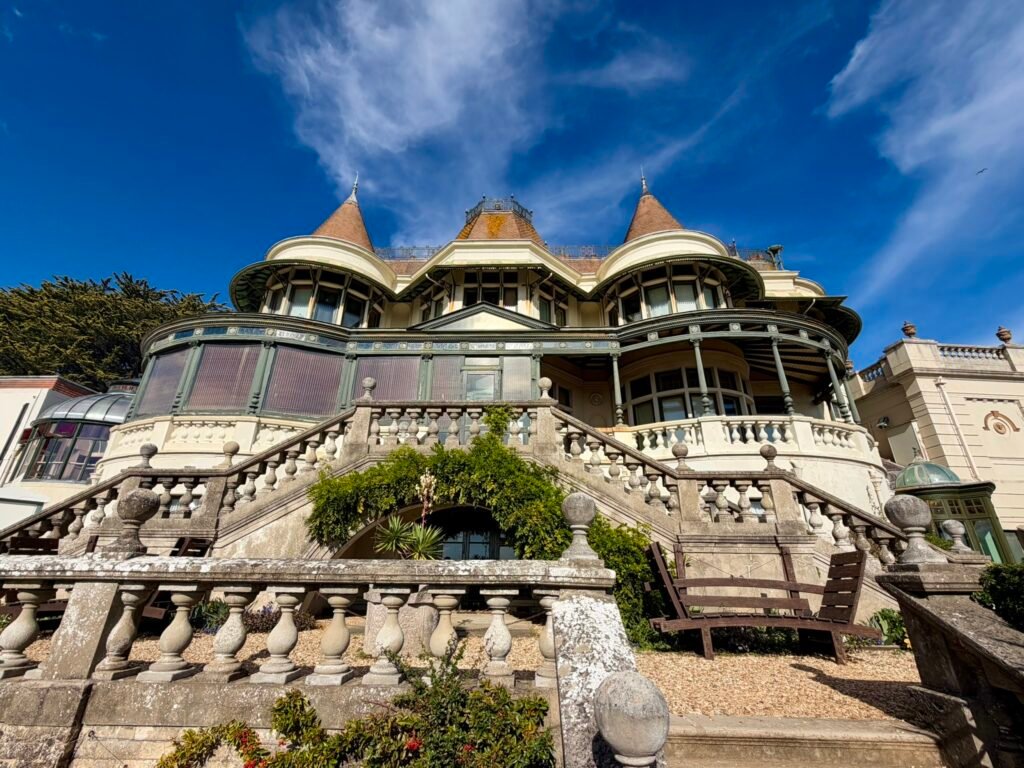
Imagine buying a seaside hotel, filling it with paintings and unusual treasures from around the world, then building your wife an extraordinary mansion because your collection has become rather difficult to accommodate. Most people might consider clearing out a cupboard. Annie and Merton Russell-Cotes, however, had considerably more ambitious plans.
Their home eventually became the Russell-Cotes Art Gallery & Museum in Bournemouth, but the story behind it is far more interesting than a rich Victorian couple collecting beautiful things. There are remarkable journeys, famous actors, unexpected friendships, personal tragedies, extraordinary generosity and one birthday present that would be rather difficult to wrap.
And it all began long before Bournemouth’s spectacular East Cliff Hall existed.
A Wedding in Glasgow, 1860
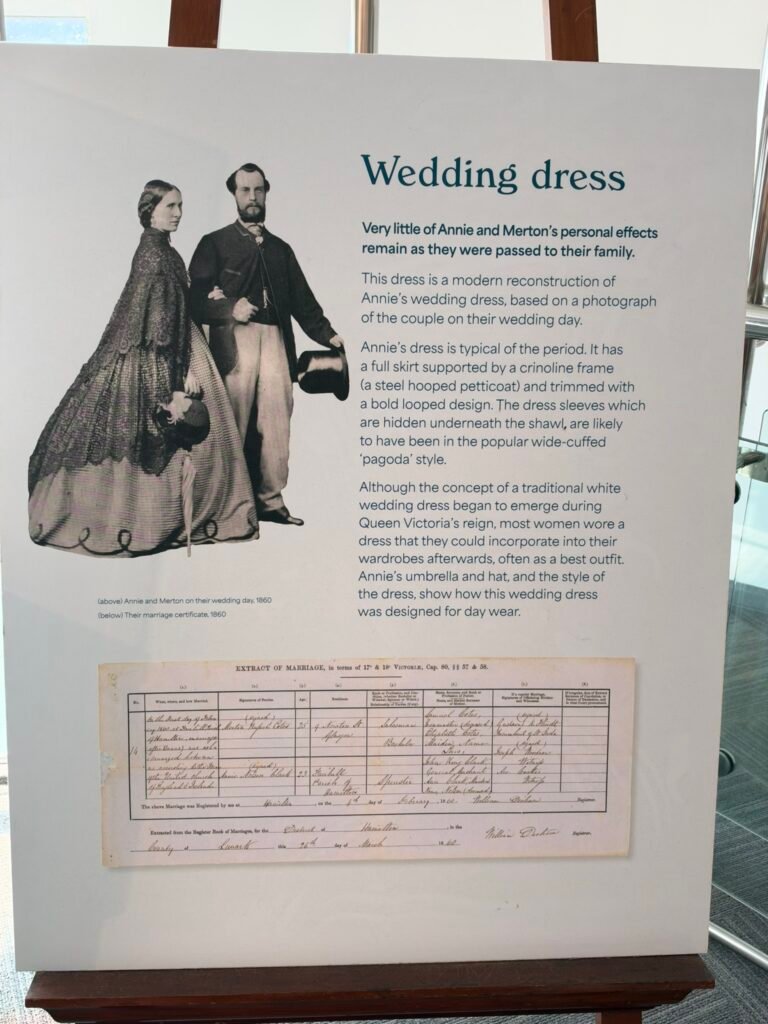
Merton Russell-Cotes and Annie Nelson Clark married on 1 February 1860, at St Jude’s Episcopal Church in Glasgow. Both were just 24 years old.
Merton wasn’t born into the sort of wealth that would eventually finance East Cliff Hall. He had started his working life as a travelling salesman, following a difficult childhood in which his father died while Merton was still young.
Annie, meanwhile, would develop into a writer, traveller, collector and philanthropist in her own right. Their marriage lasted sixty years, carrying them through commercial success, international adventures and considerable personal loss.
The couple had five children: Ella, Clara, Anita, Charlotte and Herbert. Sadly, two of their daughters, Anita and Charlotte, died during childhood. Behind the grand public image of a successful Victorian family was a much more complicated private life.
The wedding photograph and marriage certificate displayed at the museum offer a particularly personal starting point. Suddenly, the famous names attached to the building become two young people at the beginning of their lives together, with no idea quite how extraordinary their future would become.
Annie’s Wedding Dress: Victorian Fashion Without the White
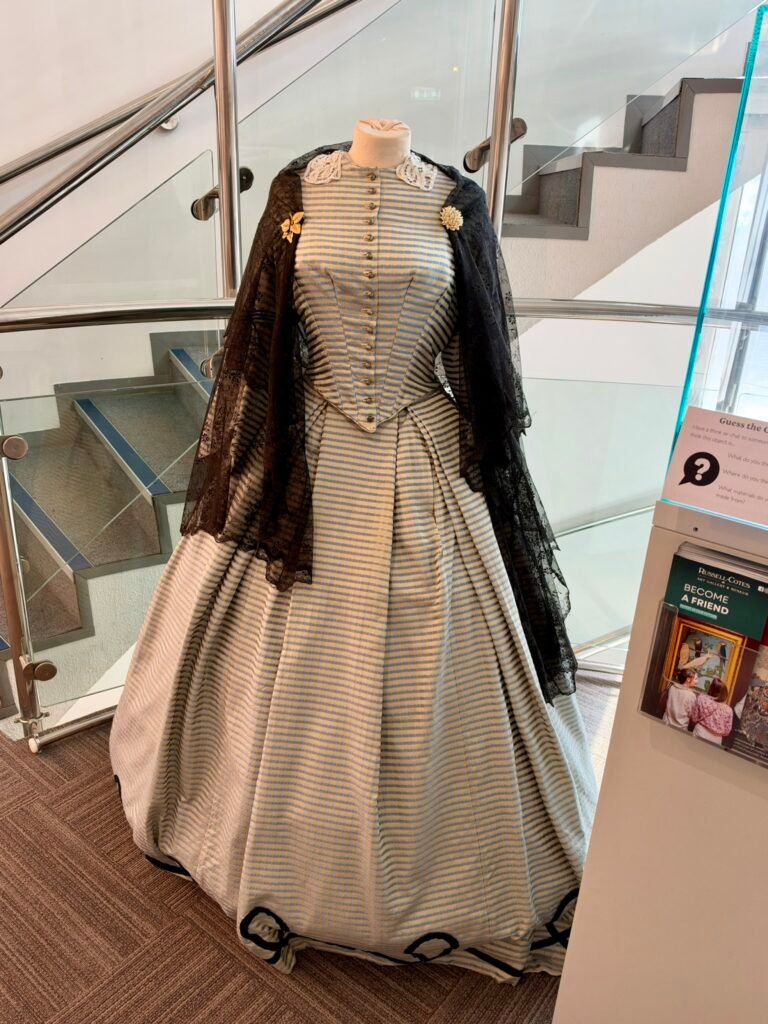
The museum also displays a modern reconstruction of Annie’s wedding outfit, based on the historical photograph.
And no, it isn’t the familiar enormous white wedding gown.
The striped fabric and dark shawl reflect a period when a fashionable bride might choose a beautiful outfit that could be worn for other occasions. White wedding dresses had become increasingly popular following Queen Victoria’s marriage in 1840, but they were by no means compulsory.
The distinction matters: this is a reconstruction, not Annie’s original surviving dress. Even so, it brings a surprisingly personal dimension to the couple’s story.
I find details like this fascinating. Grand houses can sometimes make their owners feel distant and impossibly wealthy. Clothing, photographs and family documents bring them closer to ordinary human experience.
And occasionally remind us that fashion has always been rather more complicated than it first appears.
How a Health Problem Led to a Bournemouth Hotel
The Russell-Cotes’ connection with Bournemouth began partly because Merton’s health wasn’t particularly good.
In 1876, after experiencing bronchitis, he was advised to seek a healthier environment. He and Annie visited the south of England and stayed at Bournemouth’s Bath Hotel.
Merton clearly liked what he saw, because he didn’t simply book another holiday.
He bought the hotel.
The family moved in on Christmas Day 1876. After substantial improvements, the establishment reopened in 1880 as the Royal Bath Hotel, becoming one of Bournemouth’s most prestigious places to stay.
And Merton had an interesting approach to hotel decoration.
Rather than keeping his growing art collection somewhere private, he displayed paintings, sculptures and curiosities throughout the hotel’s rooms. Guests could enjoy the surroundings while admiring extraordinary objects acquired by their hosts.
Among the hotel’s notable visitors were Oscar Wilde, Sir Henry Irving and other prominent figures from the world of art, literature and politics.
Imagine arriving for a pleasant seaside holiday and discovering your hotel had begun turning into an art museum.
At least there would have been plenty to look at if the weather was dreadful.
Annie Russell-Cotes: The Woman Behind More Than the Mansion
It would be easy to present Annie simply as the wife who received an enormous birthday present. But that would overlook much of what made her remarkable.
Annie was an accomplished traveller and writer who documented her experiences in two books, Westward from the Golden Gate and Letters from Russia.
She was particularly interested in natural history and the traditions and cultures of the places she visited. She became one of the founding members of the Japan Society and was the second woman elected as a fellow of the Royal Society of Literature.
Not exactly someone content to sit quietly beside the fireplace.
Annie was also a generous benefactor. She provided land and financial support for the Russell-Cotes Children’s Home and the Russell-Cotes Nautical School in Parkstone, institutions established to help children experiencing poverty, illness or difficult circumstances.
The museum describes her as having been affectionately known as the “good fairy of Bournemouth”.
That nickname offers a rather different picture from the one suggested by the family’s lavish interiors.
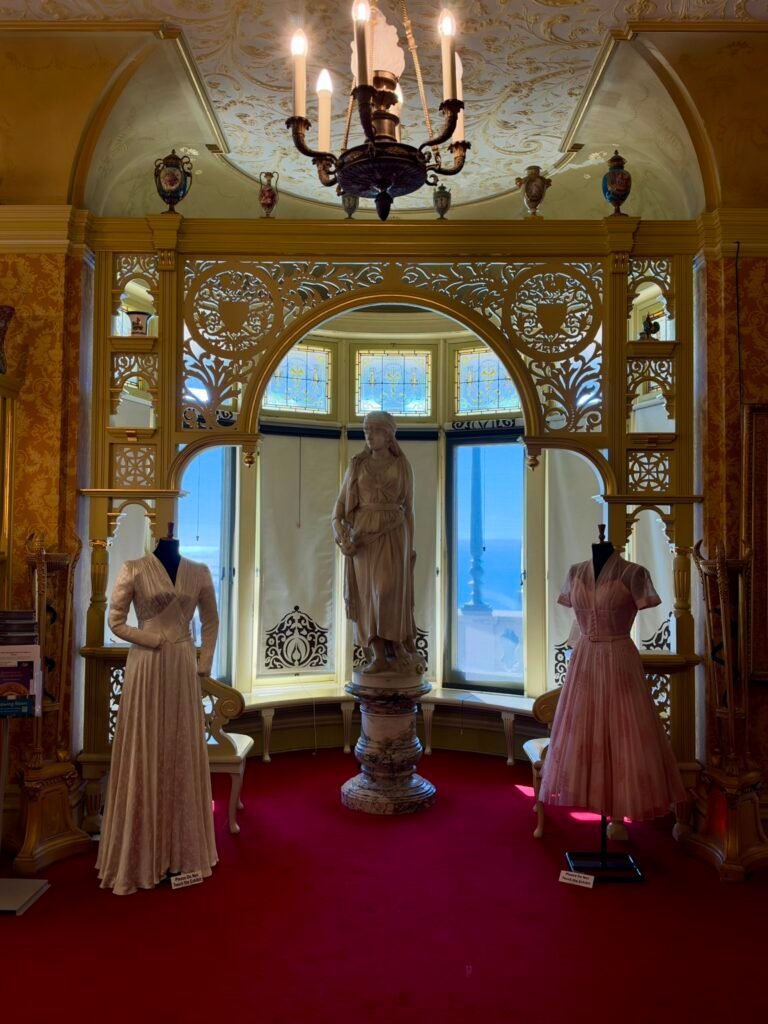
The historic costume displays add another layer to her story, although the particular dresses and exhibitions may change over time. The house preserves both public displays of wealth and glimpses of the people who once lived there.
For a closer look at those surroundings, I’ve explored the extraordinary Victorian rooms inside Russell-Cotes Museum in a separate article.
Collecting the World — And Bringing It Home
From 1884 onwards, Annie and Merton travelled extensively, including visits to Japan, Australasia, America, India, Egypt and the Pacific.
They collected paintings, ceramics, decorative objects, souvenirs and other items, building a remarkably varied collection.
Merton was especially passionate about fine art, while Annie took a strong interest in objects associated with different cultures and natural history.
Their visit to Japan in 1885 was particularly important. The objects they acquired ranged from elaborate lacquerware and sculptures to surprisingly ordinary items used in everyday life.
This is one reason the museum’s collections are so unusual. Alongside major Victorian paintings, you’ll encounter objects that reveal the couple’s fascination with the unfamiliar, the beautiful and the curious.
Of course, their collecting took place during the age of the British Empire, and some museum objects raise important questions about how they were obtained, represented and understood. Enjoying the collections doesn’t mean ignoring that historical context.
I’ve explored individual artworks and objects in Russell-Cotes Art Gallery: Extraordinary Paintings, Sculptures and Treasures.
Merton’s Other Ambition: Improving Bournemouth
Merton wasn’t only a hotelier and art collector. He became deeply involved in the development of Bournemouth itself.
He served as the town’s mayor in 1894–95, supported improvements to railway connections and campaigned for projects including the Undercliff Drive and Promenade.
These weren’t entirely separate from his business interests. A more attractive, accessible and prosperous Bournemouth was also good news for a hotel owner.
But his civic involvement left a lasting mark on the resort, and he received a knighthood in 1909 in recognition of his public service and charitable work.
It is quite extraordinary to think how much of the museum’s story is also the story of Bournemouth becoming a fashionable seaside destination.
The Russell-Cotes weren’t simply living in the town. They were helping to shape it.
Sir Henry Irving, Bram Stoker and an Unexpected Museum of Theatre
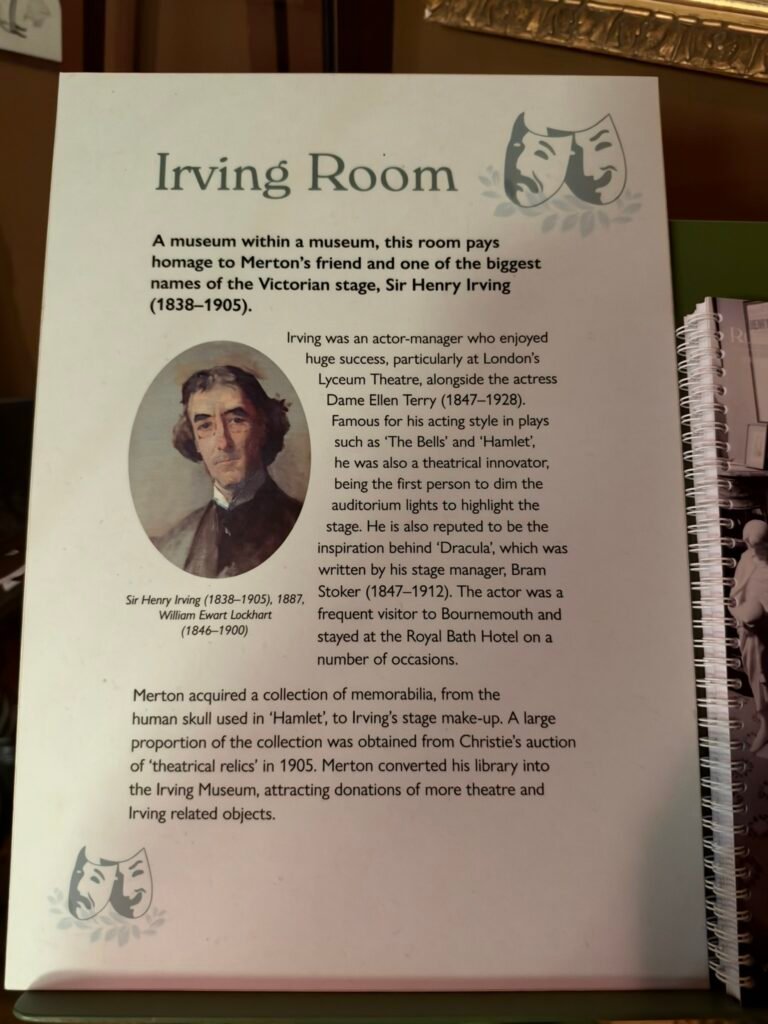
One of the most fascinating connections in the Russell-Cotes story involves the legendary Victorian actor Sir Henry Irving.
Irving was one of the great theatrical celebrities of his age, famous for his performances at London’s Lyceum Theatre and for working alongside actress Ellen Terry.
He frequently visited Bournemouth and stayed at the Royal Bath Hotel, where he developed a close friendship with the Russell-Cotes family.
There’s an entertaining literary connection too. Irving’s theatre manager was Bram Stoker, who wrote Dracula in 1897. Irving has long been suggested as one of the inspirations for the famous fictional count, although that influence remains a matter of interpretation rather than established fact.
The family clearly admired Irving enormously.
After his death in 1905, Merton acquired a substantial collection of theatrical memorabilia, much of it purchased at Christie’s auction of Irving’s possessions.
He then converted his former library into a dedicated room celebrating the actor’s life and work.
A museum inside a museum. Apparently, collecting had become a family habit that couldn’t be contained.
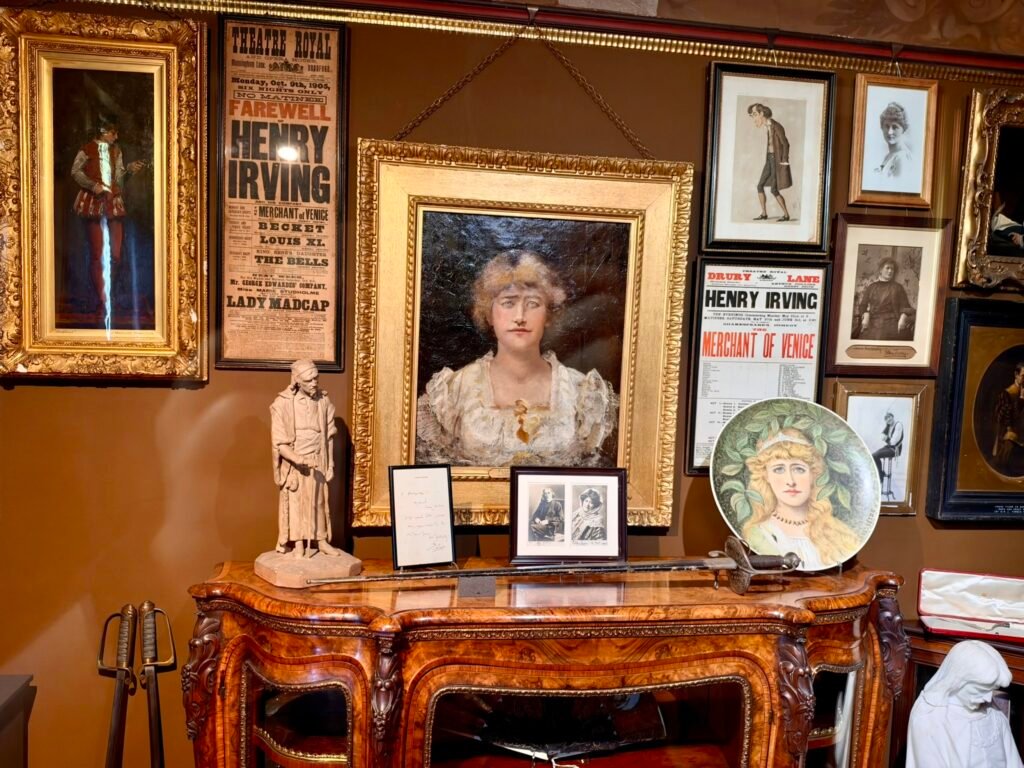
Today, the Irving Room contains theatrical portraits, posters, programmes, costumes and remarkable stage-related objects.
Among the wider collection is an actual human skull used by Irving during performances of Hamlet. According to the museum, it was acquired separately and donated in 1942.
There’s also armour associated with Irving’s portrayal of Charles I, together with objects and personal memorabilia that reveal how famous Victorian actors were celebrated.
The collection is wonderfully eccentric and unexpectedly moving. Here is a wealthy hotelier preserving the memory of a close friend through the objects that defined his career.
And if you ever thought your own hobbies had become a little excessive, Merton Russell-Cotes might make you feel considerably better.
The official Irving Room collection guide contains more fascinating details.
A Birthday Present That Became Bournemouth’s Museum
By the end of the nineteenth century, the couple’s collections were becoming too extensive for the Royal Bath Hotel.
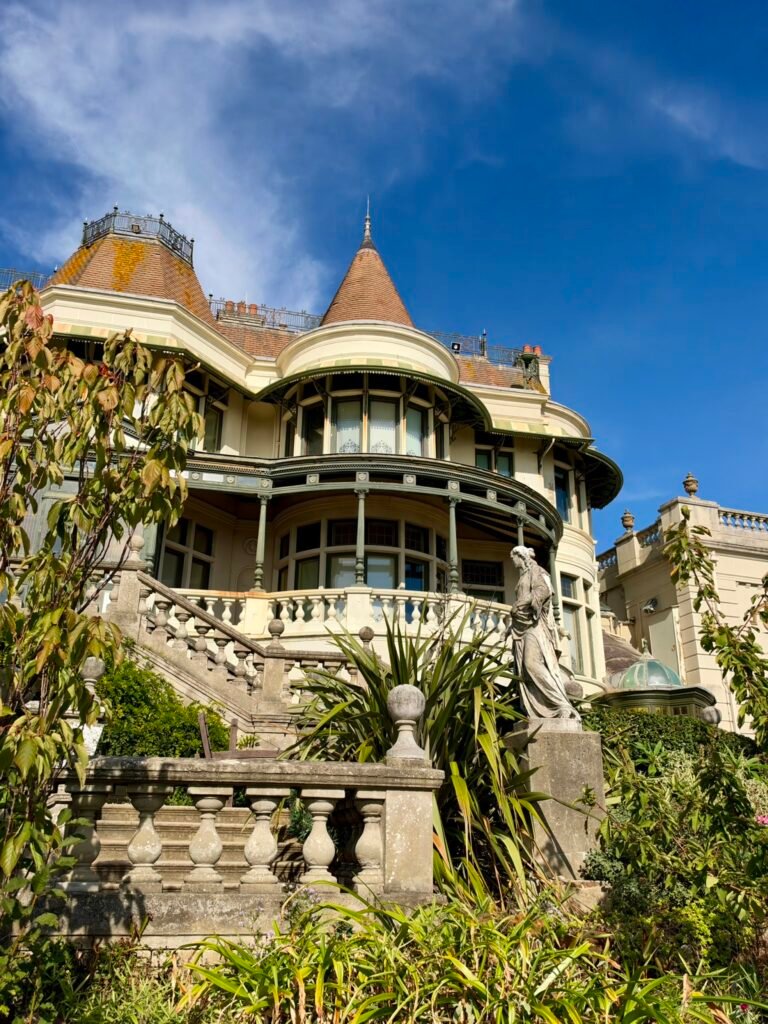
They commissioned a new home, East Cliff Hall, overlooking the sea. Architect John Frederick Fogerty designed the building, with Annie and Merton closely involved in shaping its extraordinary character.
On 15 July 1901, Merton presented the completed house to Annie for her 66th birthday.
That is certainly one way of avoiding the annual problem of choosing a suitable present.
But their greatest gift was still to come.
In 1907, Annie and Merton announced their intention to give their home, its contents and the art collection to Bournemouth for public enjoyment. While they continued living there, visitors could already explore the house on selected days.
In 1916, Annie commissioned additional galleries to accommodate the growing collection and help prepare the property for its future as a museum.
The first three galleries were officially opened by Princess Beatrice in 1919, on the couple’s 59th wedding anniversary.
By this point, Annie’s health was deteriorating. She died in 1920, after celebrating sixty years of marriage. Merton followed in 1921.
The Russell-Cotes Art Gallery & Museum formally opened to the public on 10 March 1922.
Annie and Merton never lived to see their home operating as the museum we know today, but they had planned its future and made that extraordinary gift possible.
A Legacy Worth Exploring
What I love about the Russell-Cotes story is that it isn’t simply a tale of wealth and extravagant collecting.
It’s about two people whose lives changed dramatically, who travelled widely, became involved in the growth of their adopted town and eventually turned their private passion into something the public could enjoy.
Of course, their taste was rather extravagant. I’d happily borrow a few of their decorating ideas for my future home, although the budget might struggle with a seaside mansion and several purpose-built art galleries.
But their lasting achievement is that the collection wasn’t broken up or hidden away. It remains a place where Bournemouth’s history, art and architecture meet.
Even the gardens are part of that story, and I’ve explored them separately in Russell-Cotes Gardens Bournemouth: A Hidden Seaside Oasis.
Planning Your Visit
The Russell-Cotes Art Gallery & Museum normally opens Tuesday to Sunday, 10am–5pm, plus most Bank Holiday Mondays. Its café usually opens 10am–4.30pm.
The museum has lifts serving most public areas, seating and an accessible toilet. However, the original house’s upper floor is accessible only by stairs. Visitors who cannot reach it can use a video tour, and staff can advise on other accessibility arrangements.
Admission is included with a valid Historic Houses membership, which is how I visited. You can find out more in my article Is Historic Houses Membership Worth It?.
For up-to-date admission information, parking locations and costs, car park operating hours, and accessible arrival routes, see my Russell-Cotes Museum Bournemouth visitor guide.
The museum’s official opening times and accessibility information are also useful before travelling, particularly if stairs or steep slopes could be difficult.
And for more fascinating places and local stories, explore my Dorset archive.
One journey. One story. One more stop.