
Salisbury Cathedral has spent more than 800 years impressing visitors with its soaring Gothic arches, extraordinary spire and magnificent medieval architecture.
Apparently, that wasn’t quite dramatic enough.
On Friday 6 November 2026, we returned to Salisbury for Sarum Lights: Great Journeys, an immersive light and sound experience that transformed one of Wiltshire’s most famous landmarks into a colourful, moving work of art.
We’ve admired the cathedral in daylight before, but this was something entirely different. Ancient stonework became a canvas for animated projections, vaulted ceilings glowed in extraordinary colours, and familiar architectural details suddenly looked almost unrecognisable.
It was spectacular, occasionally surreal, and certainly not an ordinary Friday evening in Salisbury.
Sarum Lights 2026: When History Met a Giant Projector
Created by the artistic collaboration Luxmuralis, the 2026 show was called Great Journeys.
Running from 3–7 November, it explored the movement of people, animals and ideas through history, using large-scale projections and an original musical score.
The programme covered everything from voyages of exploration and ancient maps to migration, modern transport and the personal journeys that shape our lives.
That’s quite a lot of travelling for one cathedral.
Rather than presenting everything as a conventional exhibition, the artists used different areas of the building to tell parts of the story. Visitors moved between installations, with the architecture becoming an essential part of the experience.
The official Salisbury Cathedral event programme explains the themes in greater detail.
But what was it actually like to experience?
A Medieval Cathedral Becomes an Enormous Screen
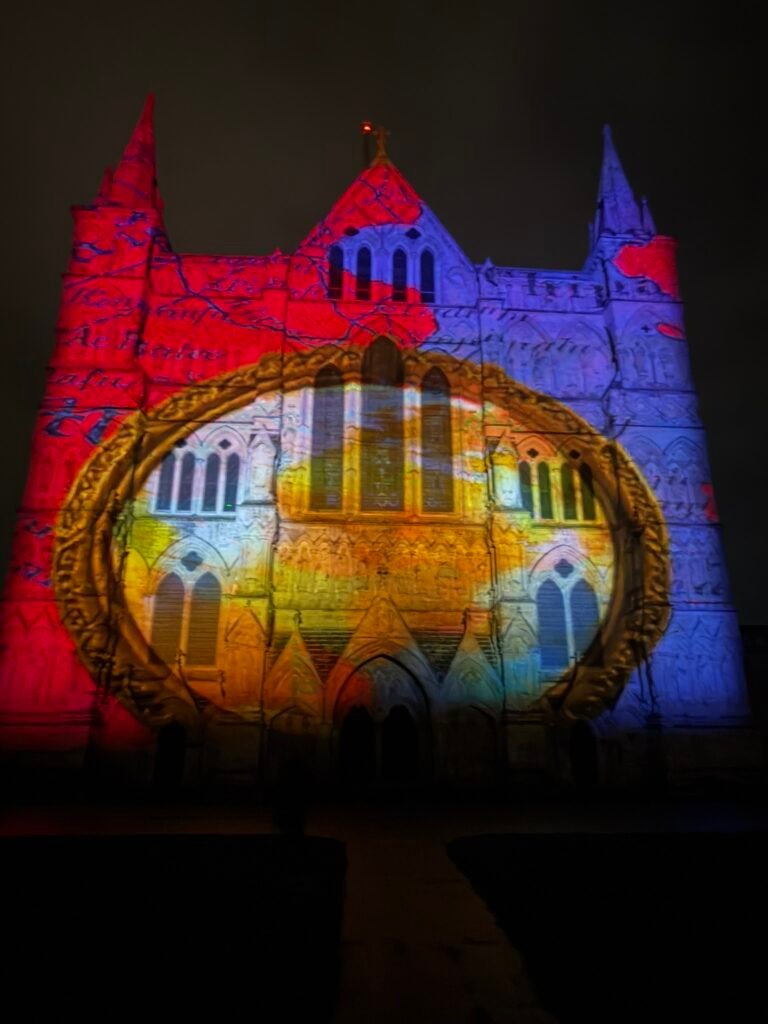
The exterior projections provided a spectacular introduction.
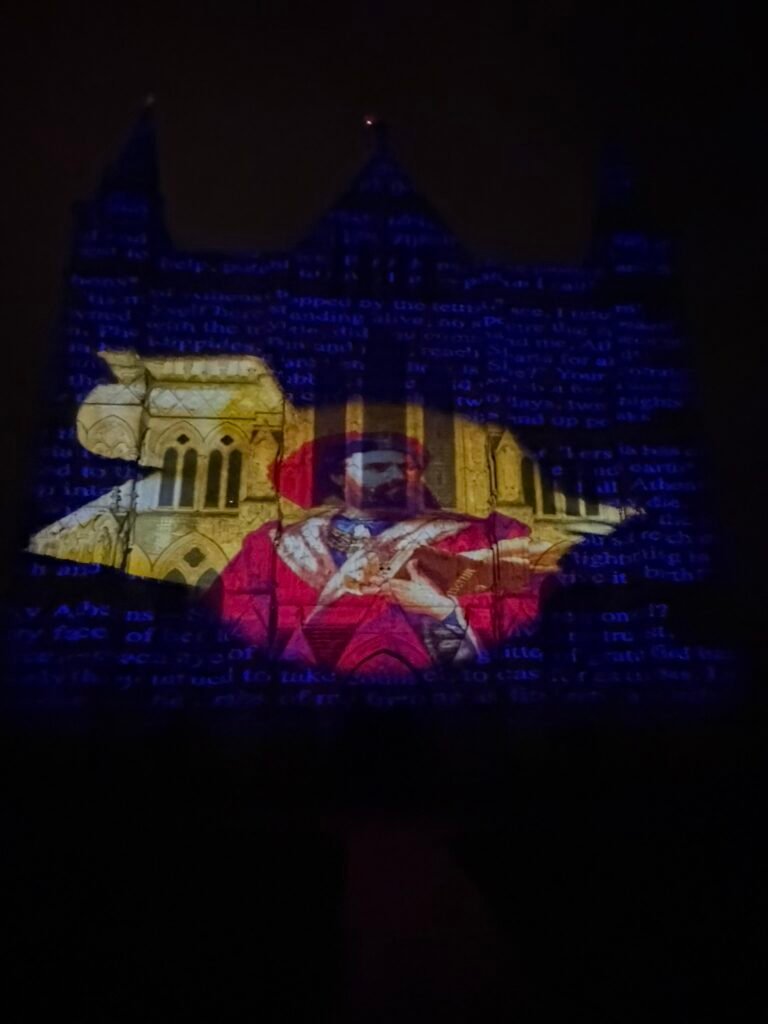
Instead of looking at Salisbury Cathedral’s familiar stone façade, we watched it disappear beneath shifting colours, enormous images and layers of projected writing.
At different moments, architectural details seemed to merge into the artwork. Windows, carvings and pointed arches became part of images much larger than anything the medieval builders could have imagined.
The contrast was fascinating.
A building constructed centuries before electricity was now hosting a thoroughly modern digital spectacle, yet its Gothic architecture made the projections even more impressive.
There was something wonderfully strange about seeing elaborate medieval stonework covered in moving imagery.
It was almost as though the cathedral had temporarily decided to become a cinema.
Except this cinema had considerably better architecture.
The Cloisters: A Colourful Surprise
The cloisters offered a completely different atmosphere.
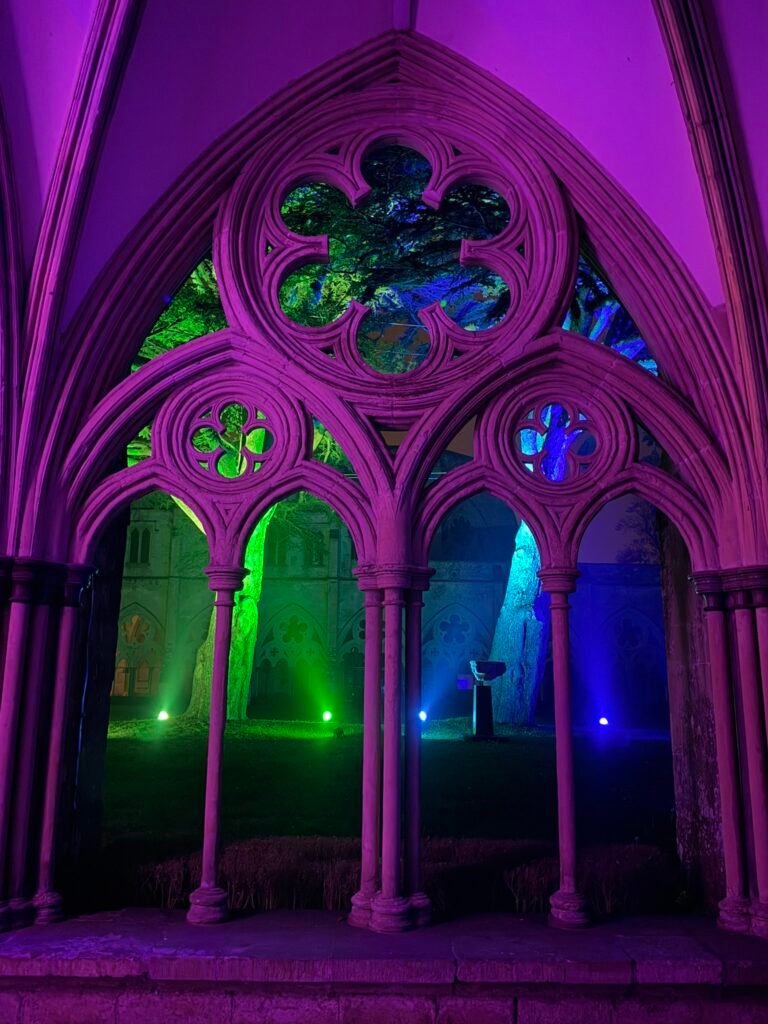
Instead of the dramatic images covering the cathedral façade, we encountered trees illuminated in vivid green and blue, framed by delicate Gothic stone tracery.
The combination was unexpectedly beautiful.
The ancient stone arches created natural picture frames, while the colourful trees beyond looked almost enchanted.
One of our favourite views came through a pointed Gothic opening, where the intricate stonework was bathed in pink and purple light, contrasting with the bright green and blue trees outside.
It was a lovely reminder that spectacular lighting doesn’t always need enormous moving images.
Sometimes, a few carefully placed lights and some beautiful architecture are enough.
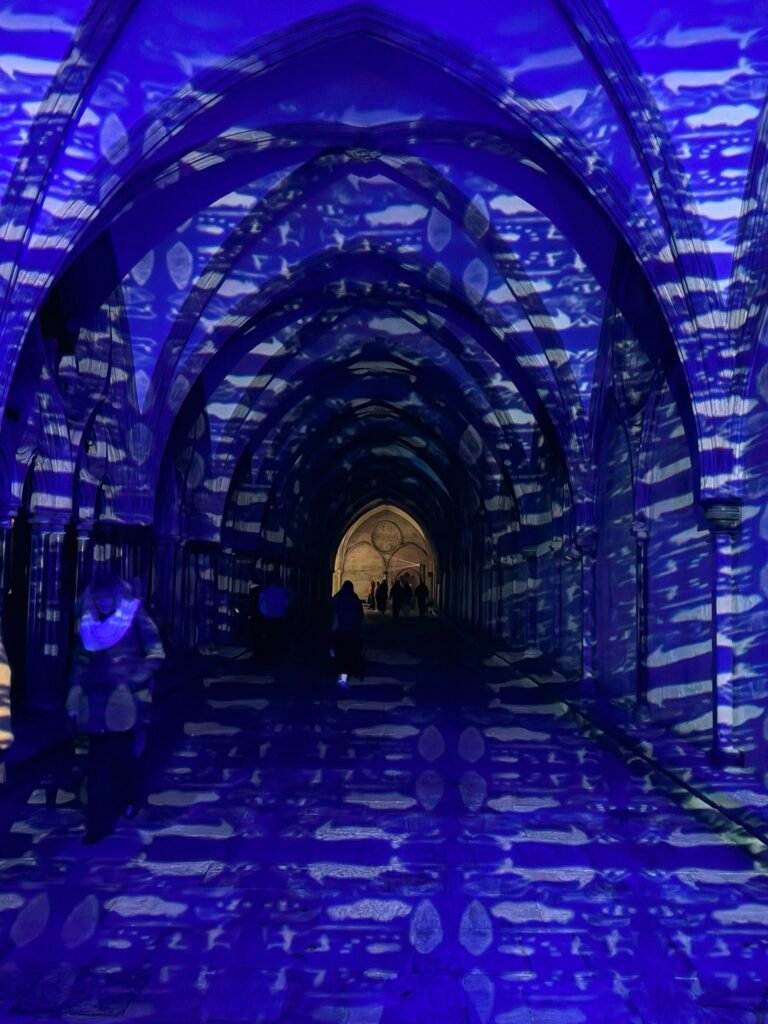
The covered walkways offered another experience entirely. Blue and white patterns spread across the stone floor, walls and vaulted ceiling, creating the impression of walking through a constantly changing artwork.
With successive arches stretching into the distance, the effect was wonderfully atmospheric.
It also made a simple walk along a medieval corridor feel considerably more adventurous than usual.
When the Gothic Arches Discovered the Colour Wheel
Inside the cathedral, the lighting became even more dramatic.
Columns glowed purple, ceilings turned green, and enormous pointed arches were illuminated in pink, red and blue.
What made the effect so impressive was the architecture itself.
Salisbury Cathedral already has extraordinary proportions. Its arches, pillars and vaulted ceilings create a sense of height and depth that photographs can struggle to capture.
Under the coloured lighting, those familiar shapes took on an entirely different character.
One passage appeared almost theatrical, while another looked mysterious and atmospheric. The colours changed how we noticed the stonework, drawing attention to details that might otherwise have gone unnoticed.
It was rather like discovering a completely different building inside the one we thought we knew.
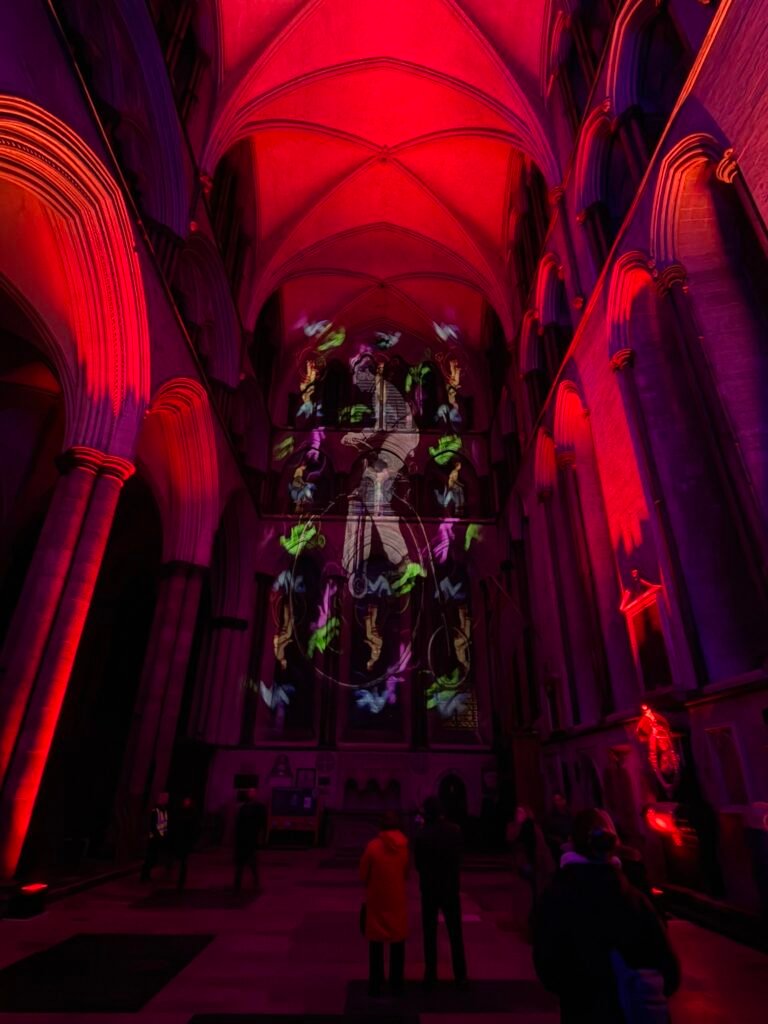
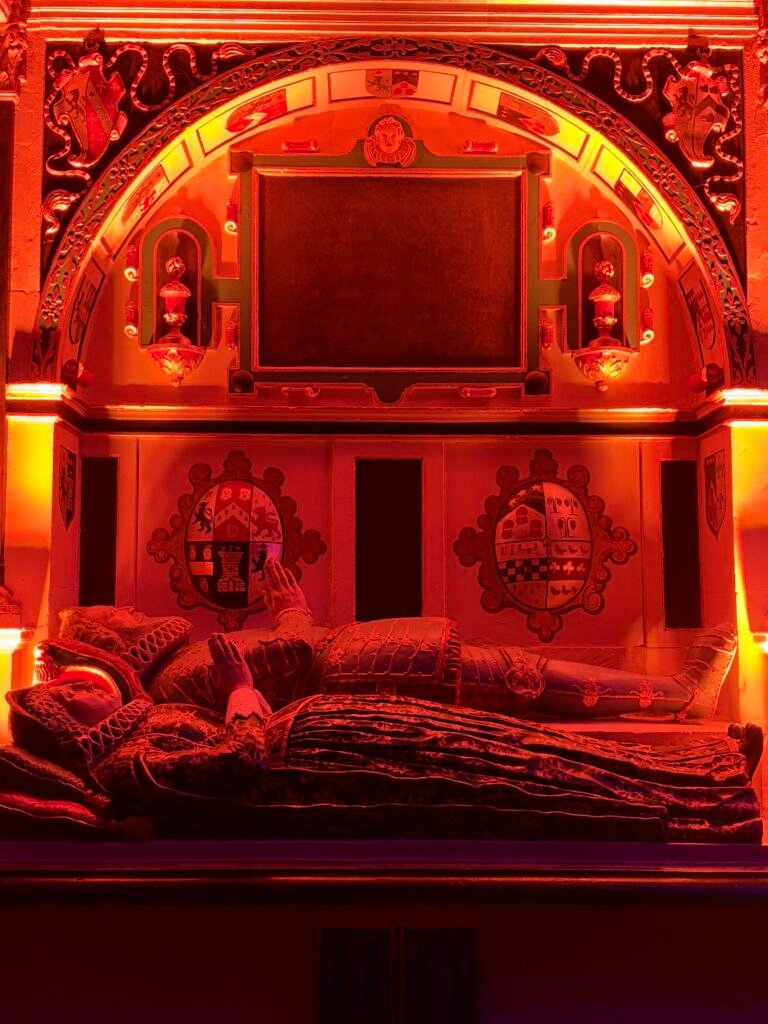
And then there were the historic monuments.
One elaborate tomb, with two recumbent effigies beneath a richly decorated canopy and heraldic shields, was illuminated in intense red-orange light.
The theatrical lighting gave the centuries-old memorial an unusually dramatic appearance.
It was an interesting contrast: a monument intended to preserve someone’s memory across generations, temporarily transformed by a modern artistic installation.
The cathedral’s history hadn’t disappeared beneath the lights. In places, the illuminations made us notice it even more.
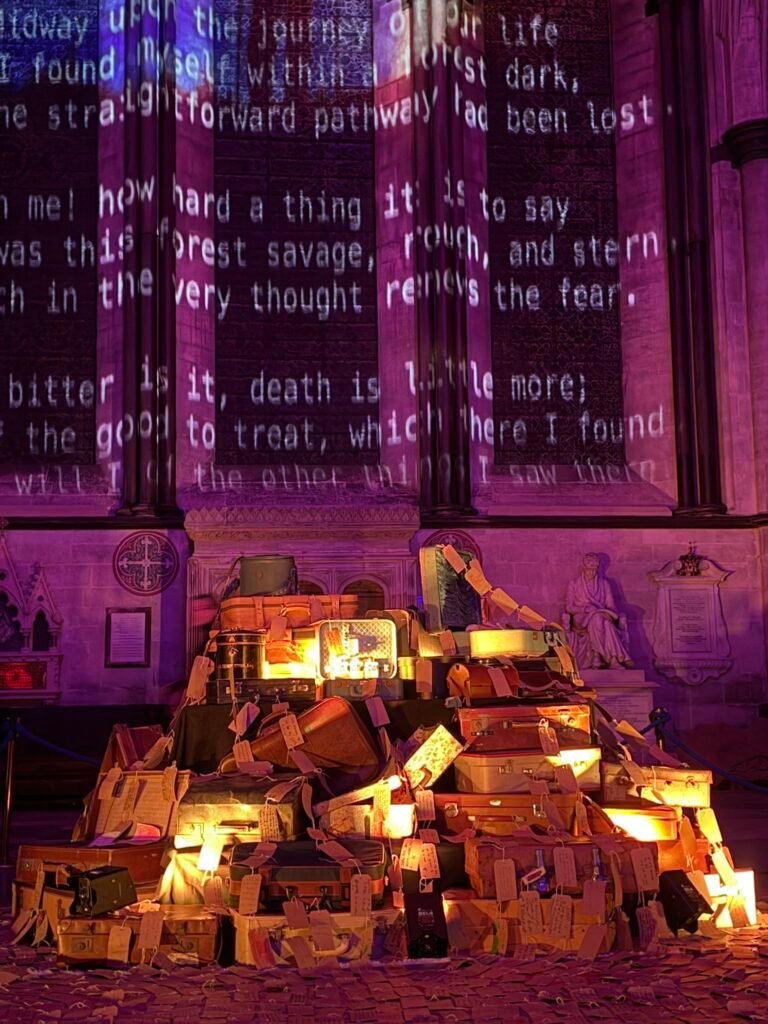
Suitcases, Stories and the Meaning of a Journey
Not everything at Sarum Lights was about bright colours and impressive architecture.
One of the more thought-provoking installations featured a large collection of illuminated suitcases, surrounded by projected writing.
At first glance, it was a rather unusual sight inside a medieval cathedral.
But suitcases are objects almost everyone associates with travelling. They suggest departures, arrivals, belongings and the things people choose — or need — to take with them.
Against the show’s broader theme of Great Journeys, the installation invited a more personal interpretation.
For us, it was a reminder that journeys aren’t always about exciting holidays or discovering beautiful places.
Some are life-changing. Others are difficult, uncertain or undertaken out of necessity.
The installation provided a quieter, more reflective contrast to the spectacular architectural projections elsewhere.
And it demonstrated that the exhibition had more to offer than simply making old buildings look colourful.
Salisbury Cathedral’s Famous Font Steals the Show
Of all the spectacular sights during the evening, one of our favourites involved something that belongs to the cathedral all year round.
The magnificent baptismal font designed by British sculptor William Pye was consecrated in September 2008.
Its broad, reflective water surface is already one of the cathedral’s most distinctive modern features.
During Sarum Lights, however, it became something extraordinary.
The vast Gothic nave was illuminated in rich purple, blue and red, and the still water reflected the arches and coloured lighting above.
The result was almost perfectly symmetrical.
Looking into the font, the cathedral appeared to continue downwards into another enormous, illuminated space.
It was mesmerising.
And unlike the moving projections elsewhere, this was a moment where a relatively simple reflection produced one of the most memorable images of the evening.
Sometimes the best special effect is already part of the building.
You can learn more about the cathedral’s architecture and remarkable features in our Salisbury Cathedral visitor guide.

Watch Our Sarum Lights 2026 Video
Photographs can capture individual moments beautifully, but moving projections are another matter.
The changing images, atmospheric soundtrack and shifting colours are much easier to appreciate when you can actually see them in motion.
We’ve put together a short video from our visit, featuring highlights of the exterior projections, illuminated cloisters and cathedral interiors.
It’s a little glimpse of what made the evening so unusual — and a chance to see how different parts of the cathedral were transformed.
Was Sarum Lights 2026 Worth Visiting?
For us, absolutely.
Not because we understood every artistic reference or followed every detail of the historical narrative.
We enjoyed it because the combination of architecture, light, music and imagination created an experience unlike our previous visits to Salisbury Cathedral.
Some installations were spectacular, others more contemplative, and the opportunity to explore such an extraordinary historic building after dark made the evening particularly memorable.
There was also something refreshing about seeing familiar surroundings presented in a completely different way.
At £13 for a Friday adult ticket, we thought the experience offered good value, particularly considering the scale of the projections and the variety of installations.
Of course, this wasn’t the occasion for a peaceful cathedral visit. The music could be loud, the lighting was constantly changing, and visitors were moving between different displays.
But that’s precisely what made it different.
If you prefer to appreciate the cathedral’s history, architecture and treasures at a more leisurely pace, a regular daytime visit offers a completely different experience.
And there’s plenty worth returning for.
One Last Look at Salisbury Cathedral
Eventually, the evening came to an end.
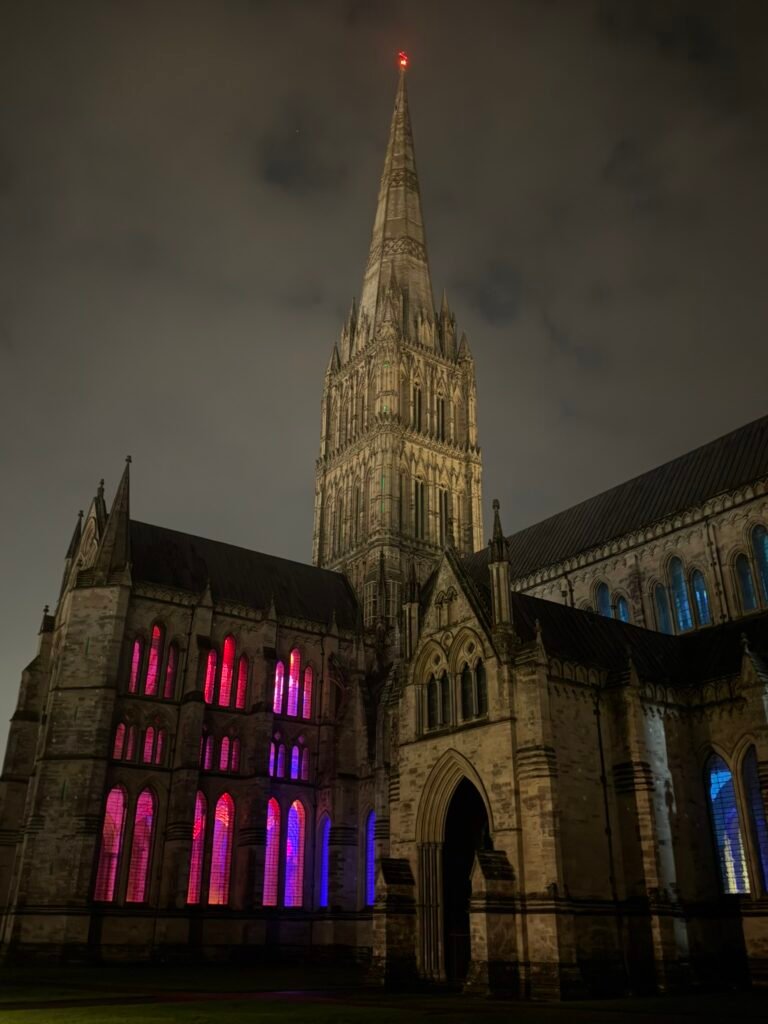
Outside, the cathedral had returned to something much closer to its familiar appearance.
Its enormous spire rose into the dark sky, while traces of pink, purple and blue light remained visible through the windows.
After spending the evening surrounded by moving projections and vivid colours, the comparatively quiet exterior made a lovely final impression.
It was almost difficult to believe that the same building had looked so dramatically different only moments earlier.
More than eight centuries after construction began, Salisbury Cathedral had managed to surprise us again.
Not bad for a building that’s been standing there since the Middle Ages.
More to Discover in Salisbury and Wiltshire
Although Sarum Lights 2026 has now finished, there’s much more to discover in Salisbury.
Our original Sarum Lights 2026 event guide covers the programme, event arrangements and what visitors could expect from Great Journeys.
For a closer look at the building itself, explore Salisbury Cathedral: 800 Years Old and Still Showing Off, including its remarkable architecture and history.
The cathedral also houses one of only four surviving original 1215 Magna Carta documents. Discover why it still matters in Magna Carta at Salisbury Cathedral: 800 Years of Freedom and Rebellion.
Just outside the busy city centre, Salisbury Water Meadows offers a completely different perspective on the cathedral, with landscapes famously associated with the paintings of John Constable.
And for more historic places, unusual discoveries and memorable days out, browse our Wiltshire travel collection.
Sarum Lights may have lasted just five evenings, but the photographs, memories and a rather colourful video will keep this particular journey alive a little longer.
One journey. One story. One more stop.