
Magna Carta at Salisbury Cathedral is proof that a piece of parchment can cause an astonishing amount of trouble. Especially when it tells a king that he can’t simply do whatever he likes.
Back in 1215, King John was having a rather difficult time. His wars were expensive, his taxes were unpopular, and some very powerful people had decided they’d had quite enough of him. The resulting disagreement gave us one of the most important documents in British history.
More than 800 years later, one of the four surviving original 1215 Magna Carta manuscripts is sitting quietly inside Salisbury Cathedral. And despite being written in Latin on sheepskin, it helped inspire ideas about freedom and justice that still matter today.
Not bad for something produced long before anyone invented a complaints department.
What Is Magna Carta, and Why Was King John So Unpopular?
Magna Carta means Great Charter in Latin. It was agreed on 15 June 1215 at Runnymede, near Windsor, following a confrontation between King John and a group of rebellious barons.
The king had been spending enormous amounts of money fighting wars in France, with disappointing results. To finance his adventures, he demanded increasingly heavy taxes and exercised his royal powers in ways that made his barons extremely unhappy.
Eventually, they decided that enough was enough.
Rather than politely suggesting a change in management, they organised an armed rebellion and forced John to accept a charter restricting some of his powers.
It wasn’t exactly a friendly staff meeting.
The original Magna Carta contained 63 clauses covering everything from legal procedures and taxation to inheritance, property rights and the treatment of widows. There were even rules about standard measurements for wine, ale and cloth.
Apparently, medieval England needed protecting from dodgy measurements as well as dodgy monarchs.
Most importantly, it helped establish the principle that even the king was subject to the law. That might sound obvious today, but in medieval England it was a pretty revolutionary suggestion.
There was one small complication: John didn’t particularly like being told what to do. Within ten weeks, Pope Innocent III had annulled the agreement, and England was heading into civil war.
So much for a peaceful resolution.
Fortunately, Magna Carta was reissued in revised forms under John’s successor, Henry III, and gradually developed into something far more significant than the original barons could have imagined.
Seeing the Original Magna Carta at Salisbury Cathedral
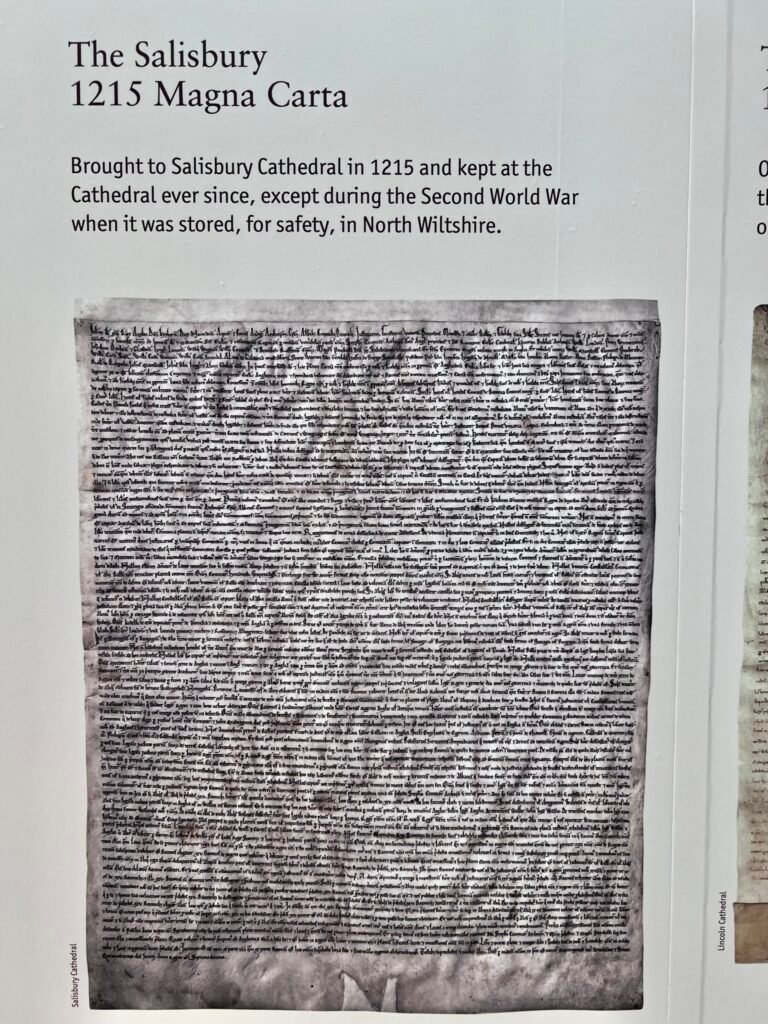
Salisbury Cathedral holds what is considered the best-preserved of the four surviving original manuscripts from 1215. Two others are at the British Library, while the fourth is associated with Lincoln Castle.
Finding Salisbury’s copy is part of the pleasure of visiting.
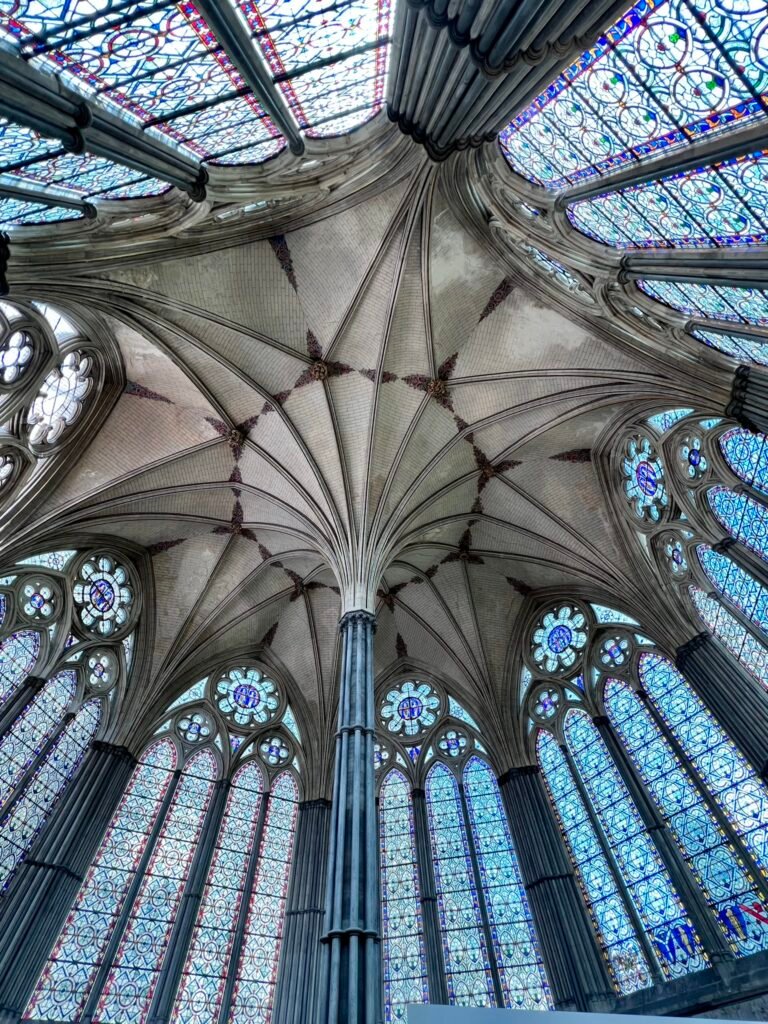
Instead of being displayed in the cathedral’s enormous nave, the document is housed in the magnificent octagonal Chapter House, reached through the cloisters.
And what a room it is.
A central stone column rises towards an extraordinary vaulted ceiling, while tall windows surround the space. Around the walls runs a medieval carved frieze depicting stories from the Bible.
It’s the sort of architecture that makes you forget why you entered the room in the first place.
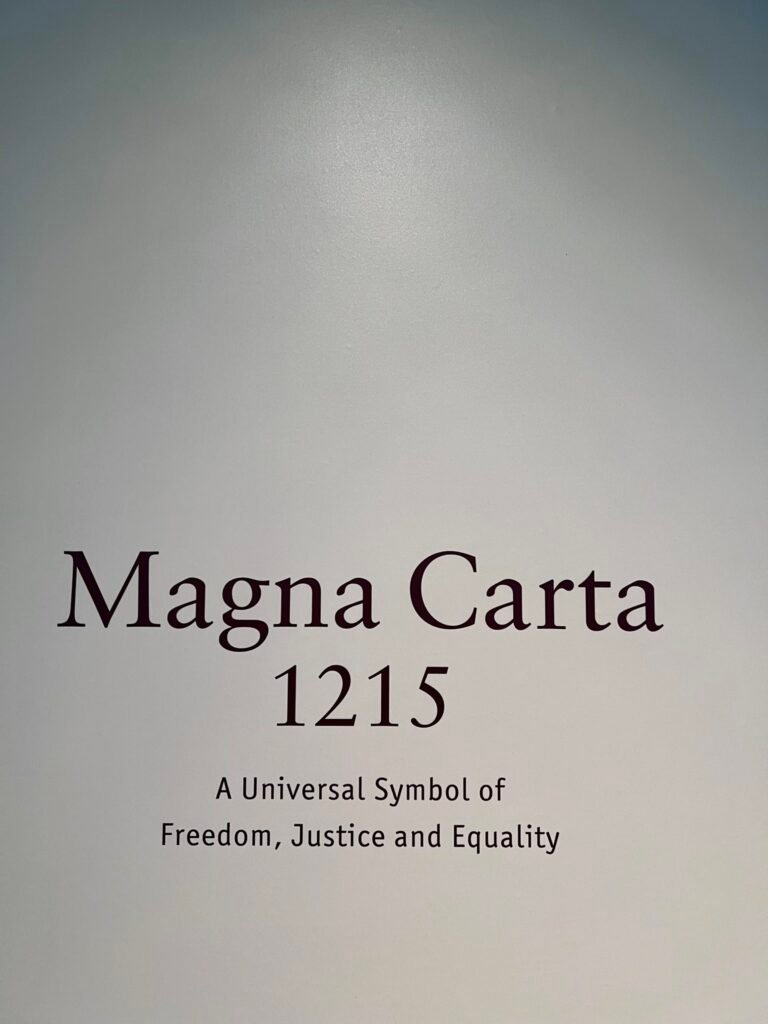
The accompanying exhibition introduces Magna Carta’s history, explains the document’s importance and explores its continuing influence on modern discussions of rights and freedoms.
Then comes the moment you’ve been waiting for.
A Glimpse of 1215 — Behind the Glass
The original Magna Carta isn’t simply lying on a table, waiting for someone to lean over it with a smartphone.
During our visit, we had to enter a darkened viewing area and look through a glass panel to see the ancient document itself. Photography of the original wasn’t permitted, so there would be no triumphant Magna Carta selfie.
And that’s entirely understandable.
This is an exceptionally fragile manuscript that has survived more than eight centuries. Protecting it is rather more important than improving someone’s Instagram statistics.
What makes the experience interesting is the contrast between the document’s modest appearance and its enormous historical reputation.
You might expect something grand and ceremonial. Instead, you’re looking at tightly packed medieval handwriting on parchment — a document that helped change the relationship between rulers and the people they governed.
Did Magna Carta Really Give Us Our Freedom?
Well, yes and no. History rarely makes things quite that convenient.
Magna Carta wasn’t a declaration that everyone was suddenly equal. In 1215, its principal beneficiaries were powerful barons and other free people, while much of the population remained outside those protections.
Nor did it instantly create modern democracy, universal human rights or trial by jury.
Nevertheless, it contained ideas that became enormously influential.
Clauses 39 and 40 established important protections against unlawful imprisonment and the denial or delay of justice.
One particularly memorable promise was:
“To no one will we sell, to no one deny or delay right or justice.”
That’s an impressive statement from a time when being on the wrong side of the king could have extremely unpleasant consequences.
Over the following centuries, Magna Carta became a symbol of the principle that government power should have limits and that justice should operate according to law.
Its influence extended far beyond medieval England, helping inspire later constitutional thinking in Britain, America and elsewhere.
The original document wasn’t perfect. It wasn’t even particularly successful at first.
But its legacy was remarkable.
If you’d like to explore the history further, UK Parliament explains Magna Carta’s clauses and their lasting significance.
Why Is Magna Carta in Salisbury?
Here’s an interesting detail: Salisbury’s Magna Carta is actually older than the cathedral building that now protects it.
The charter was issued in 1215, whereas construction of the present Salisbury Cathedral began in 1220.
Its copy was probably brought to the original cathedral at Old Sarum by Elias of Dereham, who had been involved in the events surrounding Magna Carta and later helped oversee construction of the new cathedral.
Another important connection was William Longespée, Earl of Salisbury, who was named in Magna Carta and helped lay the foundations of the present cathedral with his wife, Ela.
So the document didn’t arrive in Salisbury as some random historical souvenir. Its story is genuinely intertwined with the people and events that shaped the city.
And if you’re curious about where Salisbury’s cathedral story began, Old Sarum: The Castle and Cathedral Salisbury Left Behind makes a fascinating companion visit.
The manuscript itself has been carefully protected over the centuries. During the Second World War, it was temporarily moved to North Wiltshire for safekeeping before eventually returning.
After surviving kings, rebellions and centuries of political turmoil, it would have been rather unfortunate to lose it to a twentieth-century bomb.
How to Visit Magna Carta at Salisbury Cathedral
The good news is that you don’t need to purchase a separate ticket to see Magna Carta.
Admission to the Chapter House and its exhibition is included in the standard Salisbury Cathedral sightseeing ticket.
At the time of writing, standard adult admission is £12.50 when booked online or £14.50 on arrival, with reduced prices for students and young people. Children under 12 enter free, while residents of the SP1–SP5 postcode areas qualify for free admission with proof of residence, subject to the cathedral’s conditions.
Even better, the standard ticket is valid for 12 months from purchase, allowing return visits by the same group. Special events and tours may require separate tickets.
You can find current prices and bookings through the official Salisbury Cathedral visitor information.
Opening Times
The Chapter House and Magna Carta exhibition normally open Monday to Saturday, 10am–5pm, and Sunday, 1pm–4pm.
The cathedral itself generally opens slightly earlier on weekdays, although services, events and special closures can affect sightseeing access.
It’s worth checking the official opening times and visitor notices before travelling.
Parking and Accessibility
Salisbury Cathedral is located in The Close, Salisbury, Wiltshire, SP1 2EJ.
There is limited parking within the Cathedral Close, currently advertised at £12 for the day, including designated accessible spaces. The nearest alternative paid car parks are Lush House (SP2 7TD) and Old George Mall (SP1 2PH), approximately five minutes’ walk from the Close.
If you’re travelling by train, Salisbury station is roughly a 15-minute walk from the cathedral.
The Cathedral floor, cloisters, Chapter House, restaurant, shop and toilets are wheelchair accessible. Three wheelchairs are available to borrow on a first-come, first-served basis, and accessible toilet facilities are provided.
The building is medieval, however, so some historic surfaces may be uneven.
One Document, Eight Centuries of History
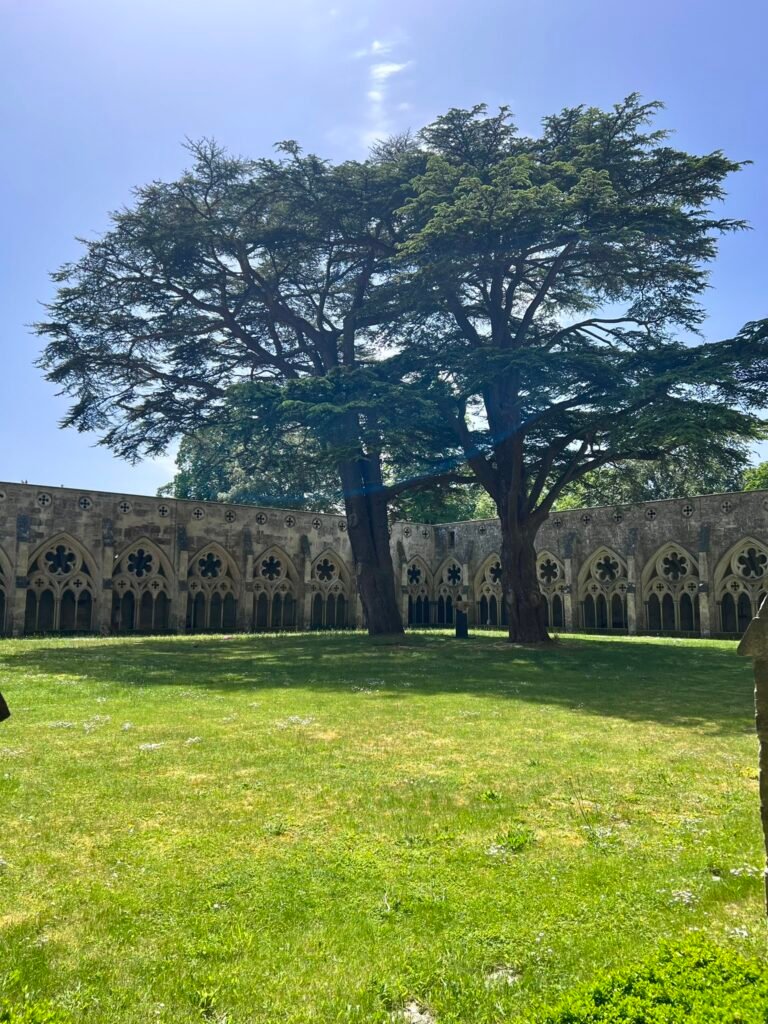
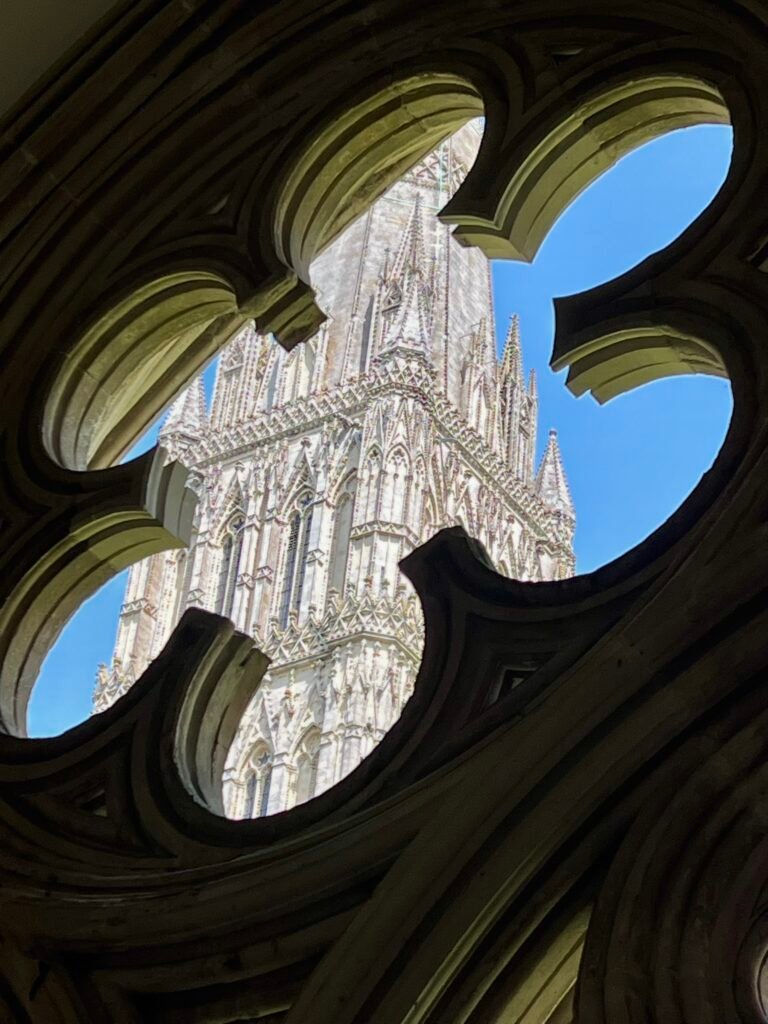
After seeing Magna Carta, the cathedral cloisters are a lovely place to finish your visit. Their Gothic arches and magnificent cedar trees offer a peaceful contrast to the political drama you’ve just been exploring.
And there’s plenty more to discover nearby.
Our Salisbury Cathedral visitor guide explores the extraordinary building itself, including its towering architecture, remarkable interior and practical visitor advice.
For a different perspective, Salisbury Water Meadows: Walking into a Constable Painting follows the scenic landscape that inspired one of Britain’s best-known painters.
If you’re visiting in November, there’s also Sarum Lights 2026 at Salisbury Cathedral, when the historic building becomes the setting for an illuminated evening spectacular.
You can also discover more historic destinations and interesting days out in our Wiltshire travel collection.
Magna Carta might not look particularly impressive at first glance. There are no diamonds, golden crowns or spectacular medieval weapons waiting behind that protective glass.
Just parchment, ink and a collection of promises made by a reluctant king.
But perhaps that’s what makes it so extraordinary. Sometimes the most powerful things in history aren’t grand buildings or victorious armies.
Sometimes they’re simply words that refuse to disappear.
One journey. One story. One more stop.