
Winchester has a cathedral that gets plenty of attention, and quite rightly so. But there’s another extraordinary church hiding just south of the city centre, and I genuinely wasn’t prepared for what I found inside. The Church of St Cross might officially be described as a chapel, but somebody clearly forgot to tell the medieval builders to keep things modest. 😂
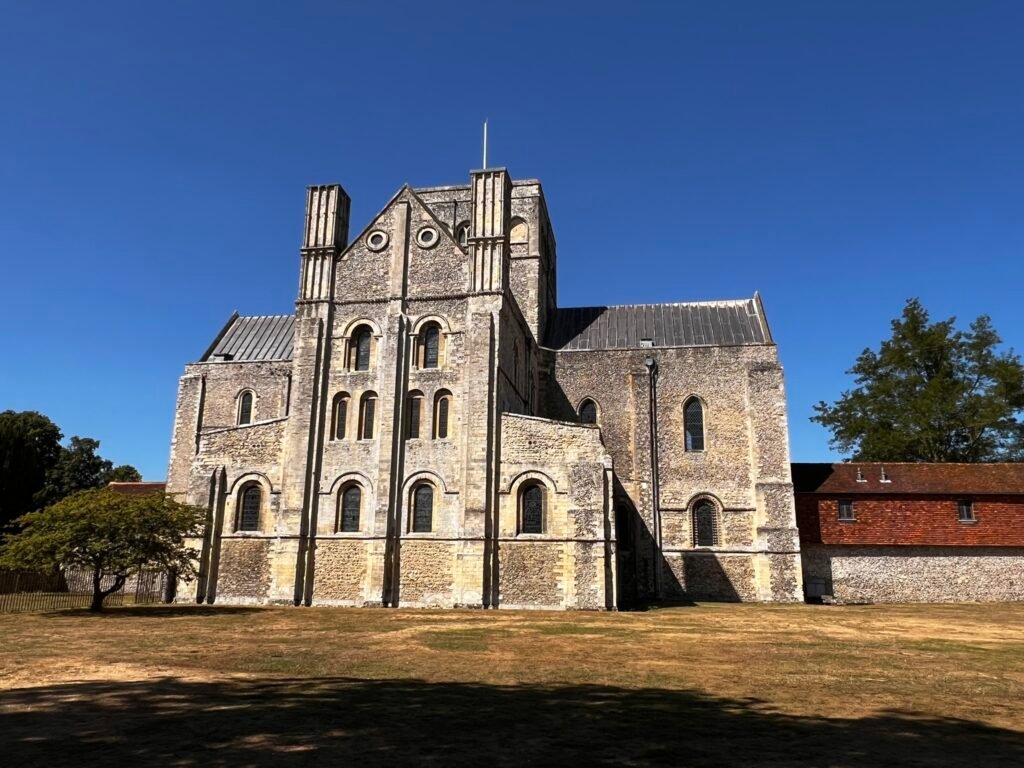
I’d already been enjoying my visit to the Hospital of St Cross when I reached this magnificent building. From the outside, it looked far grander than I expected from an almshouse church, with enormous stone walls, unusual towers and windows that seemed to belong to several different centuries. Naturally, I had to investigate.
A chapel? Someone was feeling ambitious!
Construction began in 1135, under Henry of Blois, Bishop of Winchester and brother of King Stephen. The church was built as part of the original Hospital of St Cross foundation, long before most of the surrounding buildings we see today.
Its walls are more than a metre thick, built using stone brought from places including Normandy, Dorset and the Isle of Wight, alongside local flint. Transporting all that material in the 12th century must have been quite an undertaking. I struggle enough bringing my shopping home from the supermarket!
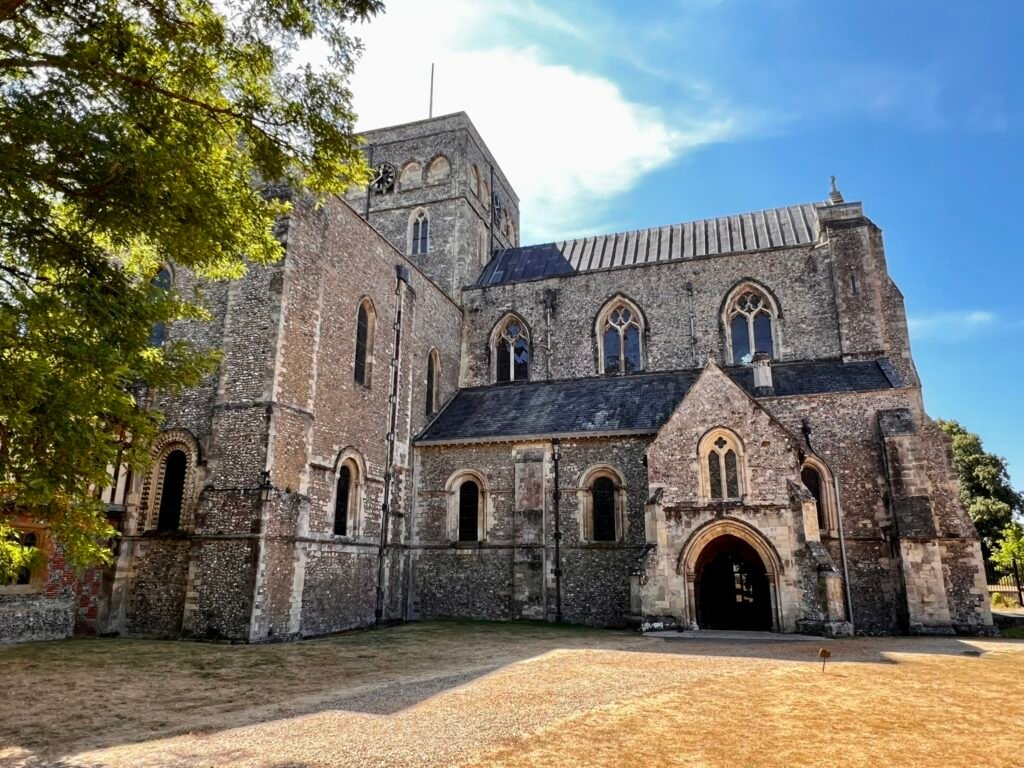
The outside is fascinating because it isn’t entirely one architectural style. You can spot rounded Norman windows alongside later pointed arches, with different building phases visible in the stonework.
This is known as Transitional Norman architecture: the period when English church builders were gradually moving towards Gothic design. And St Cross is an especially impressive place to see that change.
You don’t need to know anything about architecture to appreciate it. Just walk around the building and notice how much the windows, arches and stonework vary.
Then I stepped inside. Wow.
I think this was my favourite moment of the visit.
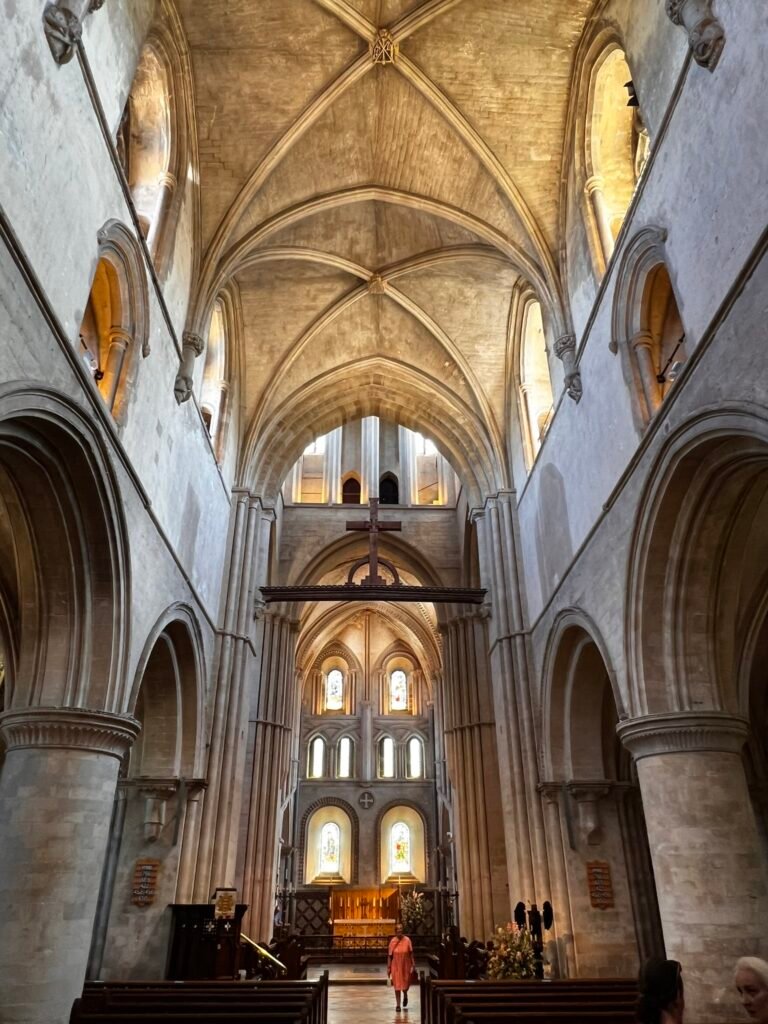
The nave feels enormous. Massive stone columns rise towards high arches, wooden pews line the central aisle, and the far end of the church glows in the daylight filtering through the windows.
There’s something wonderfully dramatic about the proportions. The stonework is substantial, almost fortress-like in places, yet the whole interior feels elegant rather than heavy.
And the atmosphere was lovely. Even with other visitors around, it was easy to slow down and appreciate the building without rushing from one attraction to the next.
I’ve visited plenty of impressive churches, including Winchester Cathedral, but St Cross has something different about it. Perhaps it’s the scale of the architecture compared with the relatively quiet setting. You simply don’t expect to find such an extraordinary interior tucked away here.
The ceiling deserves a moment of its own
If you visit, please remember to look up. I spent a considerable amount of time doing exactly that, which probably explains why I ended up with so many photographs of arches and ceilings. 😆
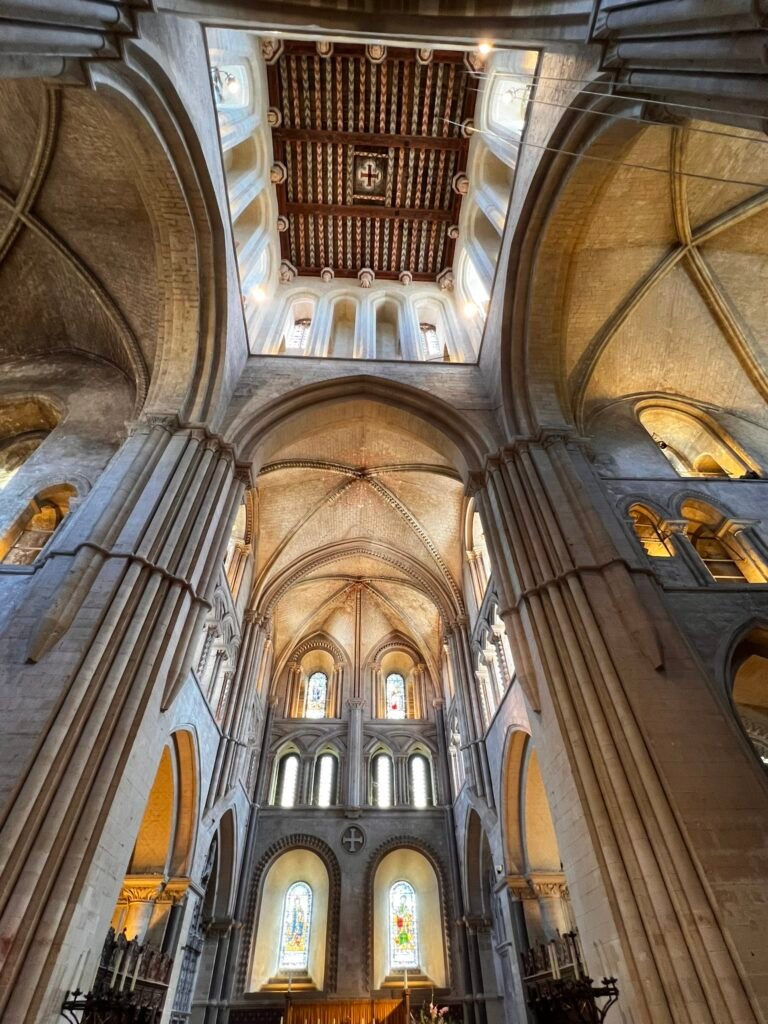
The ribbed stone vaulting is a beautiful example of medieval craftsmanship. High above, the patterned timber ceiling adds yet another layer of detail.
Those great columns and arches aren’t just decorative. They reveal how the building was designed to carry its considerable weight, and how medieval builders experimented with increasingly sophisticated forms.
The church’s combination of rounded and pointed arches makes it particularly interesting. You can almost see architecture evolving around you, without having to sit through a history lecture.
If you’d like to understand the building in greater detail, the Hospital’s official church history explains its construction and distinctive features.
Stained glass, biblical stories and a church with two identities
The stained glass is another reason to take your time. Some windows are delicate and restrained, while others are packed with vivid reds, blues and greens.
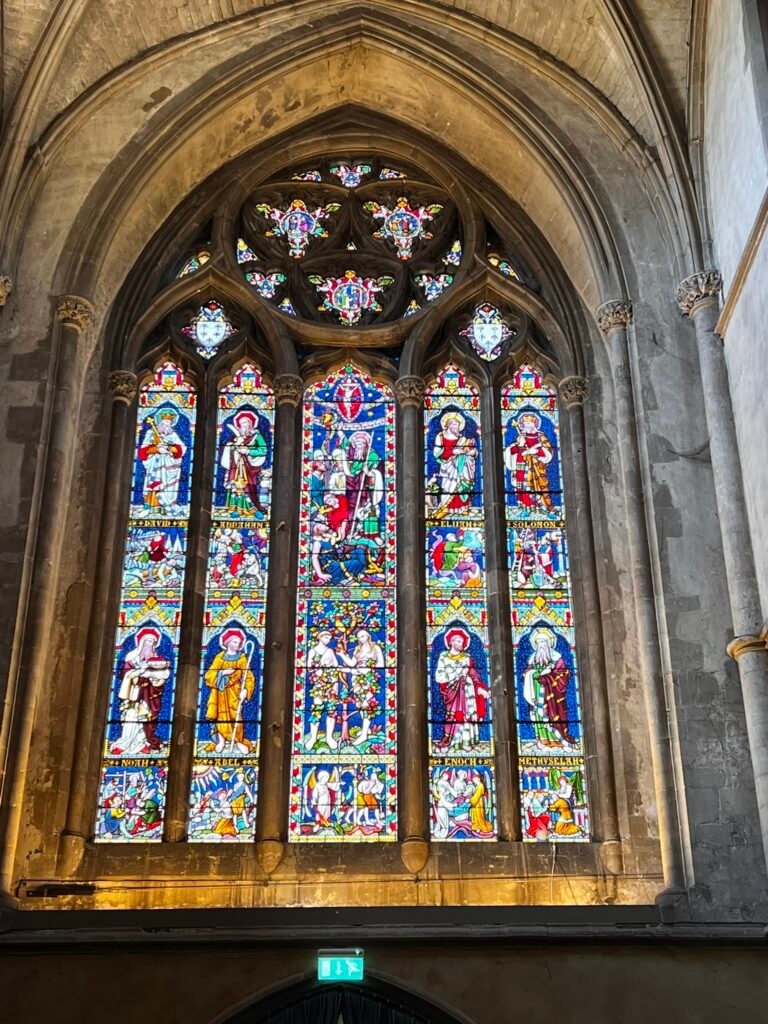
One of my photographs shows a magnificent window filled with biblical figures, including David, Abraham, Elijah and Solomon. There’s an extraordinary amount of detail in the individual panels, and it’s worth looking beyond the colours to see the stories being illustrated.
Here’s something I hadn’t realised: this isn’t only the private chapel of an historic almshouse. It also serves the local parish of St Faith.
The arrangement dates back to 1507, when the nearby parish church of St Faith was demolished and worship moved to St Cross. So although the building began life as the Hospital’s chapel, it has also served the wider community for more than five centuries.
That continues today, with regular worship taking place alongside the religious life of the resident Brothers. I explore their unusual community in Can You Really Become a Brother at St Cross in Winchester?.
You can also find current services and parish information on the Hospital’s official chapel service times page.
The medieval detail with its own calendar
Perhaps the most surprising architectural feature is one you could easily walk past.
On a column in the north aisle is a carved cross, known as a cross potent, the emblem of the Hospital of St Cross. Nearby, the stone surround of a window in the north transept has an unusual angle.
According to the Hospital, the arrangement allows sunlight to fall on the carved cross on just two significant dates: 3 May, traditionally associated with the Finding of the Cross, and 14 September, Holy Cross Day.
Imagine designing that into a medieval church! I can barely work out where the sunshine will land in my own room, never mind creating something this precise using 12th-century building techniques. 😂
It’s a wonderful example of how religious symbolism, architecture and natural light can come together.
And the little details don’t stop there. I particularly loved the carved wooden pew ends, with their intricate leaves and berries. They’re the sort of feature you might overlook while admiring the grand architecture, but they’re beautiful in their own right.
Is the Church of St Cross worth visiting?
Absolutely. In fact, if you enjoy historic churches, I’d consider it one of the highlights of the entire St Cross complex.
You don’t have to be religious or particularly knowledgeable about architecture to appreciate the place. The scale, stonework, stained glass and atmosphere make it rewarding simply to explore.
The church forms part of a visit to the Hospital of St Cross, so I’d recommend allowing time for the surrounding historic buildings and gardens too. For admission, opening hours, accessibility and parking, see my full guide, Hospital of St Cross in Winchester: No Doctors, but Free Ale? 🍺. You can also check the National Churches Trust’s St Cross information for further background.
Historic Houses members can enjoy standard admission to the Hospital as part of their membership. And there’s another rather entertaining tradition waiting at the Porter’s Lodge: free bread and ale! I’ve written about my experience in Free Bread and Ale in Winchester: The Wayfarer’s Dole.
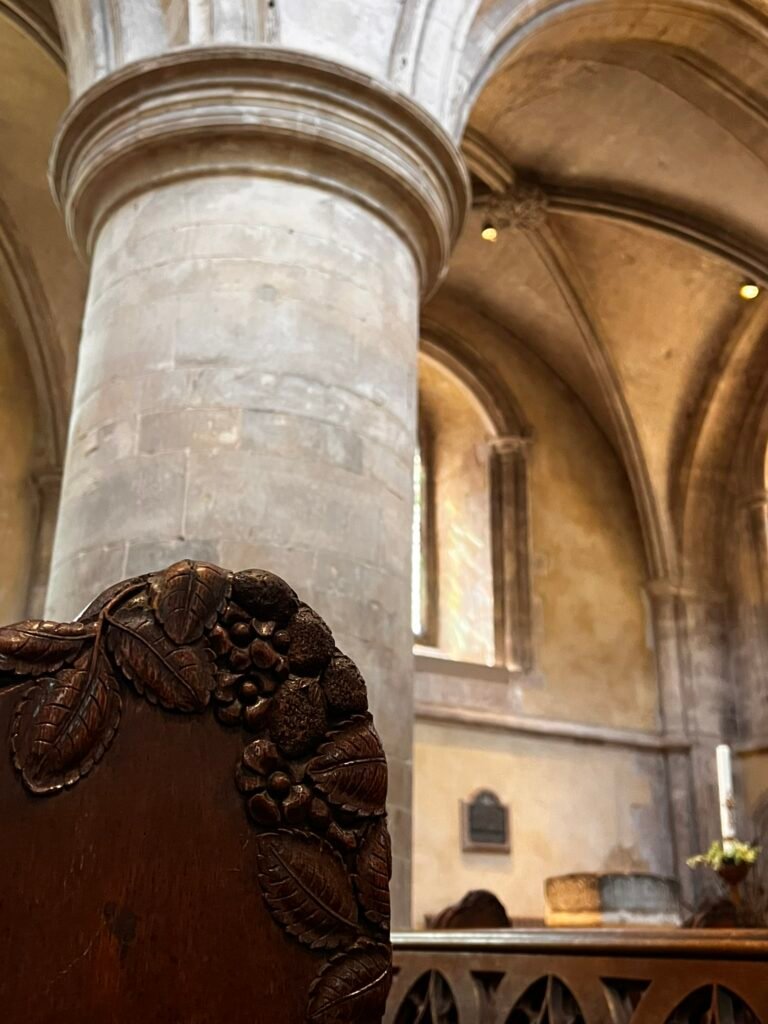
Looking back at my photographs, I love that I captured both the huge architectural spaces and this tiny piece of wood carving. That’s what made the church so memorable for me: there’s something fascinating whether you look up, straight ahead or closely at the details beside you.
So, if you’re planning a trip to Winchester, don’t give all your attention to the famous cathedral. Leave a little room in your itinerary for this quieter masterpiece.
Just be prepared to spend considerably longer looking around than you expected. And possibly leave with a sore neck from staring at the ceiling! 😆
One journey. One story. One more stop.