
I nearly didn’t go.
When a friend told me he wanted to watch the Stonehenge Summer Solstice sunrise, my first answer was basically: good luck — I’ll drive you there and pick you up afterwards.
I had already visited Stonehenge during a normal daytime visit. I loved the history, the landscape and the feeling of standing beside something people had begun creating thousands of years ago.
The one thing I had wanted to do was get closer to the stones.
During a normal visit, you follow the visitor route around the monument and see Stonehenge from a distance. That protects the site, of course, but there was still a little part of me wondering what it would feel like to stand inside the circle.
Summer Solstice offered something completely different.
Free managed access. Sunrise. Thousands of people. And a chance to experience Stonehenge in a way that ordinary visitors usually cannot.
I still wasn’t convinced.
Crowds aren’t exactly my favourite thing. Neither are festivals, spending an entire night outside or standing around for hours waiting for something to happen.
Then another friend unexpectedly decided to join us.
And somehow my carefully planned role as the person providing the taxi service turned into:
Fine. I’m coming too.
Why Stonehenge and the Summer Solstice Are Connected
The Stonehenge Summer Solstice isn’t simply a modern festival happening beside an old monument.
Stonehenge itself was constructed around the movements of the sun.
English Heritage explains that the central sarsen stones, erected around 2500 BC, were carefully positioned along the solstitial axis. At midsummer, the sun rises in the direction of the Heel Stone; in the opposite direction, the midwinter sunset was framed by the tallest part of the monument.
We still don’t know precisely what Stonehenge meant to the people who built and used it.
The evidence suggests ceremonies, gatherings and beliefs connected with ancestors, seasons and the sun, but there is a huge difference between archaeological evidence and pretending we know exactly what prehistoric people believed.
That mystery was part of what attracted me.
I’m not particularly religious, but I do feel connected to the planet, the universe and the enormous amount of time that existed before any of us arrived here.
Standing somewhere people had deliberately aligned with the sun thousands of years ago sounded meaningful.
At least, that was the version I had created in my head.
Getting to Stonehenge in the Middle of the Night
By the time we actually committed to going, the official Stonehenge parking had completely sold out.
English Heritage was explicitly telling anyone without a pre-booked parking ticket not to drive to the site, so we needed another plan.
That turned out to be Wilton Park & Ride, outside Salisbury.
We drove there from Bournemouth and caught the dedicated 334 Summer Solstice bus.
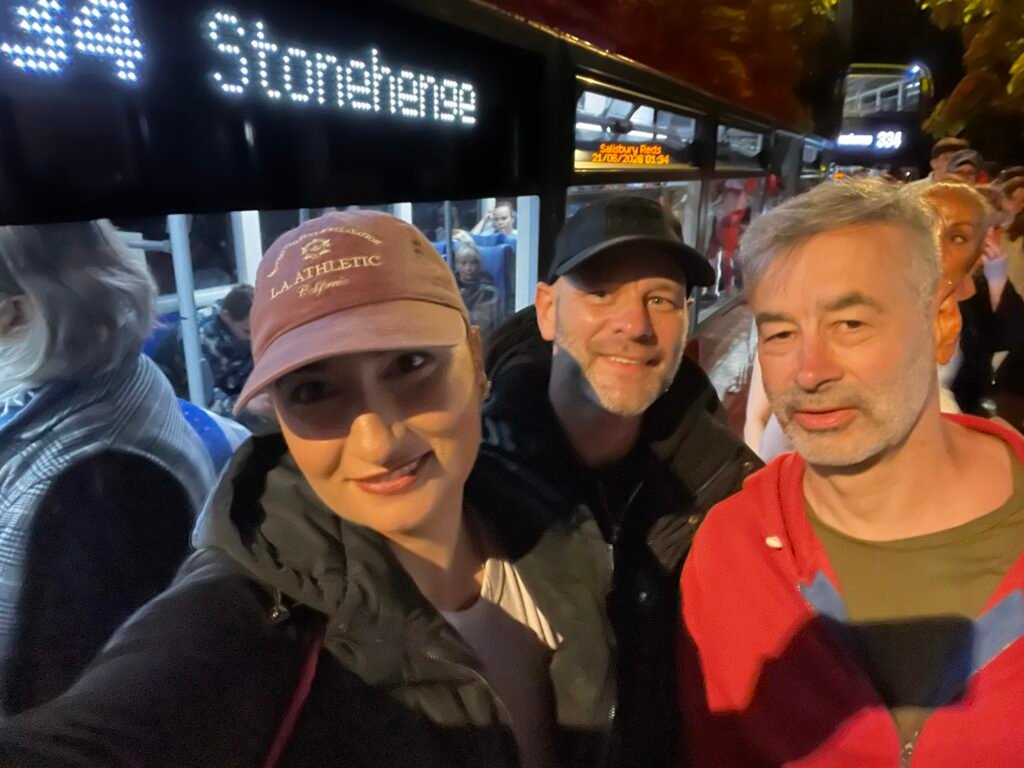
The photo on my phone puts us beside the bus at 1:34am, which is considerably more reliable than asking me to reconstruct the night from memory several months later. 😆
For the 2026 event, route 334 ran directly from Wilton Park & Ride every 30 minutes between 8pm and 4am. Return buses from Stonehenge started at 4:30am and also ran every 30 minutes. The published adult return fare was £15, and the special service was cashless.
The bus journey itself wasn’t particularly long.
What surprised me more was what happened after it.
The Walk Is Longer Than You Might Expect
The bus dropped us near the Stonehenge Visitor Centre.
At that hour the normal visitor experience was obviously not operating, so instead of hopping onto the regular visitor shuttle, we joined everyone walking towards the monument.
And it felt long.
English Heritage gives the official distance as about 1½ miles / 2km, with a walking time of approximately 25–30 minutes across uneven ground.
That matches my memory pretty well.
It was dark, the grass was wet in places, and temporary lighting helped without exactly turning the Wiltshire countryside into Piccadilly Circus.
Around us were cars, campers, vans and people who had clearly been settled in for much longer than we had.
This was also the first point where I realised that coming prepared matters.
If you’re considering a future Stonehenge Summer Solstice, don’t assume June means warm.
At three or four in the morning, I was very happy to have layers.
What I would take if I were doing it again
- warm layers, even if the daytime forecast looks good;
- comfortable shoes that can handle damp grass;
- a lightweight waterproof;
- water;
- snacks or breakfast bars;
- coffee, if you’re surviving the night rather than embracing it;
- a small torch or phone light;
- and as little unnecessary stuff as possible.
English Heritage itself recommends sensible footwear, warm waterproof clothing and a torch for the solstice walk.
Then Stonehenge Appeared in the Darkness
After security and another walk towards the monument, the stones suddenly felt close.
Very close.
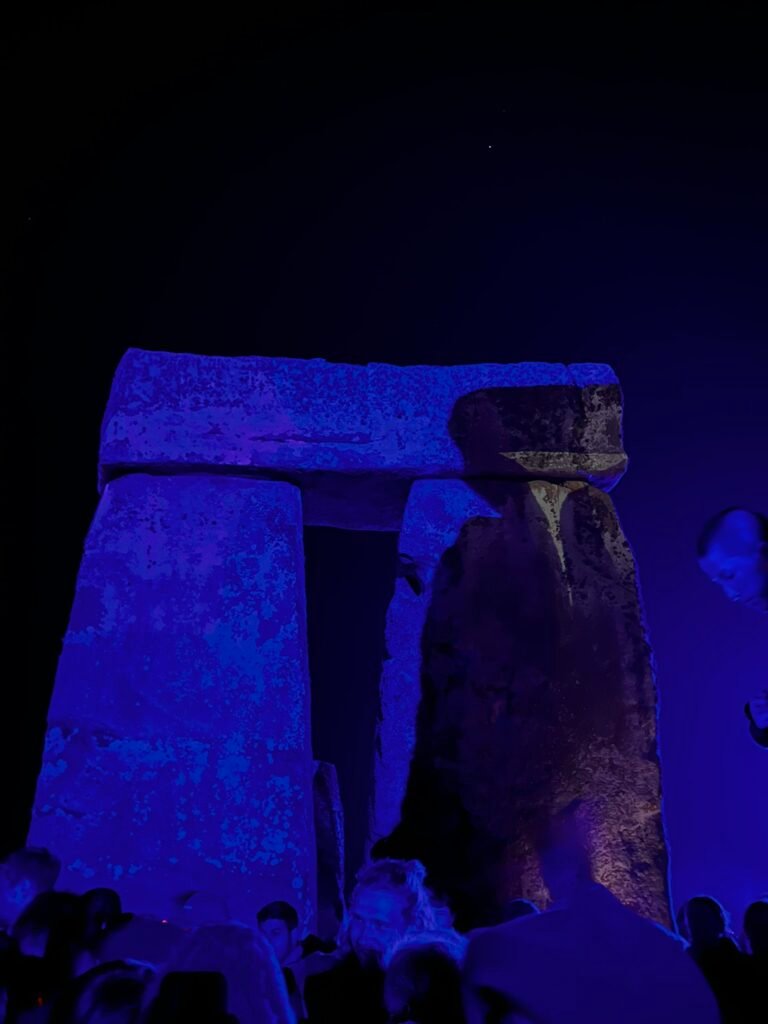
Blue and purple light washed across the enormous sarsens.
Phones appeared everywhere.
People moved between the stones.
And for a while, I loved it.
This was the thing I had wanted during my first Stonehenge visit: not simply seeing the monument from the visitor path, but understanding its scale from right beside it.
A giant block of stone looks impressive from fifty metres away.
Stand underneath one and it feels completely different.
The Moment I Touched Stonehenge
There is one part of my experience that I need to be transparent about.
I touched one of the stones.
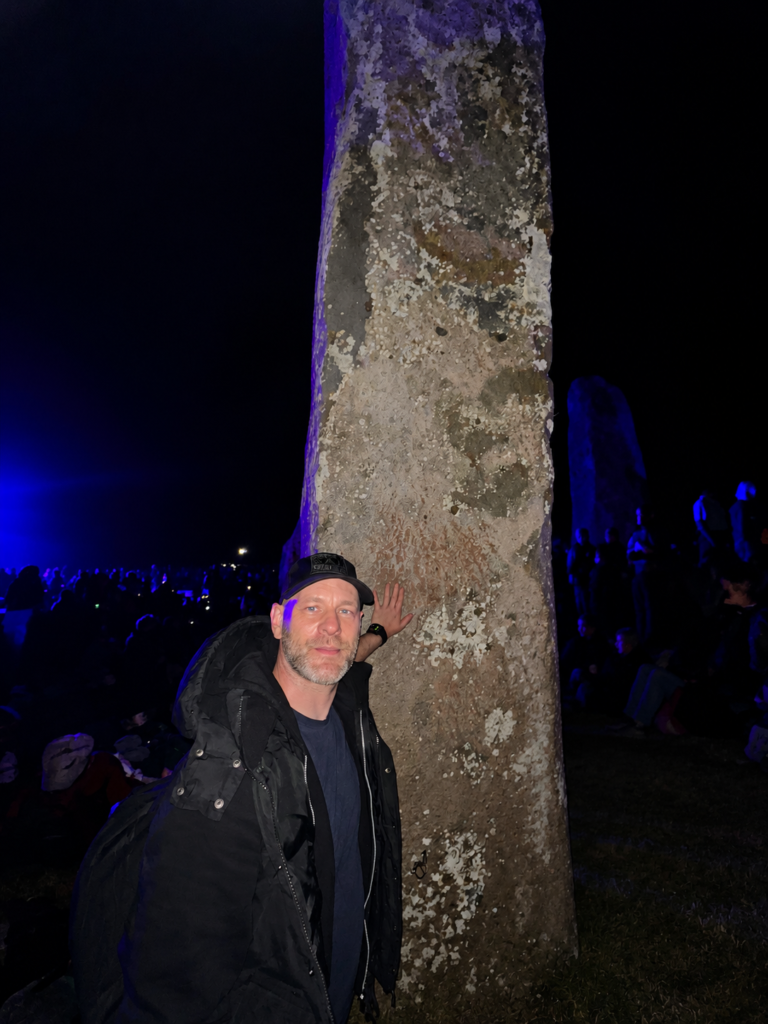
At the time, people around me were leaning against stones, sitting around them and moving freely through the monument, and I let myself get carried along with that atmosphere.
But English Heritage’s conditions of entry explicitly said not to touch or climb on the stones, explaining that contact can damage their surfaces and rare lichens.
So this isn’t me recommending that anyone repeat what I did.
It is part of what happened.
And emotionally, that brief moment was powerful.
I thought about the people who had stood in this landscape thousands of years before me. The monument had already survived more generations than I could properly imagine, while I was there for a few hours.
For a little while, the Stonehenge Summer Solstice genuinely felt like the experience I had hoped for.
Then the night changed.
The Part of Summer Solstice I Wasn’t Prepared For
I had imagined something quiet.
Maybe drums.
People watching the sky.
A strange but peaceful gathering around an ancient monument.
There were moments like that.
But there were also more than 20,000 people at Stonehenge that weekend.
And the centre of Stonehenge is not remotely big enough to make 20,000 people feel spacious.
By the time we settled into a position, we were packed together.
Move slightly and someone took the space.
Turn around and another phone appeared above your head.
Try to photograph the stones and you mostly photographed other people photographing the stones.
The crowd was part of the event — there was no escaping it.
What bothered me more was some of the behaviour I personally witnessed.
I saw people drinking despite alcohol being prohibited, smoking, leaving rubbish, vomiting and urinating around the site. There were people sleeping very close to and between stones, and others behaving around the monument in ways I found difficult to reconcile with its protected and, for many people, sacred status.
English Heritage’s published conditions prohibited alcohol and drugs, instructed visitors not to touch or climb on the stones, asked people to take rubbish away and specifically said not to desecrate the site or surrounding land.
I can only describe what I personally saw that night. It would be unfair to suggest everybody there behaved that way.
Most didn’t.
We met perfectly nice people. People talked, waited, watched the sky and shared the experience.
But enough of the other behaviour was happening around me that it began changing how I felt about being there.
I had arrived hoping the crowd would make Stonehenge feel more spiritual.
Instead, for a while, the crowd made it harder for me to feel Stonehenge at all.
And Then the Drums Started
This is the moment I remember most clearly.
Not because I can tell you exactly what kind of drums they were — I’m staying safely with rhythmic drumming rather than inventing some ancient ceremonial instrument. 😂
But because the sound changed something.
The drumming is one of the things I remember most. For a few moments, the sound changed the atmosphere completely and brought back some of the sense of ritual I had hoped to find here.
The stones were still glowing in the darkness.
The crowd was still enormous.
All of the things that had frustrated me were still there.
But with that rhythm echoing around Stonehenge, I suddenly understood why people keep coming back.
For a few minutes it stopped feeling like thousands of strangers waiting for a sunrise.
It felt like a gathering.
Waiting for First Light
Eventually the black sky began turning blue.
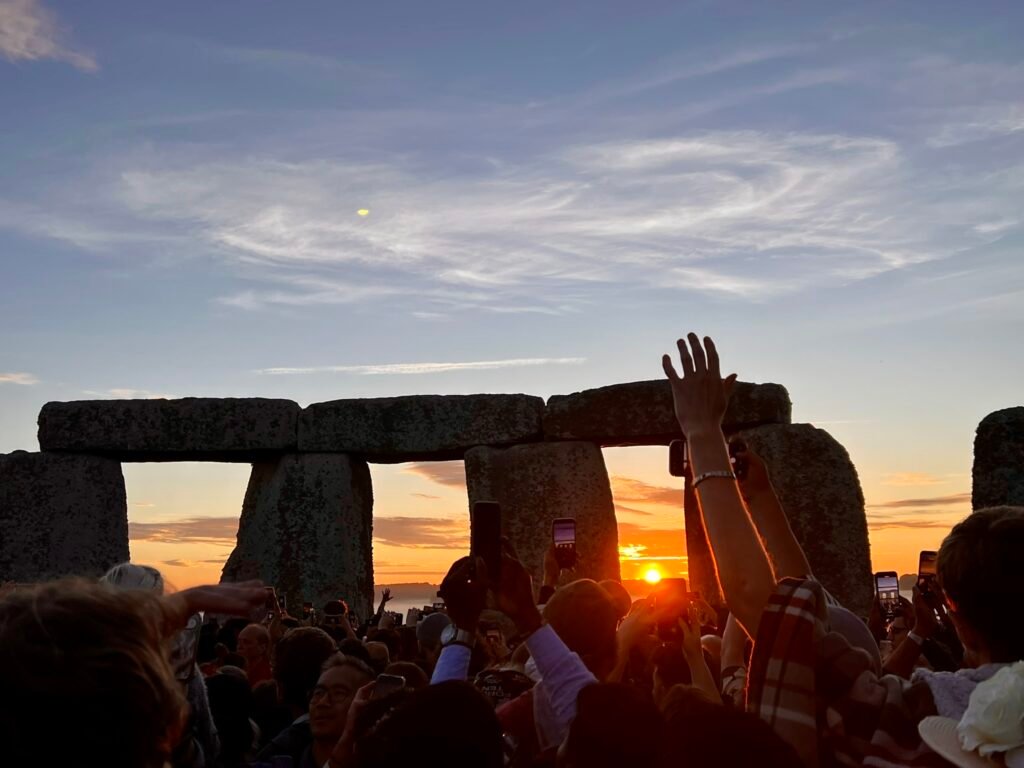
Then orange appeared behind the stones.
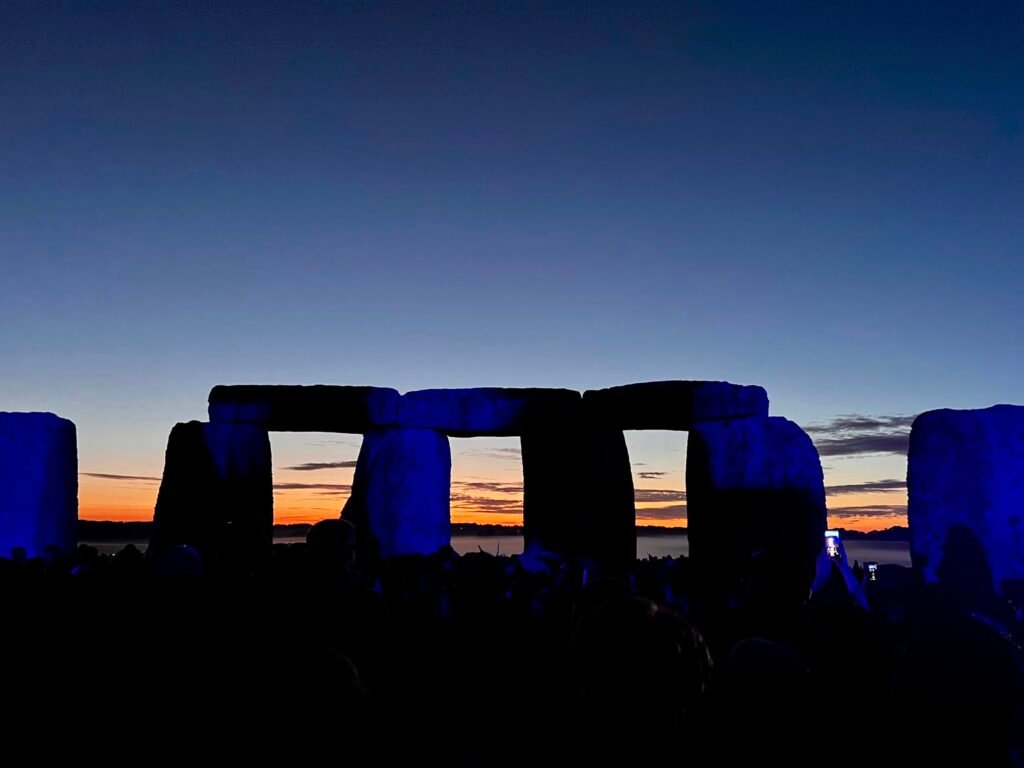
Officially, sunrise at Stonehenge on 21 June 2026 was approximately 4:52am.
My photographs tell a slightly different personal story.
The first frame where I can clearly see the sun itself appearing through the stones was taken a little after 5am.
That doesn’t mean the official sunrise time was wrong.
It simply means that was the moment when I could personally see it clearly from where I was standing, through the monument, horizon, atmosphere and thousands of other human beings.
And suddenly everybody’s phones went up.
Mine included.
That created another strange contradiction.
I had waited all night for this.
Yet when it finally happened, part of my brain stopped thinking about the sun and started thinking:
Is the photo straight?
Can I actually see it?
Whose arm is that?
Sometimes documenting an experience is exactly what prevents you from completely experiencing it.
Still, when that orange disc appeared between the stones, it was beautiful.
For a few seconds I stopped caring about the rubbish, the pushing, the waiting and the lack of sleep.
The sun was coming up on the longest day of the year.
And I was watching it from inside Stonehenge.
Was the Stonehenge Summer Solstice Worth It?
At about 5:30am, I had reached my limit.
I was tired.
I still had to drive back to Bournemouth.
And I told my friends, more or less:
You can stay if you want. I’m going. 😆
We eventually headed back across the damp grass towards the Visitor Centre.
Then came another wait — this time for the return bus to Wilton.
The official 334 timetable had return services every 30 minutes from 4:30am until 10am, although when you’re exhausted, half an hour has a remarkable ability to feel like several geological periods.
By the time we reached the car and started driving home, the roads were quiet.
And our conclusion was surprisingly similar.
I’m glad we did it.
None of us was desperate to do it again.
That probably remains the most accurate summary of my Stonehenge Summer Solstice experience.
At the time, disappointment won.
I had imagined spirituality and found crowds.
I had imagined quiet anticipation and found noise.
I had imagined an ancient place being treated with reverence and saw enough behaviour that upset me to change how I looked at Stonehenge for a while afterwards.
But distance has softened that.
When I think about the night now, the strongest memory isn’t somebody smoking beside a stone.
It isn’t waiting for the bus.
It isn’t even being crushed into the crowd.
It’s the sun.
For thousands of years, this monument has been connected to that point in the solar calendar.
And for one morning, I stood there and watched the light return through it.
That meant something to me.
Maybe once in a lifetime really is the right description.
Would I Recommend Going?
I wouldn’t tell somebody:
You absolutely have to experience Stonehenge Summer Solstice.
But I wouldn’t tell them to avoid it either.
I’d ask what they’re expecting.
If you love large communal gatherings, music, unusual traditions and the idea of welcoming the longest day surrounded by thousands of people, you may experience the night completely differently from me.
If you dislike crowds, value quiet historic places or imagine several hours of peaceful meditation beside the stones, adjust those expectations substantially.
And if you’re simply curious?
Going once might answer the question better than any article ever could.
For me, once was enough.
But I’m still glad there was a once.
Planning a Future Stonehenge Summer Solstice
The arrangements can change from year to year, so do not plan a future visit solely from my 2026 transport times or prices.
For current access rules, timings, parking and conditions, check the official Stonehenge Summer Solstice information from English Heritage before travelling. Official Stonehenge Summer Solstice information
If special buses operate again, check Salisbury Reds for the current timetable and fares rather than assuming the 2026 route 334 arrangements will remain unchanged. Salisbury Reds
And if you’re visiting Stonehenge on a normal day rather than for Solstice, I also use English Heritage membership for many of my historic stops. You can read my experience with English Heritage membership here. Is English Heritage Membership Worth It? My Experience
If the prehistoric side of Stonehenge interests you more than the crowds, another much quieter place I visited was Knowlton Church in Dorset, where a medieval ruin stands inside a prehistoric henge. It is completely different in scale, but I found that contrast between later history and a much older ceremonial landscape fascinating. Knowlton Church: Medieval Ruin in a Prehistoric Henge
One journey. One story. One more stop.