
Bournemouth Christmas Market is back, bringing its familiar wooden chalets, festive lights and seasonal atmosphere to the town centre. It’s clearly popular with visitors, and there’s plenty to enjoy if you’re in the Christmas spirit. Personally, I didn’t find it particularly extraordinary, but it’s a pleasant addition to a walk through Bournemouth at this time of year.

The market spreads across the town centre with food and drink stalls beneath the lights — a familiar festive scene that marks the start of another Bournemouth Christmas season.
I went for an evening wander, camera in hand, expecting the usual trees, decorations and something involving cinnamon. What I hadn’t expected was that a visit to Bournemouth Christmas Market 2026 would lead me from medieval Germany to a Bournemouth department store that once sent Father Christmas into the sky. Suddenly, the market itself seemed like just one chapter in a much stranger local Christmas tradition.
Where did Christmas markets actually come from?
The wooden stalls might feel like a modern seasonal invention, but Christmas markets have roots in medieval European winter trading. Long before illuminated reindeer and novelty hot chocolate, people needed somewhere to buy food and supplies for the coldest part of the year. Markets near Christmas gradually developed into places for seasonal treats, handmade decorations and gifts.
One of the best-known examples is Dresden’s Striezelmarkt, documented from 1434. Its first market lasted just one day and was primarily for buying meat for Christmas, rather than wandering around with an oversized mug of something sweet. The name comes from Striezel, a traditional festive loaf associated with what became Dresden’s famous stollen.
Nuremberg followed its own traditions: historical evidence for its Christkindlesmarkt goes back to at least the early 17th century. Toys, carved decorations, gingerbread and gifts became part of the appeal. So the modern chalet, nutcracker and sausage combination isn’t entirely random — although Bournemouth has given it a distinctly British seaside setting.
Bournemouth was celebrating long before the Alpine chalets
Bournemouth didn’t need to import Christmas enthusiasm. By the late Victorian period, its growing shopping streets were already full of festive ambition, and one particularly enthusiastic shopkeeper understood that a little spectacle could bring a lot of people into town.
J. E. Beale opened his Fancy Fair and Oriental House in Bournemouth in 1881, the beginning of the department store that would become a much-loved local institution. In 1885, he introduced a Father Christmas to the shop floor — an unusually early example of the in-store Santa experience. Imagine the excitement for local children, long before shopping centres made Santa’s grottos an annual fixture.
The family didn’t stop at putting a man in a red costume beside the toys. Soon, the preparations for Christmas involved elaborate parades, music, decorated floats and a degree of theatrical ambition that makes today’s illuminated chalets look rather restrained.
When Father Christmas arrived by aeroplane
This is my favourite part of the story. In the early 1910s, Cyril Beale decided that having Santa arrive by ordinary transport was no longer exciting enough. The solution? Put Father Christmas in an aeroplane. In an age when aviation was still new, noisy and decidedly less routine than a trip on the number 50 bus, that must have been a remarkable sight.
The historical accounts aren’t unanimous about the date: some summaries say 1912, while a detailed Dorset Life account of the flying Father Christmas places the flight on 5 December 1913. That account describes Cyril Beale taking to the air with pilot Henri Salmet, flying above Bournemouth and returning to land before continuing towards the store by road. His beard apparently had nearly as much excitement as the spectators.
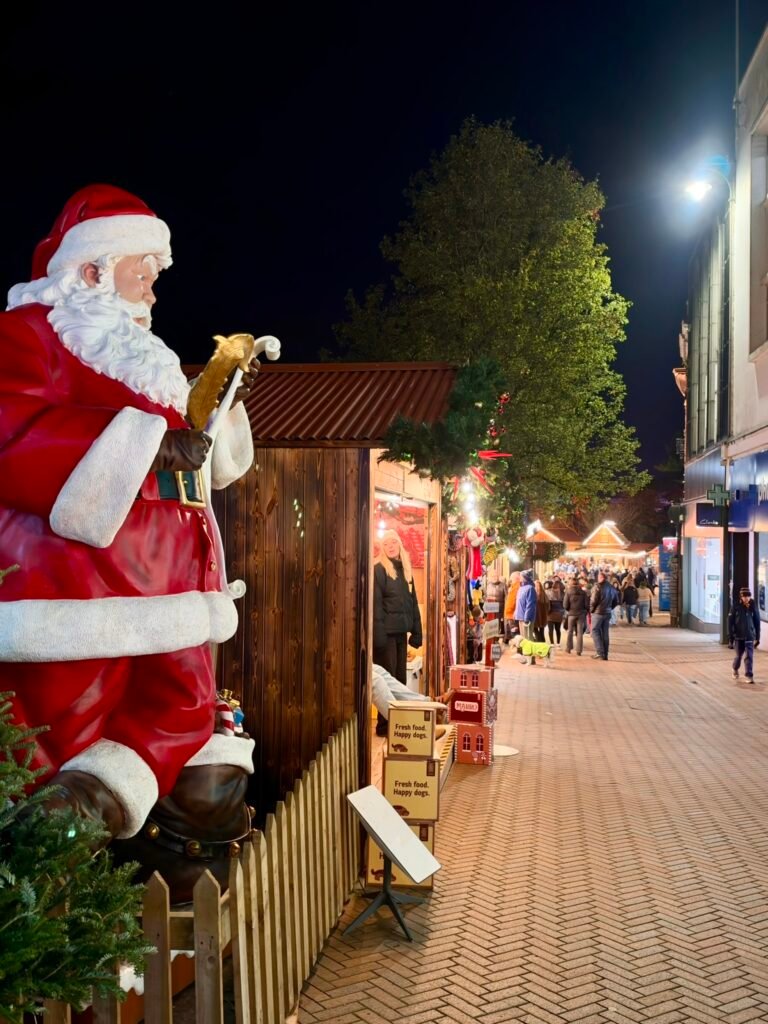
A modern Santa decoration overlooks the bustling market street, a playful visual companion to Bournemouth’s much older Christmas-parade traditions.
The flying stunt was short-lived, but Bournemouth’s Christmas parades became a much bigger tradition. By the 1950s, the processions featured enormous festive characters, bands and elaborate creations, with crowds filling the streets. Some of those giant models were so unwieldy that simply steering them around a corner was an achievement. A giant Christmas pudding negotiating a busy town centre? I’d have paid to watch that.
Eventually the parades grew so successful that they could practically stop people reaching the very shops they were supposed to promote. Beales’ own era of organising the procession ended in the 1960s, while community-led celebrations continued afterwards. It’s a lovely reminder that Bournemouth’s festive crowds didn’t begin with a collection of wooden huts.
Bournemouth Christmas Market 2026: an old idea in a modern town
The present-day market is a different kind of spectacle. Instead of a grand procession moving through the streets, it invites people to take their time among Alpine-style stalls, food counters, festive decorations and the surrounding shops. Bournemouth Christmas Market 2026 opened on 12 November, with its stalls scheduled to continue until 31 December. An early start, certainly — the medieval Dresden traders might have raised an eyebrow at a Christmas season lasting seven weeks.
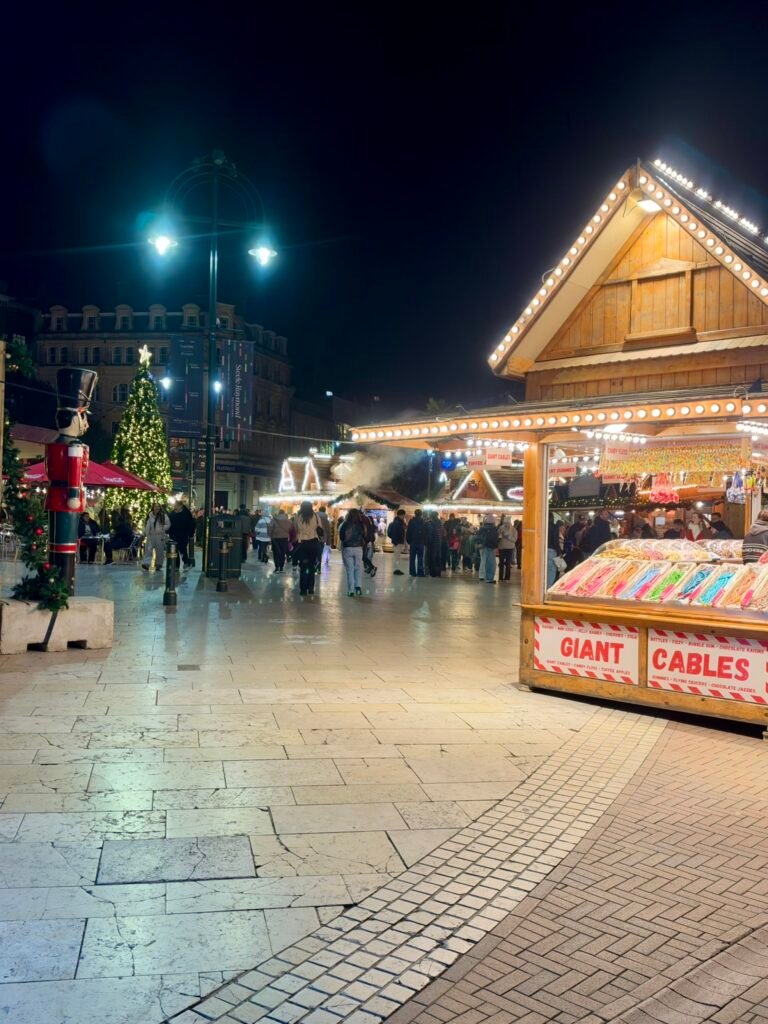
Fairy lights outline the timber roofs as visitors browse the stalls, with a brightly coloured confectionery display in the foreground.
There’s a familiar formula: warm lights outlining timber roofs, confectionery displays, the smell of hot food and the odd enormous decoration keeping watch over everyone. You can browse for gifts, meet friends or simply take a walk through the square. You don’t have to buy anything to appreciate that the town centre looks different after dark.
The spending side is, of course, part of the experience. One hot-chocolate stall I photographed had a £6 price on its menu, with a further £3 for an optional upgrade. I found that a little steep for my tastes, but it’s a clearly displayed choice rather than a compulsory entrance fee. The nutcracker beside the sign seemed completely untroubled by the economics of festive beverages.
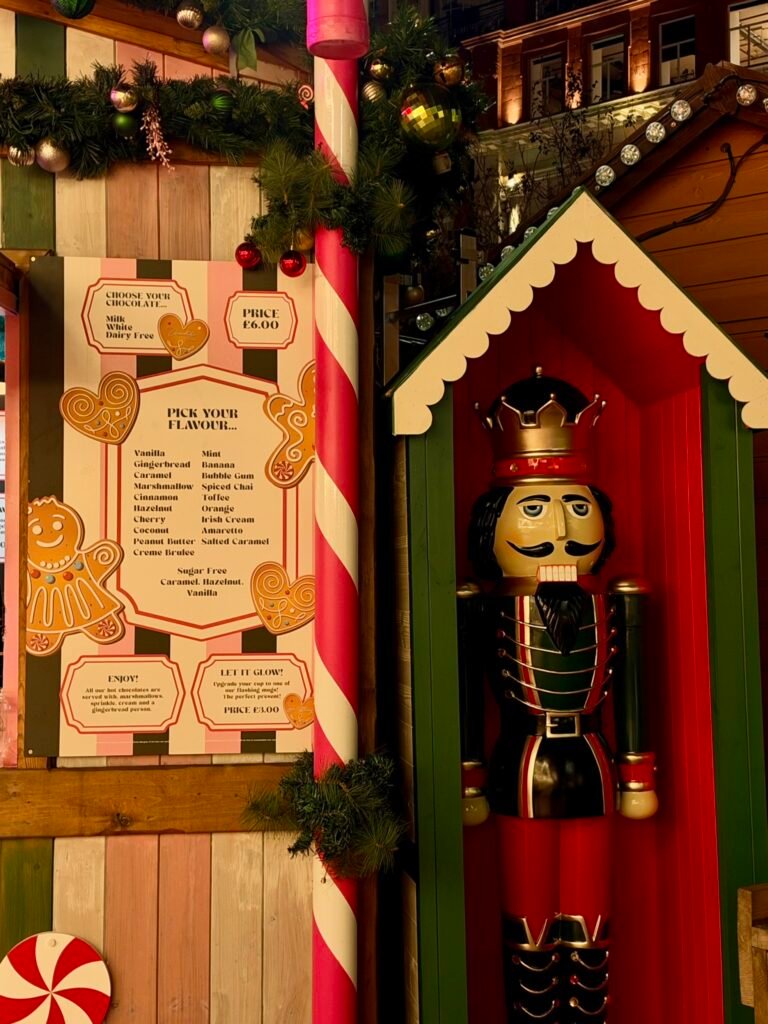
The decorated chalet displayed a choice of flavours and a £3 optional upgrade when I photographed it, a small glimpse of the food-and-drink side of the 2026 market.
And there’s no denying that the decorations photograph well. A tall tree draped in glowing red bows stands against Bournemouth’s older town-centre buildings, an almost theatrical contrast between the familiar architecture and the annual festive makeover.
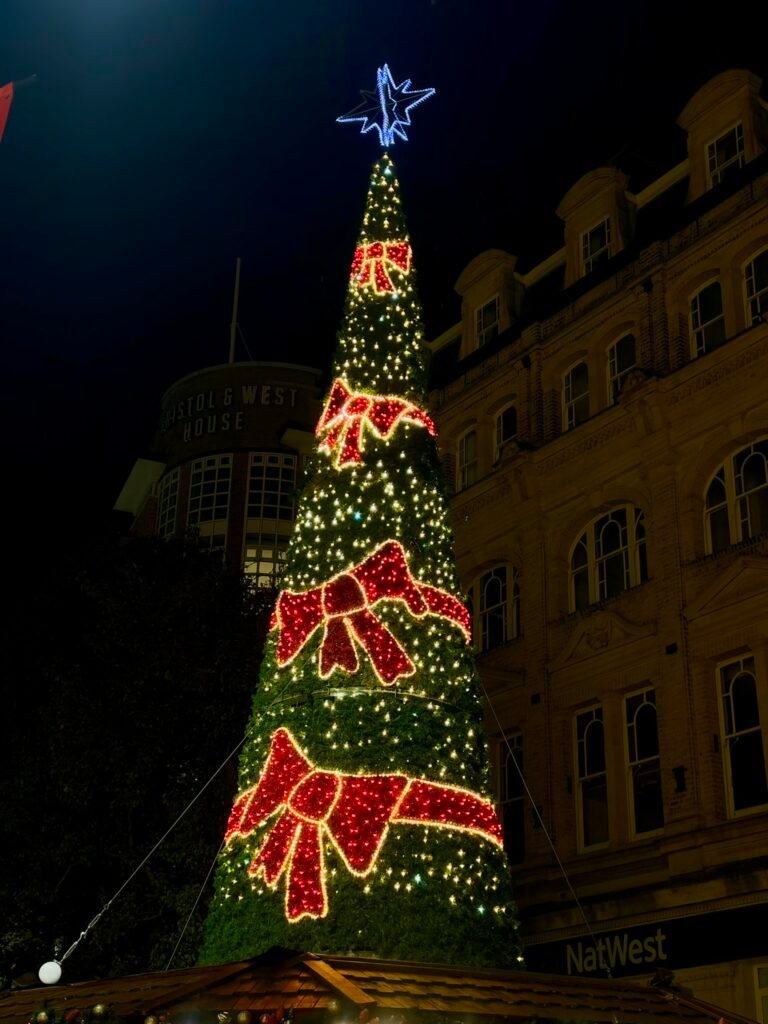
The blue star and bright decorations stand out against Bournemouth’s older town-centre buildings, linking the modern market with its familiar surroundings.
Nearby, a giant nutcracker stands beside another sparkling tree. It’s a cheerful scene, and the sort of detail that makes people stop for a photograph even if they have absolutely no intention of purchasing a Christmas ornament. I can understand why families, couples and groups of friends enjoy coming here: sometimes the point is simply being out together.
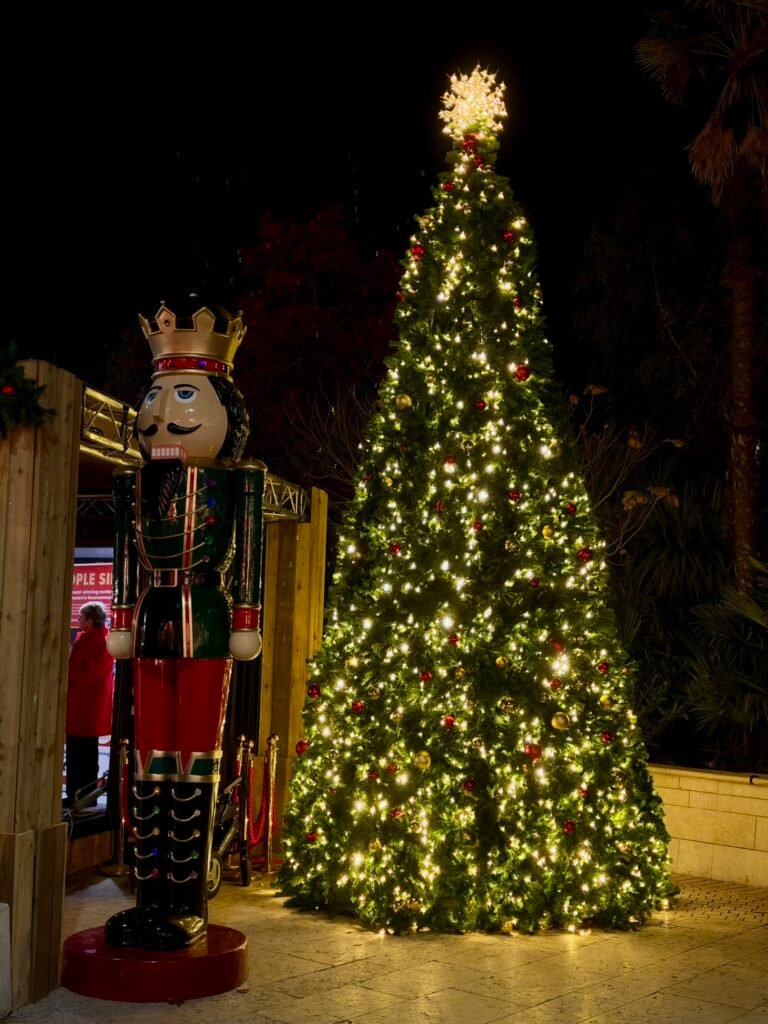
Warm white lights, red-and-gold baubles and a traditional soldier decoration make this one of the market’s more cheerful corners.
From Christmas Tree Wonderland to today’s illuminated Bournemouth
The lights beyond the stalls are part of another relatively recent chapter. Bournemouth’s original Christmas Tree Wonderland launched in 2018, bringing an ambitious free trail of illuminated trees into the Lower Gardens. It helped establish the gardens, rather than only the shopping streets, as part of the town’s festive identity.
A new arrangement took shape in 2025, when Seventa Events and SKATE Bournemouth joined forces to run a privately funded Christmas programme after public funding for the previous event could no longer continue. The offer now combines the market with the wider Festive Trail, an ice rink and other attractions. You can read about that change in the Bournemouth tourism team’s account of the new operators.
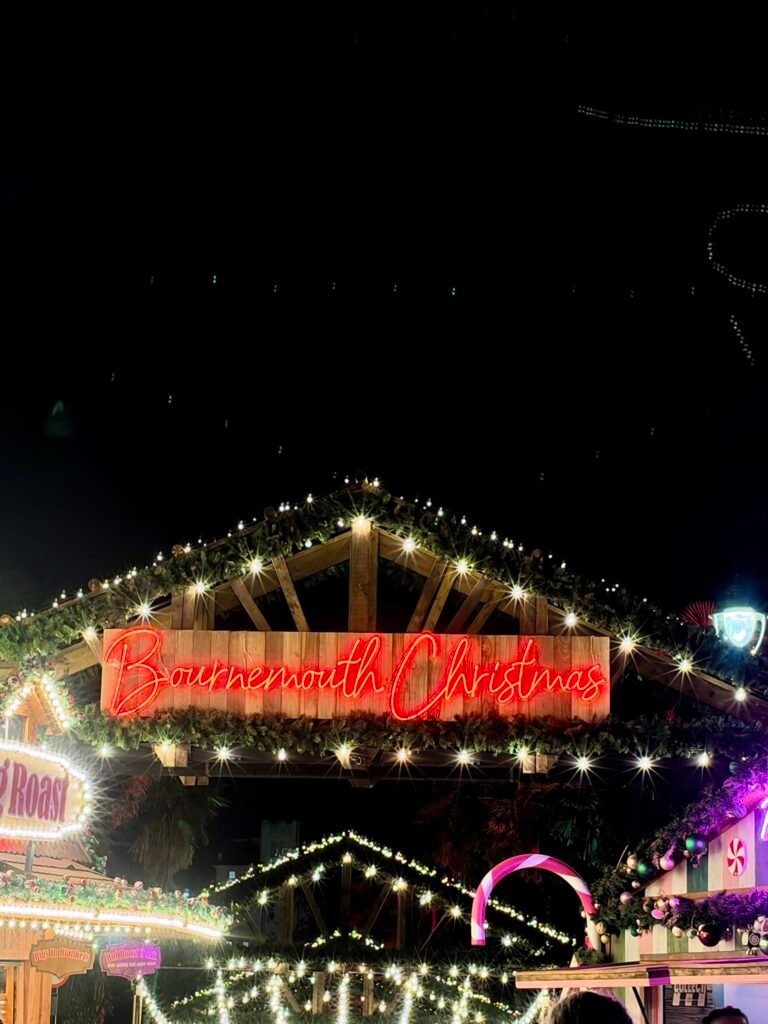
Red script lettering crowns a timber market structure dressed in greenery, with rows of lights and stalls continuing beneath it.
For me, the nicest part of the evening was carrying on beyond the buying and selling. Strings of lights under a wooden canopy draw you towards the Lower Gardens, where the setting opens up and the decorations become part of a walk rather than a row of shopfronts.

Garlands and strings of white bulbs hang beneath the timber canopy, while small trees and the illuminated BMTH display draw visitors onwards.
There are playful modern touches, too. Giant red BMTH XMAS letters make a bold declaration of local festive pride. It’s about as far from medieval German market tradition as you can get, but that contrast rather sums up Christmas in Bournemouth: borrowed customs, local memories and a little seaside-town reinvention.
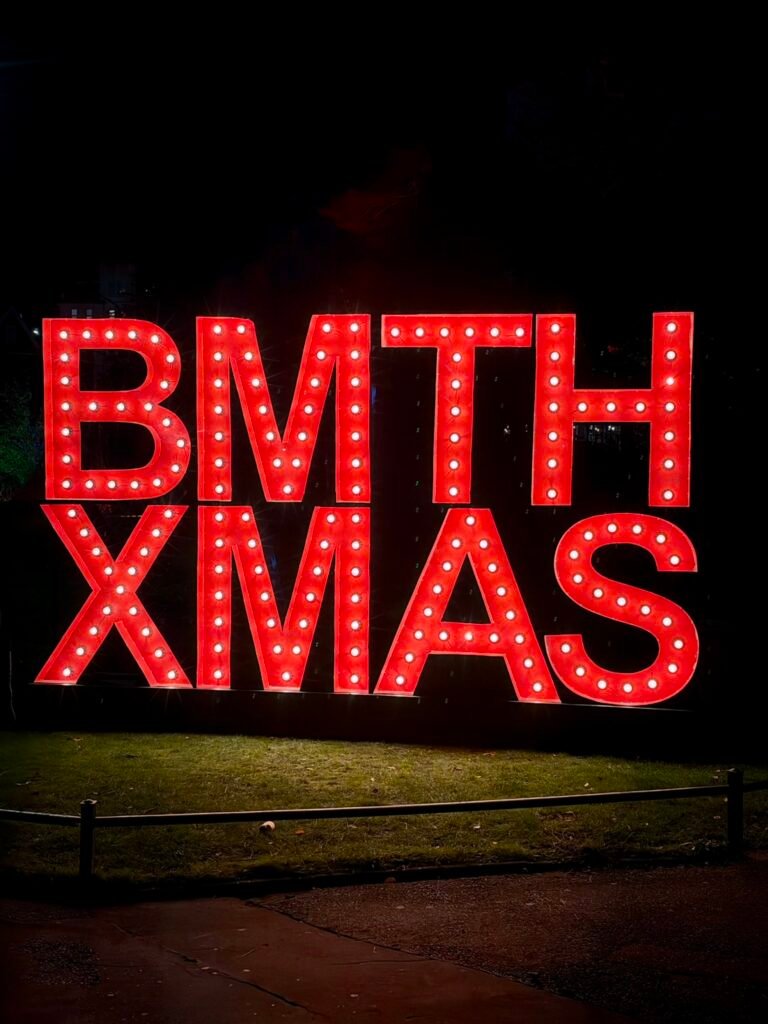
The oversized red letters are a very different kind of Christmas decoration from the market’s traditional chalets, but they have become part of the contemporary Bournemouth night-time scene.
Is the best part of Christmas in Bournemouth actually free?
That may depend on what you enjoy. If you’re after a special handmade gift or a festive treat, the chalets are there. If you simply want an evening out among lights and people, the market and the main garden trail are free to enter, with optional paid attractions elsewhere.
For exact dates, opening times, parking and accessibility, I’ve put the practical details in my separate Bournemouth Christmas Market 2026: Lights and Festive Trail guide rather than repeating them here.
Looking back at Beales’ extraordinary parades, the story isn’t only about shopping. It’s also about giving a town a reason to gather, laugh, take photographs and make memories. Perhaps the old flying Father Christmas and today’s illuminated gardens have more in common than they first appear to. If you fancy following Bournemouth’s green corridor farther inland, my Bournemouth Central Gardens and War Memorial walk offers another side of the town’s local history.
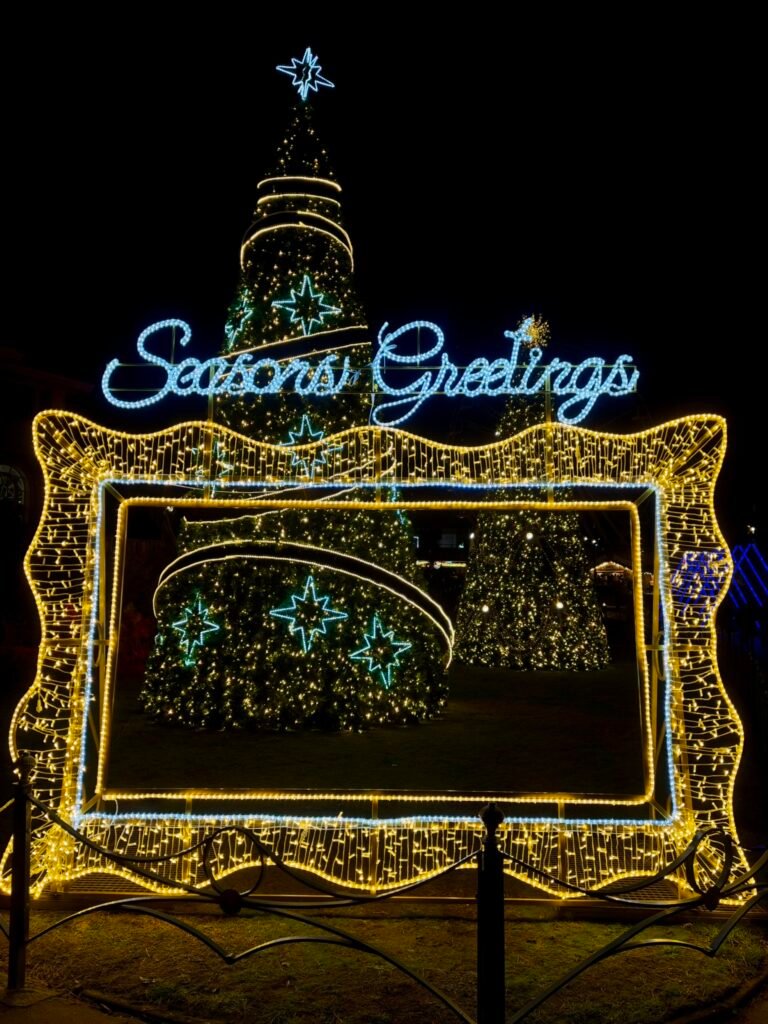
The illuminated frame sits in front of a tall decorated Christmas tree and more sparkling lights, offering a lovely place to pause before the end of a winter walk.
My own favourite ending was in the Lower Gardens, where the illuminated “Seasons Greetings” frame stands near sparkling trees and a colourful wash of light across the palms and planting. Bournemouth may not have the medieval lanes of a German market town, but it does have gardens, sea air and its own rather eccentric festive history. That’s enough to make an ordinary evening walk worthwhile.
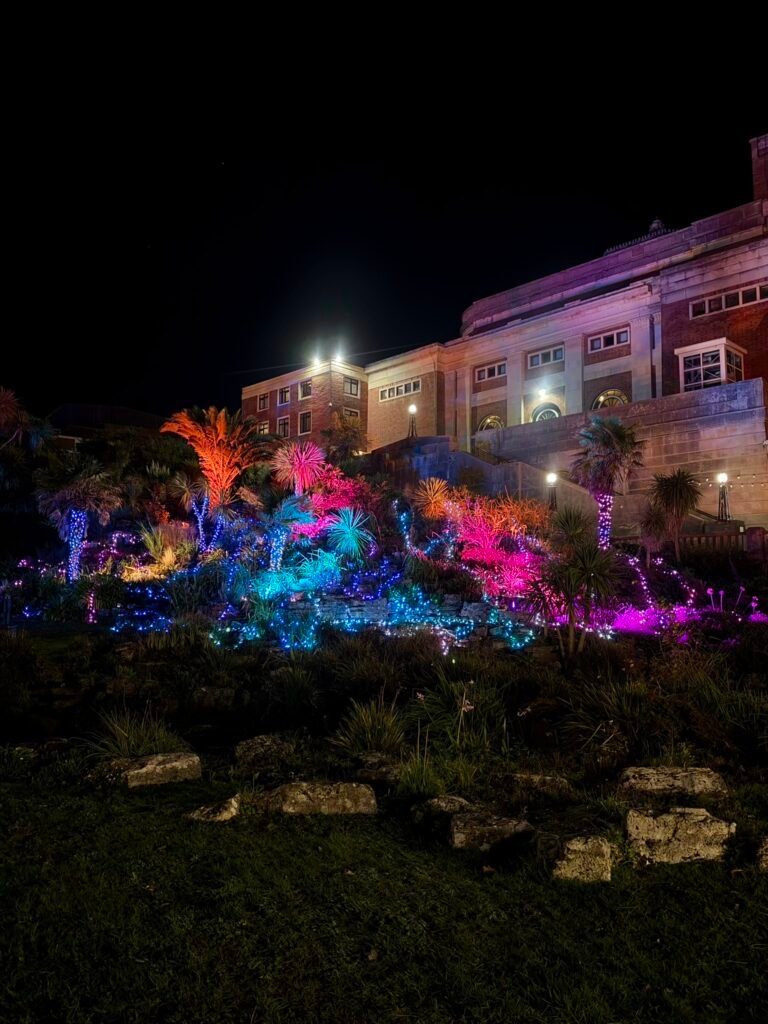
Palms and shrubs glow in blue, pink and purple beneath the neighbouring building — a quieter finale to a festive walk that does not have to revolve around shopping.
For other local stories and places worth a wander, there’s more in the Bournemouth archive and across the Dorset collection. As for Bournemouth Christmas Market 2026, I won’t declare it the greatest Christmas experience on earth — but the history behind it, and the lights beyond it, gave me plenty to enjoy. Somewhere in that story, Santa has finally found a more reliable way to get to work.
One journey. One story. One more stop.