
There are places you visit once and remember forever. And then there are places you walk through thousands of times without ever really thinking about them. For me, Bournemouth Central Gardens belongs firmly in the second category. For years, it was simply part of my daily routine: a shortcut to work, a route into town, somewhere to listen to music, or a pleasant walk to meet friends.
I’ve seen these gardens in almost every mood. Bright summer afternoons when the tennis courts were busy, quiet evenings when the paths were practically deserted, and those wonderful autumn weeks when the trees seem determined to outdo one another. But there’s something else here, standing quietly among all that greenery: the Bournemouth War Memorial. And once I started looking into its history, I realised how much I’d been walking past without noticing.
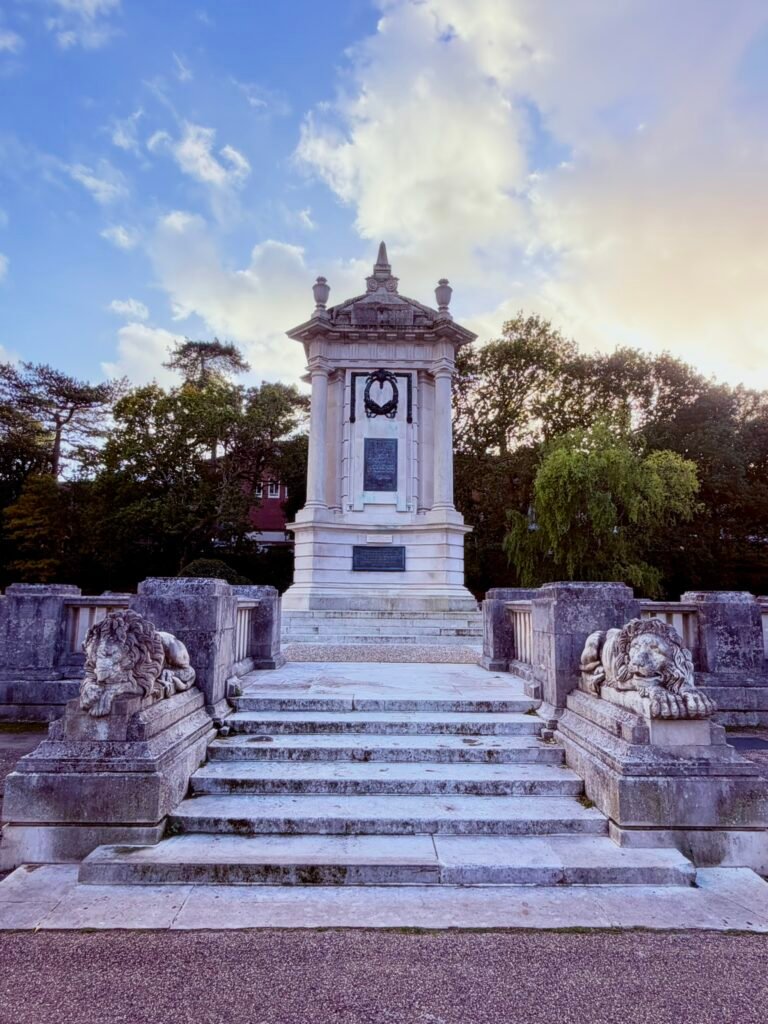
The Central Gardens war memorial was unveiled in 1922; one lion roars, the other rests, and both invite a moment of reflection.
Bournemouth Central Gardens: More Than Just a Pretty Shortcut
Bournemouth is famous for its beaches, but its gardens are every bit as much a part of the town’s identity. The chain of Lower, Central and Upper Gardens forms a green corridor running inland from the seafront, following the little River Bourne that gave Bournemouth its name. If street art is more your thing, Upside Gallery beneath Wessex Way is another free Bournemouth stop worth noticing.
It’s difficult to imagine now, but this carefully maintained landscape was once largely marshy ground. Development began in the 1840s, and permission for public pleasure grounds followed in 1859. During the Victorian era, Bournemouth was growing into a fashionable seaside resort, and creating attractive public gardens was part of that transformation.
The gardens weren’t simply somewhere to plant a few flowers. They were designed to be enjoyed, with winding walks, carefully chosen trees, landscaped spaces and places to pause. Much of their basic layout still reflects that Victorian vision.
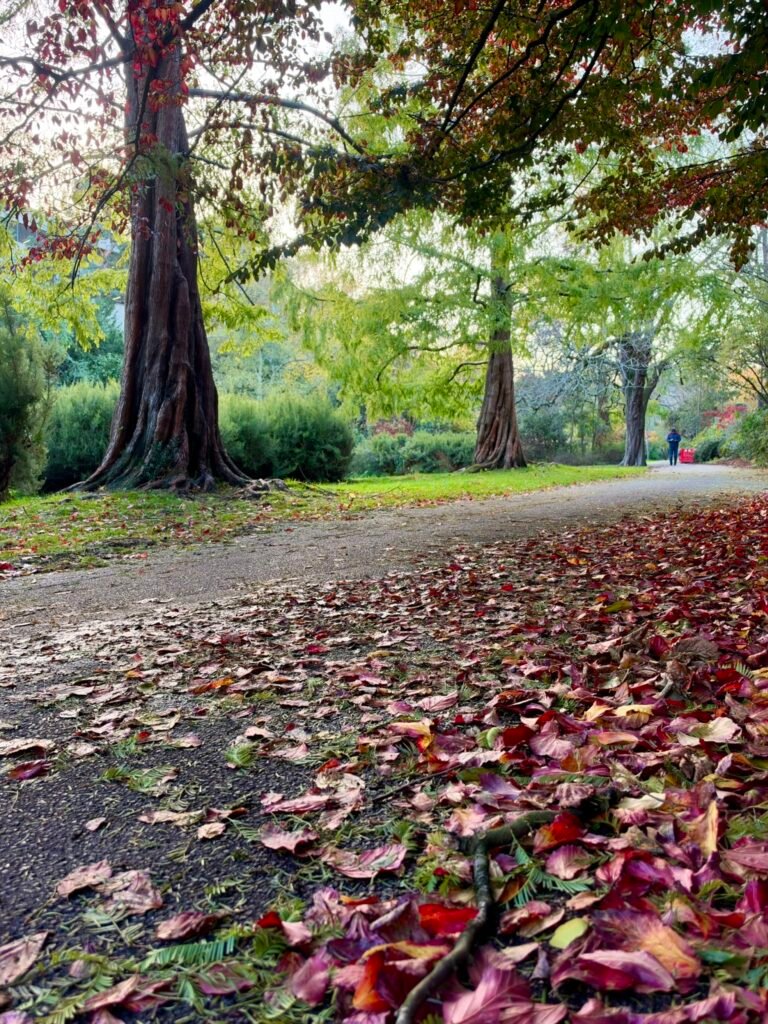
It has simply made one out of fallen leaves—and, thankfully, admission is free.
One of my favourite things about Central Gardens is how easily the atmosphere changes. A few minutes earlier, you might have been surrounded by traffic, shops and people rushing somewhere. Then you find yourself under enormous trees, following a quiet path with little more than birdsong, footsteps and whatever happens to be playing through your headphones.
And running through it all is the Bourne stream. It’s not a grand river or a spectacular waterfall, but it gives the gardens something special. Its gentle curves, little bridges and green banks make the surroundings feel like a proper landscape rather than a collection of lawns beside a busy town.
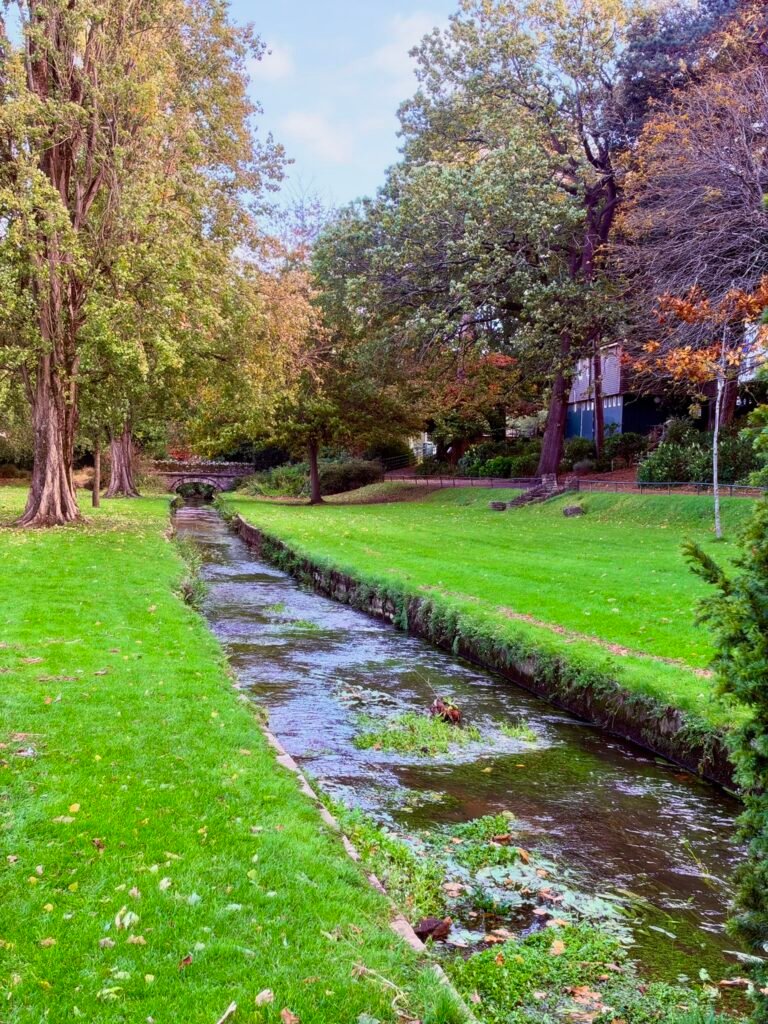
Here it passes between green lawns and mature trees, making the busy town centre feel remarkably far away.
The Same Gardens, Four Completely Different Seasons
Having walked through Central Gardens so regularly, I’ve come to appreciate the smaller changes that occasional visitors might miss.
In summer, the gardens become a popular escape from the town centre. People sit on the grass, take their lunch outside, enjoy the sunshine and play tennis nearby. There’s something wonderfully ordinary about it all, and that’s precisely why it matters. Not every beautiful public space needs to be a major tourist attraction.
Autumn, however, might be my favourite season here. The green lawns remain surprisingly bright while the surrounding trees turn shades of red, gold and orange. Fallen leaves collect beside the paths, the light softens, and familiar corners suddenly become worth photographing.
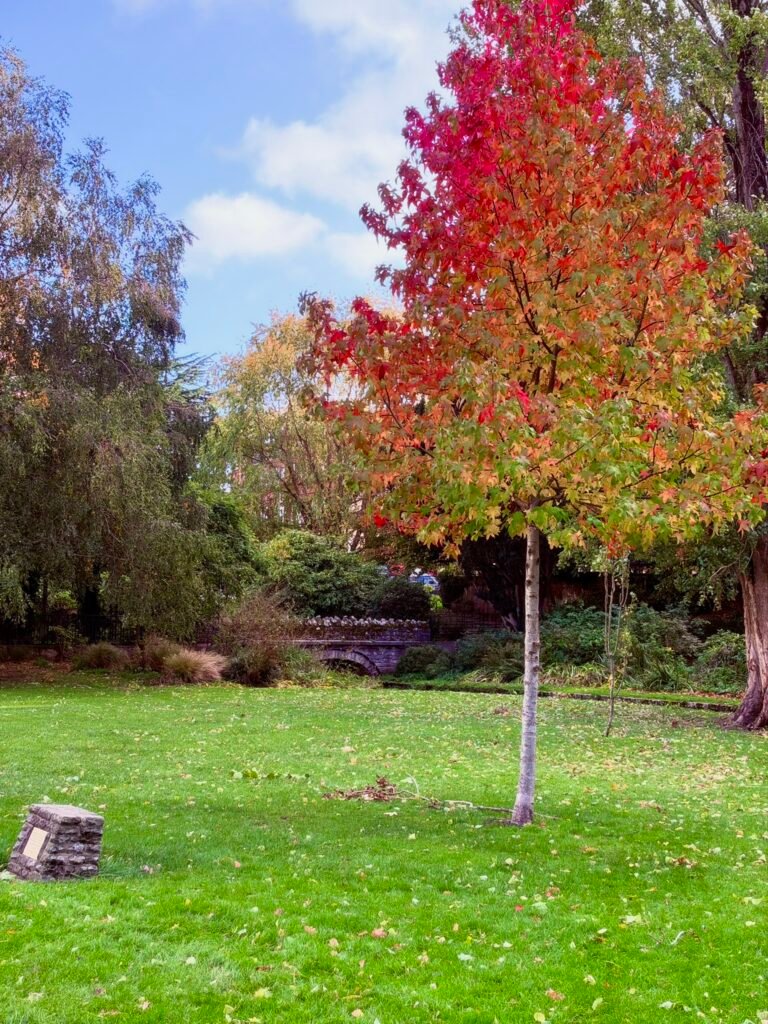
With scarlet and orange leaves against the green lawn, it is difficult not to stop for a photograph.
For visitors, it’s worth remembering that the gardens aren’t a single small park. There’s plenty to discover by simply following the paths farther along the Bourne. Even locals who know Central Gardens well might enjoy exploring the more natural Upper Gardens or heading downhill towards Bournemouth’s seafront.
A Grand Hotel, a Church Spire and Bournemouth’s Changing Identity
Look beyond the trees and you’ll notice that the surroundings have some impressive architecture, too.
One of the most striking buildings overlooking Central Gardens is Bournemouth Town Hall. With its elaborate façade and tower, it looks rather grand for an ordinary council building. That’s because it wasn’t originally built to be one.
It started life as the Mont Dore Hotel, a luxurious Victorian establishment. In 1921, Bournemouth Borough Council moved into the converted building, giving the growing resort a new civic headquarters. Its position beside the gardens and war memorial helped create the formal civic centre we recognise today.
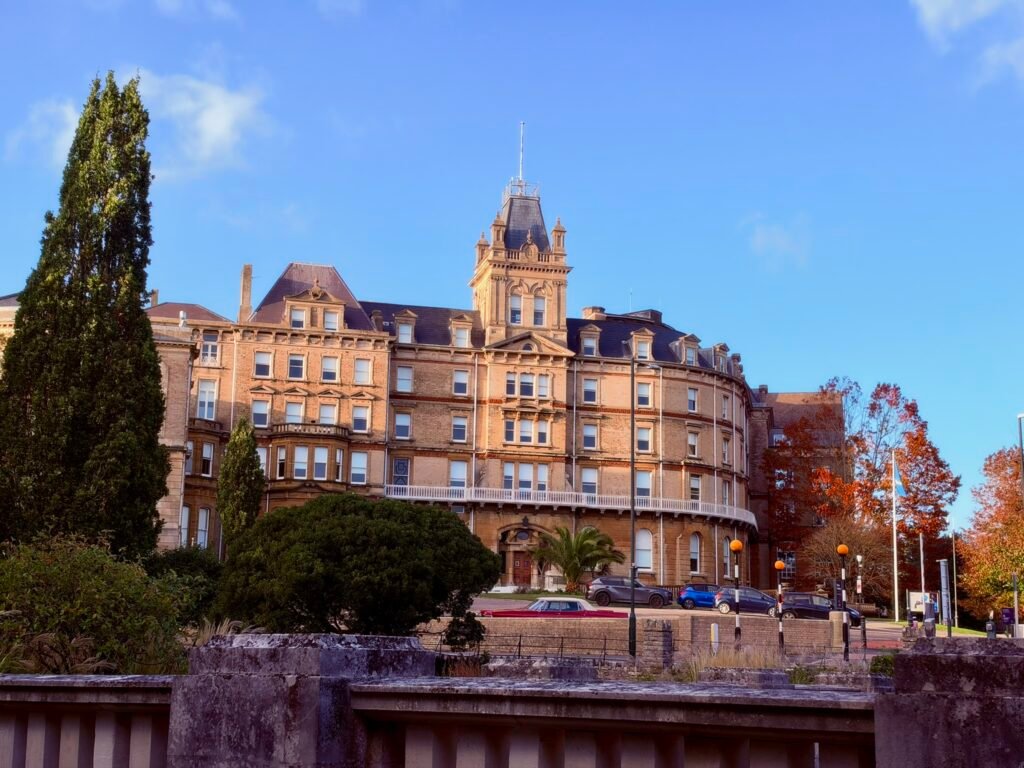
Before becoming the civic centre, this grand building welcomed hotel guests as the Mont Dore Hotel.
Another landmark rising above the surrounding trees is St Andrew’s Church, also known as Richmond Hill United Reformed Church. Its slender Gothic spire is one of those features of Bournemouth’s skyline that you might recognise immediately without necessarily knowing its name.
I particularly like how the church appears between the trees. You don’t always get a complete view of the building, just a glimpse of its striking stone tower framed by greenery. It reminds you that the gardens sit within a much older and more architecturally interesting town than the familiar image of Bournemouth’s beaches might suggest.
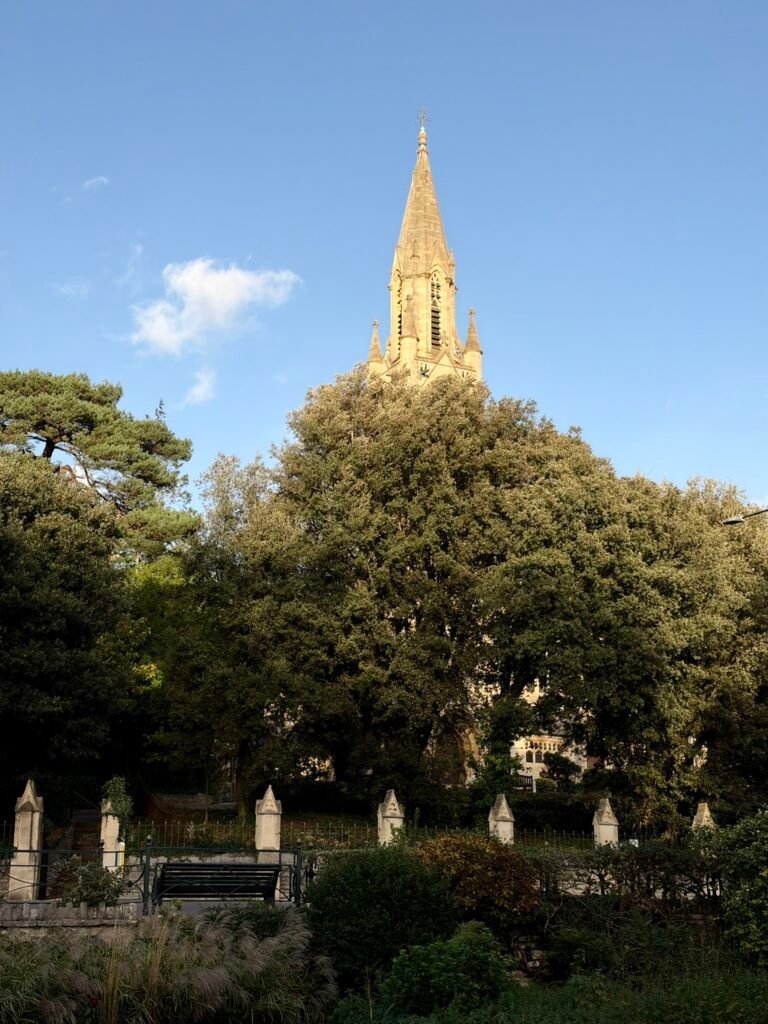
Its slender stone spire peeks through the trees near the Town Hall and War Memorial.
Bournemouth War Memorial: The Story Behind the Stone Lions
Now we come to the place that made me reconsider this familiar walk.
The Bournemouth War Memorial was unveiled on 8 November 1922 to honour local people who had lost their lives during the First World War. Its construction formed part of a wider effort to develop Bournemouth’s civic centre following the conflict.
Designed by Albert Edward Shervey, Bournemouth’s deputy architect, the memorial is built from Portland stone. Its classical columns, decorative urns and bronze wreaths give it an imposing appearance, but the most memorable details are undoubtedly the two stone lions guarding the entrance.
They were carved by monumental mason W. A. Hoare. One is shown roaring, while the other is asleep. Their designs are believed to have been inspired by a pair of lions at Chatsworth House, themselves based on sculptures by the celebrated Italian artist Antonio Canova in St Peter’s Basilica, Rome.
So those familiar Bournemouth lions have an artistic family history stretching all the way to Rome. That’s certainly something I didn’t know during the countless times I walked past them.

The pair were carved by W. A. Hoare for Bournemouth’s 1922 war memorial, giving the solemn monument a surprisingly expressive detail.
The memorial is also more historically significant than its everyday surroundings might suggest. In 2014, it received Grade II listed status*, recognising its exceptional architectural, artistic and historical importance.
Yet it remains very much part of ordinary Bournemouth life. People pass it on their way to work, children are fascinated by the lions, and visitors stop for photographs. It’s easy to admire the sculptures without giving much thought to why the monument exists.
And perhaps that’s what makes it worth stopping here properly.
The Names and Stories We Don’t Always Think About
The memorial’s original bronze dedication commemorates the men and women of Bournemouth who died during the First World War, from 1914 to 1918. A later inscription remembers those who lost their lives in the Second World War, while another dedication honours servicemen and women who died in conflicts since.
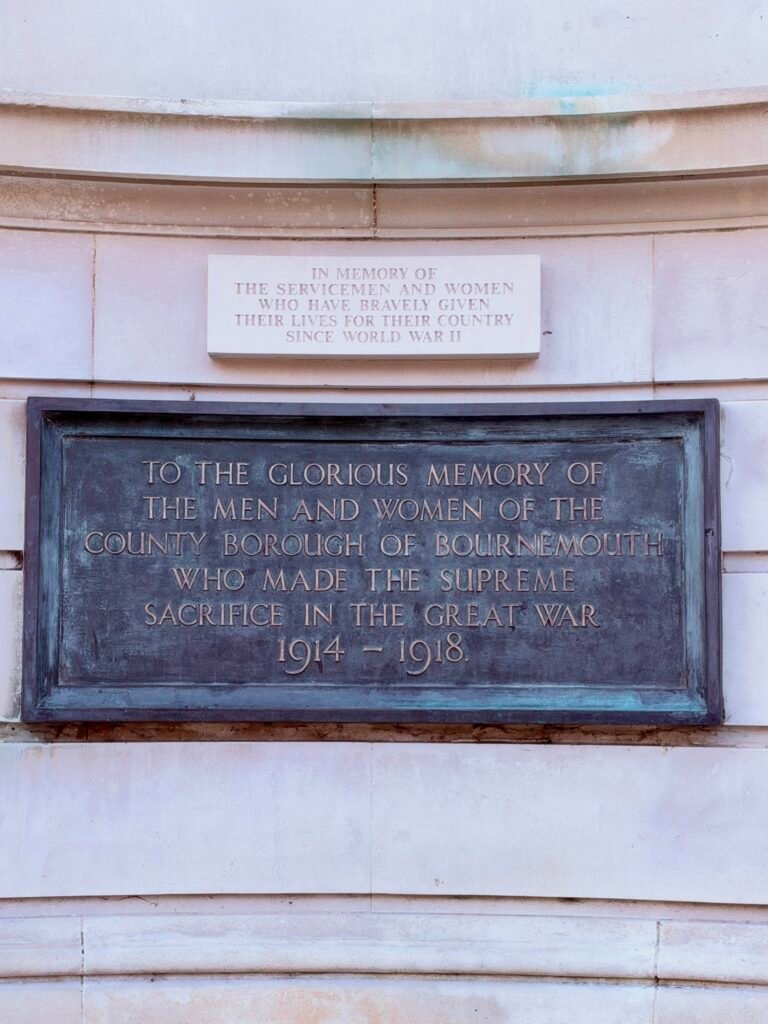
This dedication remembers Bournemouth’s men and women who died in the First World War, while a smaller plaque above honours those lost in conflicts since the Second World War.
I wasn’t born in Bournemouth, and I didn’t grow up with British Remembrance traditions. For many years, the monument was simply a familiar landmark along my route through town. I knew it was important, but I hadn’t really taken the time to understand its story.
Reading those inscriptions gives the place a different meaning. The people being remembered had their own families, friends, jobs, plans and ordinary lives. They belonged to a community that, in many ways, would have looked very different from today’s Bournemouth. Yet the loss experienced by their families is something people can understand regardless of where they come from.
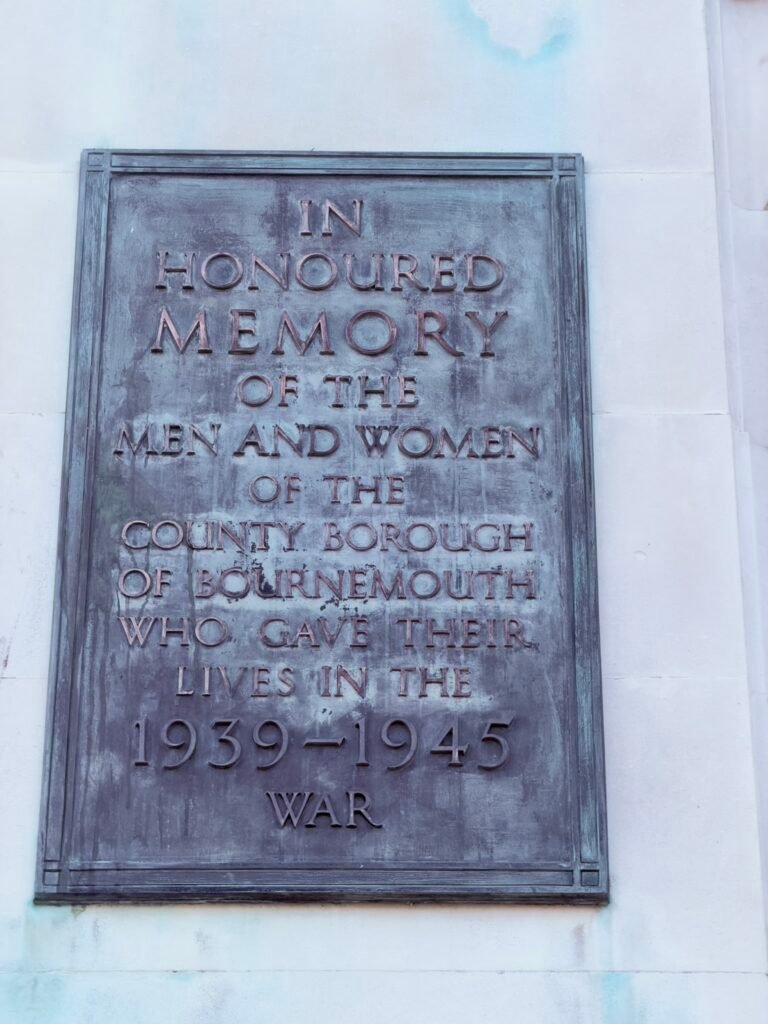
It commemorates Bournemouth’s men and women who lost their lives during the 1939–1945 war.
Every November, Bournemouth holds a Remembrance Sunday service at the memorial. For many families and members of the community, it’s an important annual occasion, but you don’t need to attend a ceremony to acknowledge what the monument represents.
I’ve lived in Britain for more than twenty years, and Bournemouth has become home. I may not share every historical connection with the people remembered here, but I can understand the human cost of war. Standing in front of those inscriptions, that feels much more important than nationality.
Two Directions, Two Very Different Sides of Bournemouth
One of the lovely things about Central Gardens is that you can explore two completely different sides of Bournemouth, depending on which direction you take.
Head inland towards Upper Gardens, and you’ll come across the Wessex Way flyover. Beneath its enormous concrete supports is the Upside Gallery, where colourful street-art murals have transformed an otherwise ordinary underpass into an unexpected outdoor art gallery. I’ve walked beneath that bridge thousands of times without properly stopping to appreciate the artwork. It’s a fascinating contrast to the gardens’ Victorian landscaping and deserves a closer look in its own right.
Head in the opposite direction, towards The Square and the seafront, and you’ll reach the Lower Gardens, where the atmosphere becomes livelier and Bournemouth’s familiar seaside attractions aren’t far away.
It was from the Lower Gardens, looking back towards Central Gardens, that I photographed the distinctive clock-topped roof of the Obscura Café, with St Andrew’s Church rising beyond it. It’s a lovely little view that brings together Bournemouth’s gardens, architecture and town-centre character.
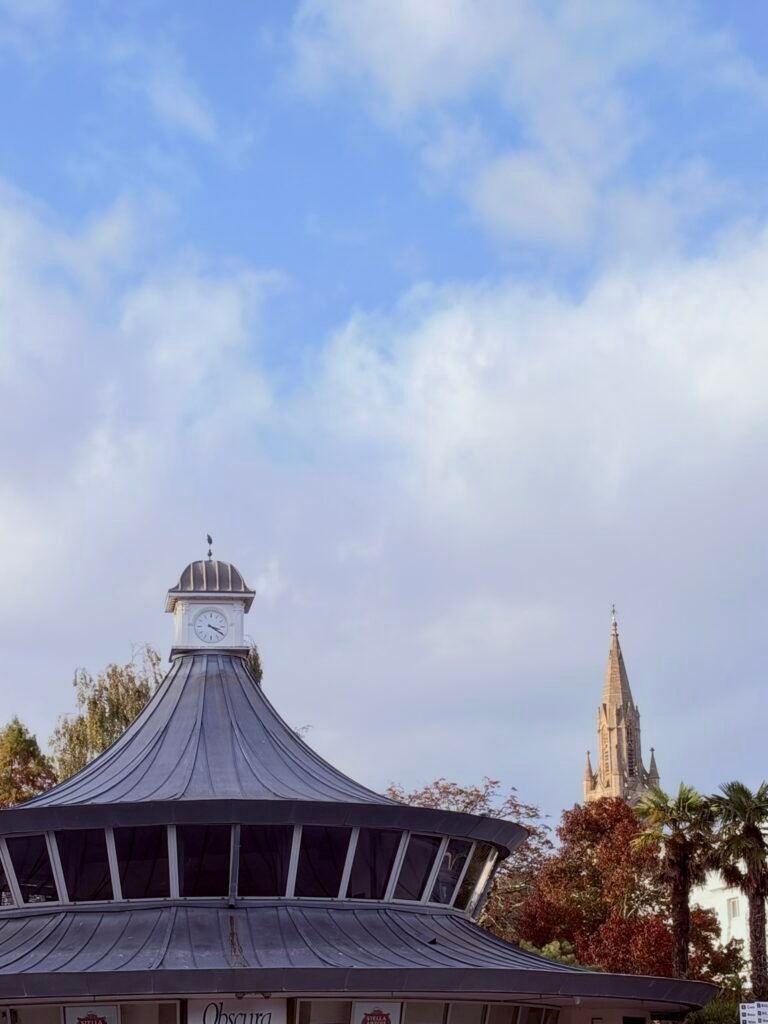
The Obscura Café marks The Square, with St Andrew’s Church visible beyond the rooftops.
From the Lower Gardens, it’s an easy walk down to the beach. If you want to make a longer outing of it, my article about Bournemouth Pier explores another familiar landmark that’s worth seeing from a slightly different perspective.
And if you enjoy discovering the stories behind buildings that locals pass every day, the historic Bournemouth Clock Tower at Lansdowne has another surprisingly interesting past.
Visiting Bournemouth Central Gardens: Practical Information
Location and parking
Central Gardens sit between Bournemouth’s town centre and the wider Bourne Valley gardens. Entry is free, and you can explore at your own pace. If you’re driving, Avenue Road car park or Richmond Gardens multi-storey are useful paid options. Check the current tariffs before travelling, particularly if you intend to stay in town for several hours.
Accessibility and facilities
The main gardens have surfaced walking paths, although gradients and some uneven areas may present difficulties. The memorial’s raised enclosure is reached by steps, so wheelchair users may find it easier to appreciate the monument from the surrounding paths. There are refreshments and toilet facilities in the wider gardens and town centre, while families can also make use of the nearby play area.
For the latest park information, visit BCP Council’s Bournemouth Gardens guide.
Perhaps the Best Places Are the Ones We Already Know
I suppose what surprised me most about researching Bournemouth Central Gardens was how much history had been sitting quietly beside my everyday routine.
The gardens themselves tell the story of Bournemouth’s transformation from a developing seaside resort into a thriving town. The surrounding buildings reveal its ambitions, while the war memorial reminds us of the people who helped shape its community and the lives lost along the way.
None of that takes away from the simple pleasure of walking here. I still love the trees, the stream, the autumn colours and those sunny afternoons when everyone seems to be enjoying a little breathing space.
But next time I pass the stone lions, I think I’ll stop for a moment longer.
And if you’re a Bournemouth local, perhaps you might too. There’s a whole collection of familiar places worth rediscovering across Bournemouth and the wider Dorset region.
Sometimes you don’t need to travel somewhere new to discover something interesting. You just need to look more closely at a place you already know.
One journey. One story. One more stop.