
For years, I genuinely thought Bournemouth had some unusually talented graffiti artists. Every time I walked beneath the Wessex Way flyover, I’d notice the enormous colourful paintings covering its concrete pillars and think, Well, at least our local hooligans have artistic talent! 😂
Apparently, I was wrong. These weren’t the spontaneous creations of Bournemouth’s next generation of Banksys. They were carefully commissioned artworks by some genuinely accomplished British street artists, forming a permanent outdoor exhibition called Upside Gallery Bournemouth.
I’ve walked beneath this bridge thousands of times over the past seven or eight years, sometimes several times a day. Yet it was only recently that I actually stopped, looked properly and discovered the fascinating stories behind the paintings. And I suspect I’m not the only Bournemouth local who’s been overlooking something rather special.
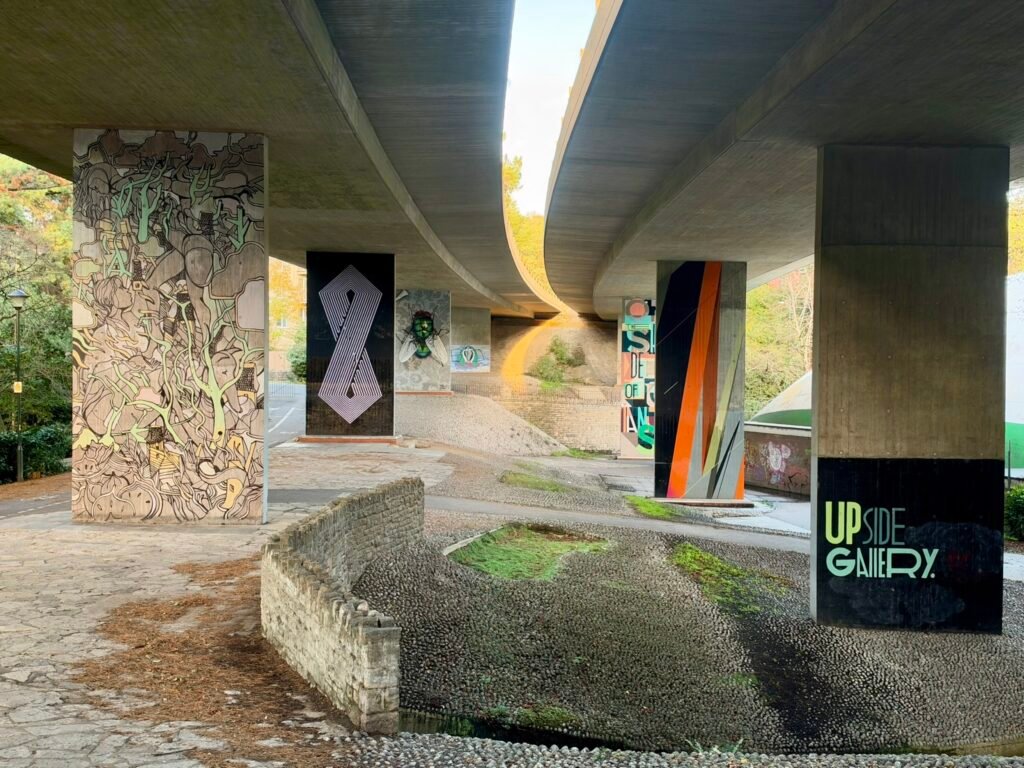
Beneath the Wessex Way, towering painted pillars turn an overlooked corner of Central Gardens into a wonderfully unexpected art stop.
From Grey Concrete to Bournemouth’s Most Unusual Art Gallery
The Upside Gallery sits beneath the Wessex Way, where the enormous road bridge crosses Bournemouth Central Gardens towards Upper Gardens. Its location is rather extraordinary: a green public park, a gently flowing stream, towering concrete supports and the constant rumble of traffic overhead.
The flyover was built during the 1970s, and its huge grey pillars weren’t exactly Bournemouth’s most attractive architectural features. They were practical pieces of infrastructure, but hardly something you’d travel across town to admire.
That changed in September 2019, when 11 professional artists transformed the supports into gigantic canvases over approximately two weeks.
The project was conceived by Bournemouth-based creative agency Paintshop Studio, with support from BCP Council and public funding from Arts Council England. The idea was to turn an overlooked urban space into somewhere people would actually want to visit.
And it worked rather well. Instead of hiding the concrete, the artists used its enormous scale to their advantage. Some paintings reach around ten metres high, which is quite impressive when you remember that most of us struggle to paint a bedroom wall without making a mess.
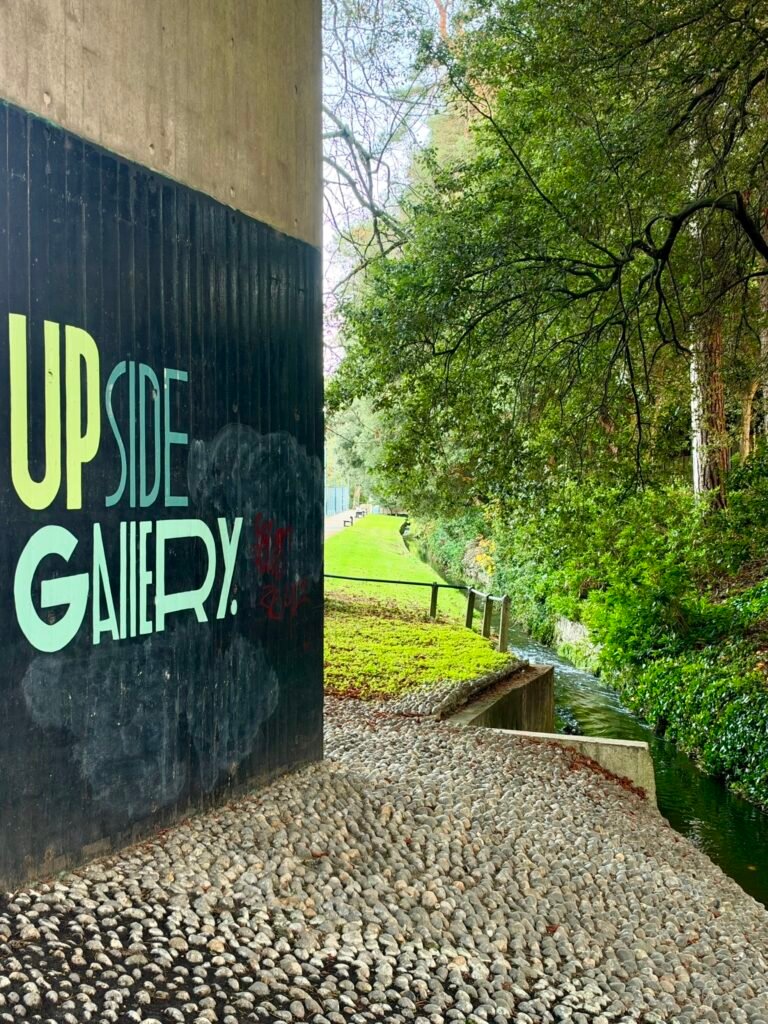
The Upside Gallery lettering marks the edge of the underpass, where quiet greenery meets a very lively display of street art.
The setting makes the project even more interesting. Here, a traditional public garden meets contemporary urban art, and the contrast somehow feels completely natural.
If you’d like to explore the surrounding green space, my Bournemouth Central Gardens and War Memorial article tells the story of a place I’ve walked through almost daily for years.
Not All Graffiti Is the Same — And That’s the Point
Before looking into the Upside Gallery, I hadn’t really thought much about the difference between graffiti, street art and commissioned murals.
Graffiti has a complicated history. It can be an act of personal expression, a highly developed artistic discipline or simply unwanted marking on someone else’s property. The difference often comes down to permission, intention and context.
Upside Gallery demonstrates what happens when talented artists are invited to work on a huge scale.
The murals are not random decorations. Each artist brings a distinct style, technique and creative background. Some specialise in realistic painting, others in abstract shapes, graphic lettering or imaginative characters.
And yes, you can still find less impressive spray-painted marks around the area, including near some of the information plaques. Those are rather different from the carefully planned works beside them.
The gallery gives visitors an opportunity to appreciate the skill behind street art without needing to know anything about art history. Which is fortunate, because I certainly wouldn’t describe myself as an art expert.
Eleven Artists, Eleven Very Different Approaches
What makes the Upside Gallery murals especially interesting is their variety. It’s not simply the same painting repeated on different pillars.
Take Tea One’s Islands, for example. The Preston-born artist combines bold colours, industrial influences, lettering and a painted boat in a composition that seems perfectly at home beside Bournemouth’s water and greenery.
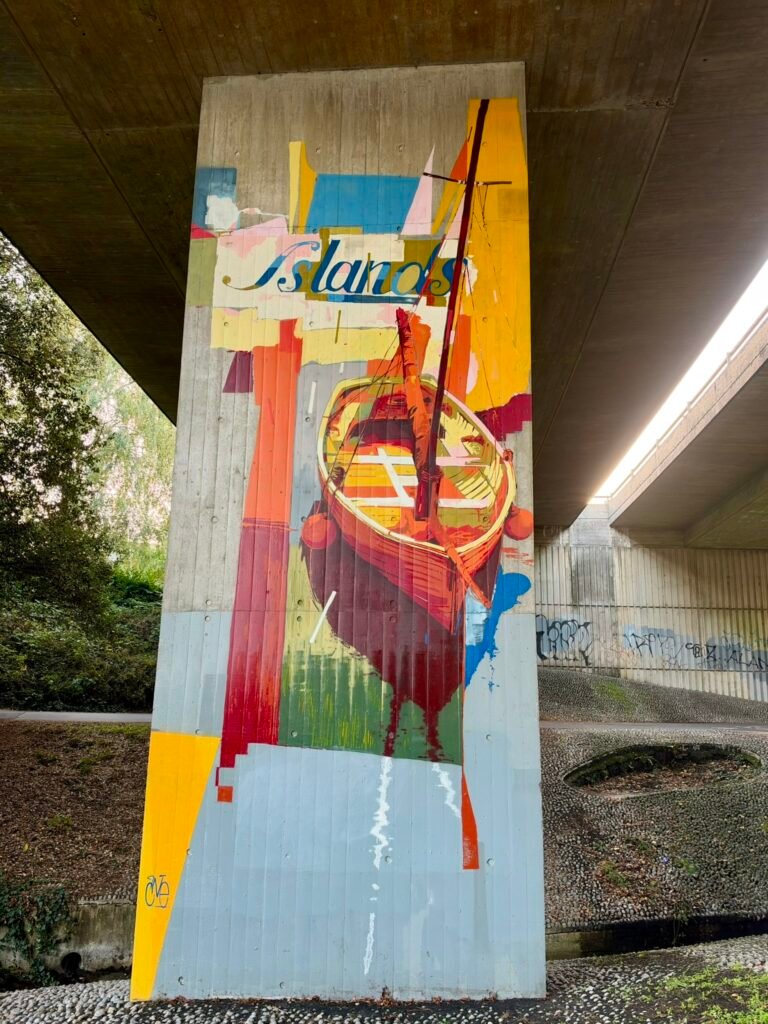
Tea One’s *Islands* brings a vivid vessel, lettering and bold blocks of colour to a concrete pillar a little way from Bournemouth’s beaches.
Then there’s London-based Remi Rough, whose work is almost the complete opposite.
His painting, Monolith B, uses sharp geometric forms and contrasting colours to create movement across the enormous concrete support. Rough has spent decades developing his style from traditional graffiti lettering into contemporary abstract art.
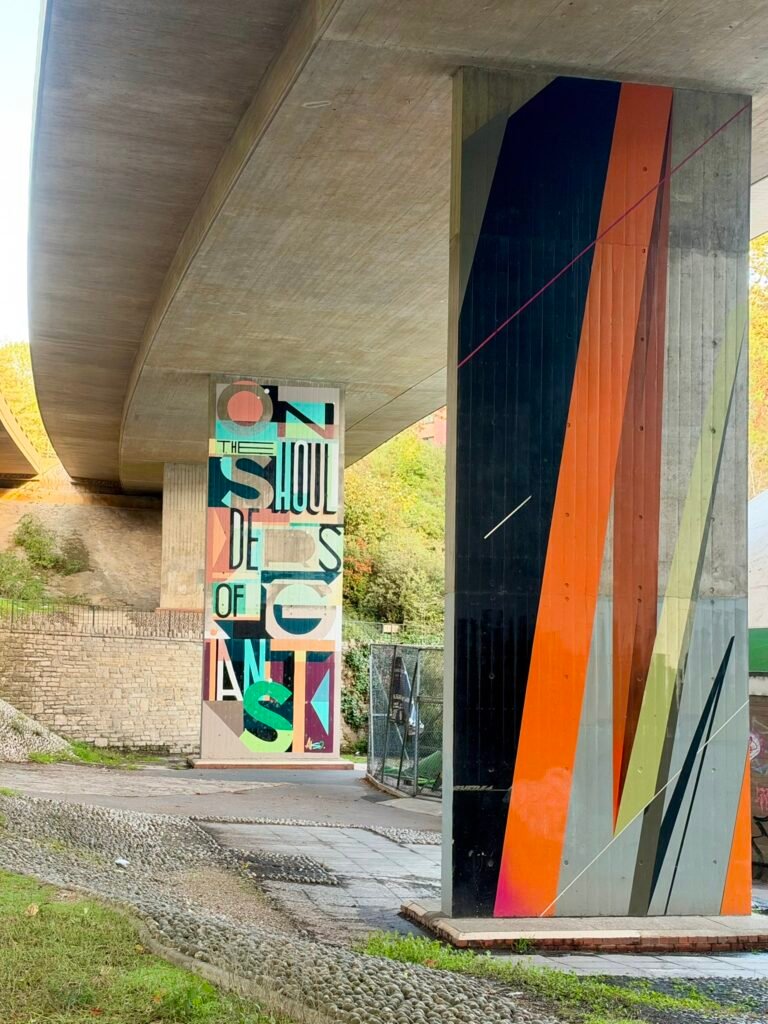
Remi Rough’s *Monolith B* swaps plain grey for sharp angles and striking colour, bringing a little organised chaos beneath the road.
I’ll admit that abstract art isn’t usually my thing. I often look at it and wonder whether there’s something I’m supposed to understand that everyone else already knows.
But standing beneath a painting this large does change the experience. You start noticing the balance of shapes, the way the colours interact and how the artist has used the pillar itself as part of the composition.
You don’t necessarily have to understand a piece of art to appreciate the creativity behind it.
Hidden Words and Metallic Illusions
Another fascinating work is History by Brighton-based Gary Stranger.
At first, the mural appears to be an elaborate black-and-white optical pattern. Look more carefully, however, and you’ll discover that the geometric shapes form letters spelling out the word History.
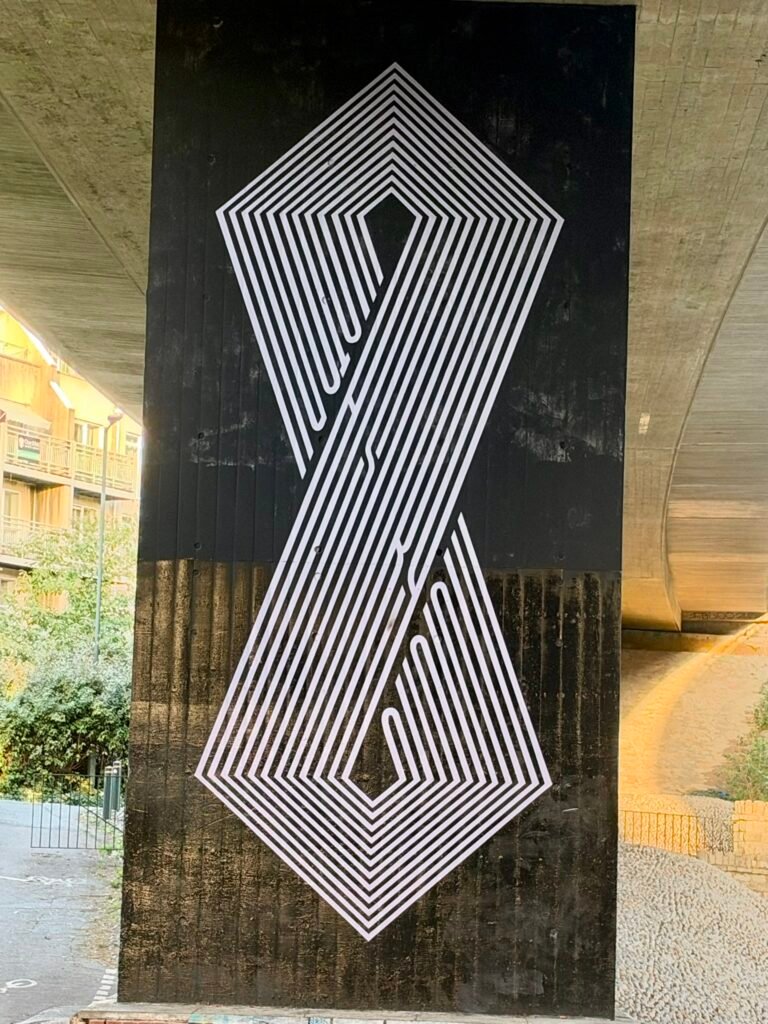
Gary Stranger makes lettering look like an endless geometric maze, proving that reading a wall can be much harder than expected.
Stranger comes from a graffiti background but has developed a highly distinctive approach to typography. His work is a reminder that letters can be much more than something we simply read.
Speaking of lettering, Bonzai’s Carpe Diem takes things in another direction entirely.
The Southampton-born artist transforms the familiar Latin phrase meaning Seize the Day into an elaborate metallic-looking design. It almost appears three-dimensional, despite being painted on a flat concrete surface.
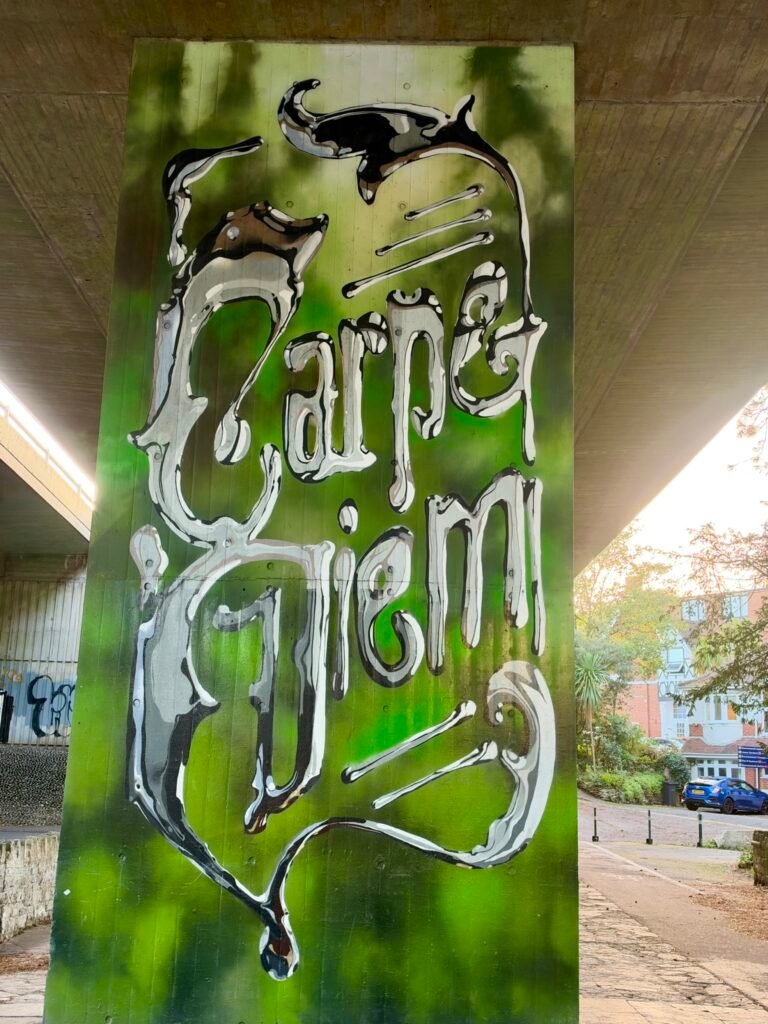
Bonzai’s *Carpe Diem* gives the familiar Latin phrase an enormous metallic-looking graffiti treatment, with no need for a translation app.
The amount of detail is remarkable. What might look like a quick piece of graffiti from a passing distance becomes something far more impressive when you actually examine it.
Perhaps that’s the biggest difference between walking past the gallery and properly visiting it: the paintings reward attention.
When Street Art Becomes Surprisingly Personal
Not every mural is about dramatic lettering or abstract shapes.
Bournemouth-based artist duo Best Ever created No Name, a thoughtful composition of fragmented human faces, hands and yellow roses.
Their style combines traditional painting techniques with extraordinarily detailed aerosol work, creating images that feel much more intimate than you might expect from such a large public mural.
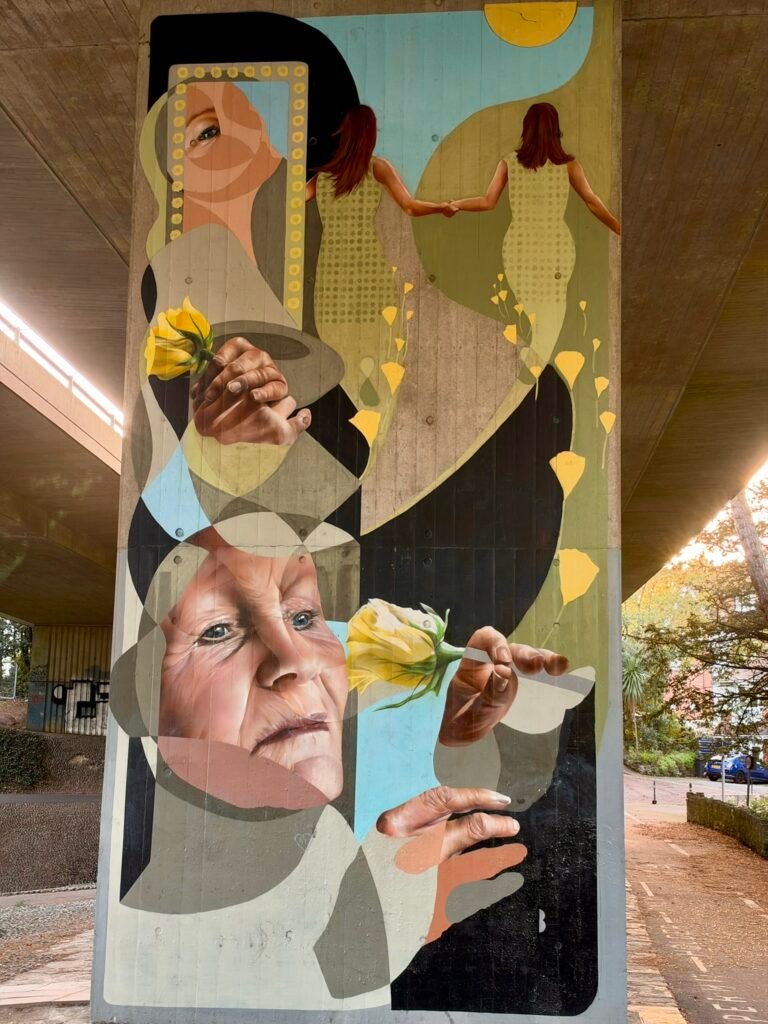
Best Ever’s *No Name* brings expressive faces, hands and yellow roses together in a layered mural that feels surprisingly intimate at this scale.
I find it particularly interesting that something created with spray paint can have the emotional qualities of a traditional portrait.
Street art is often associated with bold statements and rebellious attitudes, but it can also be quiet, sensitive and deeply human.
And speaking of realism, we’ve arrived at my absolute favourite.
My Favourite Painting: A Giant Fly. Yes, Really.
Of all the artwork beneath Wessex Way, the one I appreciate most is a gigantic fly.
Not a glamorous bird, beautiful butterfly or majestic wild animal. An ordinary fly. And it’s absolutely brilliant.
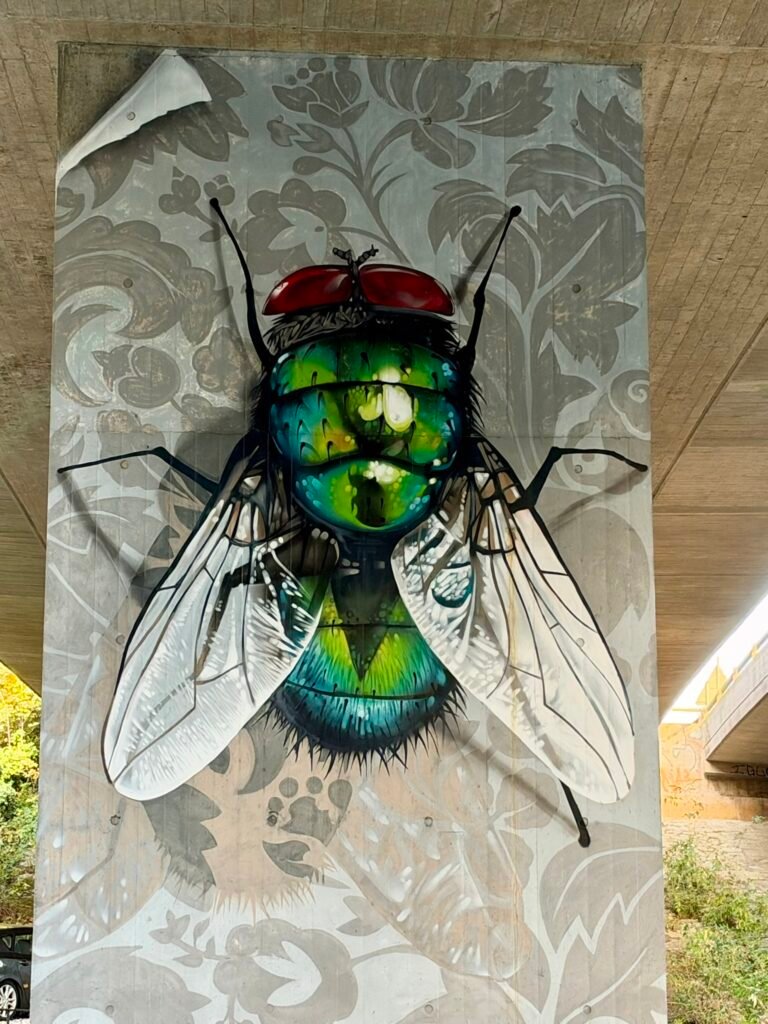
Tech Moon’s *Fly on the Wall* gives an everyday insect an extraordinary close-up, complete with iridescent colours and intricate wings.
The artist is Tech Moon, whose real name is Krishna Malla. He’s based in Bournemouth and specialises in photorealistic painting.
His mural, Fly on the Wall, depicts an enormous insect with intricate wings, iridescent colours and an astonishing level of detail.
But the idea behind the work is even better than the painting itself.
Tech Moon wanted to find beauty in something that people rarely appreciate. Most of us don’t consider flies particularly attractive; they’re more likely to be chased away from our food than admired.
The artist recognised a connection between that overlooked insect and the overlooked location of the gallery itself. Both are things we tend to ignore, even though there’s something fascinating about them when viewed differently.
I love that explanation. It almost perfectly describes my own experience with the Upside Gallery.
I’d walked past it for years without properly noticing what was there. Then, when I finally stopped, my favourite discovery turned out to be a painting about appreciating something we usually overlook.
That’s rather wonderful.
The People Who Made It Happen
One of the driving forces behind the entire project was Ricky Also, an artist and creative director at Paintshop Studio.
His own contribution, On the Shoulders of Giants, features enormous colourful typography. The title refers to the idea that artists build upon the work, discoveries and achievements of those who came before them.
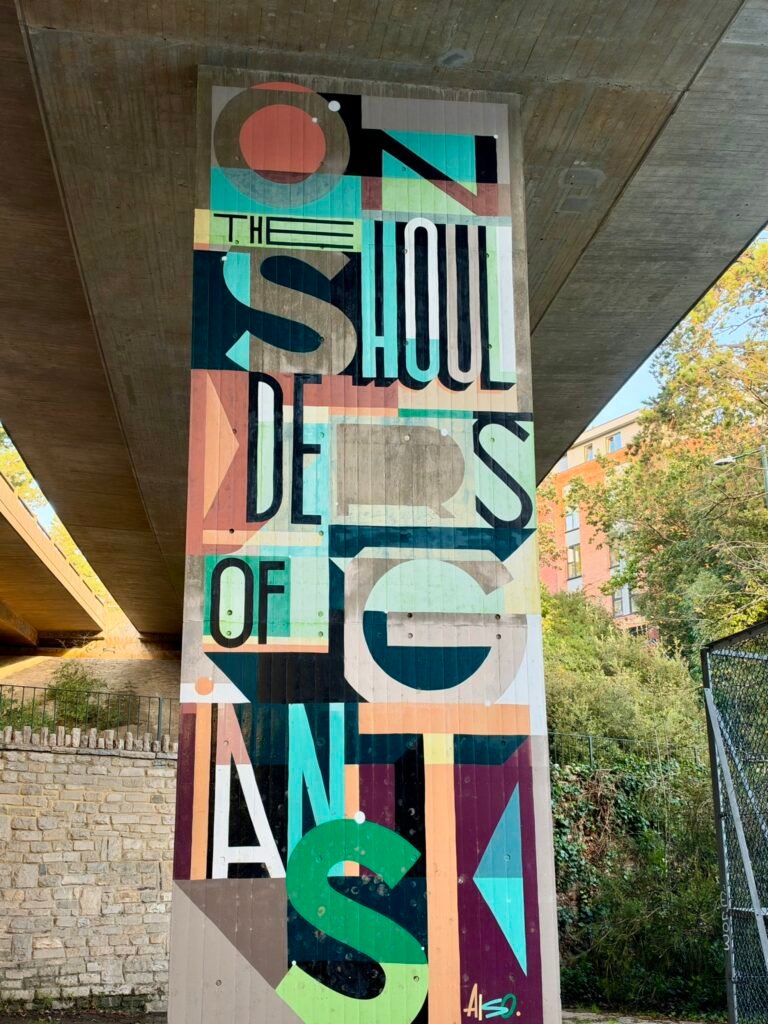
Ricky Also’s *On the Shoulders of Giants* stacks bright shapes and letters into a tribute to the creative influences behind today’s street art.
It’s a particularly fitting message for a project that brings together artists with different backgrounds and experiences. Graffiti and street art didn’t suddenly appear as respectable gallery disciplines; they’ve evolved over decades through experimentation, creativity and persistence.
Another intriguing work is Untitled by Brighton artist Alex Odisy.
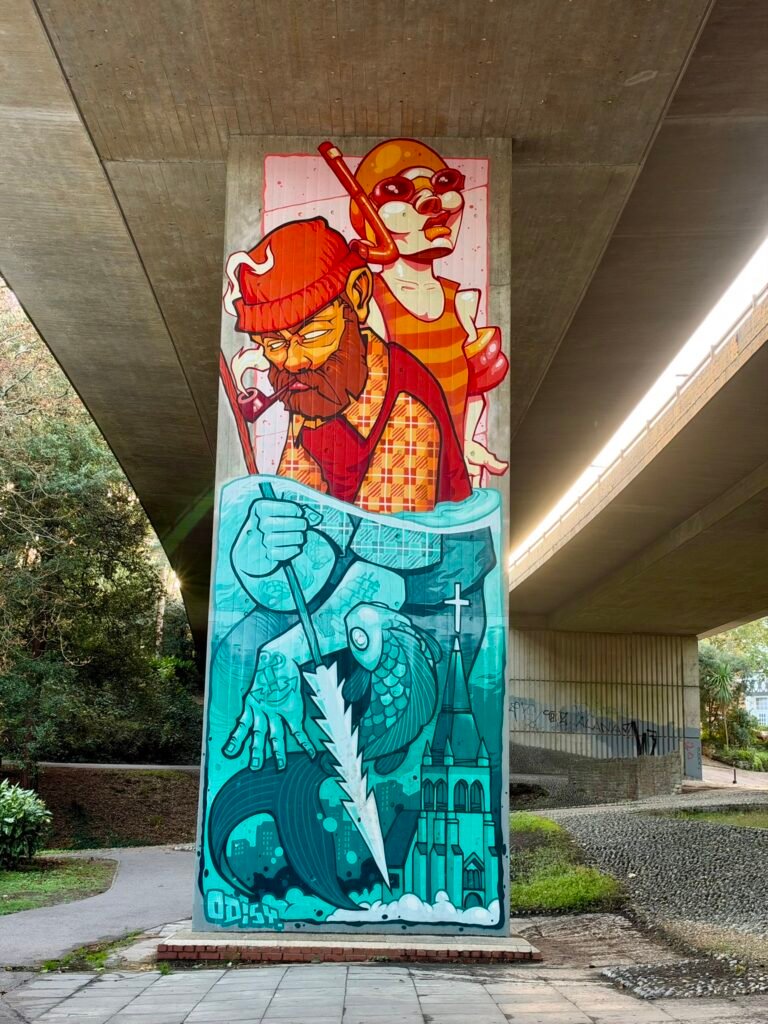
Odisy’s untitled work mixes colourful seaside characters, a fish and familiar-looking architecture into one gloriously busy scene.
His mural combines a bearded fisherman, a snorkelling character, a fish and architectural details in a wonderfully imaginative coastal scene.
It’s playful, colourful and packed with little elements to discover. For a seaside town like Bournemouth, it feels like an appropriate contribution.
The complete gallery also includes Bottled Oxygen by Squirl, inspired by the natural world and relationships between trees, and Deep Deco Forest by influential urban artist Will Barras.
That brings the original exhibition to 11 artists, each with a different perspective on what street art can be.
Bringing a Little Victorian Elegance Beneath a Flyover
Perhaps one of the most unexpected artistic choices is Lily & Roses by Philth, also known as Philth Blake.
Instead of the lettering or graffiti imagery you might expect, the artist covers a concrete pillar with elaborate pink flowers and swirling green leaves.
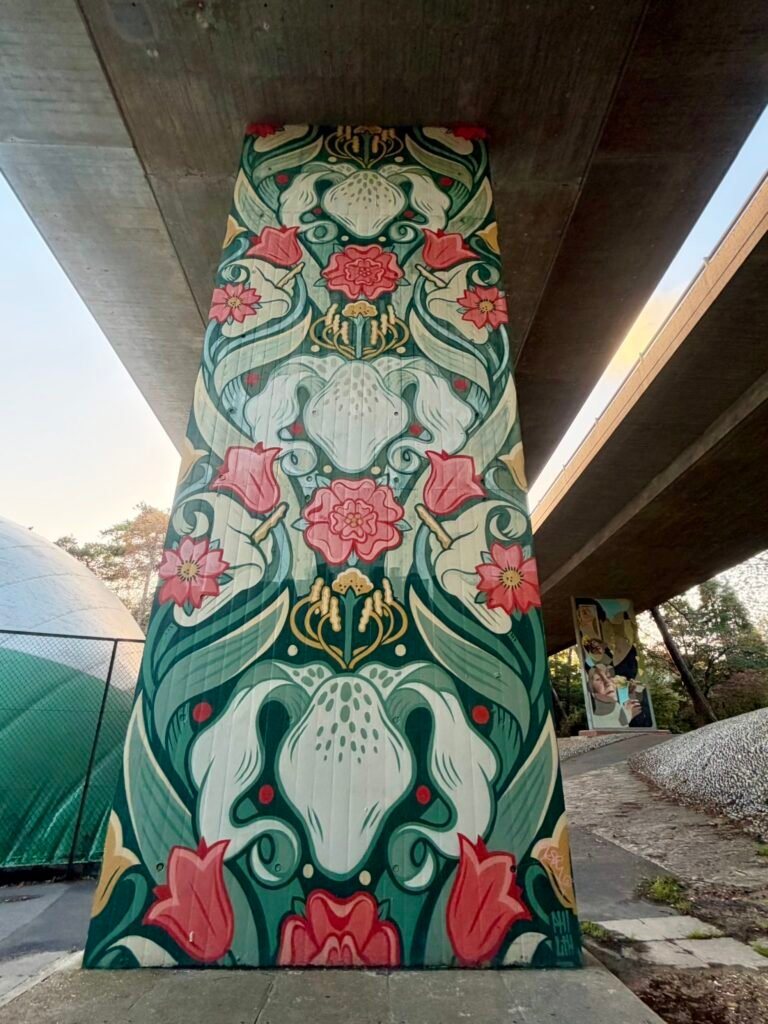
Philth’s *Lily & Roses* fills the concrete with pink flowers and swirling greenery, bringing a little Victorian-inspired elegance underneath the traffic.
The design draws inspiration from traditional decorative patterns associated with William Morris, whose work helped define the Arts and Crafts movement.
It’s a clever connection to the surrounding gardens, with their Victorian origins and abundant greenery.
Interestingly, the official gallery website identifies the work as Lily & Roses, while the information plaque beside the painting uses Rose & Lily. Whichever order you prefer, it’s certainly an unusual and attractive use of a concrete support.
It also demonstrates the extraordinary range of techniques represented here. You can move from photorealistic insects to elaborate lettering, portraits, abstract art and floral decoration within a few minutes.
Not bad for somewhere most people probably regard as a passage beneath a busy road.
The QR Codes: There’s More to Discover Than the Paintings
One detail I particularly appreciate is that the artworks have their own information plaques.
These identify the artists and include QR codes that visitors can scan using their phones. The idea is to provide interviews, background information and footage showing how the murals were created.
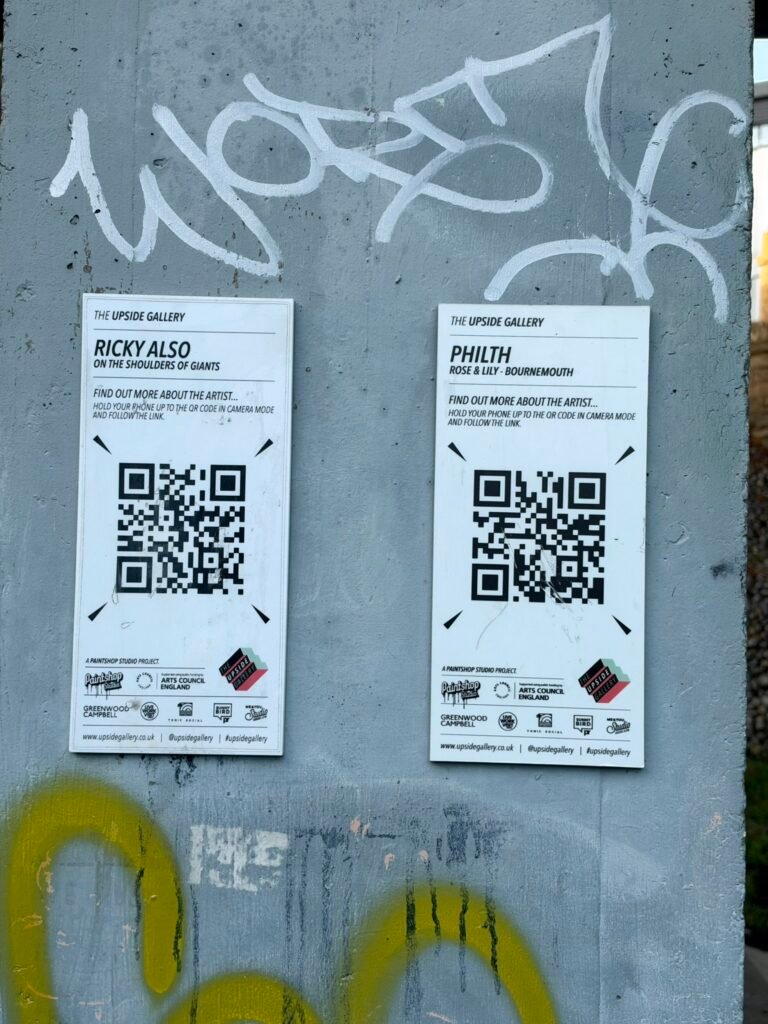
Scan the gallery plaques to discover the artists and watch short films about how the giant murals were created.
It’s a great feature, especially considering the practical difficulties of painting something around ten metres high.
The official Upside Gallery website also has individual artist profiles and videos, so you can explore the creative process even after you’ve left.
I hope projects like this help artists gain wider recognition and attract opportunities for further commissions. Their work is already being enjoyed by thousands of people passing through the gardens, although I wonder how many actually know their names.
And those little plaques are an important part of changing that.
Do the Upside Gallery Paintings Change?
One thing I wondered was whether the murals are replaced periodically, allowing different artists to showcase their work.
From the information available, the gallery was established as a permanent outdoor exhibition, rather than a temporary display or regularly changing programme.
The original paintings were created in September 2019, and I couldn’t find any published schedule for routine replacements or repainting.
That doesn’t mean the site will necessarily remain unchanged forever. Outdoor murals can require maintenance, and future projects are always possible. But visitors shouldn’t expect an entirely new collection every year.
For now, the permanent nature of the gallery is part of its appeal. These aren’t artworks hidden away for a short exhibition; they’re part of Bournemouth’s everyday landscape.
Visiting the Gallery: Daylight Does It More Justice
The Upside Gallery is completely free to explore and sits beneath the Wessex Way overbridge in Central Gardens, near the tennis courts.
Its official location is Branksome Park Road, Bournemouth, BH2 6DA.
Because it’s an outdoor public space, there isn’t a conventional gallery entrance, reception desk or ticket office. You simply walk through and explore the paintings.
Personally, I’d recommend visiting during daylight hours. Some of the artwork is incredibly detailed, and good natural light makes it much easier to appreciate.
I’ve walked through these gardens alone at night on countless occasions and have never personally experienced trouble. Even so, the area beneath the flyover can feel rather isolated after dark, and I’d welcome better lighting around the murals.
A few carefully positioned spotlights could make a real difference, both to the atmosphere and to the visibility of the art itself. For now, I think a daytime visit is the better experience, especially if you’re coming specifically to see the paintings.
From Street Art to the Seafront: Make a Walk of It
The Upside Gallery makes an excellent addition to a walk around Bournemouth, particularly if you enjoy discovering places that aren’t on every tourist’s itinerary.
From the gallery, head through Central Gardens towards The Square, then through the Lower Gardens to reach the beach and Bournemouth Pier.
It’s a lovely contrast: enormous contemporary murals beneath a concrete road, peaceful greenery and then the familiar Bournemouth seaside.
For a longer urban walk, you can explore the town centre and continue east towards Lansdowne, where the Bournemouth Clock Tower has its own interesting history. From that part of town, you can choose whether to return towards the centre or explore farther towards Boscombe.
Bournemouth has an official Public Art Trail, too. It includes Upside Gallery alongside several other sculptures, murals and historical artworks.
It’s an excellent reminder that there’s far more to discover here than the beach.
You can find more local places in my Bournemouth collection and other interesting destinations across Dorset.
Sometimes the Best Discoveries Are Right in Front of Us
I wouldn’t usually describe myself as someone who spends hours admiring paintings. I’m more interested in beautiful landscapes, unusual buildings, fascinating history and places that make me want to explore.
And yet, I thoroughly enjoyed discovering the Upside Gallery.
Not because I suddenly became an expert in contemporary art, but because I finally understood what I was looking at.
What I’d casually dismissed as extraordinarily talented local graffiti turned out to be a carefully organised creative project featuring accomplished artists, each with a story to tell.
I still prefer the realistic fly to some of the abstract works. That’s simply personal taste, and I suspect every visitor will have a different favourite.
But that’s exactly why the gallery is worth visiting. You don’t need to love every painting to appreciate the creativity, skill and effort behind the collection.
More importantly, it shows what can happen when a neglected public space is given a little imagination.
And perhaps that’s the best thing about Upside Gallery Bournemouth: it doesn’t ask you to buy a ticket, dress appropriately or understand modern art. It just asks you to stop walking for a moment and look.
After thousands of journeys beneath that bridge, I’m glad I finally did.
One journey. One story. One more stop.