
There are villages that happen to be picturesque.
And then there’s Milton Abbas, where somebody basically decided: I’d like a prettier village over there instead. 😆
Hidden among the wooded hills of Dorset, Milton Abbas is lined with whitewashed cottages, enormous thatched roofs and rows of chimneys. At first glance, it looks almost suspiciously perfect.
As it turns out, there’s a reason for that.
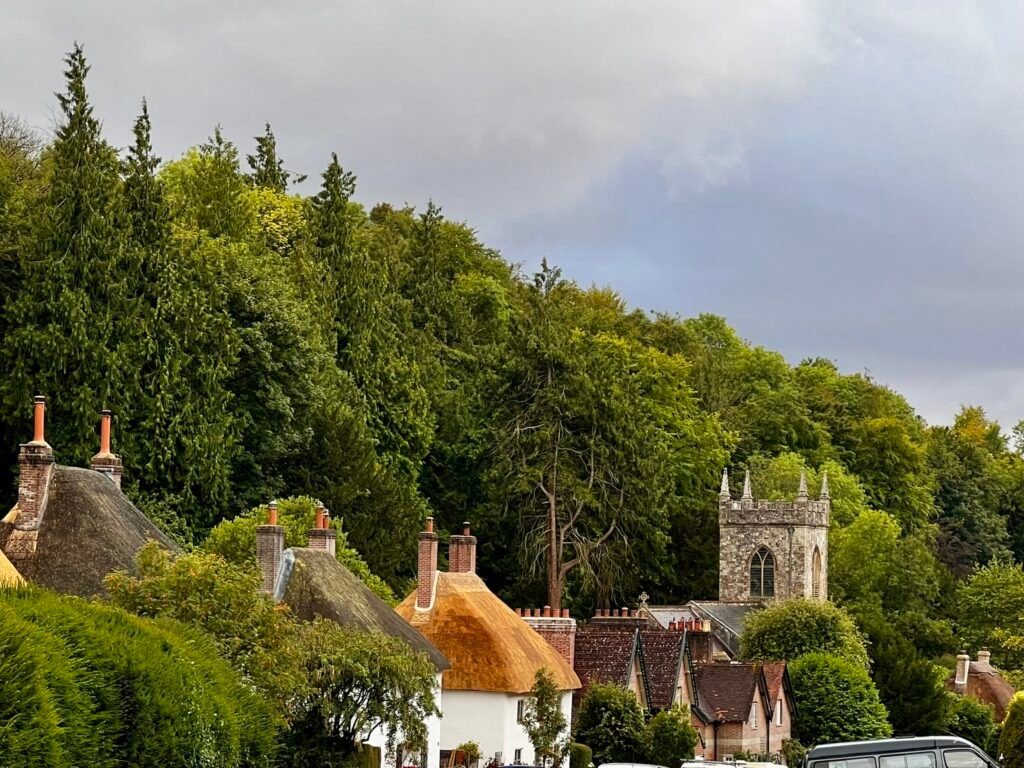
Wait… somebody actually moved the village?
Pretty much.
The story goes back to the 18th century and Joseph Damer, later the 1st Earl of Dorchester, who owned the Milton Abbey estate.
The old settlement of Middleton stood rather inconveniently close to his grand house. According to Visit Dorset’s history of Milton Abbas, Damer considered the existing village — including its noise and smells — rather incompatible with the country estate he wanted to create.
So in the 1770s, the old settlement was replaced by a new planned village: Milton Abbas.
Landscape designer Lancelot “Capability” Brown and architect Sir William Chambers were involved in creating the new setting, with 36 remarkably uniform cottages originally designed to accommodate two families each.
Suddenly those neat rows of roofs make a lot more sense.
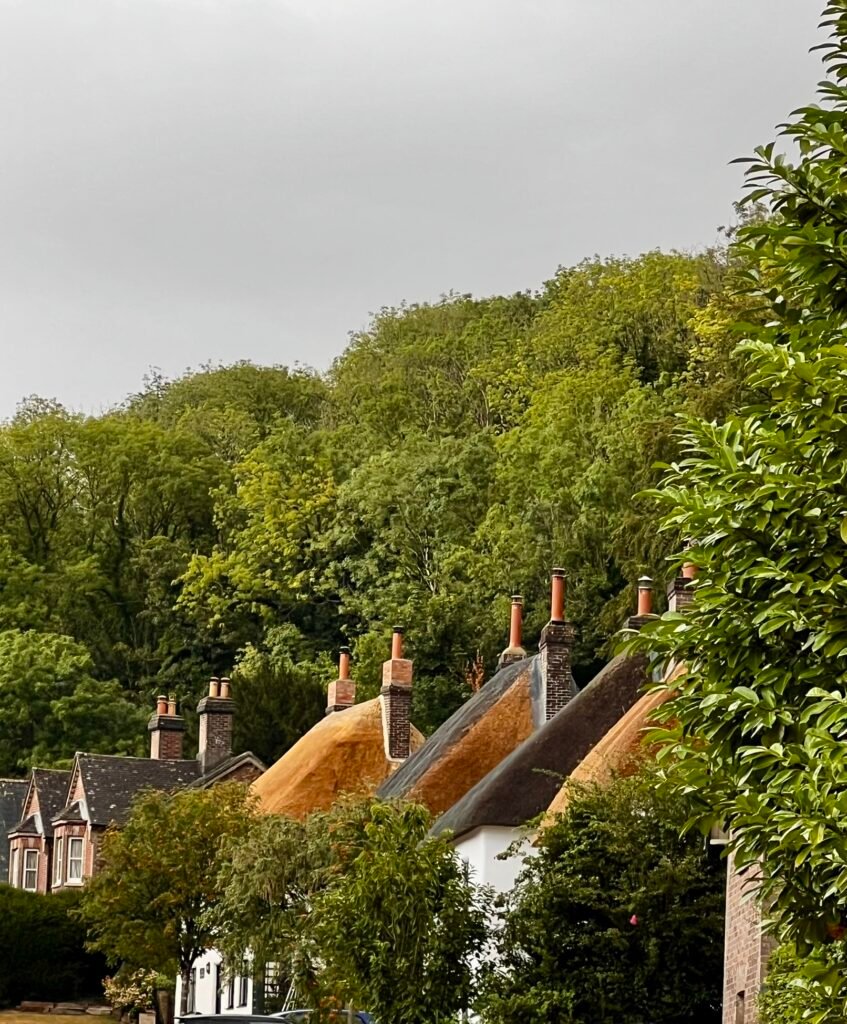
It really does look ridiculously pretty
This isn’t a village packed with attractions where you need an itinerary.
The village is the attraction.
It also happens to be one of the easiest free stops to work into a Dorset road trip, which is why it made my guide to things to do in Dorset for £0.
Walk along The Street and the repetition becomes part of its charm: white cottages, huge sweeps of thatch, brick chimneys and little front lawns, all surrounded by densely wooded Dorset hills.
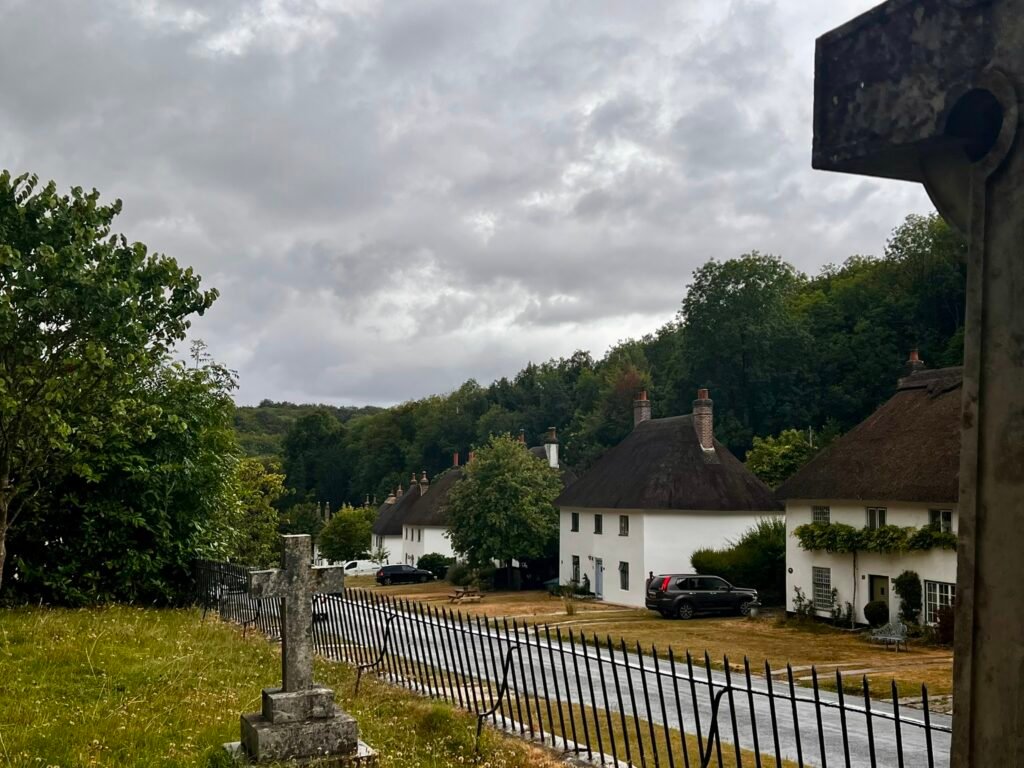
It reminded me why I like these smaller Dorset stops so much.
You arrive thinking, I’ll just have a quick look.
Then you notice another cottage.
Then another view.
Then you start wondering why every village can’t look like this.
One more stop strikes again. 😆
And apparently Dorset weather wasn’t going to let me have the full chocolate-box experience without contributing something of its own.
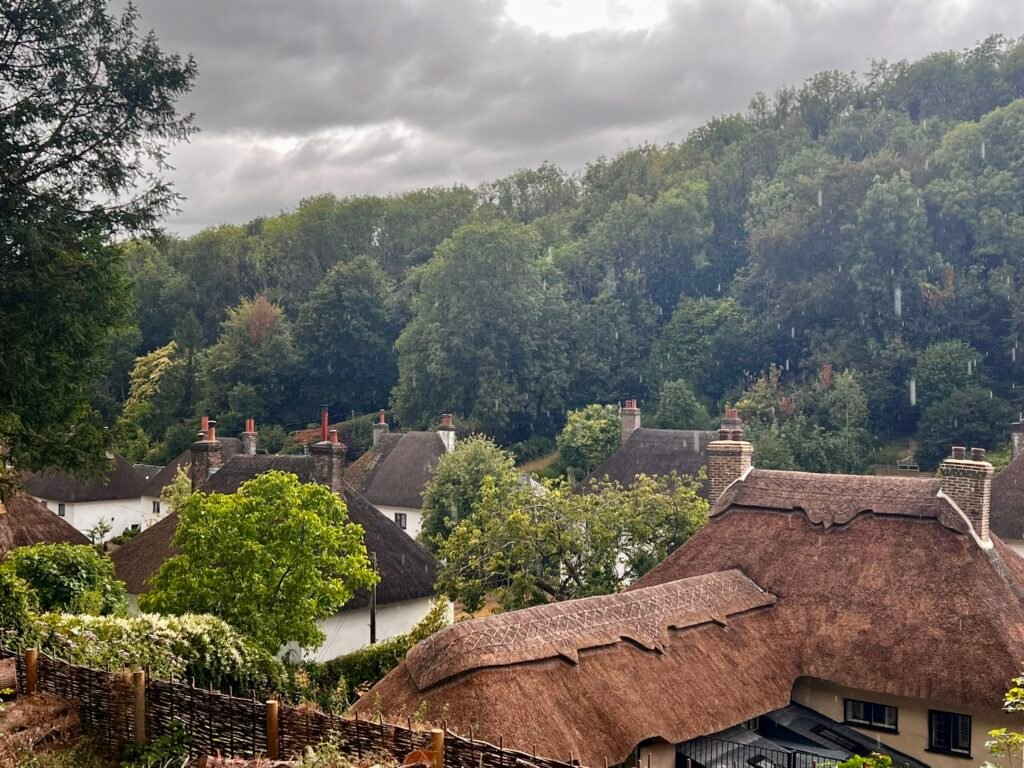
Don’t miss St James’ Church
At one end of the village you’ll also spot St James’ Church, its stone tower rising above the thatched roofs.
You don’t need to turn a Milton Abbas visit into a church expedition, but the tower is an important part of the village skyline — and it makes some of the best views here even better.
If unusual churches are your thing, though, Milton Abbas pairs rather nicely with Knowlton Church, where a ruined medieval church sits inside a prehistoric earthwork. That’s a very different Dorset scene, but another wonderfully strange little stop.
And then there’s Milton Abbey
The village story makes even more sense once you see what lies beyond it.
Milton Abbey and its estate sit nearby, surrounded by parkland. The site has a much longer history than the present village: the abbey traces its origins to a religious foundation established in 934, while the surviving medieval church largely dates from rebuilding after a fire in 1309. The estate later passed to Damer in 1752.
Today the mansion and estate are home to Milton Abbey School, so don’t assume the whole complex operates as an ordinary tourist attraction. The school’s own information focuses public visits around organised events and open days rather than unrestricted everyday sightseeing.
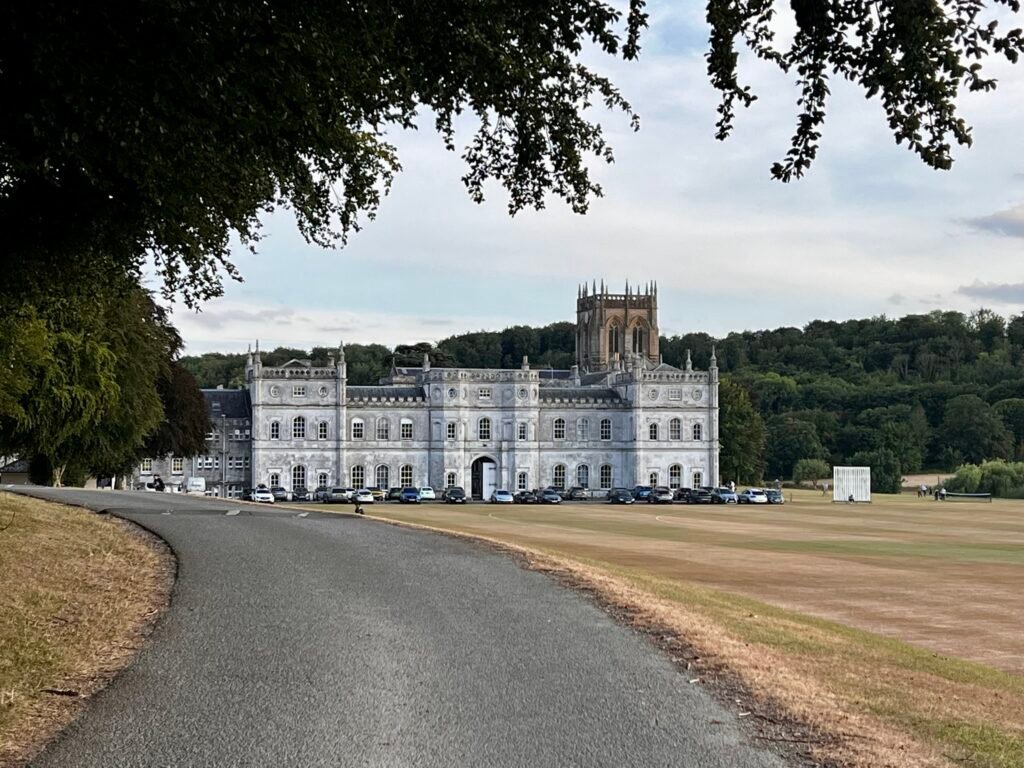
For this Quick Stop, I’d concentrate on the village itself and treat the abbey view as the final piece of the story.
Is Milton Abbas worth visiting?
Yes — if you understand what kind of stop it is.
Don’t come expecting a huge attraction or enough entertainment for an entire day.
Come because it’s an unusually beautiful Dorset village with a genuinely interesting story behind why it looks the way it does.
Walk along The Street. Look at the cottages. Find the church. Take far too many photographs of thatched roofs.
That’s basically the plan.
And it works.
If you enjoy this sort of small historic detour, Gold Hill in Shaftesbury is another Dorset stop where one distinctive streetscape is enough reason to pull over and explore.
For something much wilder afterwards, Clavell Tower and Kimmeridge Bay swaps neat thatched cottages for dramatic Purbeck coastline — but has exactly the same “well, since I’m nearby…” potential that keeps getting me into trouble. 😆
Before you go
Where: Milton Abbas, Dorset, DT11 area
Cost: Walking around the village is free.
Allow: Around 30–60 minutes for a relaxed Quick Stop around the village; longer if you’re incorporating a countryside walk.
What to see: The Street, the thatched cottages, St James’ Church and views towards the Milton Abbey estate.
Best for: Photography, architecture, village wandering and a short Dorset detour.
OMS tip: Don’t rush through in the car. The details and views make much more sense once you’re walking.
Milton Abbas is also on the Jubilee Trail, and Visit Dorset notes that several shorter walking options start around the village if you want to turn the Quick Stop into something longer.
For current visitor information and ideas for exploring the surrounding area, Visit Dorset’s Milton Abbas guide is the useful official starting point.
The Quick Stop verdict
Milton Abbas isn’t somewhere you visit because there’s loads to do.
You visit because someone reshaped an entire village more than two centuries ago — and somehow left Dorset with a place that still makes you stop the car and stare at the rooftops.
Even in the rain.
Possibly especially in the rain. 😆
One journey. One story. One more stop.