
Knowlton Church is one of those places where the building only tells half the story.
At first glance, it looks like a lonely medieval church ruin sitting quietly in the Dorset countryside. There is a square tower, broken walls, open arches and grass stretching away in almost every direction. It is attractive enough on its own, but then you begin to notice that the ground around it is not quite flat.
The church is standing inside a prehistoric henge.
That changes the whole place.
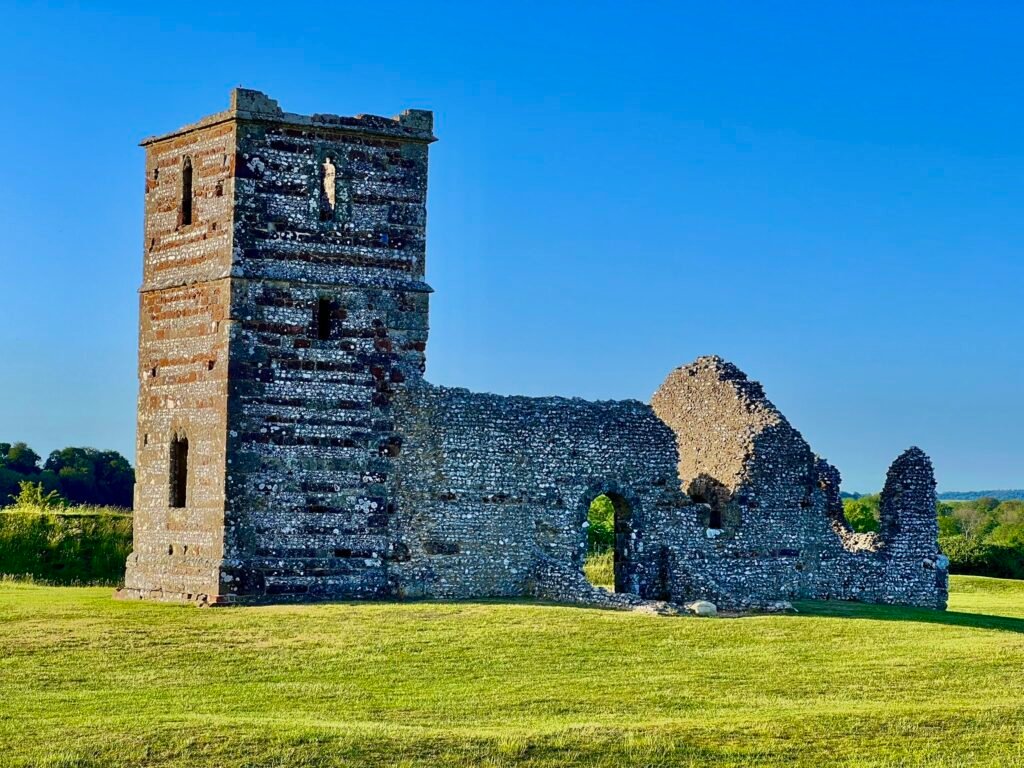
The earthwork surrounding Knowlton Church dates from the late Neolithic period, roughly four thousand years before the medieval church was built at its centre. English Heritage describes the wider landscape here as one of the great Neolithic and Bronze Age ceremonial complexes of southern England, with several henges and a remarkable concentration of burial mounds nearby.
The church itself came much later, in the 12th century, and served a settlement that has since disappeared. Its position inside the ancient earthwork creates a strange overlap of two completely different periods of belief and ritual in the same patch of Dorset countryside.
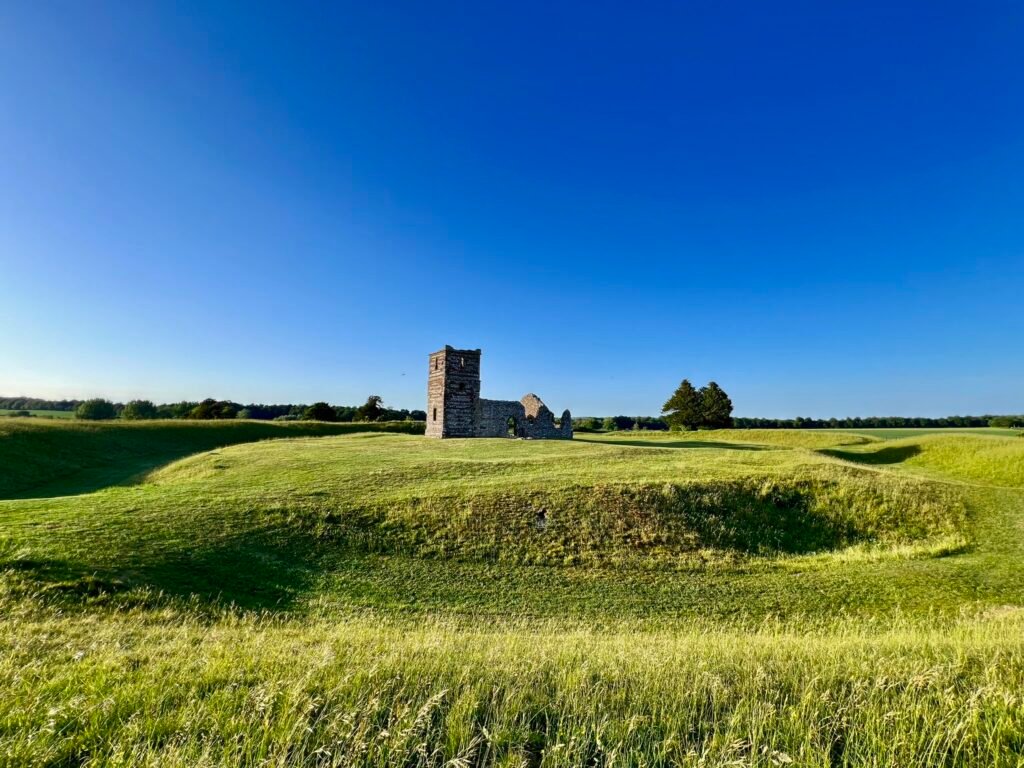
From close to the ruins, it is easy to concentrate on the stonework and almost forget about the henge. Step further back, though, and the curves in the landscape become much easier to see.
That was the part I found most interesting about Knowlton.
You are not simply looking at an abandoned church.
You are looking at a medieval building deliberately placed inside a ceremonial landscape that was already ancient long before Christianity reached Britain.
And somehow, with the ruined tower standing alone in the middle of those grassy earthworks, the two periods still feel connected.
Before Knowlton Church: Four Thousand Years of History
The most extraordinary thing about Knowlton Church is that the church is actually the younger part of the site.
The henge surrounding it belongs to the late Neolithic period, roughly 4,000 years earlier than the medieval building at its centre. English Heritage describes Knowlton as part of one of southern England’s great Neolithic and Bronze Age ceremonial landscapes, with several henges and a dense concentration of burial mounds nearby.
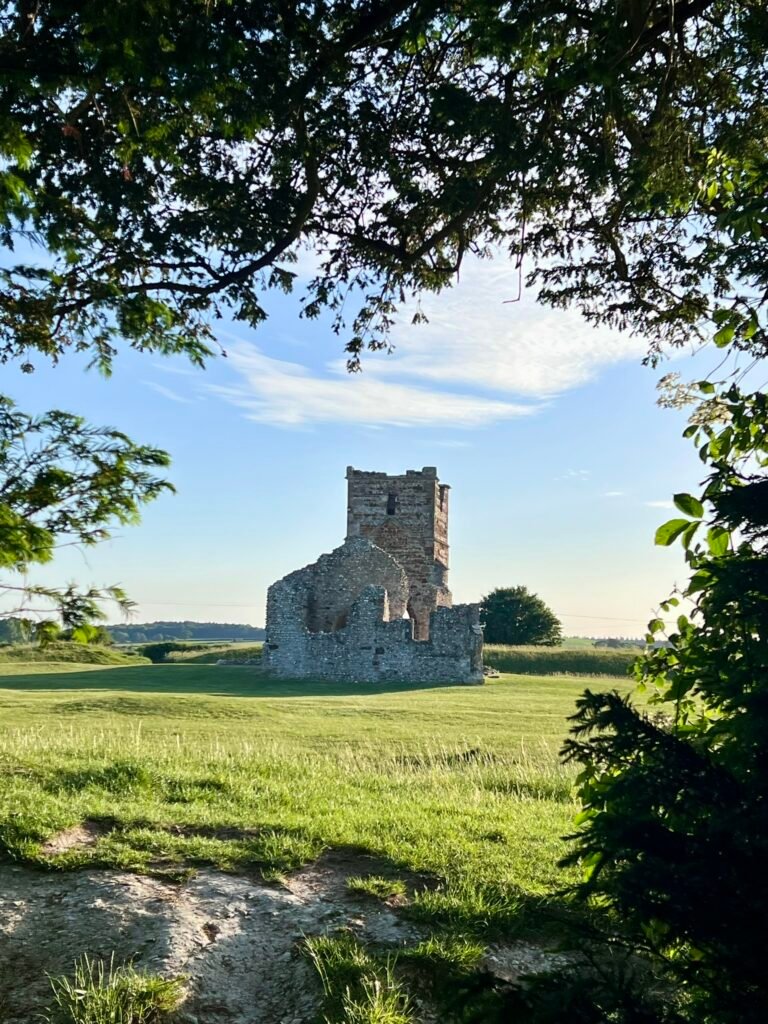
The earthworks are not dramatic in the way Stonehenge is dramatic. There are no giant standing stones and no huge monument dominating the skyline.
Instead, the history is written into the shape of the ground.
The main enclosure, now called Church Henge, is oval and formed by a broad bank with a ditch inside it — one of the defining features of a henge. Historic England records the enclosure as roughly 106 by 94 metres, with banks up to around 1.75 metres high in places.
Once you know what you are looking at, the landscape starts to make much more sense.
The grassy rises and hollows around the church are not random. They are the surviving outline of a prehistoric ceremonial site that has been used, altered and interpreted for thousands of years.
And Knowlton was not an isolated monument.
There were several other major circular earthworks nearby, along with the Great Barrow — the largest individual burial mound in Dorset — and many other barrows and ring ditches across the surrounding countryside.
That wider setting is what makes the church feel so unusual.
The ruin may be the most obvious thing to photograph, but the real story is bigger than the building.
It is a medieval church sitting right in the middle of a landscape that people were already treating as significant thousands of years before the church existed.
Visiting Knowlton Church: A Quick Stop With a Strange Kind of Calm
Knowlton Church works very well as a shorter stop.
I spent about an hour there, which was enough time to walk around the earthworks, explore the ruined church properly and take in the surrounding countryside without feeling rushed. You could certainly stay longer with a picnic or simply sit in the grass for a while, but you do not need half a day to appreciate the place.
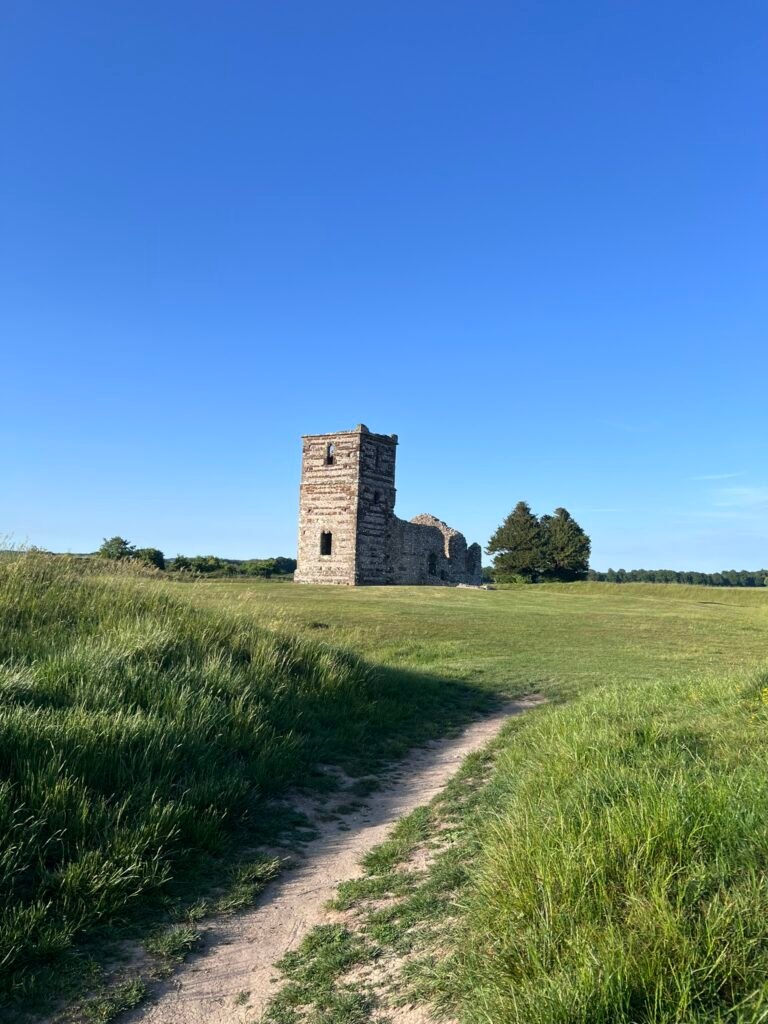
Getting there felt suitably understated too.
There is no large visitor centre or enormous car park announcing that you have arrived at an important historic site. When I visited, I simply stopped near the entrance at the side of the road. English Heritage describes the parking officially as “very limited”, with spaces in the small lay-by on Lumber Lane, so arriving at a busy time could be a little more awkward.
Luckily, it was quiet when I was there.
Knowlton is cared for by English Heritage and is free to visit, making it a good example of the quieter, smaller historic places I enjoy exploring. I’ve written more about that mix of castles, ruins and ancient sites in my English Heritage membership experience.
Once through the gate, the church appears across the grass and the site immediately feels open and peaceful. There is plenty of room to wander around the earthworks, approach the ruin from different directions and notice how much its character changes depending on where you stand.
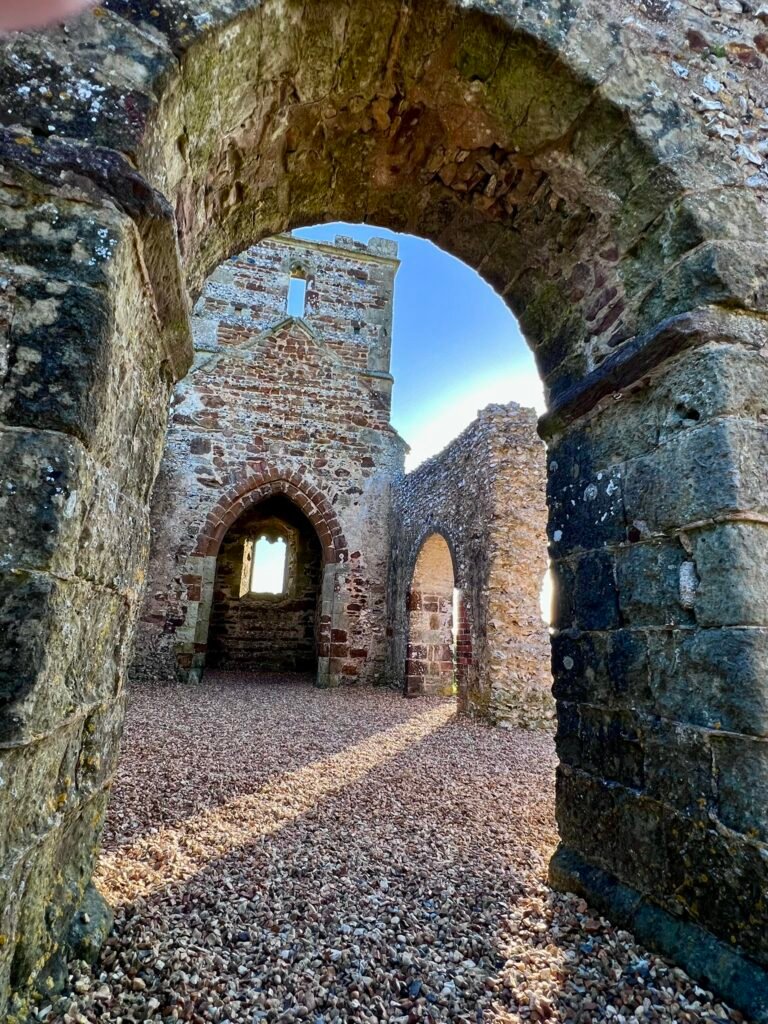
Inside, the atmosphere changes again.
The roof is long gone, so daylight pours through the broken walls and empty windows. Arches frame other arches, fragments of stonework lead nowhere, and the sky becomes part of the building.
I wouldn’t describe the place as frightening, but there was something slightly unnerving about it.
Perhaps it was the silence. Perhaps it was knowing that people had considered this patch of land significant thousands of years before the church existed. Or perhaps ruined churches inside prehistoric ceremonial sites are simply allowed to feel a little strange.
English Heritage even notes that Knowlton has acquired a reputation for haunting, alongside local legends that developed around the abandoned church and ancient earthworks. Those stories are folklore rather than evidence of anything supernatural, but standing there as the light began to drop, I could understand why the site attracted them.
Mostly, though, I found it peaceful.
It is the sort of place where you can arrive intending to make a quick stop, spend an hour exploring, and still find yourself thinking that sitting quietly in the grass for another hour would not be a bad idea at all.
The Church Came Much Later
After spending time looking at the henge, it is easy to forget that Knowlton Church has its own long history.
The earliest parts of the building — the nave and chancel — date from the 12th century, while the west tower and north chapel were added in the 15th century. Later alterations continued into the 18th century, so what survives today is really a patchwork of several different periods rather than one single medieval building.
The church once served a small settlement nearby, but that community gradually disappeared. English Heritage says the church remained in use until the 17th century, while the Historic England listing records later alterations and eventual abandonment by the late 18th century.
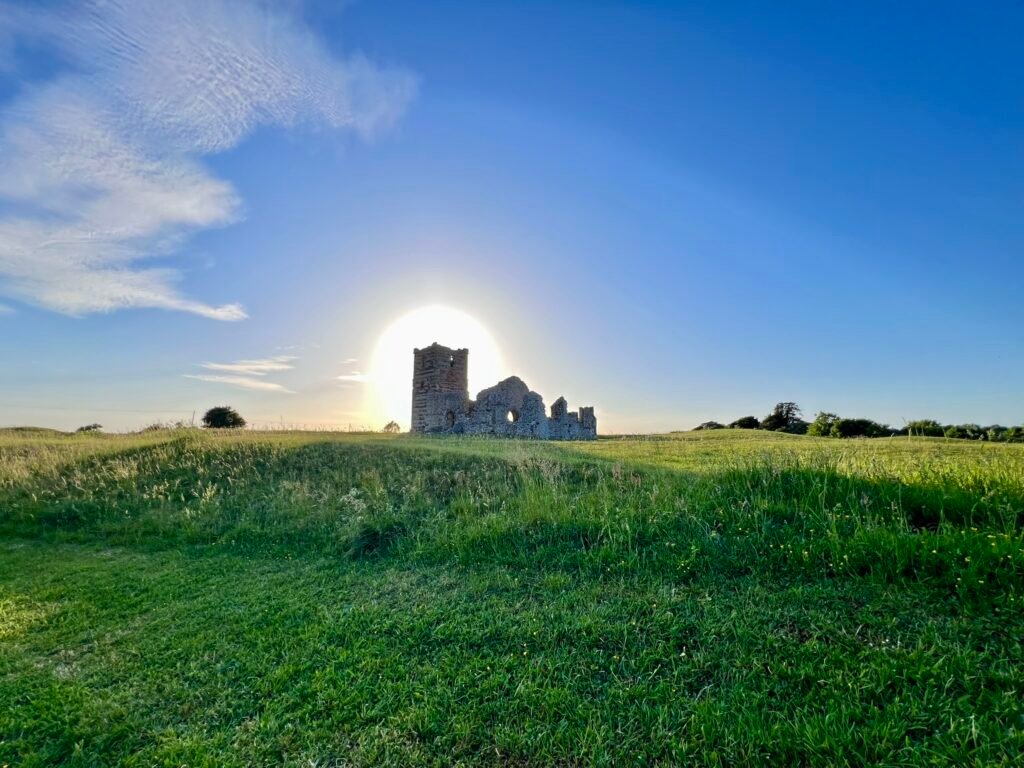
Standing there now, the ruined state of the church is part of what makes the site so memorable.
You can still read the basic shape of the building: the tower, the arches, the nave and the broken walls. But without a roof, doors or a congregation, the church feels less like an enclosed building and more like part of the landscape itself.
Grass comes right up to the stonework. The sky fills the empty window openings. Light moves through arches that once separated different parts of the church.
And then there is the location.
Building a Christian church inside a prehistoric henge may seem like a strange decision to us now, but English Heritage notes that the pairing has become an enduring symbol of the shift from earlier ritual traditions to Christian worship. Whatever the original reasoning, the decision also helped preserve both the church and the ancient earthwork around it.
For me, that overlap is what makes Knowlton more interesting than either monument would be on its own.
A ruined medieval church is atmospheric.
A prehistoric henge is fascinating.
Put one inside the other, leave them standing quietly in the Dorset countryside for centuries, and the place becomes something much harder to forget.
For a very different piece of Dorset history, Portland Castle swaps prehistoric earthworks and medieval ruins for Tudor coastal defence.
One of Dorset’s Strangest Little Stops
What stayed with me most about Knowlton Church was how much atmosphere there was in such a small place.
I only spent around an hour there, yet it never felt like somewhere I had simply stopped, taken a few photographs and moved on from. There was enough to wander around, enough history beneath your feet, and enough silence to make you slow down without really intending to.
It was peaceful, but not completely comfortable.
There is something slightly unnerving about a roofless church standing alone inside earthworks created thousands of years before it. Nothing dramatic happened while I was there, and there were very few other people around, but the site has a presence that is difficult to explain from photographs alone.
That may be why I could easily imagine coming back simply to sit there for a while.
Not necessarily to learn anything new or photograph every angle again. Just to find a quiet patch of grass, look across the earthworks and let the place be strange.
For a visit that can comfortably fit into an hour, Knowlton manages to contain an extraordinary amount of history: prehistoric ritual, medieval worship, an abandoned settlement, centuries of local stories and a church ruin that now feels almost fused into the landscape around it.
It is not a grand day out.
If you enjoy these smaller Dorset stops where the setting matters just as much as the landmark, Clavell Tower above Kimmeridge Bay gave me a completely different but similarly memorable experience.
It is a small, unusual stop in the Dorset countryside — and sometimes those are the ones I remember most.
One journey. One story. One more stop.