
There are places you visit once, admire politely, take a few photographs and never think about again. Salisbury Cathedral is definitely not one of them. We’ve been three or four times already, and somehow this enormous medieval masterpiece still manages to make us stop, stare and say, “Wow.”
Perhaps it’s the spire, which seems determined to poke a hole in the clouds. Perhaps it’s the extraordinary interior, where the ceiling disappears so far above your head that your neck starts negotiating overtime. Or perhaps it’s the fact that this beautiful old building contains everything from medieval engineering and magnificent stained glass to one of the most important documents in British history.
Whatever the reason, Salisbury Cathedral in Wiltshire is a place we genuinely love returning to. And with an admission ticket valid for a whole year, it almost feels rude not to.
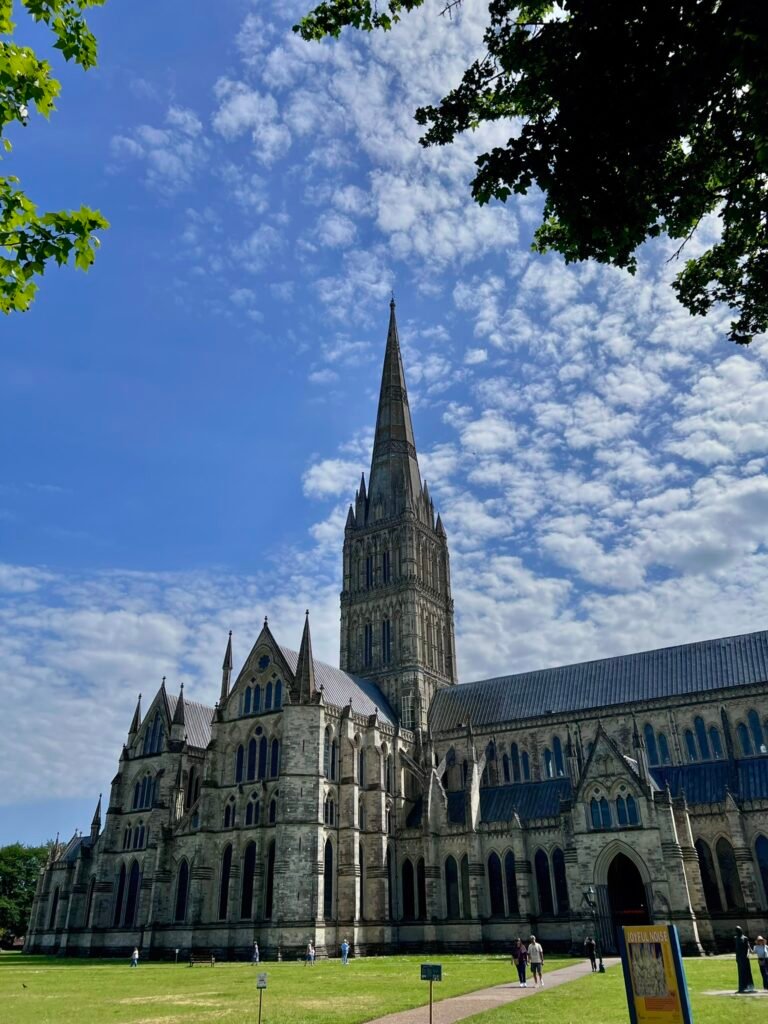
Salisbury Cathedral: A Medieval Giant with a Rather Impressive Past
The story actually begins a few miles away, at Old Sarum, where Salisbury’s original cathedral once stood beside a Norman castle.
Unfortunately, sharing a hilltop with soldiers wasn’t exactly a match made in heaven. Relations between the clergy and castle garrison were strained, the exposed position was inconvenient, and water supplies were a problem. Eventually, the cathedral authorities decided it was time for a change of scenery.
And they didn’t just move down the road. They built a new cathedral and helped create an entirely new city around it. That’s one way to deal with difficult neighbours!
The foundation stones of today’s Salisbury Cathedral were laid in 1220, and the main building was completed in just 38 years, an extraordinary achievement for something constructed without modern machinery, cranes or a convenient delivery from B&Q.
The famous spire came later, in the early 14th century, taking the building to a remarkable 123 metres (404 feet). It remains the tallest church spire in the United Kingdom.
If you’d like to discover where this extraordinary story began, my visit to Old Sarum: The Castle and Cathedral Salisbury Left Behind makes a fascinating companion read.
The Outside Is Magnificent. Then You Walk Inside.
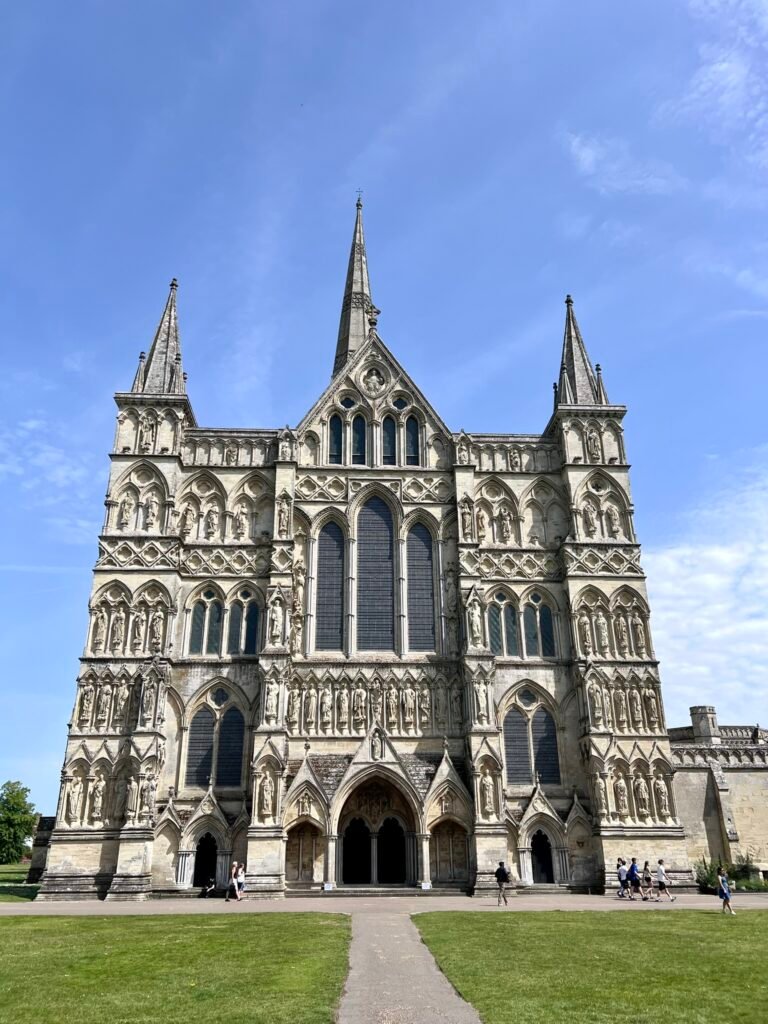
Before entering, spend some time admiring the Great West Front. It’s covered in intricate stonework, pointed arches and rows of sculpted figures, with so much detail that you could probably spend half an hour looking at it and still miss something.
But the real moment comes when you step through the doors.
Salisbury Cathedral’s interior is absolutely enormous. Long lines of elegant stone columns rise into soaring Gothic arches, while the vaulted ceiling stretches high above the nave.
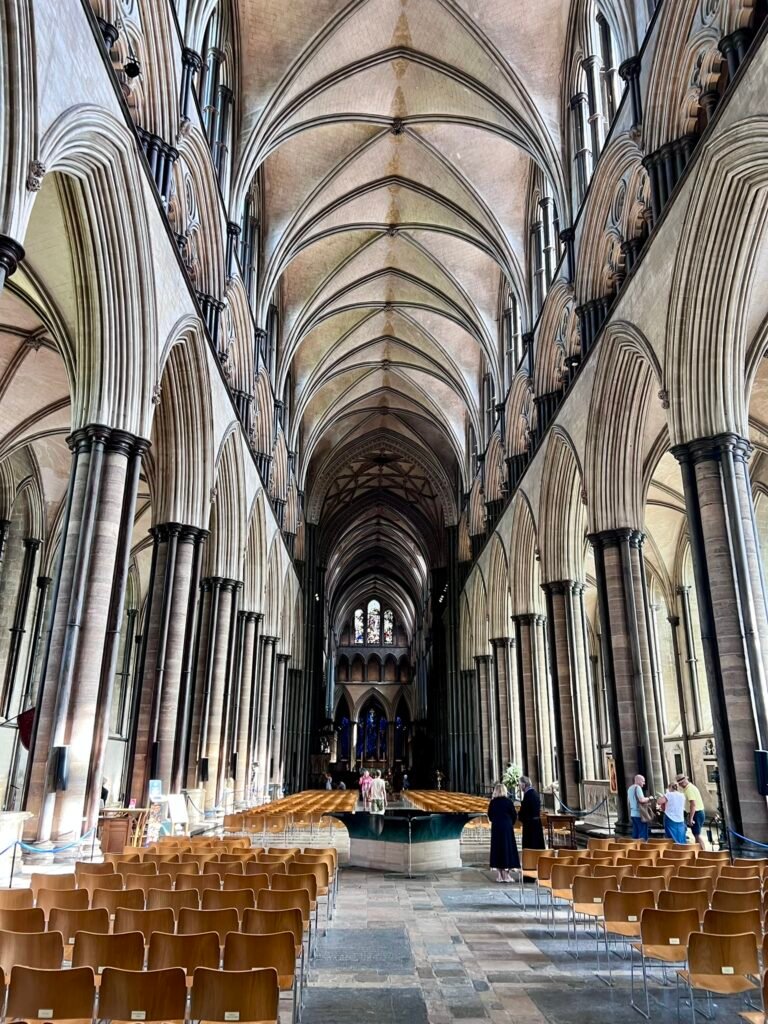
And it isn’t just the height. It’s the incredible sense of space.
Everything seems perfectly balanced, yet almost impossibly large. You find yourself following the arches upwards, wondering how medieval builders managed to create something so ambitious without computers, modern engineering equipment or anyone in a fluorescent jacket holding a clipboard.
Even after several visits, I still get that initial feeling of being completely dwarfed by the place.
It’s one of those buildings where photographs can show you what it looks like, but they struggle to convey what it actually feels like to stand inside.
An 800-Year-Old Cathedral with Some Surprisingly Modern Touches
One of the first things that catches your attention inside Salisbury Cathedral is its remarkable baptismal font.
Designed by sculptor William Pye and installed in 2008, it looks almost like a piece of contemporary art that has somehow wandered into the Middle Ages.
Water flows gently across its dark, mirror-like surface, reflecting the cathedral’s columns, windows and vaulted ceiling. It’s beautiful, peaceful and rather mesmerising.

The contrast works surprisingly well. After all, medieval stonework and modern sculpture aren’t necessarily the first things you’d think of putting together, but here they seem perfectly at home.
Continue towards the quire, and the atmosphere changes again. Elaborately carved wooden stalls, richly decorated ceilings and the magnificent Father Willis organ create a space that feels more intimate, despite the extraordinary architecture surrounding it.

Elsewhere, memorials and monuments offer glimpses into the lives of people who have been connected with the cathedral over hundreds of years. The elaborate Gorges monument, for example, is a reminder that this building isn’t just an architectural achievement. It’s also a collection of human stories.
There are treasures wherever you look, and some of them are surprisingly easy to overlook if you simply walk down the middle, take a photograph and head straight for the exit.

Windows, Chapels and a Clock That Doesn’t Tell You the Time
Among the cathedral’s most striking features is the deep-blue Prisoners of Conscience window in the Trinity Chapel, installed in 1980.
Designed by Gabriel Loire, it commemorates people who have suffered persecution for standing by their beliefs and conscience. The intense colour is breathtaking, but its meaning makes it particularly moving.

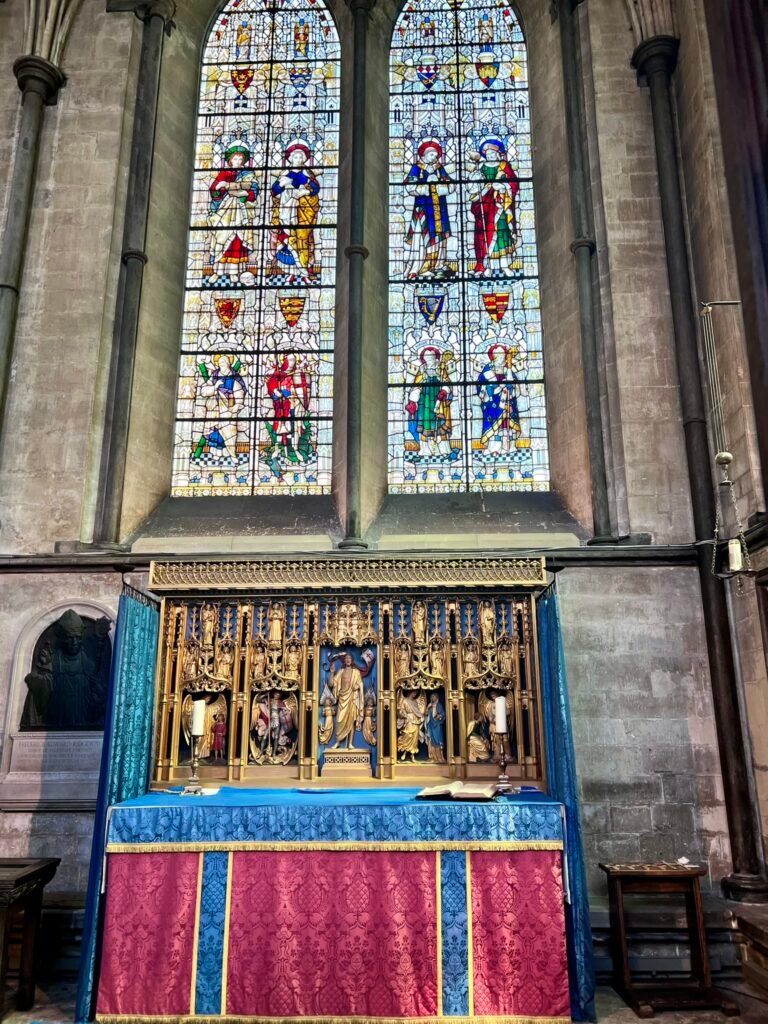
Other chapels contain beautiful stained glass, intricately carved monuments and decorative altarpieces, including the colourful reredos in St Michael’s Chapel.
Then there’s the cathedral’s medieval clock, dating from 1386 and recognised as the world’s oldest working mechanical clock.
Here’s the wonderfully strange part: it doesn’t have a clock face.
It was built to strike the hours rather than display the time, so anyone expecting hands, numbers or even a little digital screen is going to be disappointed.
Nearly 640 years old, still functioning, and apparently completely uninterested in showing you whether you’re late for lunch.
I rather admire that attitude.
Magna Carta: A Small Piece of Parchment with Enormous Consequences
One of Salisbury Cathedral’s greatest treasures isn’t particularly large or visually spectacular. In fact, compared with the building around it, it’s remarkably modest.
But its importance is enormous.
The Cathedral’s magnificent octagonal Chapter House contains one of only four surviving original copies of Magna Carta from 1215, and Salisbury’s is considered the best preserved.
Magna Carta emerged from a confrontation between King John and rebellious barons, who wanted limits placed on royal power. It certainly wasn’t a modern declaration of equal rights for everybody, but it helped establish a principle that would become fundamental to the development of our freedoms: even the monarch should be subject to the law.
Its influence continued to develop over centuries, shaping ideas about justice, lawful judgement and protection against arbitrary imprisonment.
That’s quite a legacy for a piece of medieval parchment.
Seeing it in person is genuinely fascinating. The original is carefully protected in a controlled display, and photography of the actual document isn’t permitted. You get to glimpse a remarkable survivor of more than eight centuries, rather than take home a close-up for Instagram.
I’ve given the document, its extraordinary history and the unusual experience of seeing it a separate article: Magna Carta at Salisbury Cathedral: 800 Years of Freedom and Rebellion.
It’s absolutely worth including in your visit, especially as admission to the Chapter House and Magna Carta is included with the standard cathedral ticket.
The Tower Tour: 332 Steps We’re Still Planning to Conquer
There’s one experience we haven’t managed yet, despite our repeated visits: climbing Salisbury Cathedral’s tower.
And it’s definitely on our list.
The guided Tower Tour takes visitors through hidden roof spaces, narrow medieval staircases and parts of the building that ordinary sightseeing visitors never get to explore.
There are 332 steps, eventually reaching a viewing level around 68 metres above the ground. Along the way, you can see the remarkable medieval engineering inside the tower and enjoy views across Salisbury and the surrounding Wiltshire countryside.
It sounds absolutely fascinating.
The slight complication is that we’ll need to climb 332 steps to get there. My enthusiasm is currently much higher than my confidence in my legs. 😆
Tower Tours are a separate, paid experience, costing £25 for adults when booked online in advance. They normally last around 90–105 minutes, and advance booking is essential.
The tour ticket includes cathedral and Magna Carta admission on that day, but unlike a standard sightseeing ticket, it doesn’t provide a year’s free return visits.
You can check availability and requirements on the official Salisbury Cathedral Tower Tour page.
One day we’ll finally make it up there. And when we do, I suspect there will be quite a few photographs.
A Ticket That Keeps Bringing You Back
One of the best things about visiting Salisbury Cathedral is something you might not expect: your standard admission ticket is valid for 12 months from the date of purchase.
That means you can return as many times as you like within the year, using your original ticket, with the same visiting group.
For somewhere with so much to explore, that’s a genuinely useful benefit.
Standard adult admission is currently £12.50 when booked online in advance, or £14.50 on arrival. Students aged 17 and over receive a reduced rate, while children under 12 can enter free. Certain local residents also qualify for free entry.
Special exhibitions, events and tours may have separate charges, so the annual ticket doesn’t automatically include absolutely everything.
Still, having visited three or four times, I can confidently say that Salisbury Cathedral isn’t somewhere you need to rush around in a single afternoon. Returning gives you the chance to notice different architectural details, explore another chapel or simply enjoy the atmosphere without feeling that you’ve got to inspect all 800 years of history before closing time.
Don’t Forget the Cathedral Close and Its Beautiful Surroundings
The cathedral is magnificent inside, but its surroundings deserve attention too.
The spacious Cathedral Close has beautiful lawns, historic houses and peaceful places to sit and admire the architecture. It’s also a lovely setting for photography, particularly when the sunlight catches the pale stone.
And if you’re willing to walk a little further, the famous Harnham Water Meadows offer some of the most beautiful distant views of the cathedral.
This is the landscape associated with John Constable, who painted Salisbury Cathedral from the surrounding countryside, including his celebrated Salisbury Cathedral from the Meadows in 1831.
There’s something wonderfully peaceful about seeing that enormous spire rising above trees and open fields, particularly when sheep are grazing nearby, apparently completely unimpressed by one of England’s greatest buildings.
I’ve explored that side of Salisbury separately in Salisbury Water Meadows: Walking into a Constable Painting.
For more historic places, countryside stops and worthwhile days out in the county, you can also browse more One More Stop adventures in Wiltshire.
Visiting Salisbury Cathedral: Parking, Tickets and Accessibility
Salisbury Cathedral is located in The Close, Salisbury, Wiltshire, SP1 2EJ, within walking distance of the city centre.
Parking near Salisbury Cathedral
If you’re arriving by car, the nearest public options include Lush House Car Park (SP2 7TD) and Old George Mall Car Park (SP1 2PH). Both are approximately five minutes’ walk from the Cathedral Close, with a little extra walking to reach the cathedral entrance.
Limited parking is also available inside the Cathedral Close, currently advertised at £12 for the day, including designated accessible spaces. Availability is limited, so it’s worth having another option in mind.
Salisbury Central Car Park is another possibility, about ten minutes’ walk from the Close, and Park and Ride services are available from several approaches to the city.
Check Wiltshire Council’s Salisbury parking information for current charges, restrictions and individual car park opening times before travelling.
Accessibility and facilities
The main cathedral floor, Chapter House, cloisters, Refectory Restaurant, shop and toilets have wheelchair-accessible routes. Three wheelchairs are available to borrow on a first-come, first-served basis, and large-print visitor maps are provided.
Accessible parking is available in the Cathedral Close, although the normal parking charge applies. The separate Tower Tour, with its narrow staircases and 332 steps, is not suitable for people with significant mobility difficulties.
The cathedral also has toilets, a café and a gift shop, so you can easily spend a comfortable couple of hours exploring without needing to leave the building.
Opening times and planning your visit
Normal sightseeing hours are generally 9.30am–5pm Monday to Saturday and 12.30pm–4pm on Sundays, with the Magna Carta exhibition opening slightly later.
Because Salisbury Cathedral is an active place of worship, services and special events can affect visitor access. Check the official Salisbury Cathedral visitor information before travelling, particularly if you’re planning to arrive late in the afternoon.
I’d allow at least two hours for a relaxed visit, especially if you want to see Magna Carta properly. You could easily spend longer if you enjoy architecture, photography or simply exploring without rushing.
Salisbury Cathedral After Dark: A Completely Different Experience
As if the cathedral weren’t dramatic enough in daylight, it occasionally gets a rather spectacular evening makeover.
Sarum Lights 2026 at Salisbury Cathedral takes place from 3–7 November, transforming the building with enormous projections, colour, music and immersive artwork.
This year’s theme, Great Journeys, explores movement and discovery, from ancient voyages and migration to the journeys we make through our own lives.
It’s a separate ticketed experience and isn’t included with the cathedral’s annual admission ticket, but it promises an extraordinary way to see the familiar Gothic architecture transformed.
Our usual visits have been impressive enough in daylight, so seeing those towering columns and vaulted ceilings illuminated with moving artwork should be something quite special.
Is Salisbury Cathedral Actually Worth Visiting?
After three or four visits, I think our answer is fairly obvious.
Absolutely.
Salisbury Cathedral is enormous, magnificent, full of remarkable history and surprisingly varied once you begin exploring beyond the main nave. There’s the breathtaking architecture, the peaceful reflecting font, beautiful stained glass, extraordinary monuments and, of course, Magna Carta.
But what makes it particularly special is the atmosphere. Despite its enormous scale, it never feels like just another historic building where you walk past a few information panels and leave.
There is always something else to notice, another detail worth investigating or another corner that makes you wonder how on earth people managed to build all this eight centuries ago.
And with that year-long admission ticket, you’ve got a very good excuse to come back.
We certainly intend to. There are still 332 steps waiting for us, after all.
One journey. One story. One more stop.