
Some Dorset villages become famous for their beautiful cottages. Others have a particularly impressive church, an ancient tree or perhaps a rather unfortunate place name. Tolpuddle has all of those things, but it also has something considerably more dramatic: six ordinary men who managed to upset the British establishment so badly that they were sent halfway around the world.
And what was their terrible crime? Wanting a fair wage.
Welcome to Tolpuddle, a picture-perfect Dorset village with a surprisingly rebellious past.
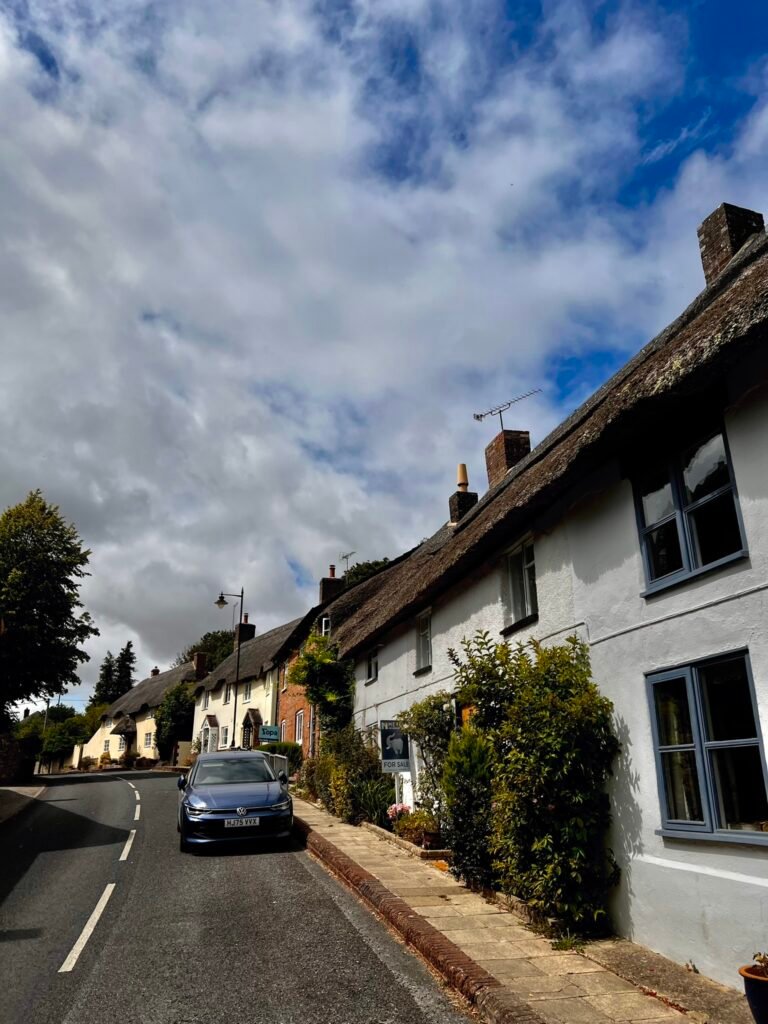
The Tolpuddle Martyrs: Six Men Who Dared to Complain
In 1834, life as an agricultural labourer was hardly a dream career. Long hours, physically exhausting work and wages that barely covered the necessities were normal. In Tolpuddle, repeated pay cuts had left workers facing wages of just six shillings a week.
Six local men decided they’d had enough.
George Loveless, his brother James, Thomas and John Standfield, James Brine and James Hammett became associated with the Friendly Society of Agricultural Labourers, an early trade union established to defend workers against further wage reductions.
There was just one problem.
Although forming a trade union was perfectly legal, the men had used an oath of secrecy, and the authorities found an old law under which they could prosecute them.
In March 1834, all six were sentenced to seven years’ transportation to Australia.
Seven years. Australia. For organising over their wages.
Imagine telling your employer you’d like better pay and receiving a one-way ticket to the other side of the planet. Suddenly, an awkward conversation with your manager doesn’t sound quite so terrifying.
Fortunately, the punishment caused national outrage. Huge demonstrations and a campaign involving hundreds of thousands of petition signatures pressured the government into granting pardons in 1836.
The men became known as the Tolpuddle Martyrs, and their story became a defining moment in the history of Britain’s trade union movement.
The Tolpuddle Martyrs’ Tree: Where History Took Root
You might expect the birthplace of such an important movement to be marked by an enormous monument, perhaps with dramatic statues and several very serious-looking plaques.
Instead, you’ll find a tree.
And what a tree it is.
On Tolpuddle’s village green stands an ancient sycamore, traditionally associated with the meetings of the Martyrs. Some discussions took place here, while others were held inside Thomas Standfield’s cottage.
The tree is believed to be more than 300 years old and is now cared for by the National Trust. It has also been recognised as one of Britain’s Great Trees.
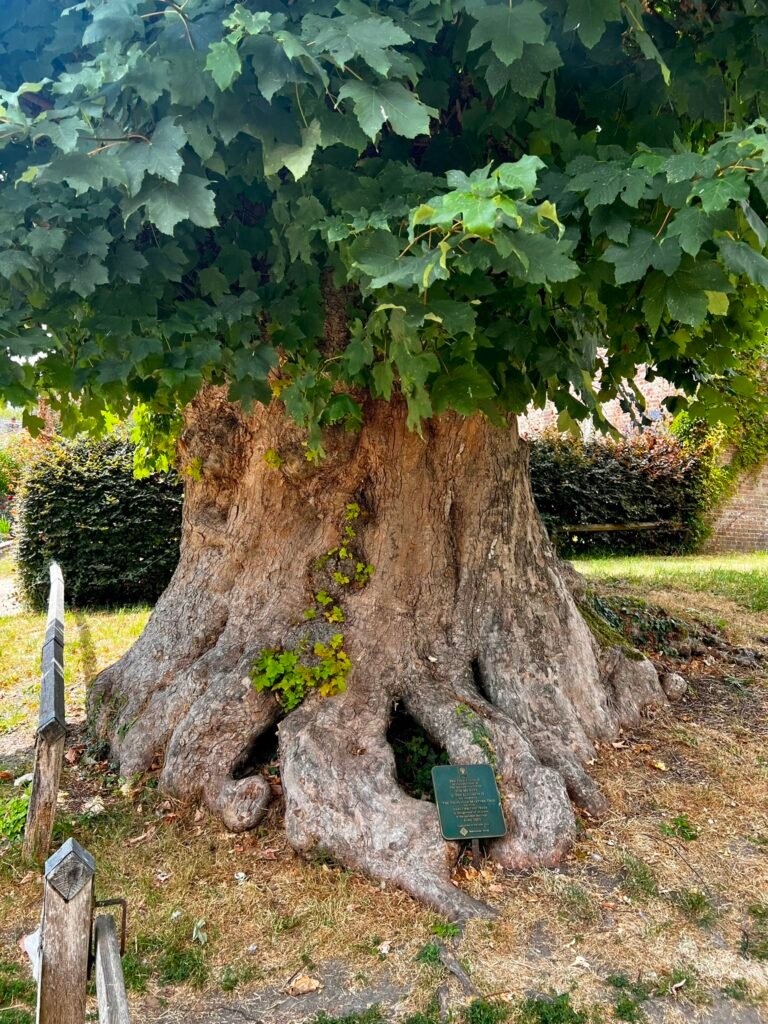
Standing beside that enormous trunk is rather humbling. It’s a living connection to people who stood up for themselves nearly two centuries ago, long before anyone had heard of an HR department.
The tree has outlived the landowners, the judges and countless governments. Not bad for something that has never moved from its spot on the village green.
A Thatched Shelter With a Rather Serious Purpose
Near the Martyrs’ Tree stands a delightful little thatched shelter, complete with wooden benches.
It looks like the sort of place where you could sit down with a sandwich, admire the village and briefly forget that the rest of the world exists.
But this isn’t just an attractive addition to the green.
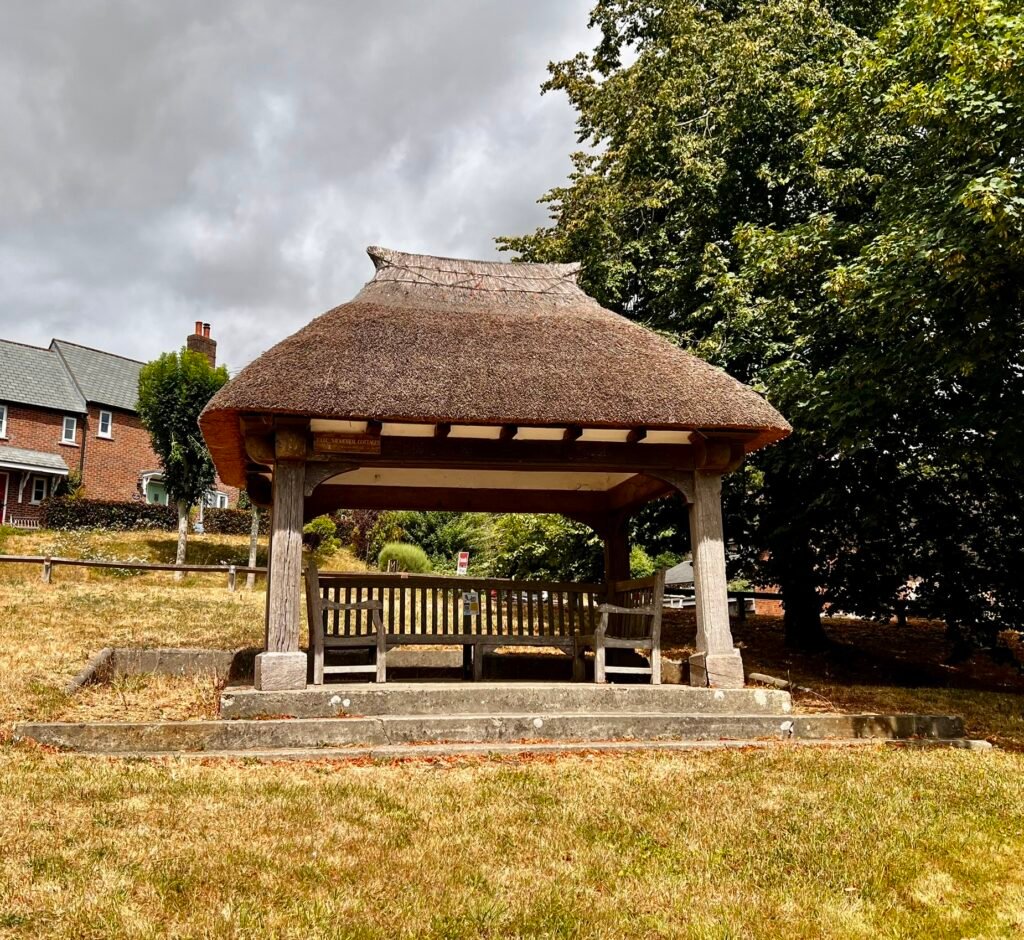
The shelter was erected in 1934, during the centenary commemorations of the Martyrs’ arrest and conviction.
That same year, the Trades Union Congress helped establish six memorial cottages for retired agricultural workers. They weren’t simply commemorating the past; they were doing something practical for the people whose working lives the Martyrs had fought to improve.
It’s a lovely example of history being remembered through something useful rather than another statue of a stern-looking gentleman on a horse.
St John’s Church: A Quiet Place With an Extraordinary Grave
A short wander through Tolpuddle brings you to the Church of St John the Evangelist.
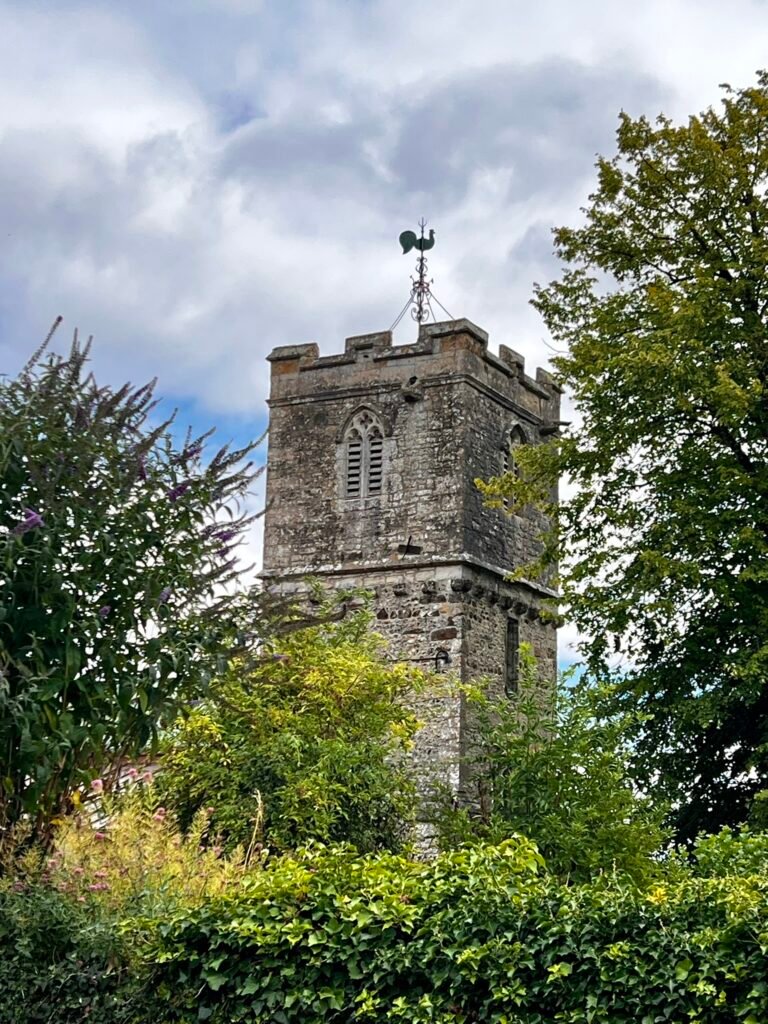
With its ancient stonework, square tower and peaceful churchyard, it’s exactly the sort of historic Dorset church that makes me reach for my camera before I’ve even reached the gate.
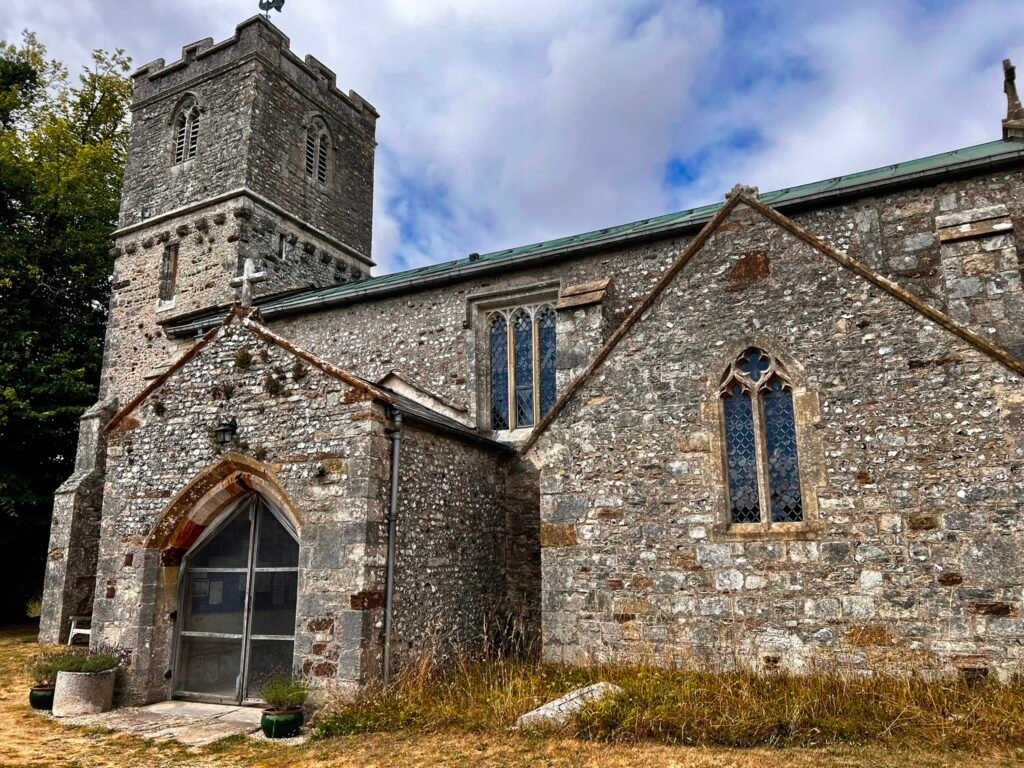
The church dates back to the medieval period, with origins in the 12th century. Its weathered walls and traditional windows make it worth a visit even without the village’s remarkable history.
But there’s something particularly important here.
Among the gravestones lies James Hammett, the only one of the six Martyrs who eventually returned to live permanently in Tolpuddle.
The other five emigrated to Canada, but Hammett remained connected to the village where the extraordinary events had begun.
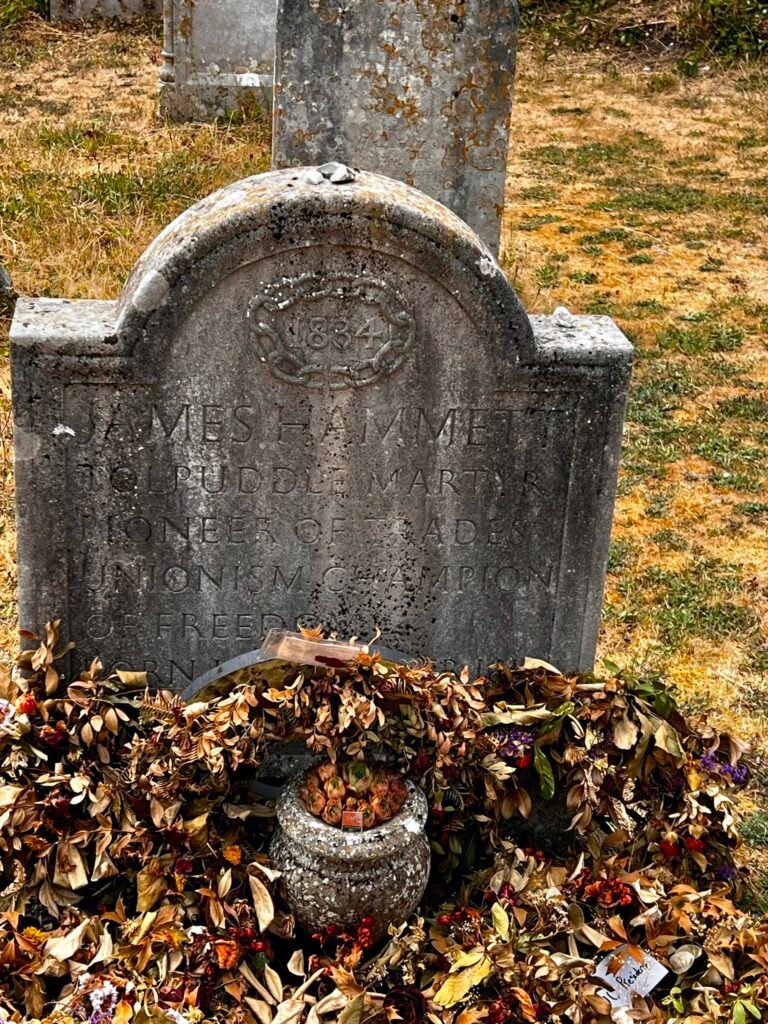
Hammett died in 1891. His commemorative headstone, created in 1934 by sculptor Eric Gill, is now Grade II* listed.
Look closely and you’ll notice the date 1834, surrounded by a chain.
It’s a simple but powerful design. A reminder that the events commemorated here affected real people and their families, not merely names in a history book.
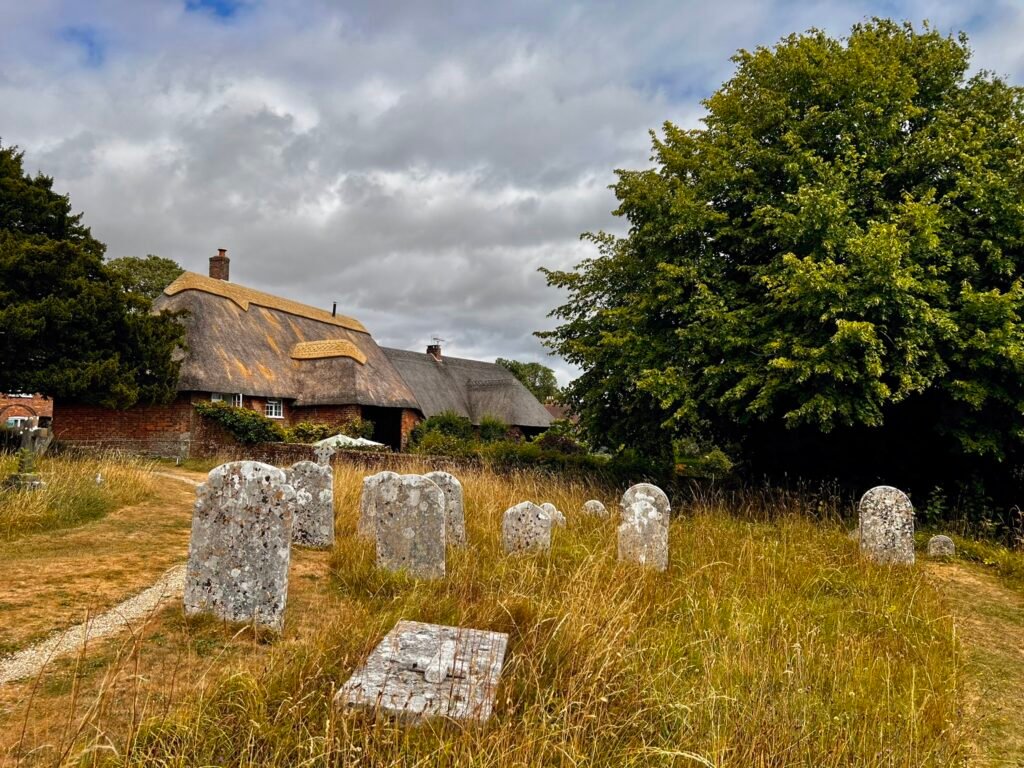
And while you’re exploring the churchyard, don’t forget to look up.
More Than Pretty Cottages: Discovering Tolpuddle Today
What makes Tolpuddle so enjoyable is the contrast between its peaceful appearance and its extraordinary history.
There are lovely thatched cottages, traditional stone buildings and quiet corners where it’s easy to imagine village life continuing much as it did generations ago.
Yet behind that beautiful rural scenery lies a story of injustice, extraordinary courage and the power of ordinary people working together.
If you’d like to explore the events in more detail, the Tolpuddle Martyrs Museum is an excellent addition to your visit. Admission is free, and its exhibitions explain the arrests, transportation and campaign for the men’s freedom.
There’s also an official Tolpuddle village history trail, which helps connect the places around the village with the people and events that made them famous.
You don’t need to be especially interested in politics to appreciate what happened here. The story is ultimately about people who believed that working hard should at least provide enough money to live.
A fairly reasonable request, you’d think.
Visiting Tolpuddle, Dorset: Parking, Opening Hours and Accessibility
Tolpuddle lies roughly seven miles north-east of Dorchester, close to the A35. It’s a small village, so a gentle wander is a much better way to explore than attempting to drive from one historic feature to the next.
Parking: The easiest confirmed option for visitors is the free parking provided at the Tolpuddle Martyrs Museum on Dorchester Road, DT2 7EH. The museum does not publish separate car-park opening hours, so check directly if you intend to leave your vehicle there outside museum hours. Parking near the church is limited, and the village’s narrow roads deserve consideration for residents.
Admission: Exploring the village, seeing the Martyrs’ Tree and visiting the churchyard are free. The museum is also free to enter, with no advance booking required.
Museum opening hours: From April to October, Tuesday–Saturday 10am–5pm and Sunday 11am–5pm, with bank holidays generally 11am–4pm. Monday is closed. From November to March, Thursday–Saturday 10am–4pm and Sunday 11am–4pm, with Monday–Wednesday closed. The museum closes between Christmas and New Year. Always check the official opening hours before travelling.
Church opening: St John’s Church is normally open daily for visitors, although fixed daily visiting hours aren’t published. Entry is free, subject to services and other church activities.
Wheelchair access and facilities: The museum confirms access for people with disabilities and mobility difficulties, and its grounds have seating. The churchyard has gravel paths, while the church interior contains some changes in level. An accessible toilet and hearing loop have been reported at St John’s, but visitors who depend on these facilities should confirm current arrangements before travelling. Some grassy or uneven areas around the village may be more difficult for wheelchair users.
Allow: Around 45–90 minutes for a relaxed village walk, or longer if you’re visiting the museum and following the history trail.
OMS tip: Don’t rush directly to the famous tree and leave. Wander through the village, take a closer look at the church and give yourself time to appreciate the little architectural details. Tolpuddle rewards curiosity.
One Small Village, One Very Big Legacy
Tolpuddle is proof that the most interesting places aren’t necessarily the biggest, grandest or most spectacular.
Sometimes they’re the ones with a story that changes the way you see them.
I came away appreciating the village’s quiet charm, but also thinking about those six men who challenged something they believed was unfair. They couldn’t possibly have imagined how far their story would travel.
And that’s what makes this little Dorset village so memorable. Behind the thatched roofs and peaceful green lies an important piece of British history, still remarkably relevant today.
If you enjoy discovering the unexpected stories behind pretty villages, nearby Puddletown has a literary double life of its own, while Milton Abbas offers another fascinating chapter of Dorset village history.
There are plenty more intriguing places to discover across Dorset, and some of the best stories are hiding in the places you might otherwise drive straight past. If you are building a longer village-hopping route, Blandford Forum makes an interesting contrast, and there are more stops in my Dorset travel collection.
One journey. One story. One more stop.