
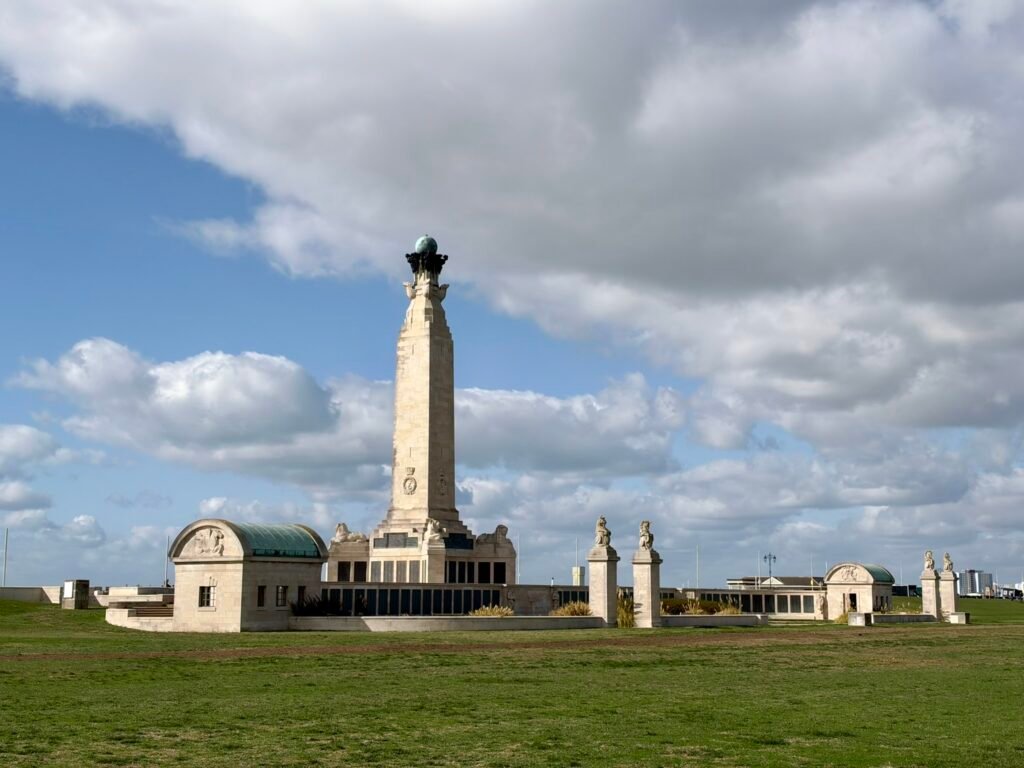
If you’ve ever walked across Southsea Common in Portsmouth, you’ve probably noticed that enormous stone tower rising above the grass. It’s impossible to miss, looks rather impressive, and you might have assumed it’s just another old war memorial.
Fair enough. I probably wouldn’t have given it much thought either if I hadn’t stopped to photograph it.
But here’s something I wasn’t expecting: this monument was actually designed to be seen from the sea. And those unusual figures holding a green globe at the very top? They have a meaning too.
Once you start looking properly, the Portsmouth Naval Memorial becomes considerably more interesting than a very tall piece of stone.
And then you discover what all those thousands of names are doing there.
A memorial with a second job
Most memorials are designed for people to visit. This one was also designed for sailors to recognise from their ships.
After the First World War, thousands of Royal Navy personnel had died without a known grave. Most had been lost at sea, leaving their families without anywhere to visit and remember them.
The solution was to create three major naval memorials at Portsmouth, Plymouth and Chatham, the country’s principal naval manning ports.
Rather than hiding them away, the designers created enormous obelisks that would also serve as navigational landmarks.
That’s rather extraordinary when you think about it: a monument visible to sailors approaching home, commemorating those who never made that journey themselves.
Portsmouth’s original memorial was unveiled on 15 October 1924 by the Duke of York, who later became King George VI.
What’s actually happening at the top?
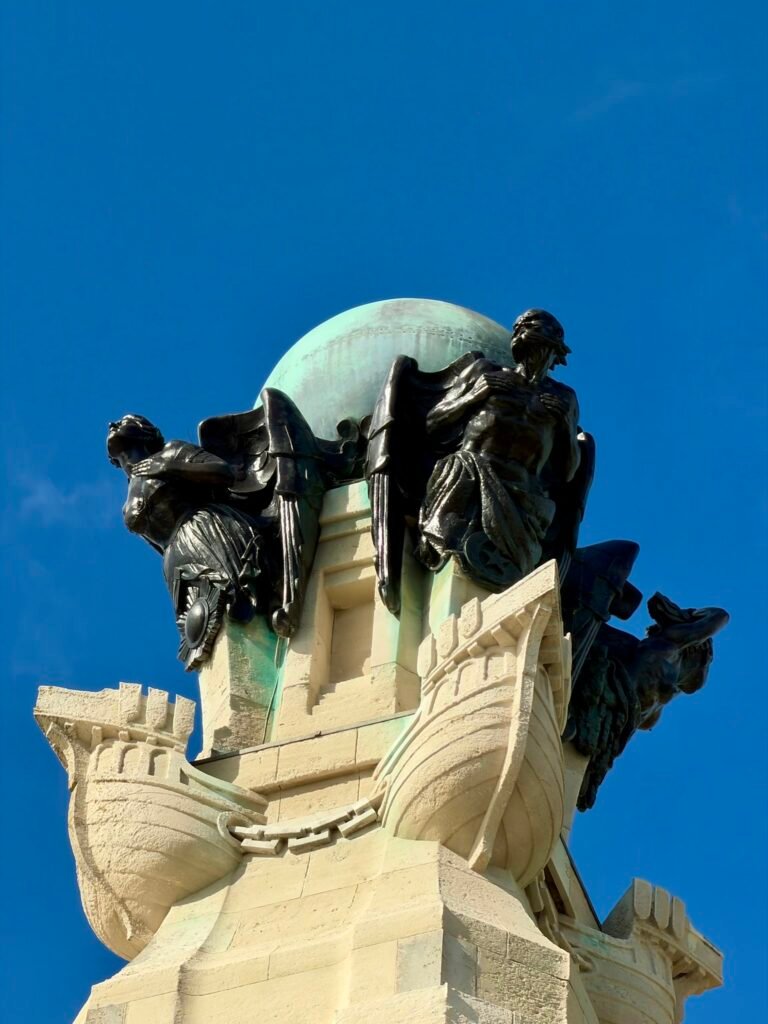
If you’re standing beneath the tower, look up.
Right at the summit are four projecting ship-like structures, bronze figures and a large greenish globe. It’s quite an elaborate arrangement for something you might initially mistake for a simple stone column.
The projections represent ships’ prows, inspired by ancient Roman monuments. The bronze figures symbolise the four winds, supporting a copper globe representing Earth.
The green colour comes from the natural ageing of the copper, rather than somebody deciding it needed a fresh coat of paint. 😂
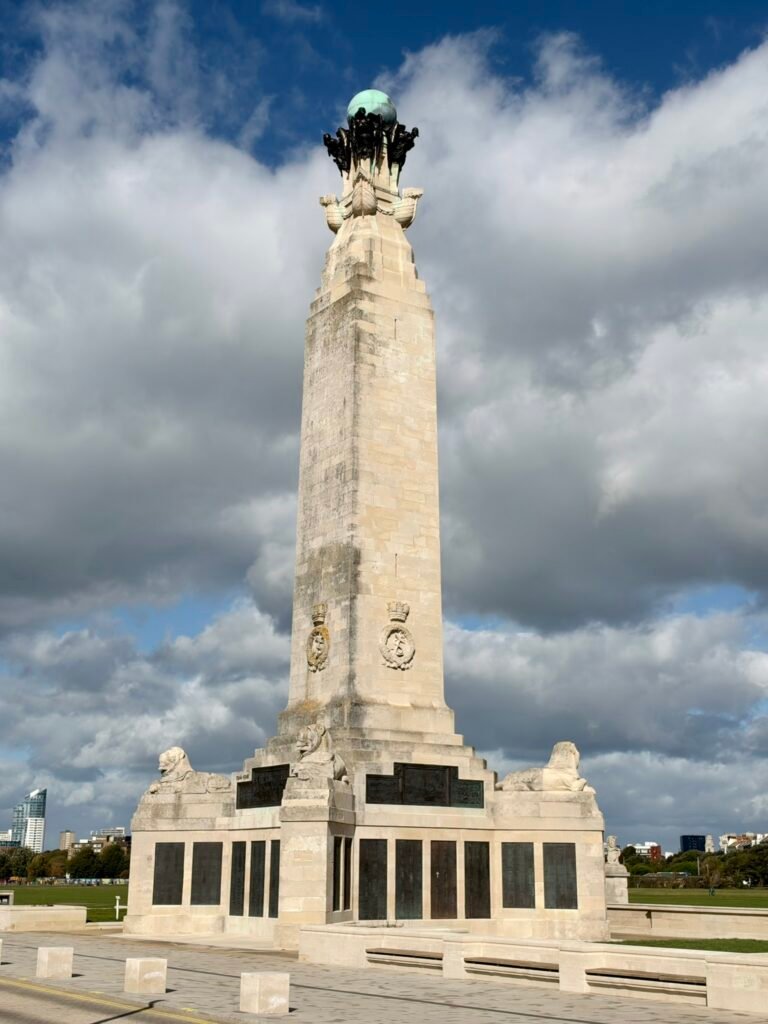
And those enormous reclining stone lions around the base? They’re part of the original design too.
The monument was designed by Sir Robert Lorimer, with sculpture by Henry Poole. You can explore its architecture in the official Historic England listing.
Nearly 25,000 names. And one thing they share.
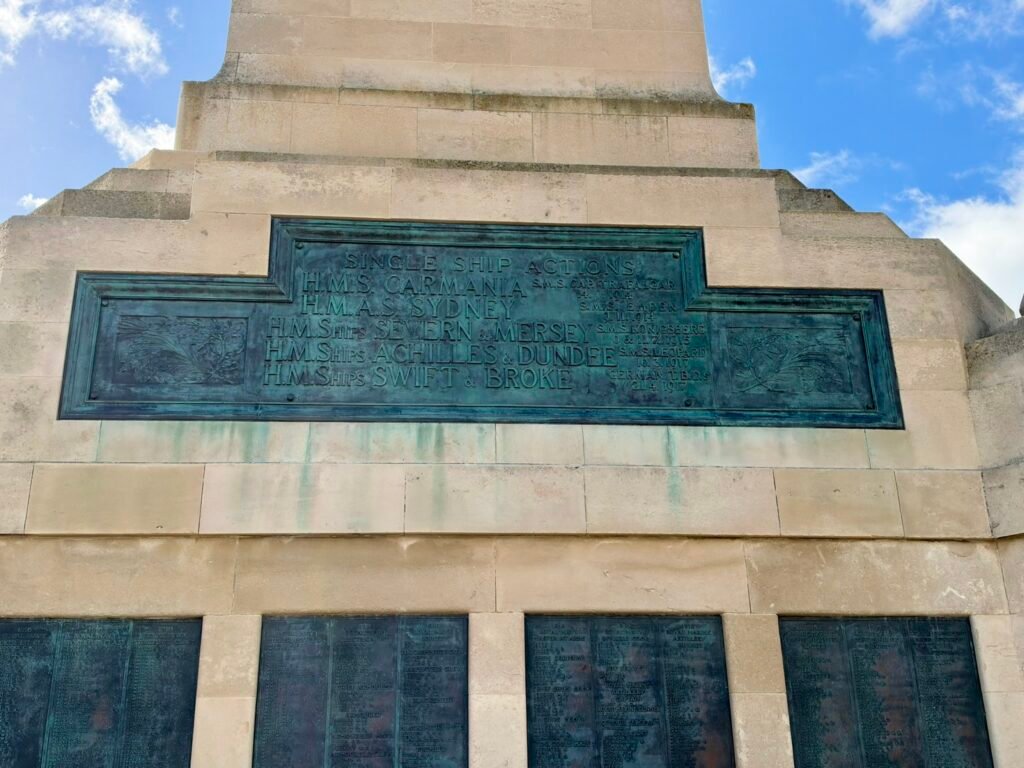
Look at the bronze panels surrounding the memorial.
They’re covered in names. Row after row, stretching around the central tower and along the surrounding walls.
The memorial commemorates more than 9,600 people from the First World War and approximately 14,900 from the Second.
That’s around 24,500 individual lives.
But here’s what makes this different from an ordinary cemetery: these people had no known grave.
Imagine receiving the news that someone you loved had died, but having nowhere to visit afterwards. No headstone, no grave, no particular place to leave flowers or simply stand for a few minutes.
For thousands of families, that was the reality.
The memorial gave them somewhere to go.
You don’t need to understand naval battles or military ranks to appreciate that each name belonged to someone with family, friends, hopes and a future they never got to experience.
Suddenly those bronze panels feel very different.
Why does part of it look newer?
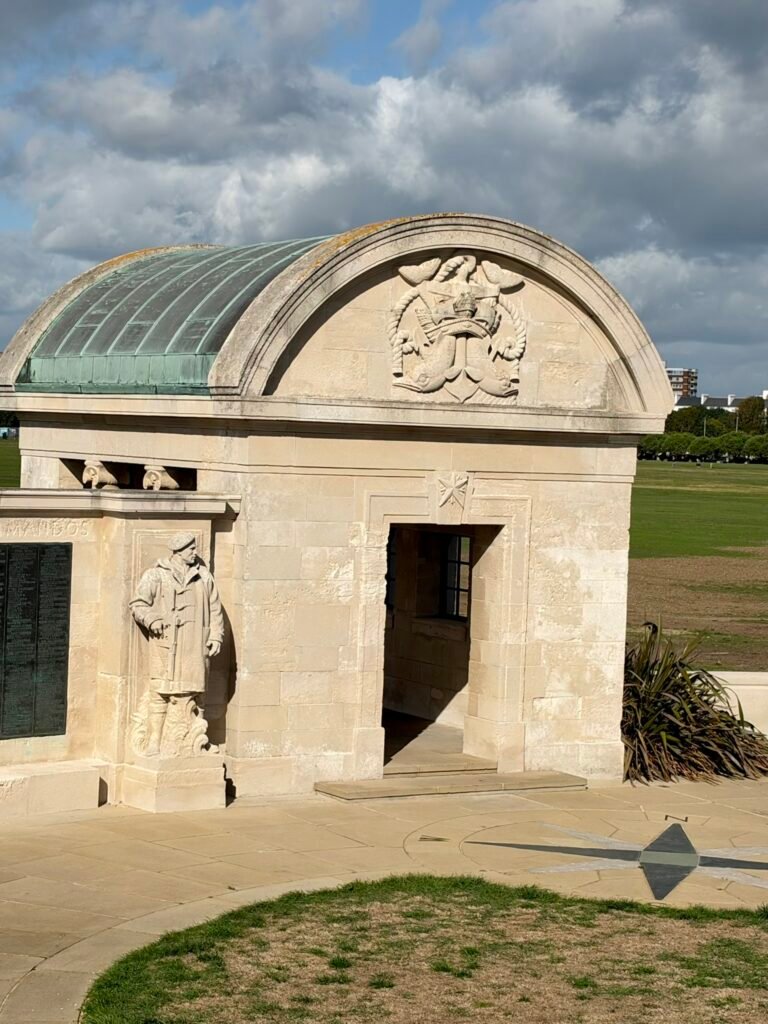
The enormous central obelisk is surrounded by lower curved walls, smaller buildings with green roofs, statues and ornamental stonework.
That’s because the memorial was built in two stages.
The original 1924 structure commemorated the First World War. After the Second World War, thousands more names needed somewhere to be recorded.
Instead of replacing the original monument, architect Sir Edward Maufe designed an extension with curved memorial walls, bronze panels and small shelters.
The additions were unveiled in 1953 by Queen Elizabeth the Queen Mother.
Look closely and you’ll find more maritime carvings, sculpted figures and decorative details. It’s almost like an outdoor architectural gallery, except everything has a deeper purpose.
Free parking near Southsea Common — a useful discovery!
Parking near popular seaside attractions isn’t always cheap, so I was pleasantly surprised to discover that parts of Southsea offer up to three hours of free on-street parking.
I found a space on Beach Road, but here’s the useful part: it isn’t just Beach Road!
The street belongs to Portsmouth City Council’s KC – West Southsea parking zone, which includes several surrounding roads such as Clarence Road, Elphinstone Road, Florence Road and many others.
The council’s official West Southsea parking-zone page lists the included streets and provides a downloadable colour-coded map. The colours help identify the area; they don’t mean every marked space is free.
The three-hour allowance applies to eligible spaces, not automatically to pay-and-display bays or car parks. Always check the signs and current restrictions before leaving your car.
I found it worth driving around the surrounding streets rather than immediately paying for parking. I imagine finding a space would be considerably harder on a sunny summer weekend, though! 😂
For my visit, three hours was enough to explore the memorial and nearby Southsea Castle, with plenty of photography stops.
A castle, a ruined church and two amusement piers
One thing I really liked about this part of Portsmouth is how much else you can discover on the same walk.
Nearby Southsea Castle was built for Henry VIII in 1544. It’s a proper Tudor coastal fortress with wonderful views across the Solent. Better still, admission is free, although the main castle has seasonal opening hours.
Heading towards Old Portsmouth, you’ll also find Royal Garrison Church, cared for by English Heritage. This medieval building started life as part of a hospital for travellers and the poor before becoming a military church. An air raid in 1941 destroyed the nave roof, leaving a remarkable roofless space.
Royal Garrison Church is free to enter too, but check its limited opening times before visiting. For more places cared for by English Heritage, I’ve explored Titchfield Abbey in Hampshire and written a separate guide to whether English Heritage membership is worth it.
And if you fancy something completely different, Southsea has two amusement piers. Clarence Pier lies to the west, while South Parade Pier is further east, with its own fairground attractions. Rides are seasonal, so check what’s operating.
I didn’t attempt to squeeze all of that into my three-hour parking window. How much you can see really depends on how often you stop — particularly if you’re anything like me and keep finding another angle worth photographing. 😂
Perhaps that’s a good excuse to return.
One little thing before you leave
Whether you’re interested in naval history, Tudor castles, unusual architecture, seaside rides or simply a walk with a view, there’s considerably more around Southsea Common than you might expect.
But before leaving the Portsmouth Naval Memorial itself, I’d suggest doing one small thing.
Walk towards the bronze panels and choose a name. Any name.
You probably won’t know who that person was, where they lived or what they dreamed of doing with their life.
But for a few seconds, someone who might otherwise remain just another name among thousands has your attention.
And perhaps that’s the whole point.
One journey. One story. One more stop.