
There are castles you admire from behind a rope, castles where half the rooms are closed, and then there is Old Wardour Castle — where the roof has largely disappeared, the walls are broken open to the sky and, rather wonderfully, you are still invited to climb through it.
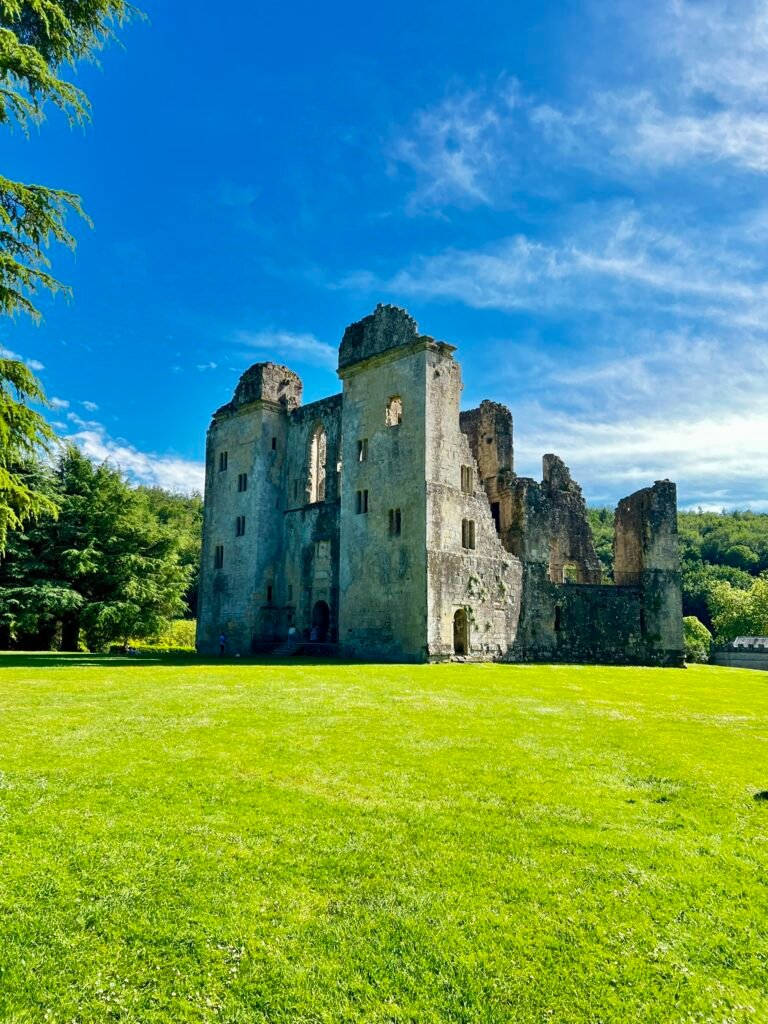
Hidden in the Wiltshire countryside near Tisbury, Old Wardour looks almost too theatrical when you first walk onto the lawn. Six-sided, surrounded by trees and sitting beside landscaped grounds and a lake, it is considerably more elegant than your average pile of medieval rubble.
Then you notice that a substantial chunk of it is missing.
That is not centuries of gentle decay. Old Wardour was caught up in the English Civil War, besieged twice, and partly blown apart during the fighting. Yet enough survived to make it one of those ruins where you can still understand the building rather than simply stare at a few disconnected walls. The castle began as an unusually luxurious late-14th-century residence, was later transformed for the Arundell family, and eventually became the spectacular ruin you can explore today.
And “explore” really does mean explore.
Stone doorways lead into roofless rooms. Narrow stairs curl upwards inside the walls. Huge Gothic windows frame nothing but sky. Keep climbing and eventually the countryside opens below you, with lawns, woodland and water spreading out beyond the shattered masonry.
This is where Old Wardour surprised me most. From the lawn, it is beautiful.
From inside, it becomes an adventure.
Why Old Wardour Castle Looks So Different
The first thing that makes Old Wardour Castle unusual is its shape. Most medieval castles make immediate visual sense: square towers, curtain walls, a keep in the middle, somewhere obvious to defend. Wardour went in a rather more ambitious direction.
The main building was designed around a hexagonal courtyard, with six sides arranged into an extraordinarily symmetrical plan. Built in the 1390s for John, 5th Lord Lovell, it rose to five storeys and was conceived as much to display wealth and status as to withstand trouble. English Heritage describes its design as unique in England.
Lovell was no inexperienced aristocrat playing at castles. He had served as a soldier abroad, held important royal positions and had become governor of Devizes Castle. By the time he acquired Wardour, he had the money and connections to create something deliberately impressive.
And impressive meant more than thick walls.
Inside were grand entertaining spaces including a great hall and great chamber, private accommodation higher up, fireplaces, latrines and large windows bringing light into rooms that were intended to be lived in comfortably. This was a medieval power statement with rather better amenities than the word castle sometimes suggests.
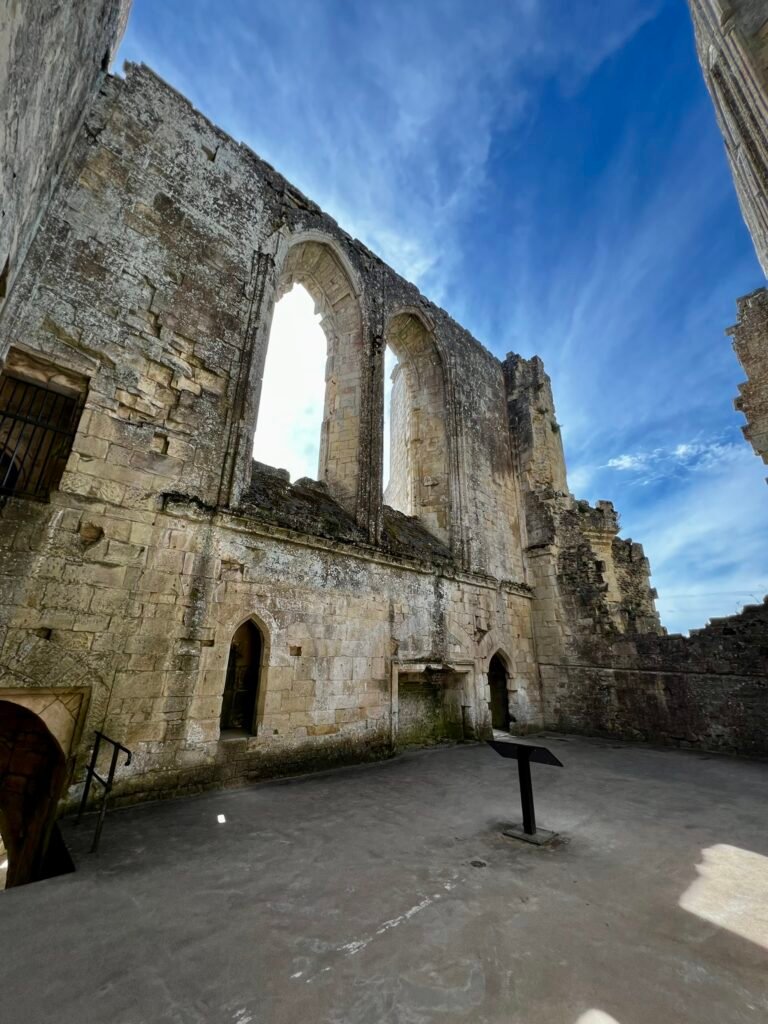
Today, standing inside those roofless rooms, you get an oddly effective glimpse of that original ambition. The furniture, floors and ceilings have disappeared, but the proportions have not. Tall windows stretch through the surviving masonry and doorways still connect spaces that once formed a sophisticated household.
That is one reason the castle is so satisfying to explore. You are not trying to reconstruct the entire building in your imagination from a lonely foundation stone and an interpretation board. Enough survives for you to move through it and understand where rooms, stairs and levels once fitted together.
The building did not remain frozen in the Middle Ages either. After passing through several owners, it came into the hands of the Arundell family. In the 1570s, Sir Matthew Arundell modernised the castle rather than replacing it, adding Renaissance details to the medieval structure. The work is associated with architect Robert Smythson, whose career also included some of Elizabethan England’s most celebrated houses.
Look closely around the entrance and courtyard and you can therefore spot two architectural worlds living together: medieval pointed openings alongside more fashionable Tudor and classical details.
It should have been the beginning of another long chapter as a grand family home.
Instead, less than a century later, Old Wardour was about to acquire the enormous missing section that makes it so unforgettable today.
Two Sieges, One Castle and a Very Large Explosion
By 1643, Old Wardour had stopped being a fashionable family home and become something far more dangerous: a Royalist stronghold in the middle of the English Civil War.
The Arundells were a Catholic family and firmly supported King Charles I. When Thomas, 2nd Lord Arundell, left Wardour to join the king at Oxford, responsibility for the castle fell to his wife, Lady Blanche Arundell.
She was about 60 years old.
And when Parliamentarian forces arrived on 2 May 1643 demanding the castle, she refused to hand it over.
Inside Wardour were Blanche, members of her family, servants and a defending force of only around 25 men. Outside was a much larger Parliamentarian force under Sir Edward Hungerford.
What followed was six days of resistance.
The attackers fired artillery at the castle and attempted to use gunpowder against its defences. One explosion was sent through a latrine shaft and shook the building, but even that failed to bring Wardour down immediately.
Meanwhile, the household kept fighting. Contemporary Royalist accounts even describe the maidservants helping to reload weapons as the defenders became exhausted.
Eventually, food, sleep and options were running out. Blanche agreed to surrender on 8 May after securing terms intended to protect the people inside.
Her ordeal was not quite finished.
The Parliamentarians occupied Wardour, seized valuables from the household and took Blanche and members of her family prisoner. Not long afterwards she learned that her husband had died from wounds received while fighting for the Royalist cause.
That could easily have been the end of the story.
It wasn’t.
The Arundells came back
Later that year, Blanche’s son Henry Arundell, now 3rd Lord Arundell, returned with Royalist forces determined to recover the family home.
Suddenly the situation was reversed.
The Parliamentarians were now trapped inside Wardour Castle while the Arundells were outside trying to get back in.
The second siege began in December 1643 and dragged on for around three months. This time the castle faced the sort of destruction that centuries of normal occupation had never managed.
Henry’s forces eventually dug a mine beneath the walls and packed it with gunpowder.
The intention was to force the garrison to surrender.
What happened next was rather more permanent.
The charge exploded — possibly triggered accidentally by Parliamentarian fire — and an entire section of Old Wardour Castle was blown apart.
The garrison surrendered on 18 March 1644.
Henry Arundell had succeeded in recovering his family’s castle.
Unfortunately, he had also helped turn it into a ruin.
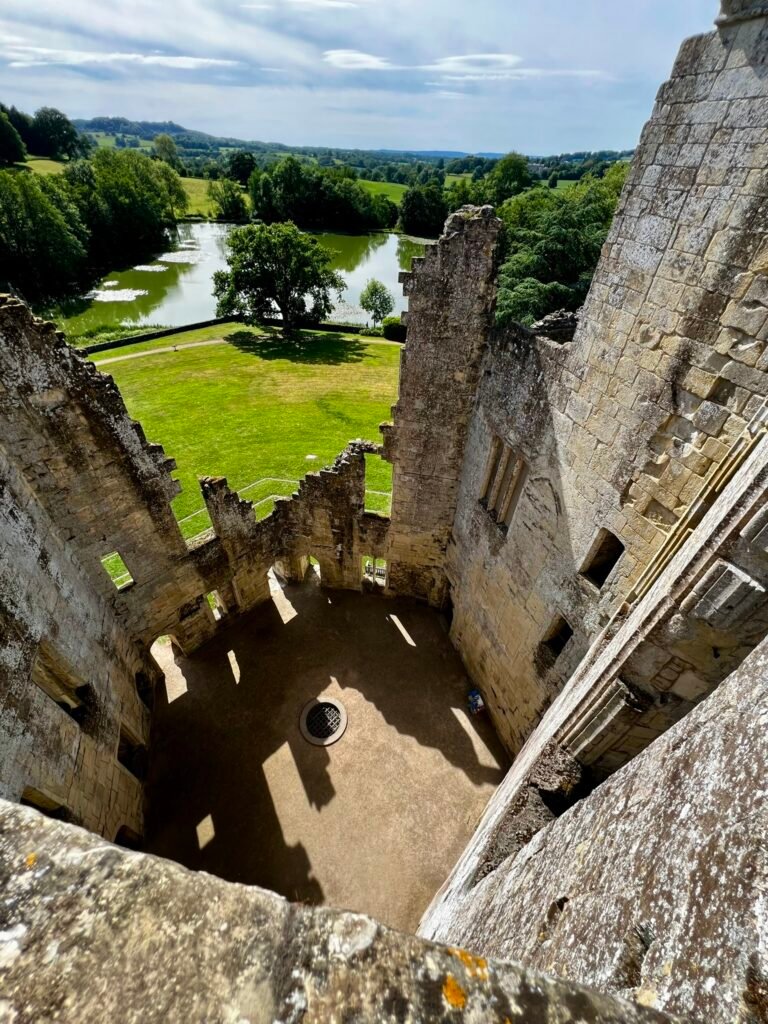
From above, the consequences are much easier to understand.
Instead of a complete enclosed residence, one side now opens dramatically towards the landscape. Rooms terminate in broken masonry. Staircases lead past missing floors. Windows that once looked out from furnished chambers now frame trees, water and sky.
It is destruction, but strangely photogenic destruction.
And this is one of the reasons Old Wardour is so memorable today: the explosion did not flatten it. It ripped the building open.
Enough survived to preserve the shape, height and internal layout, while the missing section transformed the castle into something far more theatrical.
After the war, the Arundells eventually regained their estate following the Restoration of Charles II in 1660. But the medieval castle was never fully rebuilt.
Its days as the family’s main home were over.
Its second life — as one of Wiltshire’s most extraordinary ruins — had begun.
Climbing Through the Castle
Old Wardour becomes much more fun once you stop looking at it as a ruin and start treating it like a building you can actually explore.
The route pulls you through narrow passages, surviving chambers and staircases tucked into the thickness of the walls. One moment you are standing at ground level looking up at a tower of broken stone; a few minutes later you are looking down into the same space from above.
That constant change of perspective is what keeps the visit interesting.
There is no sense of simply walking around the outside, reading a board and moving on. You keep disappearing into the structure, turning corners and finding another staircase, doorway or opening that changes the view again.
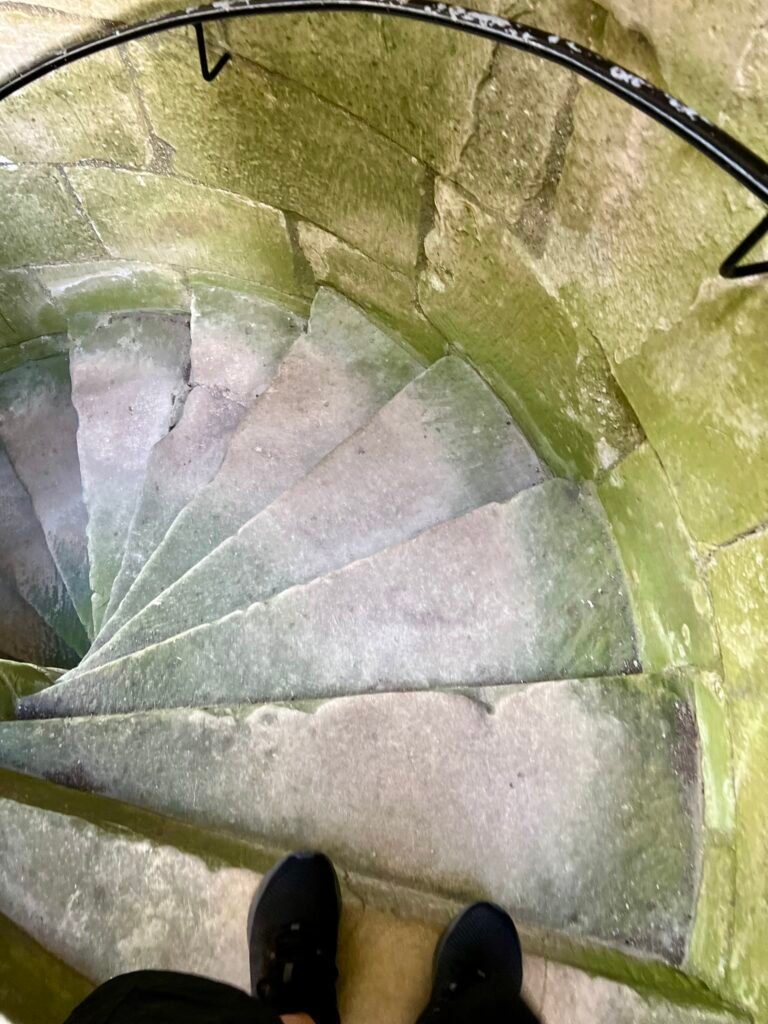
The spiral stairs are one of the best parts.
They are narrow enough to feel properly medieval, worn enough to remind you how many people have climbed them before you, and just awkward enough to make the journey upwards feel like part of the experience rather than a route between floors.
This is also where the castle starts to feel much bigger than it looked from the lawn.
From outside, the surviving walls are impressive. From inside, you begin to understand how many levels were once packed into them. Doorways appear above your head, fireplaces sit several metres up a wall, and openings that once belonged to furnished rooms now lead straight into open air.
It is slightly surreal.
You can stand in what was once a grand domestic space and look through a window that no longer has a room attached to it.
The higher you go, the better it gets
As you climb, the castle gradually opens out.
The enclosed feeling of the lower levels gives way to wider views across the ruins and surrounding countryside. From higher up, the six-sided layout becomes much easier to read, and the damage caused by the Civil War is suddenly obvious in a way it is not from ground level.
You can trace the line of walls, see how the rooms fitted around the central space and understand just how much of the original structure still survives.
And then there are the views.
Trees, lawns and water begin appearing through broken windows and gaps in the masonry, turning the ruined walls into enormous stone picture frames.
It is one of those places where the best view is rarely directly in front of you.
Sometimes it is below.
Sometimes it is through a doorway.
Sometimes it appears when you turn around halfway up a staircase.
That unpredictability is probably the best part of exploring Old Wardour.
You never quite know what the next opening in the wall is going to reveal.
The Side of Old Wardour That Looks Completely Different
Walk around Old Wardour Castle and something slightly strange happens: the building seems to change character as you go.
From the entrance side, it can look remarkably complete. The paired towers still rise to almost their original height, the façade retains its ordered windows and decorative details, and from across the lawn you could almost forget that this is a ruin.
Keep walking.
The illusion disappears.
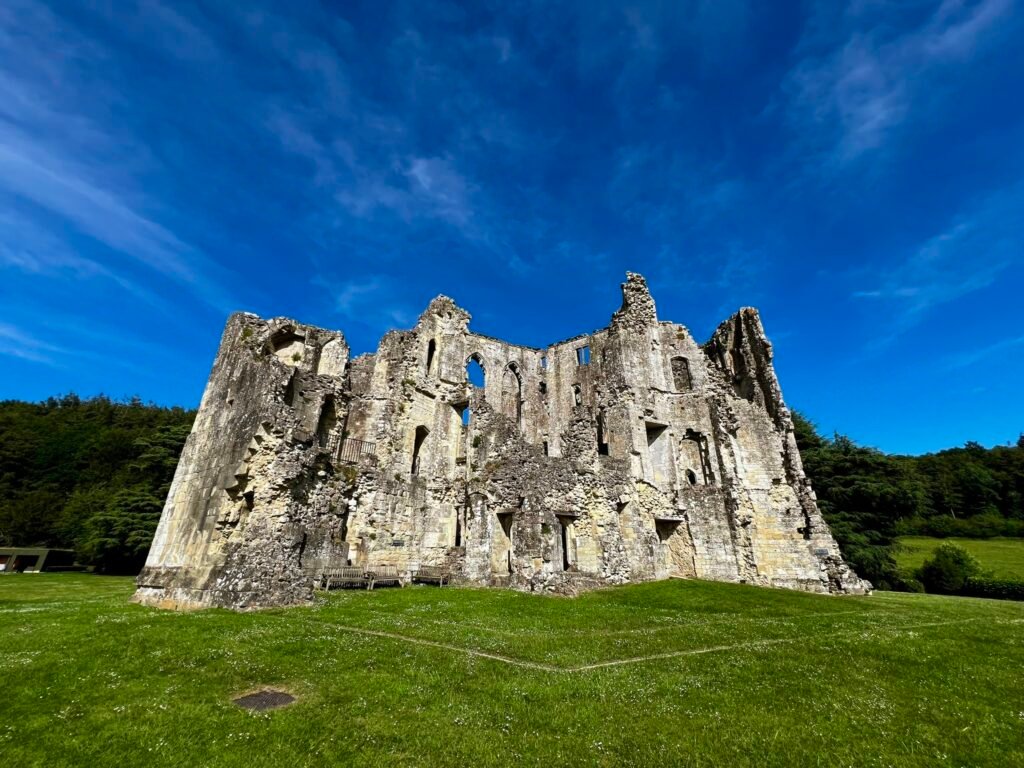
The south-west side is where the damage becomes impossible to ignore. An entire section of the castle is gone, leaving rooms exposed like a giant stone cross-section.
Walls suddenly stop.
Windows open onto nothing.
Fragments of upper floors cling to masonry with empty space beneath them.
And because the surviving parts still reach such a considerable height, the missing section feels even more dramatic. You are not looking at a ruin that has gradually collapsed into a low outline; you are looking at a substantial building with a piece violently removed from it.
That contrast is one of Old Wardour’s best features.
The original design was obsessed with symmetry. Even some windows were arranged to maintain the appearance of balance whether they served a practical purpose or not. Yet centuries later, the castle is visually defined by the exact opposite: one side composed and almost mansion-like, the other broken open.
It makes walking around the exterior worthwhile rather than simply using the lawn as the quickest route back to the entrance.
There are details everywhere once you slow down — surviving window surrounds, sections of decorative stonework, the remains of upper chambers and sudden glimpses straight through the building. Different angles reveal just how much structure survived despite the enormous damage.
And the further you move away from the walls, the more Old Wardour starts interacting with its setting.
The castle stops dominating the whole view.
Water appears between the trees. Lawns roll away from the ruins. Woodland begins to surround the stone.
That is not accidental.
Because long after Old Wardour stopped functioning as somebody’s home, the Arundells found an entirely new use for their broken castle.
They turned it into scenery.
When a Ruined Castle Became Part of the Garden
Old Wardour’s story could have ended with the Civil War.
The building was badly damaged, the family eventually moved on, and by the 18th century there was little practical reason to turn the old castle back into a comfortable home.
So the Arundells did something much more interesting.
They let the ruin become part of the landscape.
A new family residence — New Wardour Castle — was built nearby in the 18th century, while the medieval castle was deliberately retained as a picturesque feature within the wider estate. What had once been a home and defensive stronghold gradually became something to look at, walk around and admire.
In other words, Old Wardour became a romantic ruin long before romantic ruins became a weekend photography obsession.
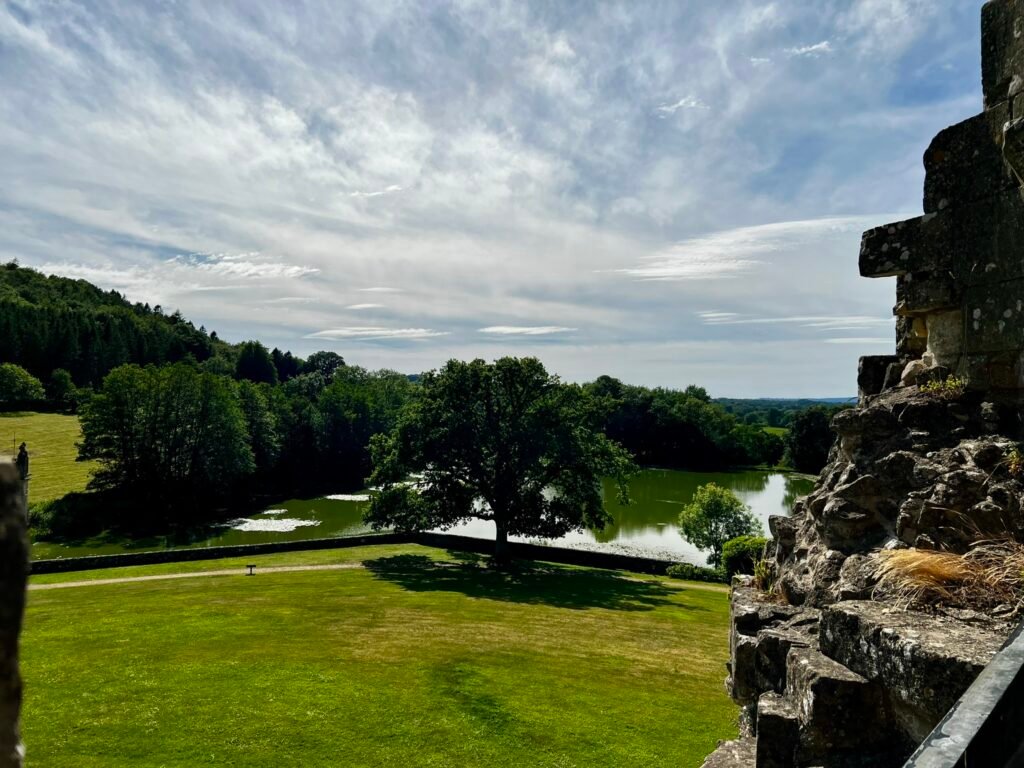
The setting makes much more sense once you know that history.
The lake, lawns and woodland are not simply pleasant scenery that happens to surround the castle. They became part of the way the ruin was experienced. From some viewpoints, Old Wardour appears through trees or across stretches of water rather than standing alone as a military monument.
That softness changes the atmosphere completely.
You can spend several minutes inside looking at shattered walls and evidence of siege warfare, then step outside and find yourself beside calm water with ducks drifting across it.
It is quite a tonal shift.
And it is one of the reasons Old Wardour feels different from many other castle ruins. The building is dramatic, but the visit is not bleak. There is enough greenery and open space around it to make the whole place feel surprisingly relaxed.
You can sit on the grass.
Walk beside the water.
Look back at the castle through the trees.
Or simply find another angle and wonder how a building that was once blown apart managed to end up looking this photogenic.
The Arundells effectively turned destruction into decoration.
And they did not stop with the lake.
Elsewhere in the grounds, another deliberately picturesque feature was created — one that gives you one of the strangest and best views of the castle.
A grotto.
The Grotto With a Castle View
There is something wonderfully odd about wandering away from a medieval castle, stepping into a rough stone grotto — and then turning around to find Old Wardour Castle perfectly framed in the opening.
The grotto belongs to a much later chapter in Wardour’s story. By the late 18th century, the old castle was no longer being treated simply as an abandoned ruin. The surrounding landscape was being deliberately shaped to make the most of it.
Paths, water, woodland and ornamental structures were arranged so that the castle appeared and disappeared as visitors moved through the grounds. Rather than one obvious viewpoint, the idea was to create a succession of little discoveries.
And the grotto delivers one of the best.
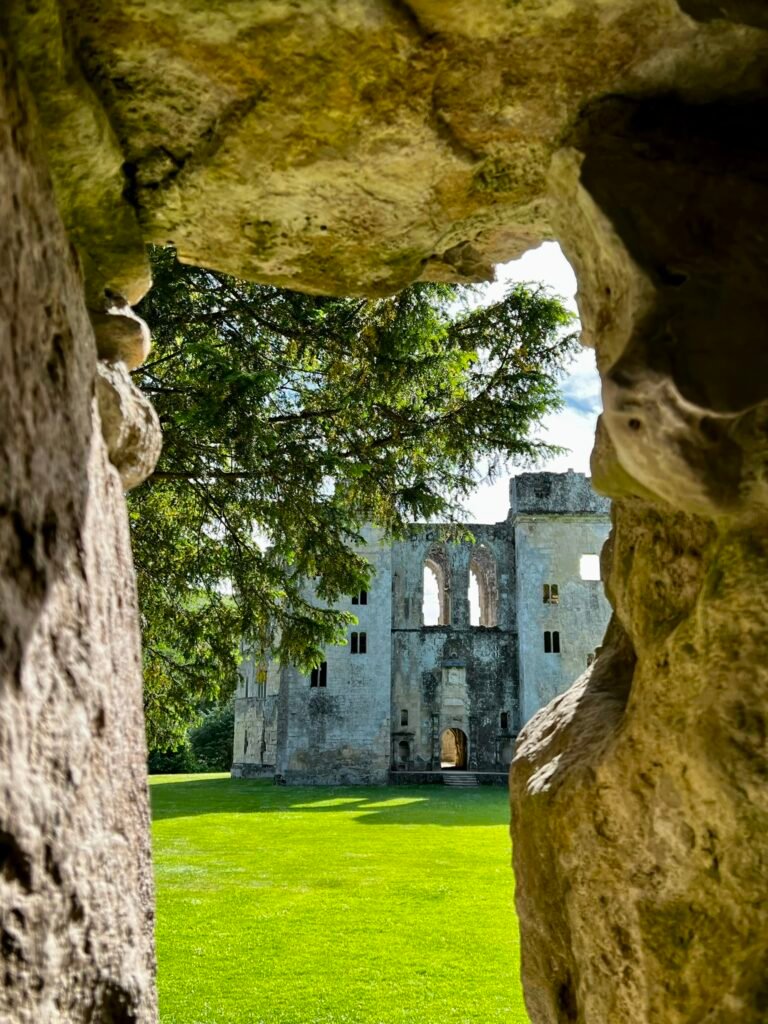
From inside, the dark stone opening acts almost like a ready-made picture frame.
The castle sits beyond the trees and lawn, suddenly looking less like a battered medieval fortress and more like part of a carefully composed landscape.
Which, by this point in its history, is exactly what it had become.
The larger grotto was created in 1792, built by local craftsmen Josiah and Joseph Lane. Historic stone was reused in its construction, helping the deliberately rustic structure feel as though it had always belonged among the ruins and woodland.
It is theatrical, slightly eccentric and completely in keeping with the period.
And more than two centuries later, the trick still works.
You step inside, turn around and there it is: the castle sitting neatly in the opening as though somebody designed the whole thing specifically for your camera.
They more or less did.
It is also a good reminder not to rush straight back to the exit once you have finished climbing around the castle itself. Some of Old Wardour’s most memorable details sit outside the main ruin, where the landscape tells the final part of its story.
A medieval home became a battlefield.
The battlefield became a ruin.
And eventually, the ruin became something people deliberately came to admire.
That is quite a transformation.
What Is Old Wardour Castle Actually Like to Visit?
For somewhere with this much history, Old Wardour Castle is refreshingly easy to enjoy without turning the visit into a military operation of your own.
It is compact enough that you can explore it properly in an afternoon, but there is enough inside the ruins and around the grounds to stop it feeling like a quick photo stop. English Heritage gives an average group visit time of around 90 minutes, although I would allow closer to two hours if you want to climb the castle, listen to parts of the audio guide, wander around the lake and grounds, and actually stop to enjoy the views rather than racing through them.
The castle itself is the main event. You can move through the surviving ground-floor rooms and climb the towers using the narrow stone staircases we have already encountered. There are 93 steps to the top of the tower, and some of the spiral stairs are steep and tight, so this is one of those visits where sensible shoes beat ambitious footwear.
The reward is worth the climb.
Because Old Wardour is so open, the views keep changing as you move upwards. You are not simply climbing to one viewing platform at the end; windows, broken walls and doorways reveal the landscape at different heights along the way.
Bring a picnic rather than expecting lunch
There is no café at Old Wardour Castle.
There are drinks, ice creams and packaged snacks available, but if you want something more substantial, bringing a picnic is the better plan. There are picnic tables and benches, plus plenty of grass around the castle where you can sit when the weather cooperates.
And this is one place where a picnic actually feels like part of the visit rather than emergency food consumed beside the car.
Castle in front of you. Lake nearby. Wiltshire countryside around you.
You could do considerably worse for a sandwich location.
Parking is easy — getting there is the interesting bit
Old Wardour has free on-site parking, with 20 regular spaces and additional overflow capacity. The castle sits around three and a half miles south-west of Tisbury, and some of the approach roads are narrow, which is worth knowing before your sat-nav enthusiastically sends you into the countryside.
Once you arrive, however, everything feels wonderfully removed from busy roads and towns.
That slightly hidden location is part of the appeal.
Accessibility is mixed
The grounds and ground floor of the castle have accessible routes, including access into the courtyard, but the upper levels are reached by historic stairs and there is no lift. Wheelchair access therefore does not extend to the towers or higher floors. Accessible toilets and designated parking bays are available.
Pushchairs are permitted around the site too, although English Heritage advises that the castle stairs are not suitable for carrying them to the upper levels.
So even if climbing the castle is not practical for everyone in your group, the exterior, courtyard and landscaped grounds still provide plenty to see.
Take the audio guide — or wander at your own pace
A free audio tour is available, either through a phone or a handset. It adds context to the rooms and brings characters such as Lady Blanche Arundell into the visit without forcing you to stop and read an interpretation panel every thirty seconds.
I like having that option at ruins.
You can listen when something catches your interest, put it away when you want to photograph something, and then continue exploring without feeling as though you are following a museum route.
Dogs are also welcome, which makes Old Wardour particularly easy to combine with a countryside day out.
English Heritage members have an obvious advantage here
Old Wardour Castle is managed by English Heritage, so admission is included for members.
If you already visit castles, abbeys and ruins regularly, this is exactly the sort of property that makes membership useful: interesting enough to plan a trip around, but also easy to combine with other historic places on the same day.
I have a separate guide on whether English Heritage membership is worth it, including how the membership works and the type of visits where it starts making financial sense.
For Old Wardour itself, though, the nicest thing is that you do not need an elaborate itinerary once you arrive.
Explore the castle.
Climb as high as you comfortably can.
Walk the grounds.
Find the grotto.
Then give yourself enough time to sit down somewhere and look back at the ruin before leaving.
That last part is surprisingly easy to forget when there is always another staircase to investigate.
Is Old Wardour Castle Worth Visiting?
For me, absolutely.
Some historic sites are fascinating because of the history. Others are beautiful because of the setting. Old Wardour Castle somehow manages to be both — and then adds a little bit of magic on top.
I genuinely loved it.
There is something deeply romantic about the place: the broken walls, the huge windows open to the sky, the lake beyond the ruins, the greenery creeping around the stone. It never felt gloomy or severe. If anything, it felt almost dreamlike.
And climbing to the top was one of my favourite parts of the visit.
The spiral stairs make you work for the view, but that only makes reaching the higher levels more satisfying. Once you are up there, looking down into the ruined rooms and out across the Wiltshire countryside, you really understand why this castle is so special.
It is beautiful from the outside.
But it is the experience of moving through it — climbing, turning corners, looking through empty windows and suddenly finding another view — that made me enjoy it so much.
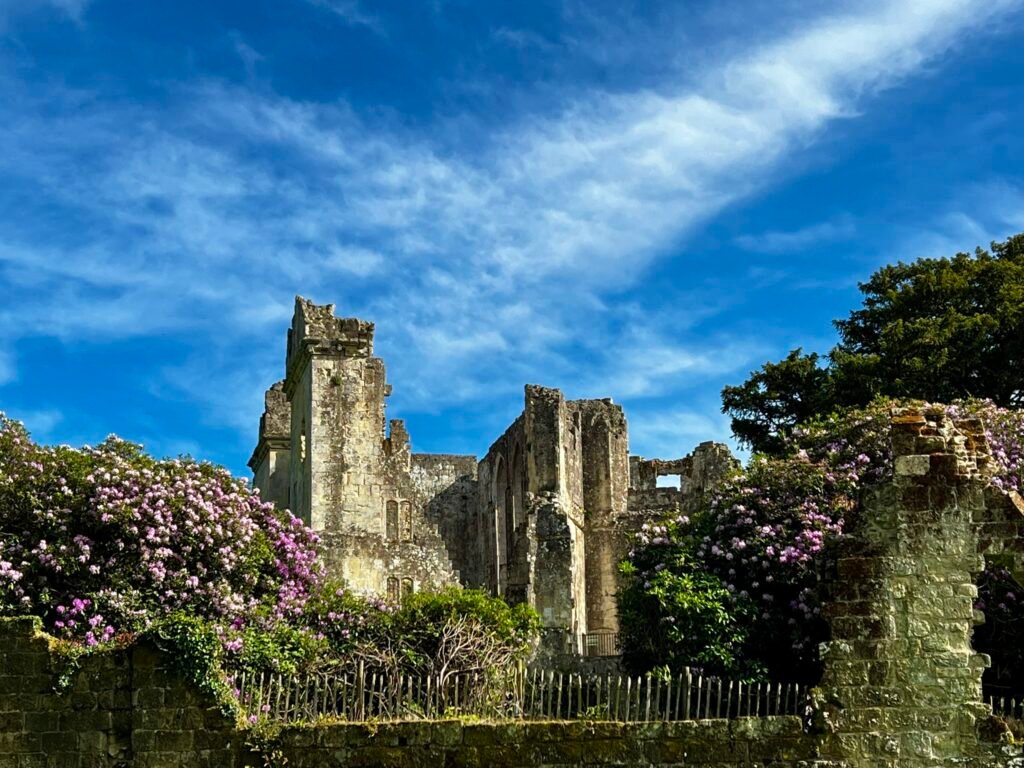
That final image sums up the place perfectly for me.
Old Wardour is dramatic, but it is also strangely gentle. The ruin sits among trees, flowers, lawns and water in a way that makes it feel less like a monument and more like somewhere you want to stay for a while.
If you enjoy atmospheric ruins, there are a couple of other OMS stops worth pairing with it in spirit. Old Sarum near Salisbury offers another English Heritage site with a completely different kind of ruined landscape, while Sherborne Castle and Sherborne Old Castle is another fascinating example of an old fortress sitting alongside a later, more comfortable replacement.
But Old Wardour has its own character.
It is unusual, romantic, slightly theatrical and incredibly photogenic.
And yes — very much a place worth making one more stop for.
One journey. One story. One more stop.