
Royal Garrison Church Portsmouth is one of those places where the building itself makes you stop and wonder what on earth happened to it. From outside, it looks like a handsome medieval church with impressive stone walls, pointed windows and a little bell turret. Then you step inside, look up, and discover that most of the ceiling is the sky. Quite literally.
I’d visited Portsmouth’s Naval Memorial earlier that day, and Royal Garrison Church was my next stop before exploring the Round and Square Towers. I’ve always enjoyed Portsmouth’s mixture of seaside atmosphere, military history and beautiful old buildings, but this church was a particularly lovely discovery. Its roofless ruins are impressive enough; what I wasn’t expecting was the charming little chapel hidden at the other end, full of stained glass, beautifully carved wooden seats and a magnificent brass eagle. And the best part? This remarkable English Heritage property is completely free to visit.
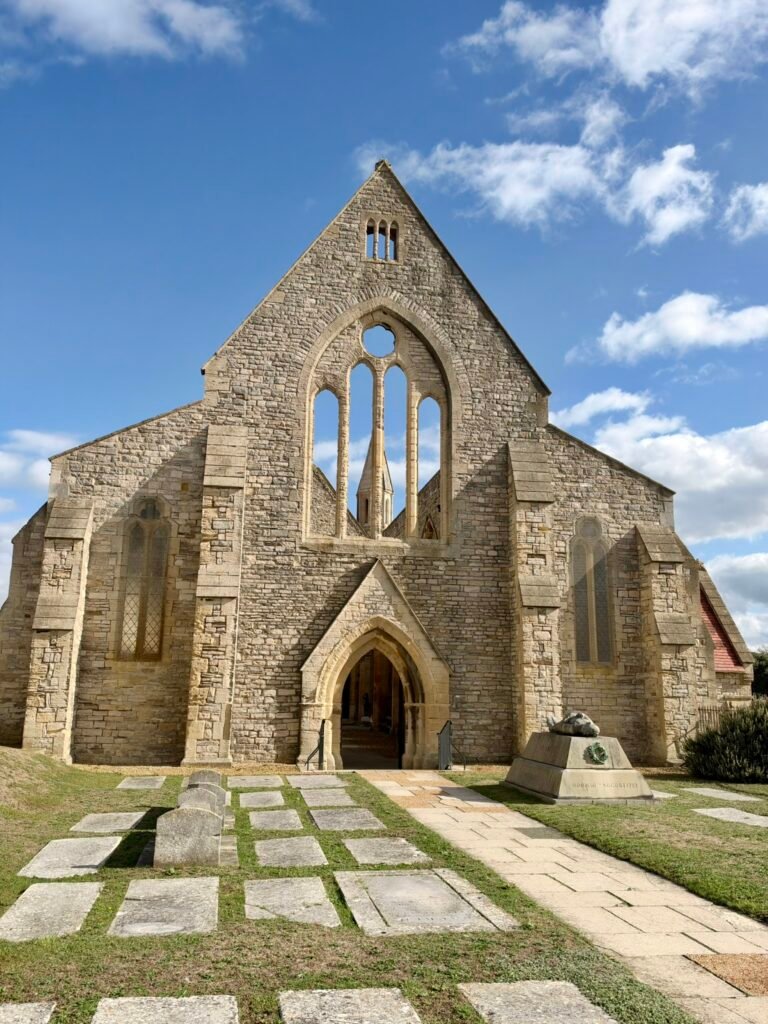
The roofless west end of Royal Garrison Church frames its surviving bell turret, while General Sir Charles James Napier’s memorial stands beside the entrance.
A Church That Looks Like Someone Forgot the Roof
The first thing that strikes you about Royal Garrison Church is its extraordinary shape. The western end rises into a tall, dramatic stone gable, with a beautiful Gothic window opening straight into the sky. There’s no glass left in that enormous central window, and no roof behind it either.
Yet look along the side of the building and you’ll see red roof tiles, narrower windows and the pointed bell turret of an apparently complete church. It’s a curious combination, almost as though two very different buildings have been joined together.
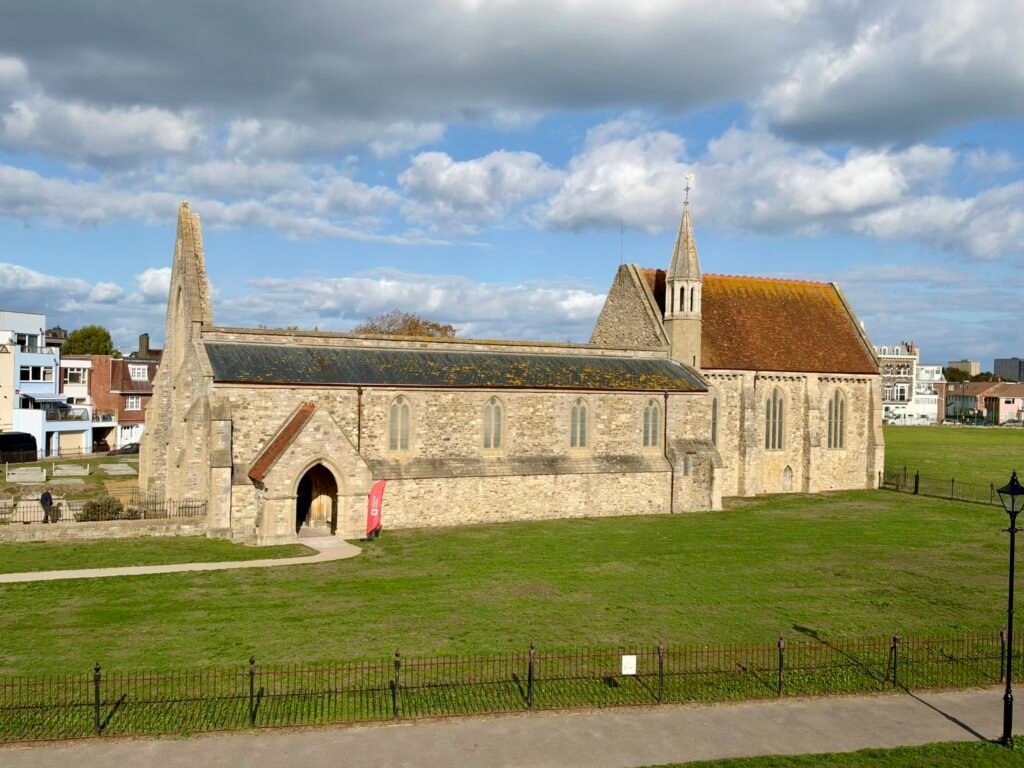
This side view shows the roofed chancel and adjacent sections, in striking contrast with the roofless nave damaged during the Portsmouth Blitz.
The difference is the result of a single devastating event in 1941. But before we get to that, it’s worth understanding why this church was here in the first place — because its story actually begins with a hospital.
Even the little bell turret has an interesting history. It was added during the Victorian restoration, rather than being part of the original medieval building. And perched on top is a charming cockerel weathervane, still watching over Old Portsmouth from its lofty position.
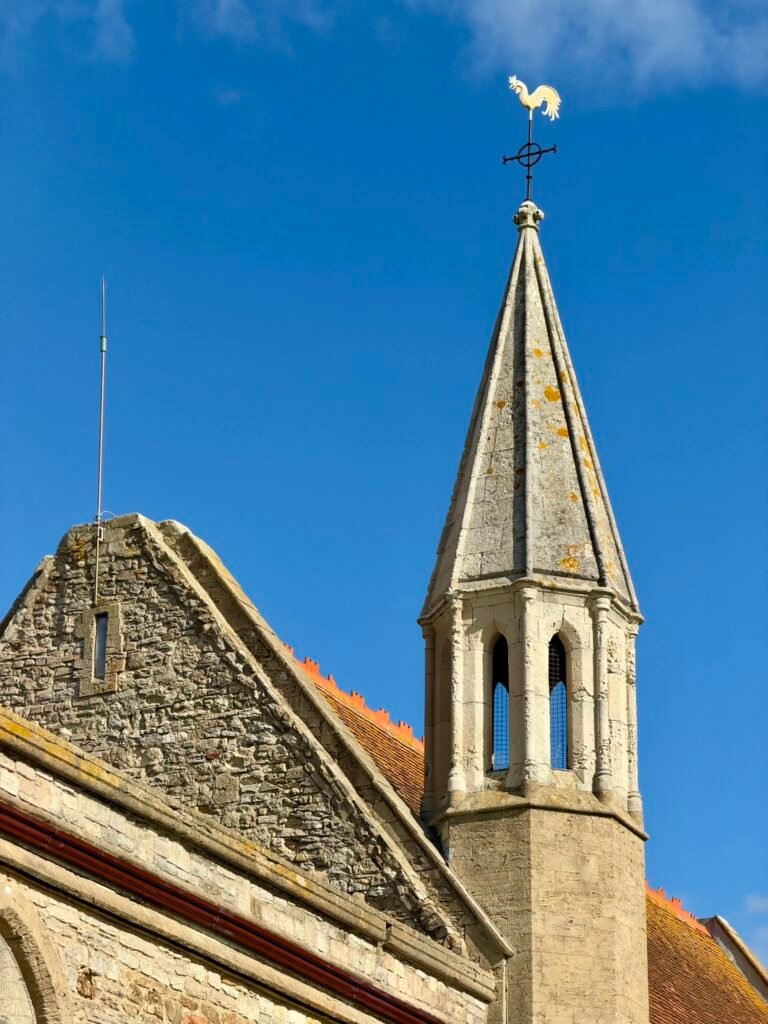
The pointed stone turret rises above the surviving church roof, with its weathered cockerel weathervane standing out against the blue sky.
Domus Dei Portsmouth: When This Church Was a Medieval Hospital
Around 1212, Portsmouth was developing into an increasingly important naval port under King John. Two influential men, William de Wrotham, Keeper of the King’s Ships, and Peter des Roches, Bishop of Winchester, helped establish a religious hospital here.
It was called Domus Dei, meaning House of God, and its purpose was to provide shelter and care for poor people, the sick and travellers passing through the port.
The earliest buildings may have been wooden, with the surviving stone structure probably dating from rebuilding work around 1230–1235. So although the site’s origins go back more than 800 years, not every surviving stone necessarily dates from its foundation.
And here’s what makes the layout particularly fascinating: the enormous space we now call the nave wasn’t originally built just to accommodate a congregation. It was essentially a medieval hospital hall.
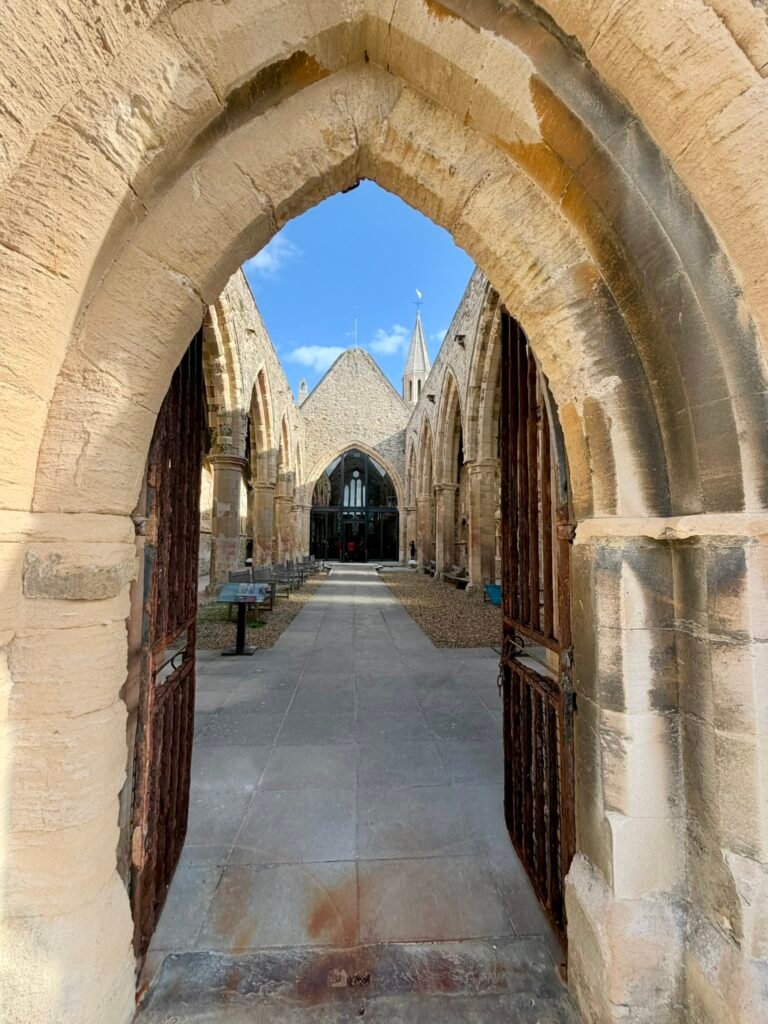
Beyond the pointed stone arch, a straight path runs between the ruined nave arcades towards the glazed entrance to the surviving chancel.
Imagine this space with a roof overhead and beds arranged along its sides. Travellers arriving by sea, people suffering from illness and those in need of shelter could receive care here. At the eastern end stood the chapel, where religious services were held.
The arrangement meant that patients could remain in the main hall while still being connected to the chapel. Religion and healthcare were closely intertwined in medieval society, and institutions like Domus Dei served both practical and spiritual purposes.
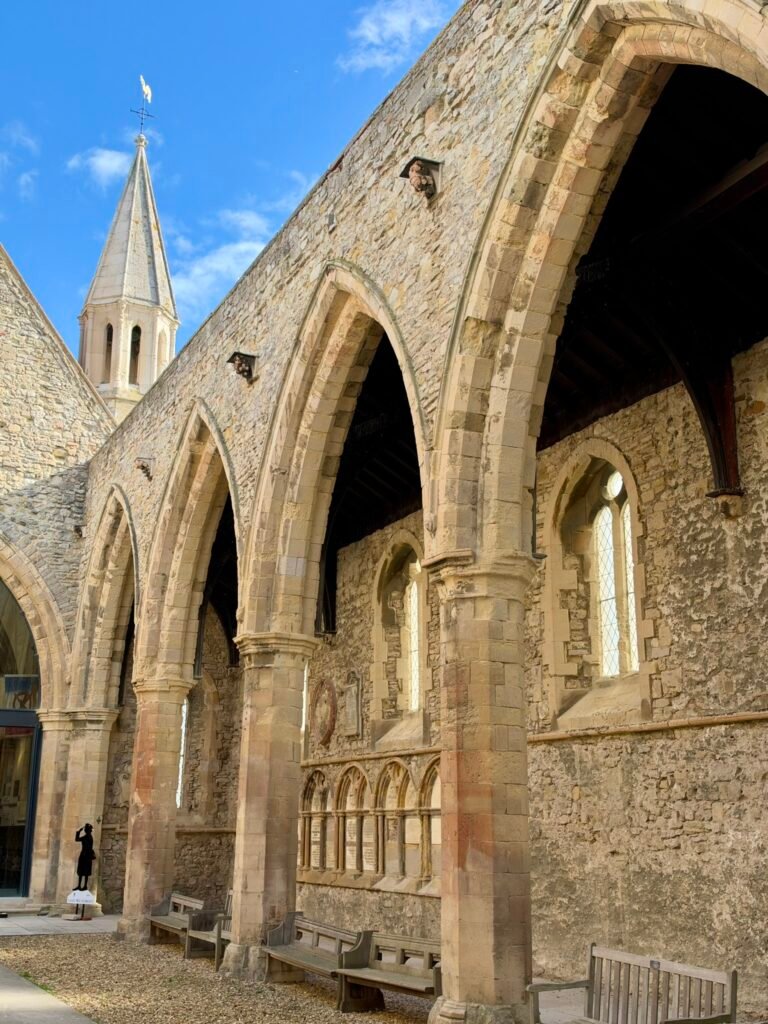
Rows of pointed stone arches and their substantial columns make the former hospital hall feel both grand and unexpectedly peaceful.
Standing beneath those enormous Gothic arches today, I found it surprisingly easy to imagine how impressive the original building must have been.
The great stone columns, pointed archways and high windows have survived centuries of alterations, destruction and repair. Without the roof, the architecture becomes almost sculptural. The shapes stand out against the sky, and sunlight falls across the old stonework in ways the medieval builders probably never intended.
It’s beautiful, but the circumstances that created this appearance were anything but.
Why Is It Called Royal Garrison Church?
I genuinely wondered about the name. After all, garrison doesn’t exactly sound like the sort of word you’d associate with a medieval hospital.
A garrison is a group of troops stationed in a town, fortress or other military location. Portsmouth has been an important military and naval centre for centuries, so a church serving its soldiers would naturally become known as a garrison church.
But it took several dramatic changes for Domus Dei to acquire that identity.
In 1540, during the dissolution of religious houses under Henry VIII, the hospital was surrendered to the Crown. Its buildings were subsequently used to store weapons and military supplies, including ammunition.
By the late 16th century, the site was being incorporated into the residence of Portsmouth’s military governor. Over time, the former hospital hall became a chapel serving the town’s military garrison.
The name eventually stuck, and by the 19th century the surviving building was widely known as the Royal Garrison Church.
One small detail caught my attention while exploring the ruined walls: a weathered carved stone head projecting from the masonry. I have no idea whom it represents, and I couldn’t establish its precise age, but it certainly adds a little personality to the otherwise austere stonework.

Its weathered features are easy to miss among the rough masonry — and its precise identity remains uncertain.
A Royal Wedding — But Not Quite Where You Might Think
Now for perhaps the most surprising chapter.
On 21 May 1662, King Charles II married Catherine of Braganza in Portsmouth.
And the ceremony took place at the Governor’s House, part of the complex associated with today’s Royal Garrison Church.
There’s an important distinction here: the marriage occurred in the Governor’s House, not in the surviving roofless nave. Much of that former residence was demolished in the 1820s, so the room where the wedding took place no longer exists.
Nevertheless, the connection is extraordinary. A building complex that began as a medieval hospital later provided the setting for a royal wedding.
Portsmouth certainly knows how to collect interesting chapters of British history in one place.
The Night Portsmouth Lost the Church Roof
On 10 January 1941, during the Second World War, Portsmouth suffered a devastating German air raid. Incendiary bombs struck Royal Garrison Church, and the roof of the great nave was destroyed.
The eastern chancel survived, but the western hall was left a roofless shell.
It’s difficult to imagine the destruction while walking through the peaceful ruins today. There are benches, information boards and neatly maintained paths, while sunlight streams between the medieval arches. Yet the missing roof is a permanent reminder of the bombing that changed the city.
Rather than reconstructing the entire church, the authorities eventually chose to preserve the ruined nave, retaining its dramatic open-air character.
The result is one of the most atmospheric historic spaces I’ve encountered in Portsmouth.
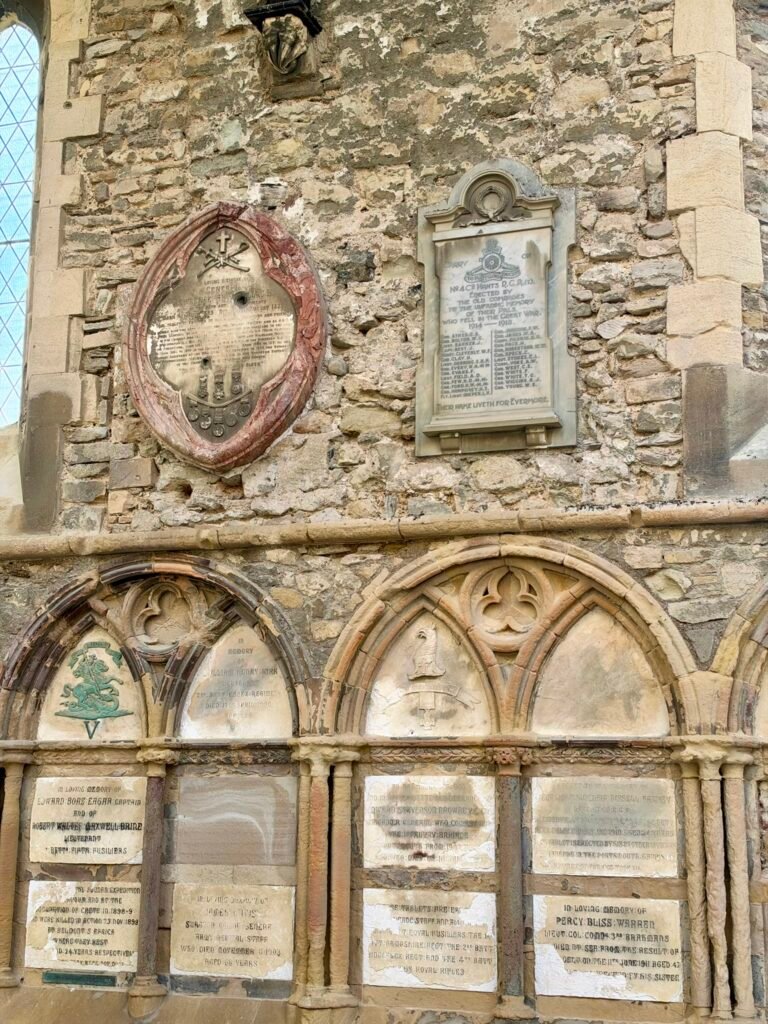
Regimental badges, names and inscriptions fill the shallow Gothic arches, preserving the memory of soldiers who served — and those who never returned.
The nave also contains a remarkable collection of military memorials. Some commemorate individual officers, while others remember members of regiments and military units. They represent different periods of Portsmouth’s long military history, including conflicts far beyond the two world wars.
It’s worth examining these carefully rather than simply walking past. Names, dates, badges and inscriptions reveal the lives of real people behind the uniforms.
And there’s something particularly moving about seeing those memorials in a building that has itself experienced the destruction of war.
The Smaller Details Are Worth Your Attention
While the vast ruined arches are the obvious attraction, there are smaller features that deserve a closer look.
One is the circular stone baptismal font, decorated with quatrefoil-style carvings and supported by a cluster of small columns.
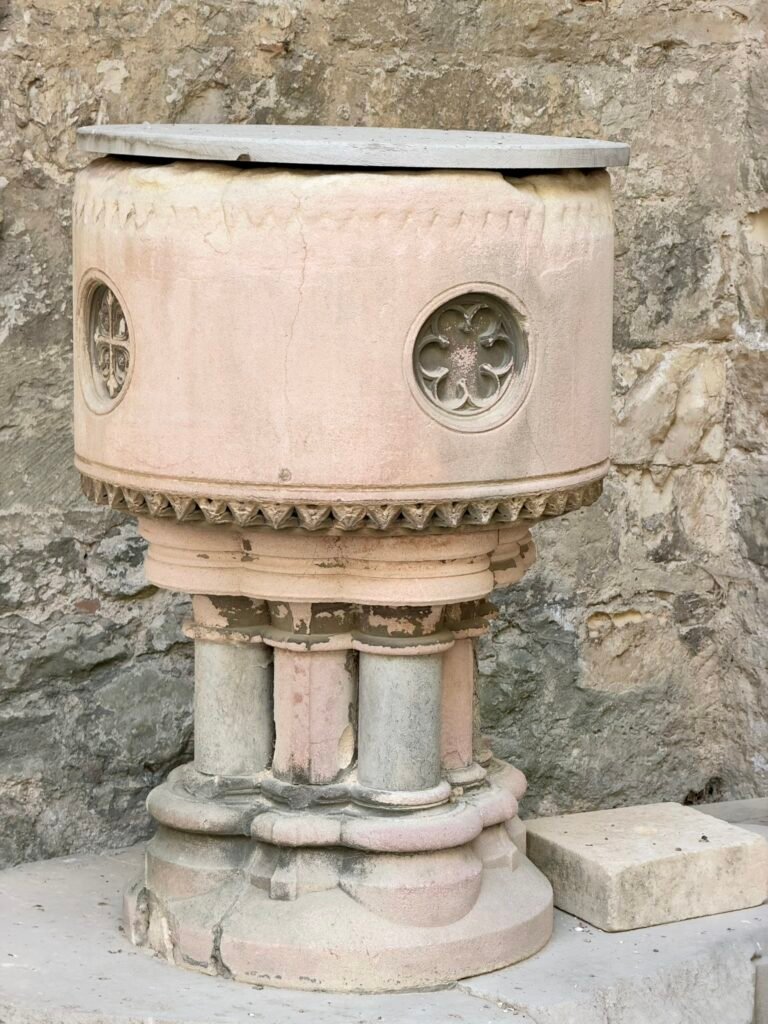
This circular stone baptismal font has pierced-looking quatrefoil motifs and small supporting columns, set against the old stone masonry.
Its pale stone contrasts nicely with the rough masonry behind it. I couldn’t verify the font’s precise age, so I wouldn’t want to present it as an original 13th-century feature, but it’s an attractive piece of church furnishing in its own right.
Another particularly striking object stands outside the west entrance.
At first glance, the reclining stone figure might seem like an unusual decorative sculpture. In fact, it commemorates General Sir Charles James Napier (1782–1853), a prominent British Army officer whose career included campaigns during the Napoleonic Wars and in India.
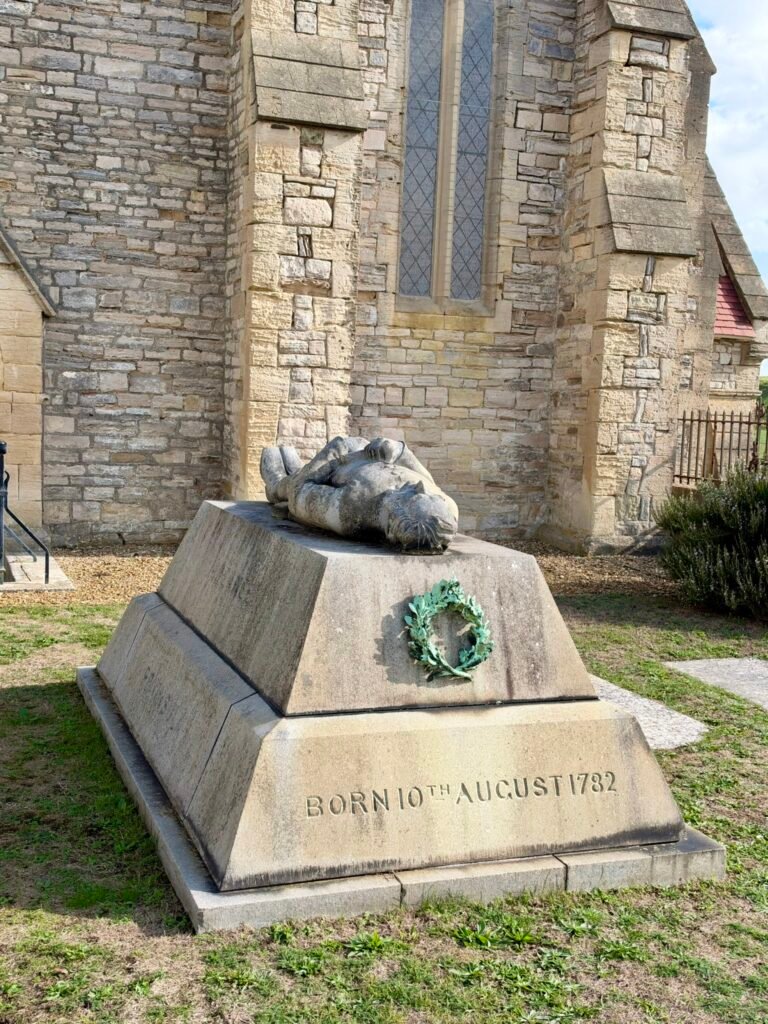
The reclining monument commemorates General Sir Charles James Napier (1782–1853); his resting place is associated with the western end of Royal Garrison Church.
Napier’s career also forms part of the complicated history of Britain’s imperial expansion, and his memorial is a reminder that military monuments can invite both admiration for craftsmanship and reflection on the events they commemorate.
There is another curious detail: the monument was moved during Victorian alterations to the church. Research into its original position indicates that Napier’s burial vault does not lie directly beneath the reclining sculpture we see today.
Even the location of the memorial has a story.
Then Comes the Lovely Surprise: The Surviving Chapel
After exploring the open-air ruins, I entered the surviving chancel, and the atmosphere changed completely.
Outside, the former hospital hall feels enormous, weathered and exposed to the elements. Inside, the roofed chapel is colourful, beautifully furnished and surprisingly intimate.
The first things I noticed were the stained-glass windows and the remarkable wooden seats. Then came the patterned floor tiles, the hanging military banners and all the little decorative details that make the space so interesting.
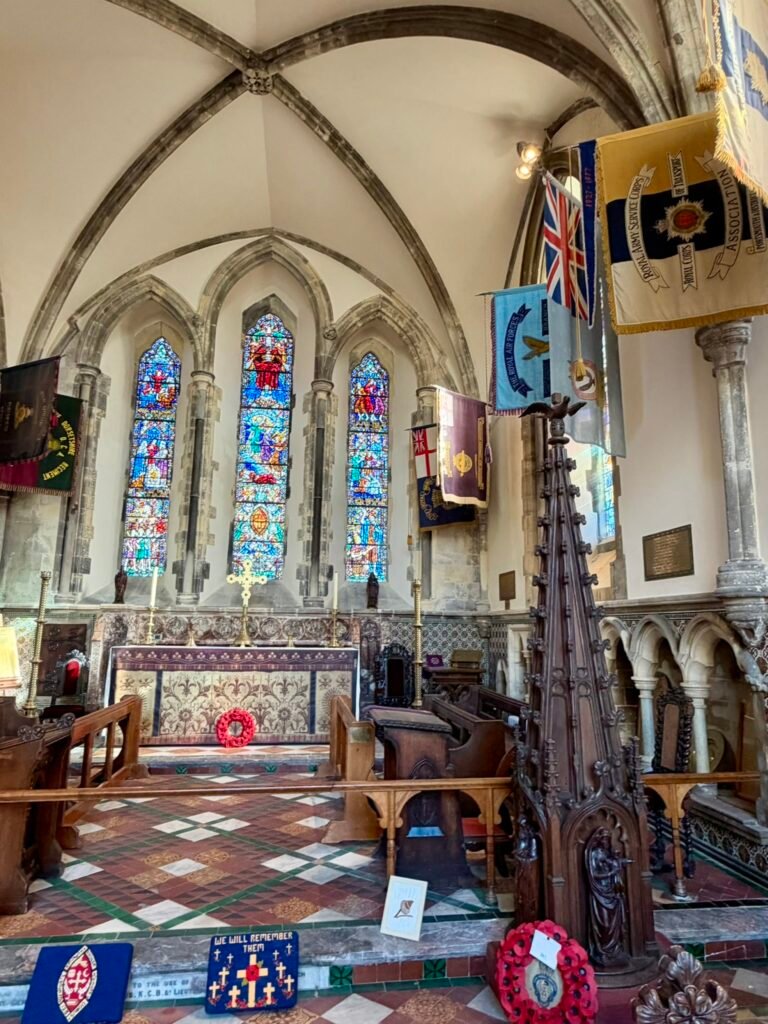
Stained-glass windows, military standards, patterned floor tiles and remembrance wreaths fill the roofed chancel, where occasional services still take place.
It’s almost difficult to believe that this charming interior and the dramatic ruins outside belong to the same building.
The contrast is part of what makes Royal Garrison Church so memorable.
And unlike the former hospital hall, the chancel remains a consecrated place of worship. This isn’t merely a preserved historical display; it retains an active connection with its original religious purpose.
Stained Glass That Tells the Church’s Story
The three magnificent east windows are among the chapel’s highlights.
They were designed by stained-glass artist Carl Edwards and unveiled in 1957, replacing glass lost during the Second World War.
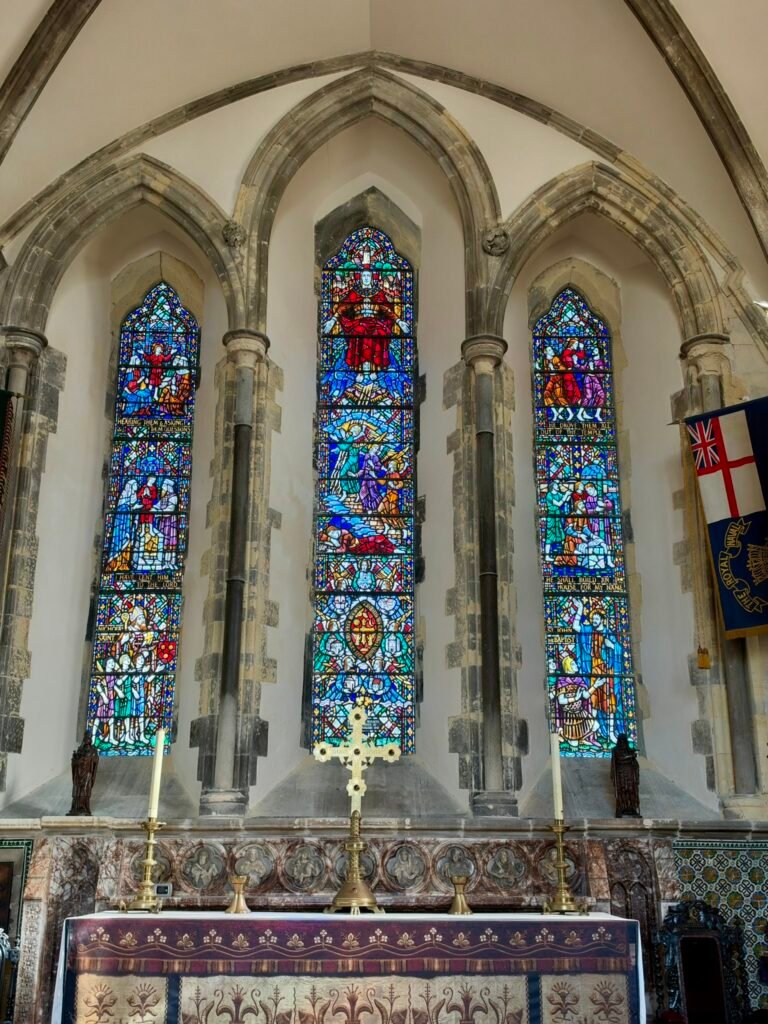
Designed by Carl Edwards and unveiled in 1957, the three east windows use biblical imagery inspired by the church’s original name, Domus Dei — the House of God.
The windows contain religious scenes connected with the concept of Domus Dei, the House of God. They bring colour, symbolism and an unexpectedly modern chapter to this medieval building.
Other windows commemorate military organisations associated with the church, including the Eighth Army and the Royal Regiment of Artillery.
I particularly like how the stained glass creates a link between different centuries. Medieval architecture provides the setting, Victorian restoration shaped much of the interior, and 20th-century artists helped repair what the war had destroyed.
Wooden Choir Stalls and Military Memories
The beautifully carved wooden choir stalls were another favourite feature.
They date from the Victorian restoration period and contain memorial associations with prominent military figures. Their elaborate carved ends, polished wood and decorative details make them worth examining individually.
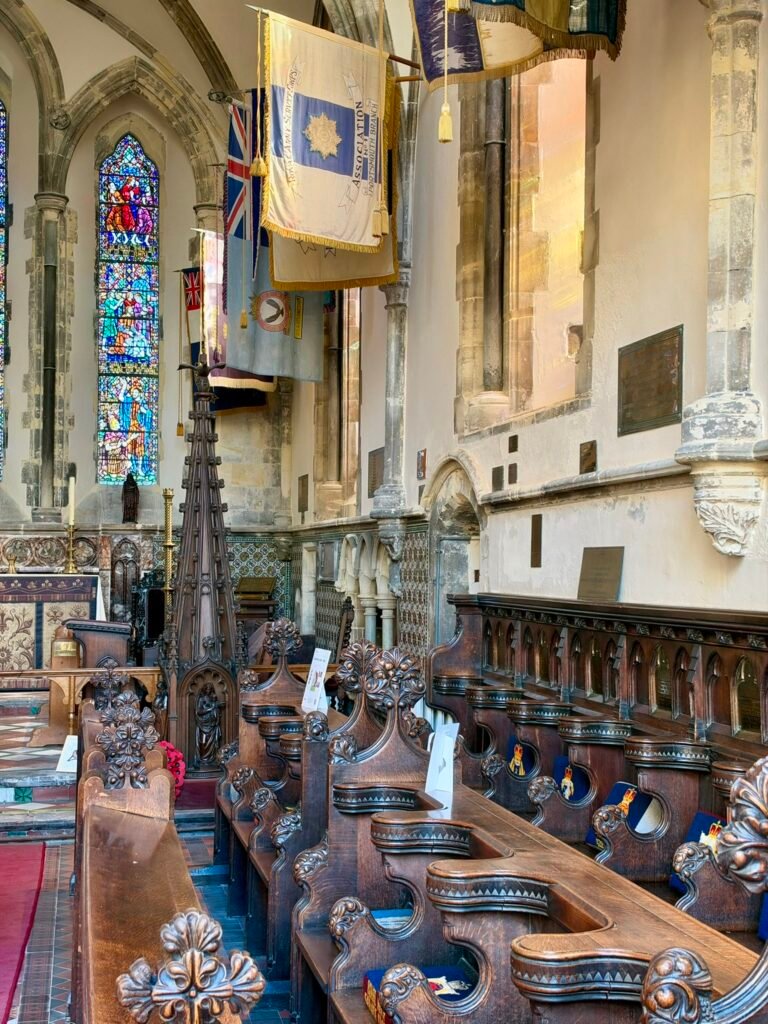
Richly carved wooden choir stalls sit beneath hanging regimental and association standards, including one for the Royal Army Service Corps Association’s Portsmouth branch.
Military standards hang above the stalls, reinforcing the building’s long connection with Portsmouth’s armed forces.
I found the combination rather beautiful. The architecture is imposing, but the craftsmanship of the furnishings gives the chapel a warmer, more personal character.
It’s the sort of place where you enter expecting to spend five minutes and suddenly find yourself inspecting every carved detail.
A Brass Eagle With Plenty of Character
And then there’s the eagle.
A magnificent polished brass eagle lectern stands with its wings spread wide, holding a place of honour among the chapel’s furnishings.
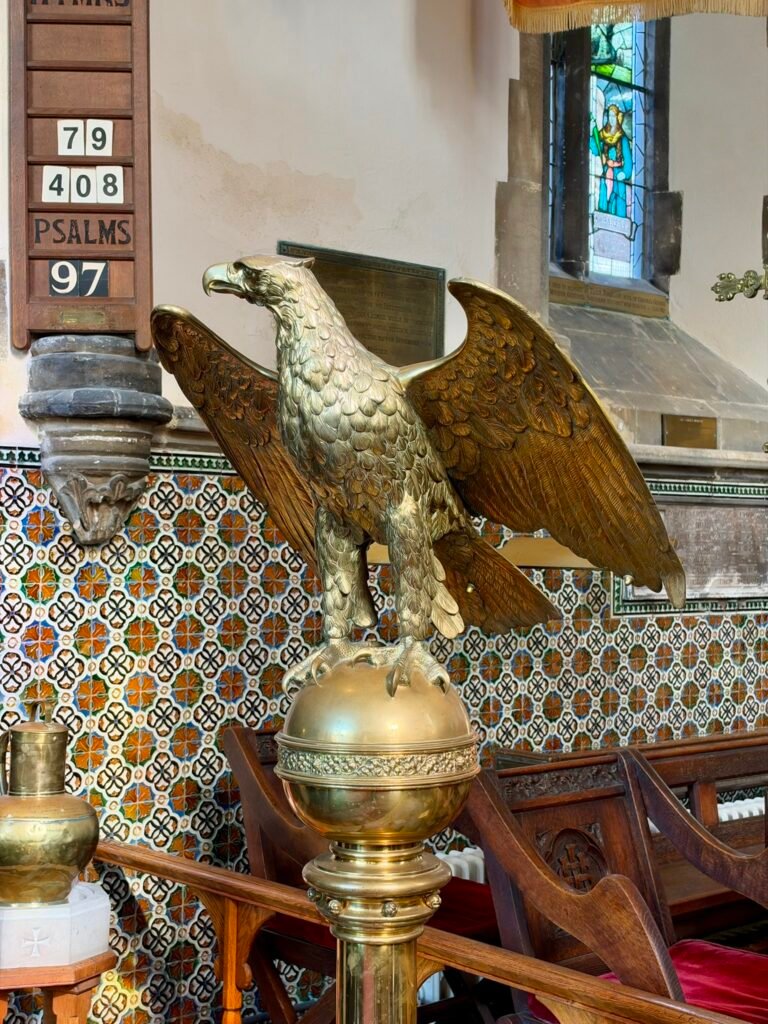
The polished brass lectern stands before intricately patterned wall tiles, with a stained-glass window and hymn board behind it.
An eagle lectern traditionally supports the Bible during readings, with the bird often interpreted as a symbol of Saint John the Evangelist.
This particular example is beautifully detailed, and I thought it looked rather magnificent against the colourful patterned tiles behind it.
I’m not especially interested in every piece of church furniture I encounter, but give me an impressive brass eagle and suddenly I’m paying attention.
The decorative pipe organ is worth a look, too. Its painted pipes rise within a Gothic stone arch, adding another layer of colour and craftsmanship to the chapel.
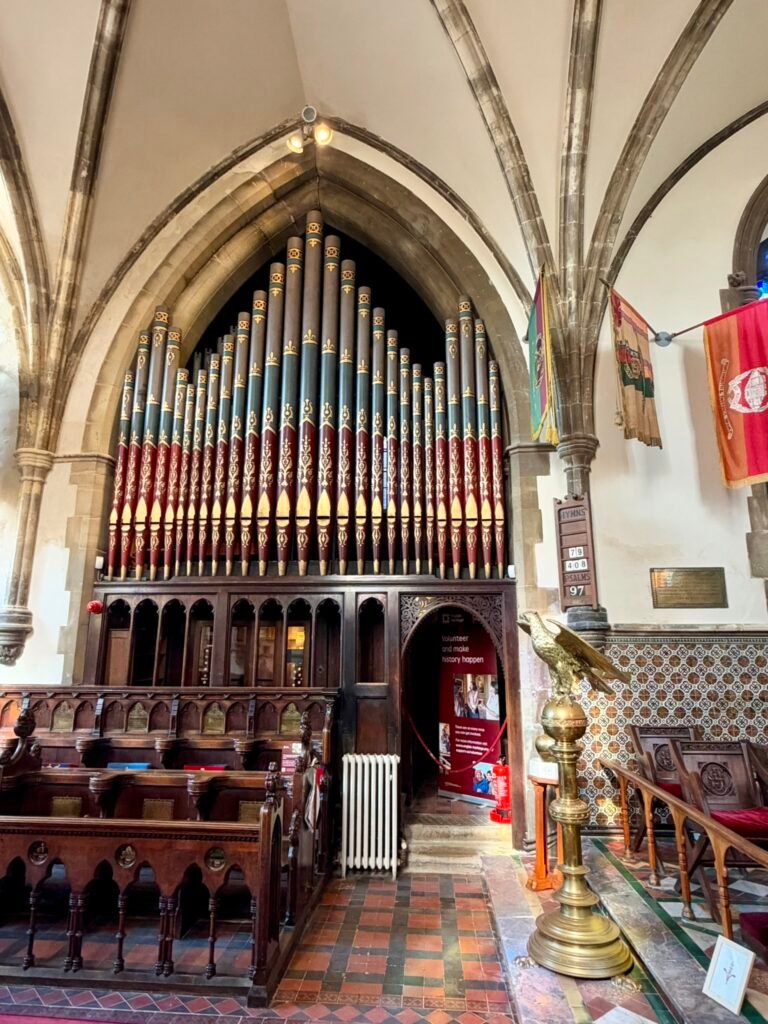
Painted pipes rise within a pointed Gothic arch above dark woodwork, a richly decorated contrast to the plain stone of the roofless nave.
What makes the interior so appealing isn’t any single object. It’s the way the stained glass, carved woodwork, military standards, stone arches and small decorative details work together.
For such a relatively compact chapel, there’s an extraordinary amount to discover.
English Heritage and the Importance of Keeping Places Like This Open
Royal Garrison Church is looked after by English Heritage, with the help of local volunteers.
One of the nicest things about the property is that entry is free for everyone. You don’t need an English Heritage membership or an admission ticket to explore it during its opening times.
But maintaining an 800-year-old building — especially one exposed to the elements — is hardly inexpensive.
English Heritage looks after hundreds of historic places across England, including more than 300 that are free to visit. Conservation, specialist repairs, site management and volunteer support all require resources.
That’s one reason I appreciate having an English Heritage membership*. It offers admission benefits at many paid properties, but it also supports the charity’s wider work to protect historic sites.
I wouldn’t claim that my individual membership directly keeps Royal Garrison Church free. However, supporting organisations that care for places like this is one way of helping preserve our shared heritage for future generations.
And I think that’s a worthwhile reason to become a member.
If you’re interested in the site’s remarkable past, English Heritage’s detailed history of Royal Garrison Church* is well worth reading. It explores the medieval hospital, royal connections, military history and wartime destruction in considerably more depth.
Visiting Royal Garrison Church Portsmouth
Location, free entry and opening times
Royal Garrison Church stands on Penny Street, Old Portsmouth, PO1 2NJ, close to Grand Parade and the historic seafront.
Admission is free, but opening is seasonal and can depend on volunteer availability. The site generally opens during the warmer months and closes for much of the winter, apart from announced special openings.
Before travelling, check English Heritage’s official Royal Garrison Church visitor information* for the latest opening arrangements.
I’d allow approximately 30–45 minutes for a relaxed visit, perhaps longer if you enjoy historic architecture, military memorials or photography.
Parking: My Two-Hour Free Parking Discovery
When I visited Old Portsmouth, I found free short-stay parking in the KD Castle Road parking zone, around the Great Southsea Street and Castle Road area.
The council’s rules permit non-permit holders to park for up to two hours in eligible bays, with no return to the zone within four hours. Not every nearby space follows the same rules, so always check the actual bay signs and any payment instructions before leaving your car.
It’s worth studying Portsmouth City Council’s KD Castle Road parking information before your visit.
There is also short-stay roadside parking closer to Royal Garrison Church and a paid car park nearby. If you’re planning to explore several Old Portsmouth attractions, remember that two hours can disappear surprisingly quickly.
Accessibility
Parts of Royal Garrison Church are wheelchair accessible, but the historic site includes uneven surfaces, changes in level and some steps. The open-air nave has a paved central route, while other areas are less straightforward to navigate.
Visitors with limited mobility should check the current access arrangements with English Heritage before travelling. Dogs on leads are welcome in the outdoor areas, while only assistance dogs are permitted inside the chancel.
Make It Part of an Old Portsmouth History Walk
One of the reasons I enjoyed this visit so much was that I could combine several historic places without needing to drive between them.
My day began at the impressive Portsmouth Naval Memorial on Southsea Common. It’s a moving monument commemorating sailors who lost their lives at sea and have no known grave, and its enormous scale is particularly striking.
Royal Garrison Church was the next stop, with its completely different mixture of medieval history, military remembrance and architectural beauty.
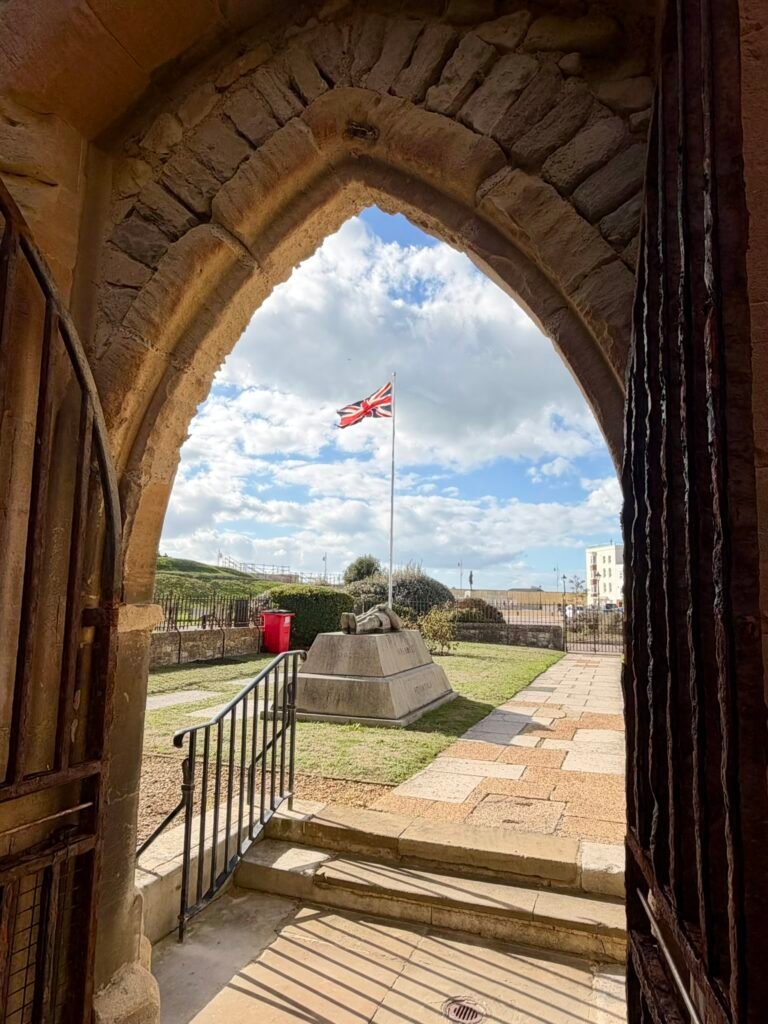
The Union flag flies beyond the open west doorway, with General Napier’s reclining monument just outside: a fitting final view of the church’s long military story.
Afterwards, I continued towards Old Portsmouth’s waterfront to explore the Round Tower, Square Tower and Hotwalls.
Those historic fortifications provide another perspective on the city’s development, and the views across Portsmouth Harbour and the Solent make the walk even more enjoyable.
You could easily turn these three stops into a relaxed half-day exploring Old Portsmouth, with time for a coffee or lunch along the way.
Portsmouth is one of those cities I keep returning to because there’s always something else worth discovering. I still owe the Historic Dockyard a proper visit, along with more of the city centre, including the Guildhall.
For more historic places, coastal walks and day-trip ideas, explore the wider Hampshire collection on One More Stop.
A Roofless Ruin That Hasn’t Lost Its Charm
Royal Garrison Church surprised me in several ways.
I expected an attractive historic ruin, and the enormous roofless nave certainly delivered. What I didn’t expect was the remarkable story behind it — from medieval hospital to military storehouse, royal connections, wartime destruction and the beautiful chapel that survived.
Nor was I expecting to become quite so interested in its wooden choir stalls, stained glass and brass eagle.
It’s a place where you can appreciate the architecture without knowing anything about medieval history, but where a little historical knowledge makes the experience considerably richer.
And perhaps that’s what I enjoy most about exploring Portsmouth. Its history isn’t confined to museums or expensive attractions. Sometimes it’s standing quietly beside an ordinary street, waiting for someone to wander inside.
Royal Garrison Church is a perfect example. It’s free, beautiful, unusual and full of stories. Just don’t forget to look up — although in the ruined nave, there isn’t much to stop you seeing the clouds.
One journey. One story. One more stop.