
Salisbury Cathedral is impressive enough when you’re standing right in front of it. But move a little further away, add some trees, a few sheep and a beautiful green meadow, and suddenly the whole scene looks suspiciously like a painting.
Which is rather appropriate, because one of Britain’s greatest landscape artists thought exactly the same thing about 200 years ago.
Welcome to Salisbury Water Meadows, where John Constable found inspiration, the cathedral becomes part of the countryside, and the local sheep appear completely unimpressed by either.
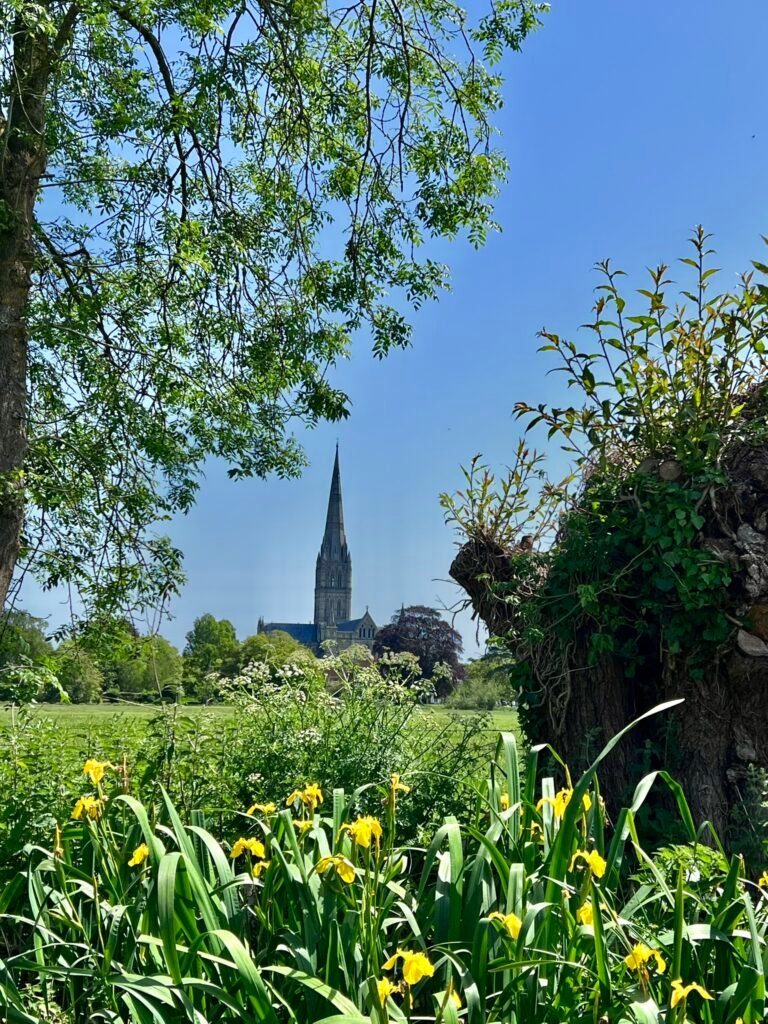
Salisbury Water Meadows: A View Worth Painting
There are places where you visit the main attraction, take a photograph and leave.
Then there are places where stepping away from the attraction somehow makes it even more beautiful.
The Harnham Water Meadows, just southwest of Salisbury Cathedral, are a perfect example.
Instead of standing beneath enormous medieval walls, you’re looking across open greenery, waterways and trees, with the cathedral’s extraordinary spire rising above the landscape.
And the best part? There’s no admission ticket required to enjoy the public walking route and its views.
John Constable certainly appreciated the scenery. He visited Salisbury repeatedly and painted the cathedral from several different viewpoints.
His monumental Salisbury Cathedral from the Meadows, exhibited in 1831, transformed this familiar Wiltshire landscape into something considerably more dramatic.
Although Constable’s finished composition involved artistic interpretation, the countryside around Harnham remains closely associated with his famous views.

Constable, Clouds and a Rather Dramatic Cathedral
Constable wasn’t simply interested in producing a pretty postcard.
He loved painting changing skies, shifting light and the atmosphere of the English countryside.
In Salisbury Cathedral from the Meadows, the cathedral rises beneath enormous storm clouds, while a rainbow appears across the sky.
It is an extraordinary painting, and not exactly the sort of cheerful landscape you’d choose to advertise a guaranteed sunny afternoon.
But there was more happening than questionable Wiltshire weather.
Constable had lost his wife, Maria, in 1828, and the painting is often interpreted partly through his grief. Its stormy atmosphere also reflects his concerns about changes affecting the Church.
The rainbow, meanwhile, introduces a sense of hope.
Suddenly, what looks like an attractive countryside scene becomes something much more personal.
You can explore Constable’s connection with Salisbury through the National Gallery’s account of his Salisbury Cathedral paintings.
Fortunately, appreciating the scenery today doesn’t require understanding every artistic symbol. Sometimes a beautiful view is simply a beautiful view.
And sometimes there’s a sheep standing in the middle of it.
The Sheep Have Absolutely No Interest in Art History
One of the loveliest things about Salisbury’s water meadows is how surprisingly rural they feel.
You’re only a short walk from the city centre, yet the landscape has a completely different character.
Green fields stretch towards mature trees, waterways wind through the surroundings, and sheep graze happily across the grass.
They’ve probably got the right idea.
While visitors admire the cathedral and contemplate Constable’s artistic genius, the sheep are concentrating on lunch.
No admission tickets, no guided tours, no complicated historical explanations. Just grass.
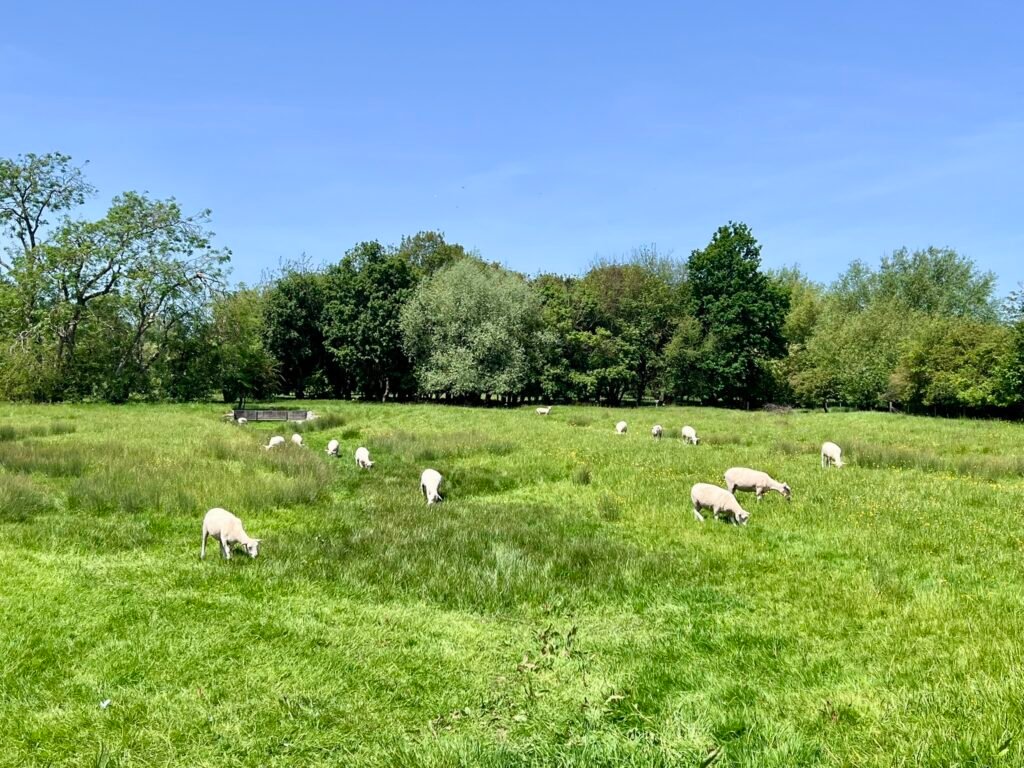
The meadows are also more than an attractive setting for photographs.
They’re part of an old agricultural landscape where water was carefully managed to encourage grass growth. These historic water-meadow systems helped farmers produce grazing earlier in the season.
So the peaceful fields have a practical history of their own.
Quite an achievement for somewhere that now looks as though its main occupation is being photogenic.
Walking Through Harnham Water Meadows
You don’t need to organise an expedition to enjoy the famous views.
One of the best ways to explore is along the Town Path, a public walking route connecting Salisbury with Harnham.
Starting from Queen Elizabeth Gardens, you can follow the route towards the Old Mill at Harnham, passing waterways and enjoying views back towards the cathedral.
The route combines open scenery with pleasantly shaded sections, making it a lovely contrast to the streets and buildings around the Cathedral Close.

The path is generally straightforward, although conditions can become wet or slippery after rain. The surrounding meadows are also working and conservation landscapes, so stick to the public routes rather than wandering through grazing fields.
There’s no need to rush. This is the sort of walk where an unexpected view can be a perfectly reasonable excuse to stop for another photograph.
Or five.
Visit Wiltshire’s official Salisbury walking guide includes the Town Path and further ideas for exploring the area.
Sometimes the Best Cathedral View Is From Far Away
Something interesting happens when you photograph Salisbury Cathedral from the water meadows.
The building stops dominating every part of the picture.
Instead, trees frame the spire, flowers fill the foreground, and the surrounding countryside becomes just as important as the architecture.
Move a little further along the path, and the cathedral might almost disappear behind the branches before revealing itself again.
It’s a lovely reminder that the same landmark can look completely different depending on where you’re standing.
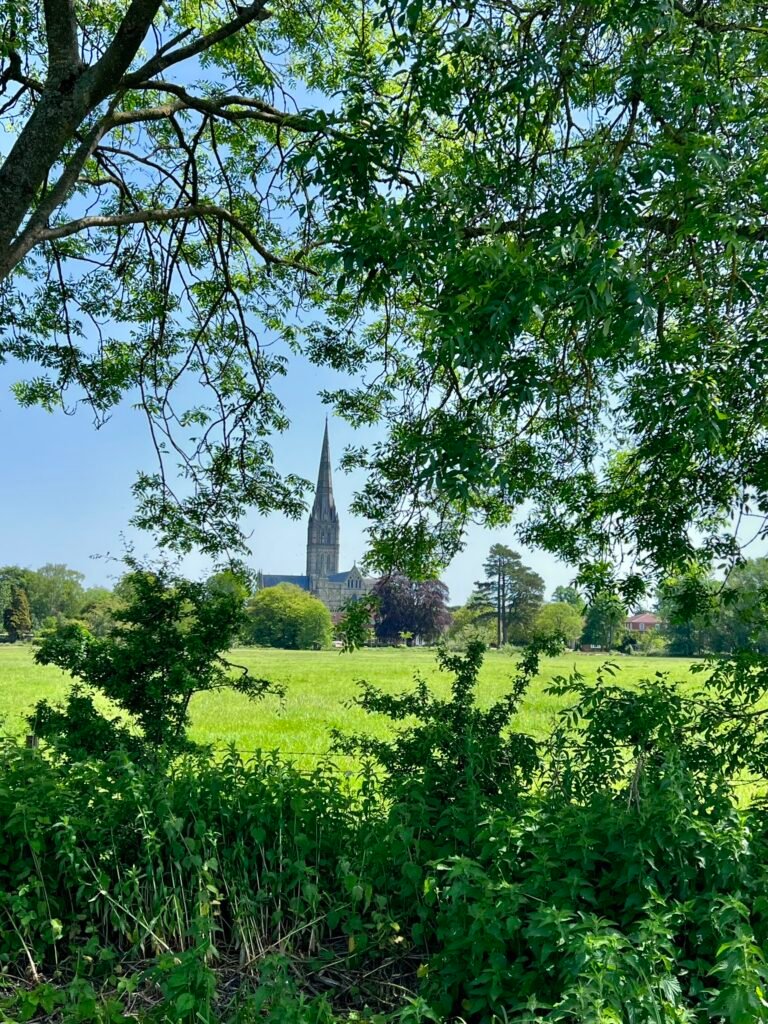
And unlike Constable, we don’t have to spend months producing a six-foot canvas.
A camera, a little patience and some decent light will usually do the job.
Although getting the sheep to cooperate is another matter entirely.
Three Different Ways to Discover Salisbury Cathedral
This peaceful countryside walk makes a wonderful companion to the cathedral itself.
If you want to explore the building rather than admire it from a distance, start with Salisbury Cathedral: 800 Years Old and Still Showing Off, where I explore the architecture and the experience of visiting.
Inside the cathedral is another remarkable story: Magna Carta at Salisbury Cathedral: 800 Years of Freedom and Rebellion, featuring one of the most important surviving documents in English history.
And Salisbury’s cathedral story actually began somewhere else entirely.
Before the present building existed, the original cathedral stood on a windswept hill north of the city. You can discover what happened in Old Sarum: The Castle and Cathedral Salisbury Left Behind.
For a completely different experience, there’s also Sarum Lights 2026 at Salisbury Cathedral, transforming the building into a colourful light-and-sound spectacle during November.
If you’re collecting more ideas for exploring the county, you’ll find further historic places and interesting stops in my Wiltshire travel collection.
Are Salisbury Water Meadows Worth Visiting?
Absolutely, particularly if you enjoy walking, photography or places where history and nature meet without requiring a complicated itinerary.
The public Town Path is free to walk, the cathedral views are beautiful, and the whole experience offers a refreshing change from sightseeing inside historic buildings.
Of course, the water meadows aren’t a substitute for actually visiting Salisbury Cathedral.
They’re something different.
A chance to see the same extraordinary building through the landscape that fascinated one of Britain’s greatest painters.
And perhaps that’s what makes this particular stop so memorable.
Sometimes you don’t need to get closer to appreciate something.
Sometimes you just need to stand a little further away.
Preferably with a few sheep.
One journey. One story. One more stop.