
What do a medieval harbour defence, a Royal Navy meat store, a row of artists’ studios and a family preparing to cross the Atlantic have in common? Surprisingly, you’ll find them all within a short walk in Old Portsmouth. I went looking for historic towers and a few good photographs. What I found was considerably more interesting — and a lot stranger — than two enormous lumps of stone standing beside the sea.
Square Tower: From Gunpowder to Beef!
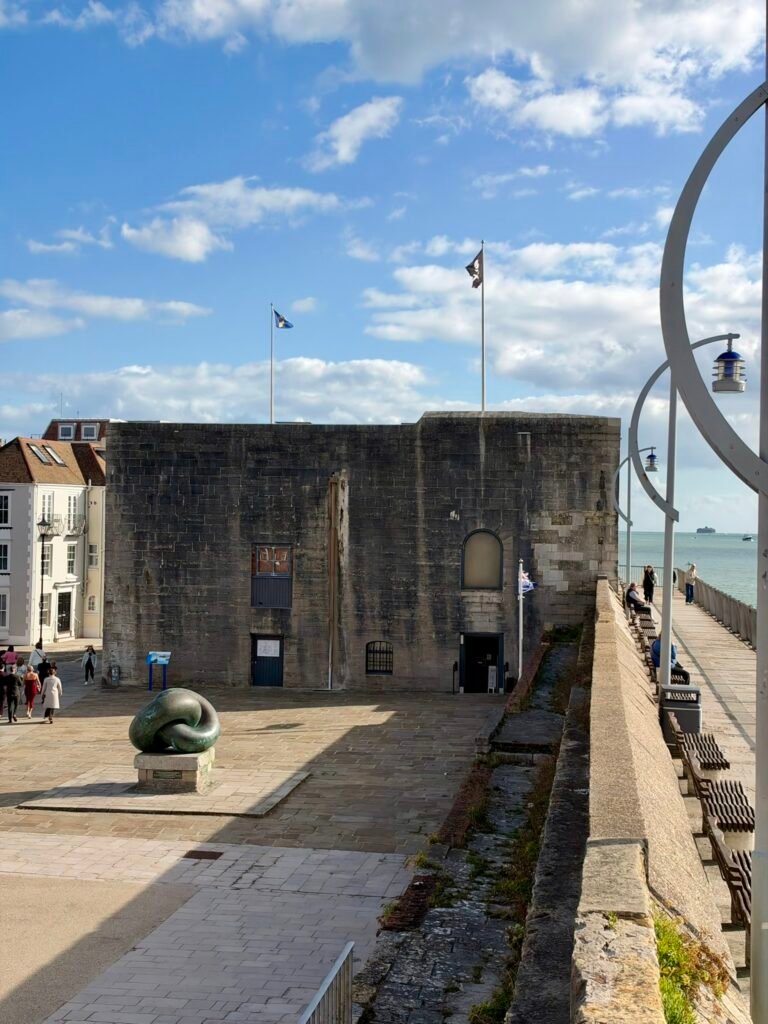
Let’s begin with the Square Tower, which has been guarding Portsmouth’s waterfront since 1494, during the reign of Henry VII.
It originally served as a fortified residence for the military governor. But living beside the harbour apparently wasn’t exciting enough, because the building eventually became a gunpowder magazine.
And during the English Civil War, things became particularly dramatic.
When Portsmouth was besieged in 1642, the Royalist governor threatened to blow up the tower and its stockpile of ammunition unless his surrender terms were accepted.
Imagine having that neighbour.
“Lovely weather today!”
“Yes. By the way, I might explode the entire building.”
Fortunately, the tower survived.
In 1779, it received an extraordinary career change: the Admiralty turned it into a meat store for the Royal Navy.
From potentially blowing up half the neighbourhood to storing dinner. That’s quite a transformation!
It later acquired a semaphore signalling station in 1823, using mechanical signals to communicate with other stations in a network reaching towards London.
Today, the tower hosts weddings and events, although its exterior is fascinating enough for a Quick Stop. For a fuller account of its extraordinary history, Portsmouth’s official heritage record reveals just how many times this remarkable building has been adapted.
Hotwalls: Not Quite What the Name Suggests
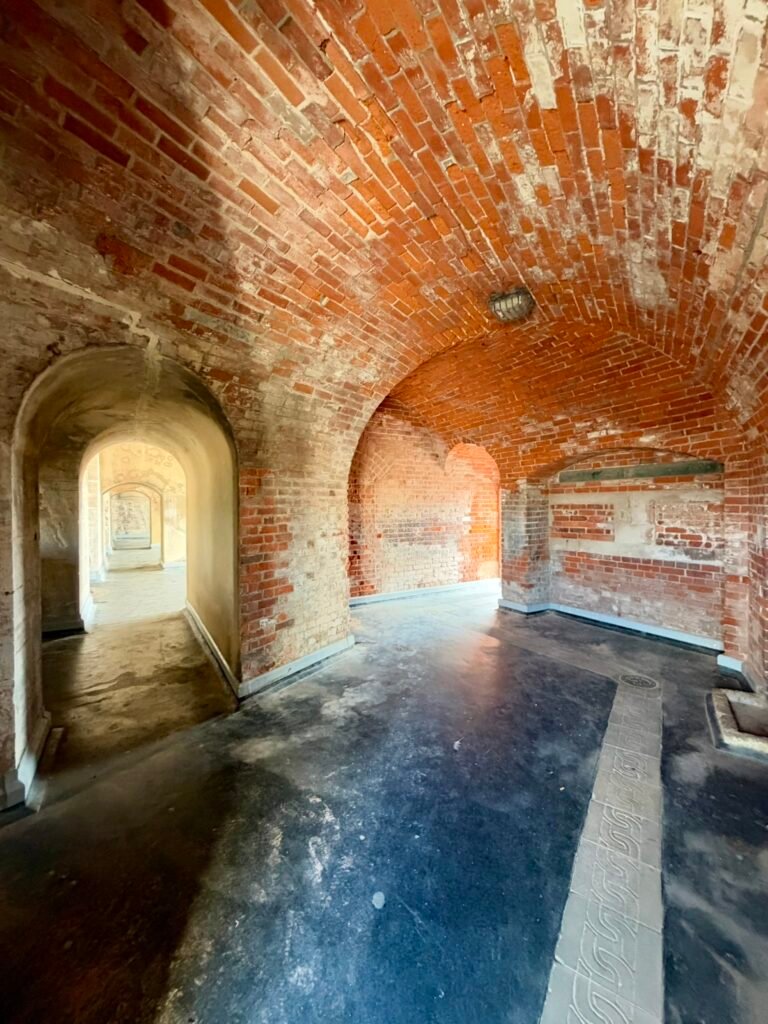
A short distance along the waterfront, the medieval stone gives way to red-brick arches, vaulted passageways and some wonderfully atmospheric corners.
Welcome to Hotwalls!
Despite the name, there’s no geothermal activity here. Nor is this some trendy nightclub district, although it sounds as though it could be.
The name may come from the practice of preparing heated cannonballs, known as hot shot, during the Spithead Mutiny of 1797. Another explanation is rather less dramatic: the walls simply became a popular sheltered suntrap.
Personally, I was hoping for flaming cannonballs. But sunbathing is probably preferable for everyone involved.
The surviving structures were part of Point Battery and Barracks, which underwent major reconstruction in the mid-19th century.
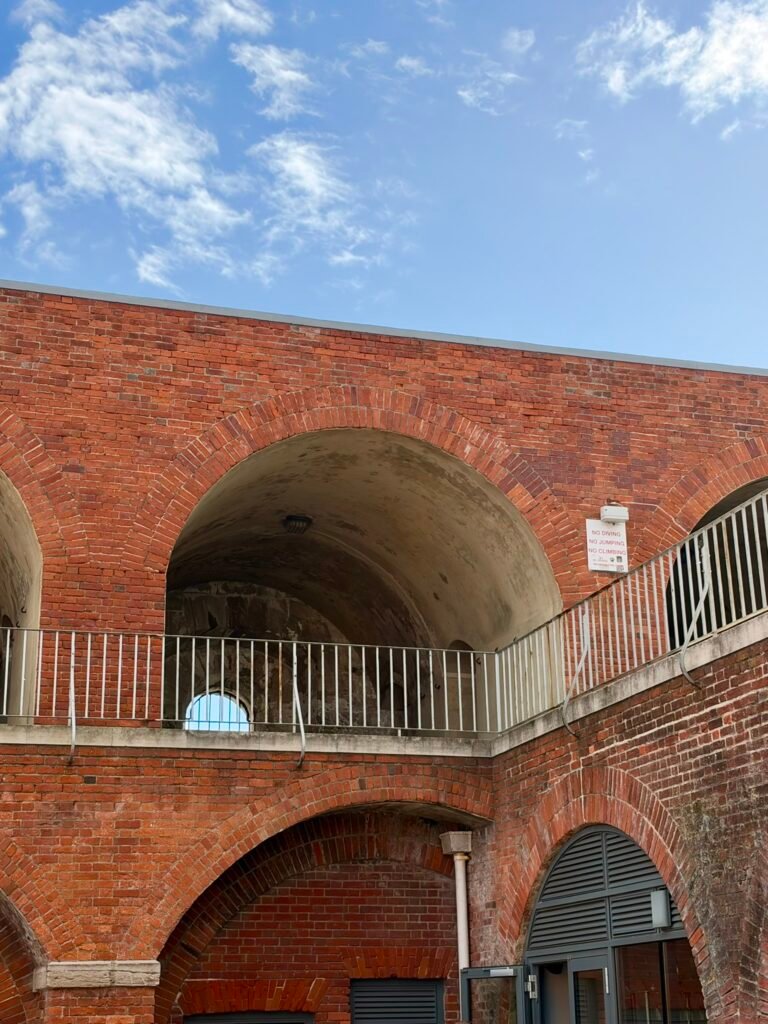
What I particularly like is how the area has been reused instead of being left to crumble.
The former military arches now house Hotwalls Studios, where contemporary artists and makers work in spaces once associated with soldiers and coastal artillery.
Imagine telling a Victorian gunner that his barracks would one day accommodate independent artists.
He’d probably demand to inspect your cannon.
You can explore the historic surroundings without buying an admission ticket, and the studios offer another reason to return. Opening times vary between individual artists, so check before planning to go inside.
Round Tower: The Harbour’s Medieval Bouncer
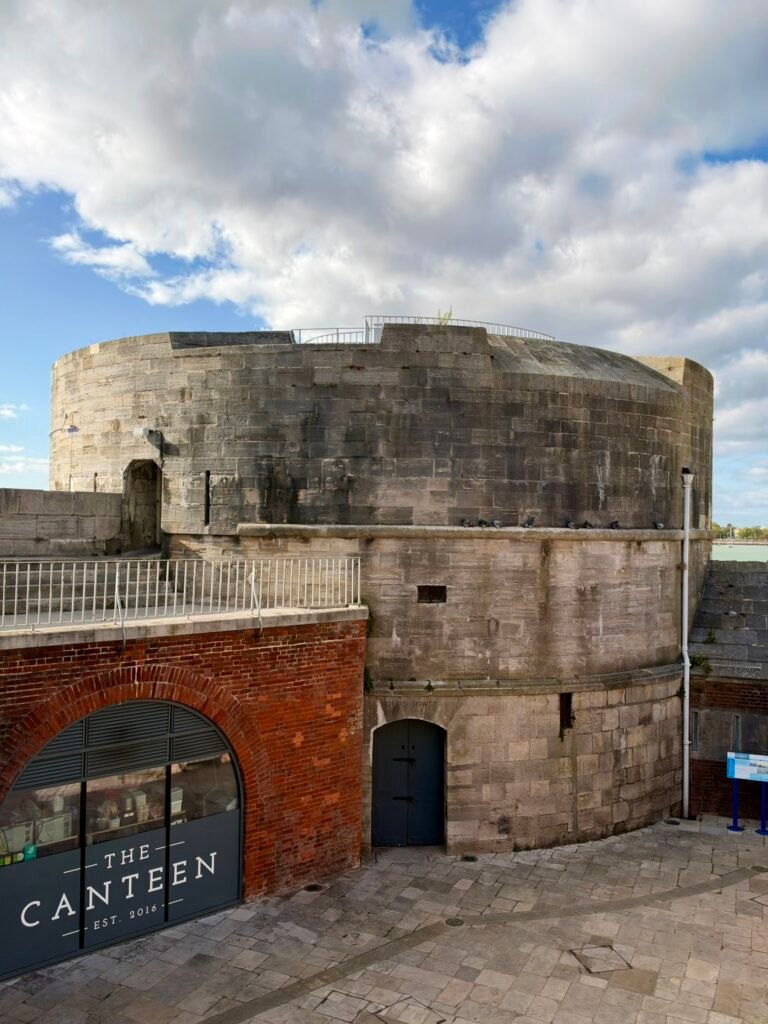
A little further along stands the magnificent Round Tower.
And unlike its square neighbour, this one was originally part of a genuinely ingenious security system.
Under Henry V, a wooden tower was established here in the early 15th century. It was later rebuilt in stone, while another tower stood across the harbour entrance on the Gosport side.
Between them, a huge defensive chain could be used to prevent unwanted ships from entering.
Essentially, Portsmouth had invented the medieval equivalent of:
“Sorry, you’re not on the guest list.”
Except instead of an intimidating nightclub doorman, you had artillery, fortified towers and several tons of iron chain.
The Round Tower was rebuilt and adapted repeatedly over the following centuries, eventually forming part of the larger harbour defences.
And now? Instead of keeping ships out, visitors climb the adjoining steps to enjoy the views across Portsmouth Harbour and the Solent.
Not a bad retirement.
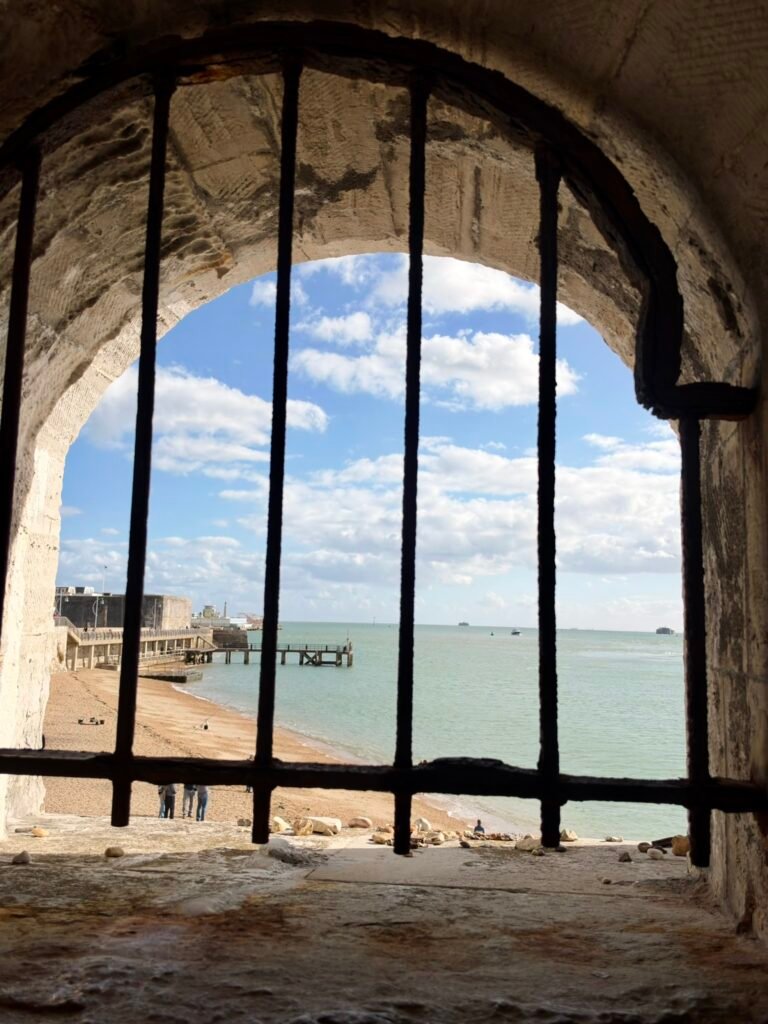
One of my favourite photographs from this stop was taken through a barred stone window.
Beyond the old ironwork, there’s a small beach, a pier, open water and boats on the horizon. The view feels almost peaceful — a striking contrast to the structure’s original purpose.
Today, the upper walkways offer some excellent photography opportunities, although they involve steps and aren’t fully accessible to everyone. The lower-level studios and The Canteen café provide an easier alternative.
For details about the surviving defences, Visit Portsmouth’s guide to the Round Tower and Point Barracks explains how the military complex developed over time.
The Surprise Statue: A Family Leaving Everything Behind

Among all those imposing stone walls, I found something much more personal.
A bronze family stands near the old fortifications: a father, a mother and two children, apparently preparing for a journey.
The sculpture is called The Crossing, also known as the Pioneer Statue.
Presented to Portsmouth on 27 August 2001 by members of the Pioneer Heritage Foundation, it commemorates Europeans who left their homelands to begin new lives in America.
Created by sculptors Mark DeGraffenried and Neil Hadlock, the figures have a particularly touching detail.
The little girl stepping forward represents the journey into the unknown.
Look at her again.
Suddenly, it’s no longer just another statue beside the waterfront.
For generations of emigrants, leaving Europe meant saying goodbye to familiar streets, family members and everything they’d ever known. Their new lives began with an uncertain voyage across the ocean.
And here we are, centuries later, standing in a city whose harbour witnessed countless departures and arrivals.
I think that’s what makes Old Portsmouth so interesting. You come for military history and unexpectedly find a very human story waiting beside it.
Free Parking in Old Portsmouth: Yes, Really!
Now for something almost as surprising as the harbour chain: we managed to park for free nearby!
I can’t confidently identify the exact bay we used, but Portsmouth City Council has a particularly useful arrangement in its KD Castle Road parking zone.
Non-permit holders can park free for up to two hours in eligible bays. Streets within the zone include Castle Road, Great Southsea Street, Sussex Road and Queen’s Grove.
That’s a very reasonable option for a quick visit without paying city-centre parking prices.
There is a catch, though: the free allowance doesn’t automatically apply to every parking space. Pay-and-display bays have different requirements, so always check the roadside signs before leaving your car.
Alternatively, the KA Old Portsmouth parking zone allows non-permit holders one hour free in eligible spaces, including streets much closer to the historic waterfront.
One hour might suit a brief look at the towers. Two hours gives you considerably more freedom to explore and take photographs without constantly wondering whether a parking officer is admiring your car. Or preparing to decorate it with a ticket.
Is Old Portsmouth Worth a Stop?
Absolutely.
For me, this little stretch of waterfront offers something that many major attractions struggle to deliver: several centuries of history, fascinating architectural details, coastal views and an interesting walking route without a compulsory admission fee.
The exterior of the towers, the historic waterfront and the surrounding public walkways are free to explore. Access to particular interiors or events may vary.
There’s plenty more nearby, too. Royal Garrison Church is another free historic attraction worth checking out when it’s open, while Southsea Castle deserves its own visit — and its own One More Stop article. [COMING SOON]
If you enjoy exploring Portsmouth’s less obvious stories, don’t miss my article about the Portsmouth Naval Memorial, where more than 25,000 names reveal another extraordinary chapter of the city’s maritime history.
And for a very different kind of coastal landmark, there’s always Bournemouth Pier: Better to Look At Than Walk On? — which also has a few historical surprises.
What stayed with me about Old Portsmouth wasn’t just the view. It was the sheer variety of stories packed into such a small place.
One tower once stored gunpowder. Another helped guard the harbour with a giant chain. Old military arches have become creative studios. And nearby, a bronze child takes her first step towards an entirely new life.
Not bad for a walk that didn’t even cost us anything to park.
One journey. One story. One more stop.