
High above Bournemouth’s seafront, three red jets appear to be climbing into the sky, each leaving an extraordinary twisting trail behind it. From a distance, you could easily mistake them for a rather unusual piece of seaside art.
But these are not just decorations. This is the Jon Egging Memorial, and its story involves a tragic day at the Bournemouth Air Festival, an idea from local schoolchildren, a dramatic cliff collapse and a legacy that continues to change young people’s lives.
I stopped to photograph the sculpture and discovered that another memorial nearby holds a surprising, much older story too.
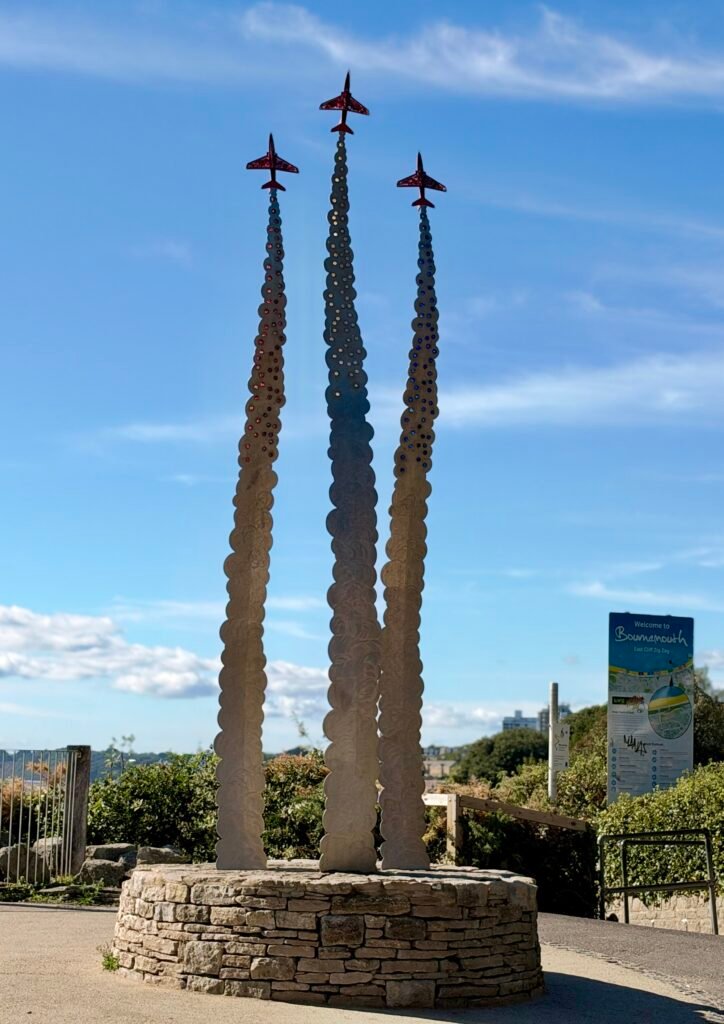
The Red Arrow who never returned
On 20 August 2011, Bournemouth was hosting its annual Air Festival. The famous Red Arrows had completed their display when tragedy struck.
Flight Lieutenant Jon Egging, known to his colleagues as Eggman, was flying as Red 4. As the team returned towards Bournemouth Airport, his Hawk aircraft crashed in open fields near the River Stour, killing him.
It was a devastating loss for his family, his fellow pilots and the wider Bournemouth community.
There’s an important detail here: although his memorial stands overlooking the sea, the aircraft did not crash into Bournemouth Bay. The accident occurred near the airport, after the display.
Today, the three aircraft rising above East Cliff commemorate Jon’s life rather than the location of the accident.
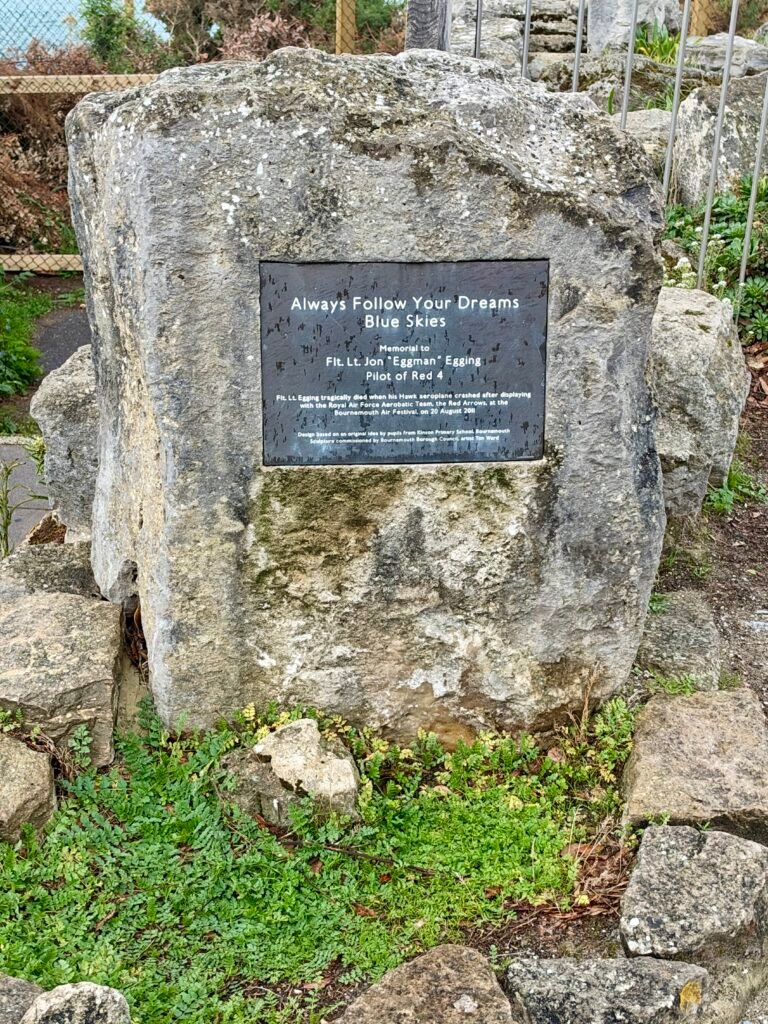
A beautiful tribute designed by Bournemouth children
One of the most remarkable things about this memorial is who helped create it.
Following Jon’s death, Bournemouth Borough Council invited local schoolchildren to submit designs. Jon’s wife, Dr Emma Egging, and his mother, Dawn, selected an idea created by pupils at Kinson Primary School.
Artist Tim Ward, of Circling the Square, developed their concept into the five-metre-high sculpture unveiled on 29 August 2012.
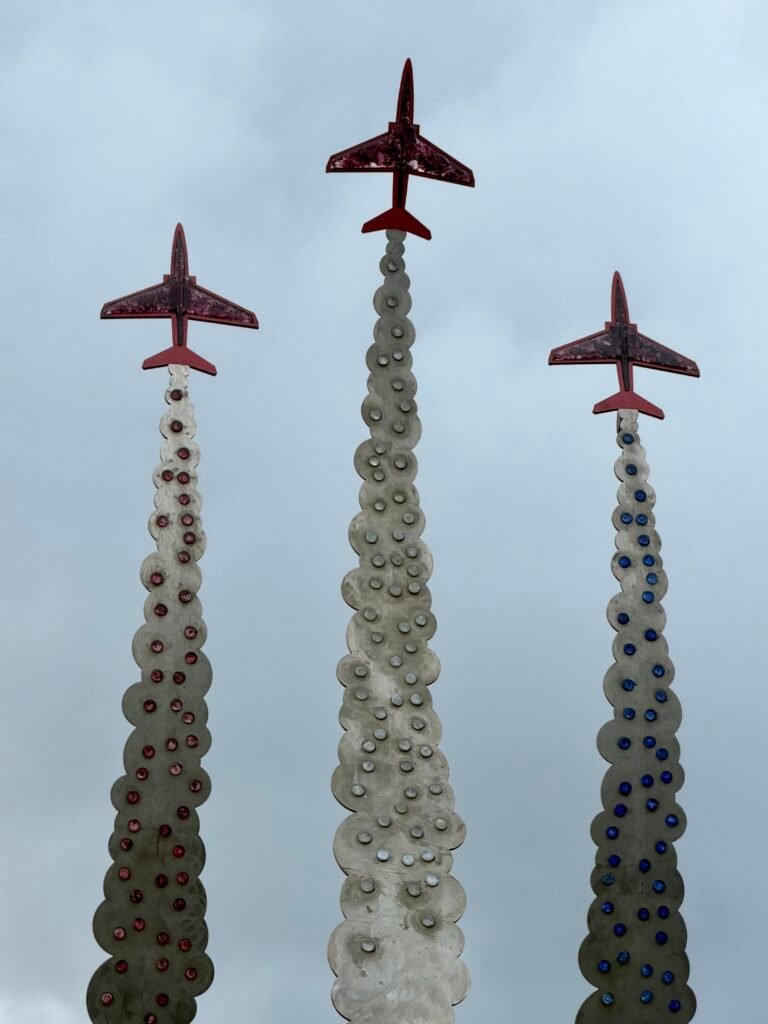
Look carefully at the three trails. They’re made from stainless steel with coloured glass details in red, white and blue, rising towards three Red Arrows aircraft.
It’s an incredibly thoughtful design: the aeroplanes seem to be flying upwards, leaving their colourful display trails behind.
Beside the sculpture, a stone carries a simple message:
“Always Follow Your Dreams. Blue Skies.”
Knowing that local children helped shape the memorial makes those words especially meaningful.
Even the memorial survived a cliffside drama
You might assume those three Red Arrows have always stood exactly where they are today.
They haven’t.
In April 2016, a major landslip damaged Bournemouth’s East Cliff, leaving the memorial’s original position dangerously close to the unstable cliff edge.
The sculpture itself survived, but keeping it there was no longer safe.
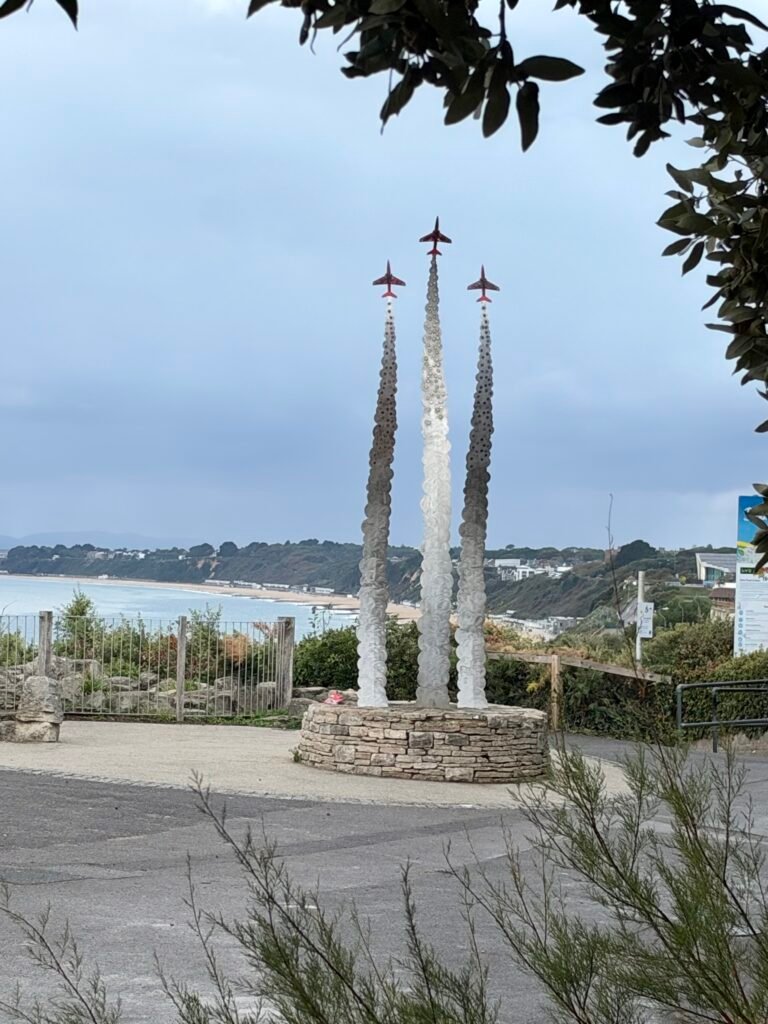
In 2017, it was carefully removed, restored and relocated to a safer position near the East Cliff zigzag path.
The new setting includes a low cairn built from Purbeck stone, reflecting Jon’s love of walking in the mountains. Even the base has a personal story.
The memorial was unveiled again in its new home on 18 August 2017, with Jon’s family present.
That makes its peaceful clifftop setting rather remarkable: this sculpture has witnessed changes to Bournemouth’s coastline and has itself been given a second home.
Another memorial nearby tells a story from 1947
And here’s something I certainly didn’t expect to discover.
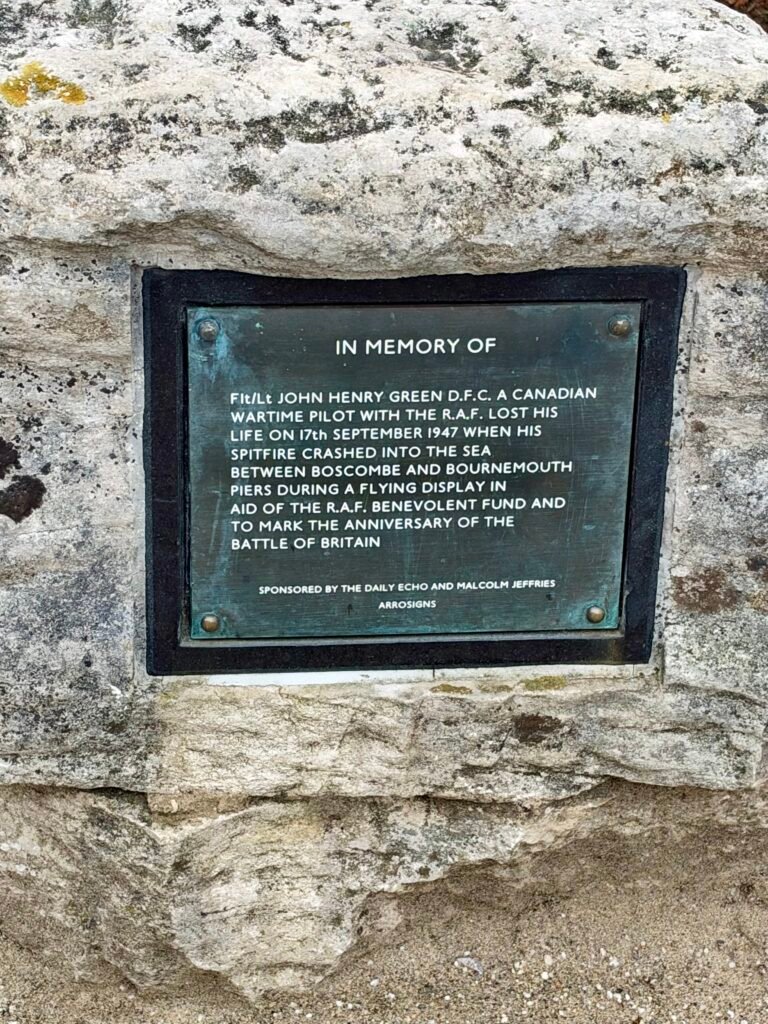
Just a short distance away is another stone plaque, remembering Flight Lieutenant John Henry Green DFC, a Canadian wartime pilot who served with the RAF.
On 17 September 1947, Green was flying a Spitfire during an aerial display over Bournemouth. The event was raising funds for the RAF Benevolent Fund and marking the anniversary of the Battle of Britain.
His aircraft crashed into the sea between Bournemouth and Boscombe piers, and he lost his life aged just 29.
Unlike Jon Egging’s accident, this tragedy happened over Bournemouth Bay itself.
So here, beside one beautiful stretch of coastline, are reminders of two separate aviation tragedies more than six decades apart.
It’s the kind of detail you might never notice if you simply continued walking towards the beach.
A memorial that still helps young people today
The story doesn’t end with the sculpture.
In 2012, Jon’s wife Emma founded the Jon Egging Trust to carry forward his ambition to inspire young people.
Its Blue Skies programme helps young people who may be struggling with confidence, school or difficult circumstances. Through teamwork, leadership development and opportunities connected with aviation, science and other workplaces, the charity aims to help them see what they can achieve.
What began as a way of remembering one pilot has grown into a charity supporting young people across England and Wales.
That is arguably the most powerful part of the memorial’s story. It doesn’t simply remember a life — it points towards what other lives might become.
Where to find the Jon Egging Memorial
You’ll find the sculpture on East Overcliff Drive in Bournemouth, near the top of the East Cliff zigzag path, overlooking Bournemouth Bay.
The memorial is outdoors and free to visit. You can stop to admire the sculpture, read the plaques and take in the views across the bay. Watch for any temporary cliff-path restrictions when planning your walk.
For anyone exploring Bournemouth on foot, it’s a worthwhile addition to a seafront walk. And if you enjoy discovering local places that people often overlook, you might also like the story of the Bournemouth Clock Tower at Lansdowne or my collection of free places to visit in Dorset.
Next time you pass those three red aircraft above the cliffs, look a little closer.
There’s a story behind the sculpture, another story beside it, and a reminder that something meaningful can continue long after the person who inspired it has gone.
One journey. One story. One more stop.