I knew Stratford-upon-Avon would be popular. It is Shakespeare’s hometown, after all. What I wasn’t expecting was to arrive in what sometimes felt like the Cotswolds had accidentally grown its own Oxford Street. 😆 Between the crowds, historic buildings, Shakespeare everywhere you look and the much calmer walk beside the River Avon, this turned out to be a very different stop from the quiet villages and countryside I’d been exploring.
But underneath all the tourism is a genuinely fascinating town. Stratford has more than 800 years of history, buildings that Shakespeare himself would have recognised, the house where he was born, the church where he was baptised and buried, and enough surviving pieces of his world to make the past feel unusually close.
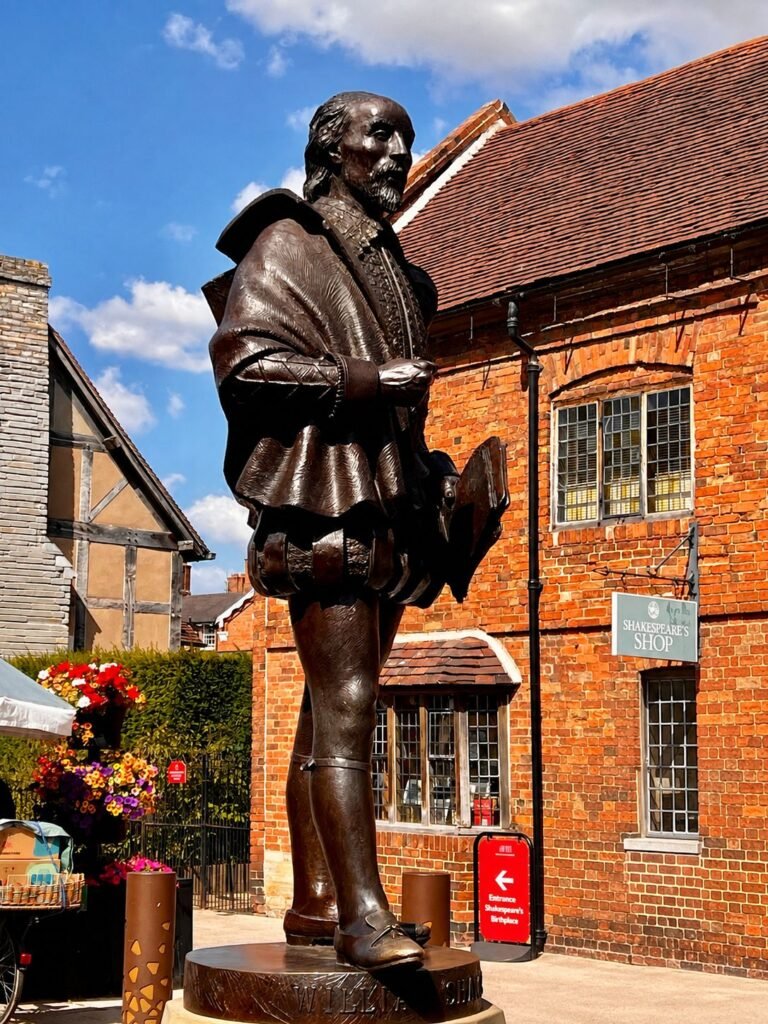
Table of Contents
First Impressions of Stratford-upon-Avon
My first impression was simply how busy it was. After spending so much time exploring small villages, ruined castles and quieter historic places, Stratford felt almost like a different kind of trip altogether. There were people everywhere, busy streets, shops, cafés and queues — and plenty of reminders that Shakespeare is very much the town’s main attraction.
That isn’t necessarily a criticism. Stratford feels alive rather than preserved behind glass, and once I started looking beyond the crowds, there was an extraordinary amount of history sitting right in the middle of an ordinary modern town.
A Town Older Than Shakespeare
It is almost impossible to separate Stratford-upon-Avon from Shakespeare today, but the town had already been developing for centuries before he was born. There was an Anglo-Saxon settlement here, centred around the area we now call Old Town, long before Stratford became the busy market town Shakespeare would have known.
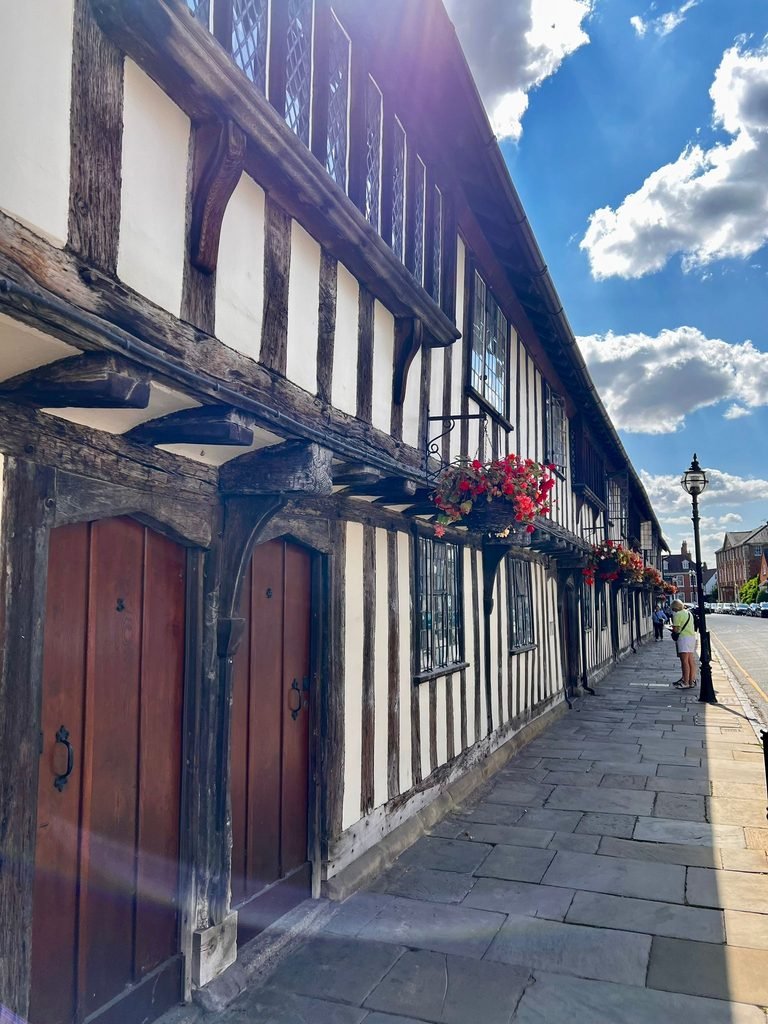
The really important change came around 1196, when Stratford was developed as a planned medieval town and was granted the right to hold a weekly market. Streets were laid out in a remarkably orderly pattern, with long, narrow plots of land running back from them. More than 800 years later, much of that medieval street pattern still shapes the centre of Stratford today.
Even some of the street names tell you what happened here. Sheep Street was associated with the sheep market, Rother Street with cattle, and Wood Street with wood. Wide Bridge Street was designed to accommodate market trading. Stratford wasn’t created as a Shakespeare attraction — it was a working commercial town long before Shakespeare became its most famous export.
Why here?
The location made sense. Stratford developed around an important crossing of the River Avon, where routes converged, making it a useful place for trade. Even the name reflects that geography: essentially a street or road crossing a ford on the Avon. The river that now makes Stratford so picturesque was therefore part of the reason the settlement developed here in the first place.
Shakespeare Wasn’t Always the Tourist Attraction
Because Stratford’s Shakespeare tourism really exploded much later. In 1769, actor David Garrick organised a three-day Shakespeare Jubilee in the town — more than 150 years after Shakespeare died — which helped transform Stratford into a destination for Shakespeare admirers.
There’s a rather funny historical angle here too: the enormous Shakespeare celebration was plagued by terrible weather and flooding. So Stratford dealing with hordes of Shakespeare tourists apparently isn’t an entirely modern phenomenon. 😂
From Market Town to Shakespeare’s Town
The Jubilee helped put Stratford more firmly on the map for Shakespeare admirers, and interest continued to grow during the nineteenth century. His Birthplace became an increasingly important destination for visitors wanting to see where the playwright’s story began.
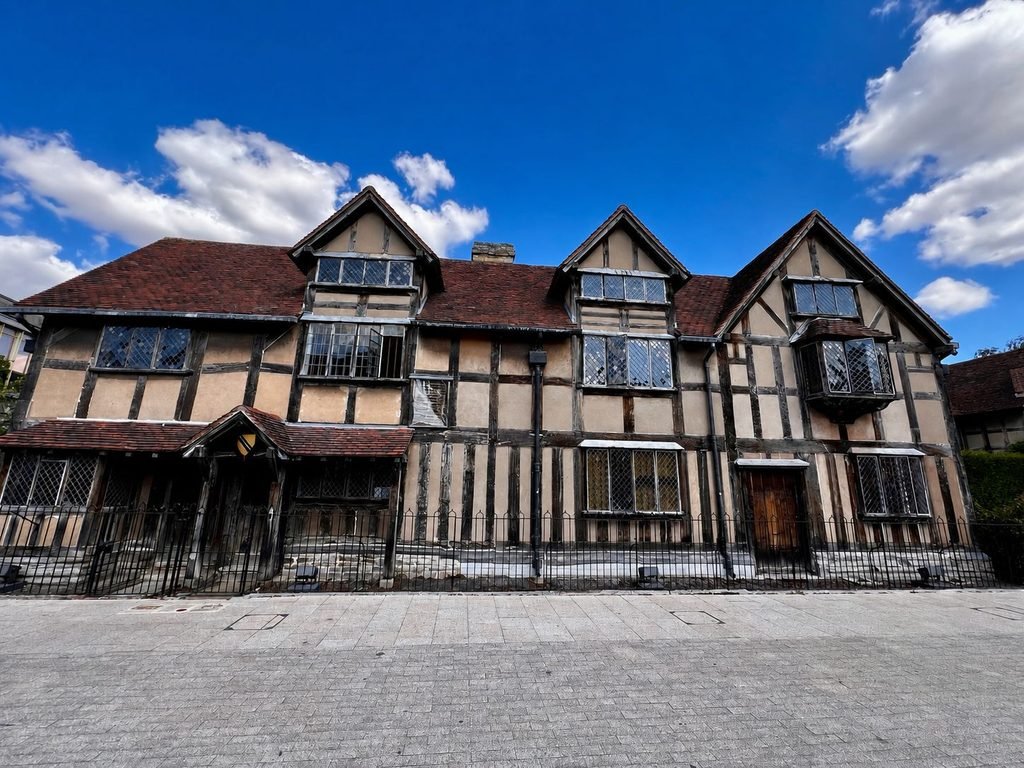
In 1847, Shakespeare’s Birthplace was purchased for the nation after being put up for sale. There were even fears at the time that the house could be bought by an American showman and transported across the Atlantic — which makes its familiar place in Stratford today feel rather less inevitable than you might expect.
Shakespeare Was Richer Than I Expected
One thing that surprised me while exploring Stratford was just how successful Shakespeare became financially. We tend to think about the playwright, the poems and the Globe Theatre, but there was another side to his story: William Shakespeare was also a businessman, investor and substantial property owner.
His success in the London theatre world made him wealthy enough that, in 1597, at the age of just 33, he bought New Place in Stratford. This wasn’t a modest retirement cottage. It was the largest house in the borough, with somewhere around 20 to 30 rooms, extensive grounds and ten fireplaces. Shakespeare had gone from growing up as the son of a glove-maker to owning one of the most prestigious homes in his hometown.
And he didn’t stop with the house. He later bought 107 acres of land, invested in property and acquired an interest in local tithes. His family had also secured a coat of arms in 1596, giving them the right to use the status of gentlemen — something that mattered enormously in the social hierarchy of Elizabethan England.
London Made Him Famous. Stratford Became Home.
What I found particularly interesting is that Shakespeare never really abandoned Stratford for London. His wife Anne Hathaway and their children remained here, and many of his major investments were made back in his hometown. He worked in London but continued travelling between the two places, eventually spending more of his later life in Stratford.
New Place remained his family home until his death in 1616. Unfortunately, the house itself no longer survives — after passing through several owners, it was eventually demolished in the eighteenth century. Today the site is preserved as Shakespeare’s New Place, so you can stand on roughly the same ground without actually seeing the enormous house that once stood there.
Holy Trinity Church: Where Shakespeare’s Story Ends
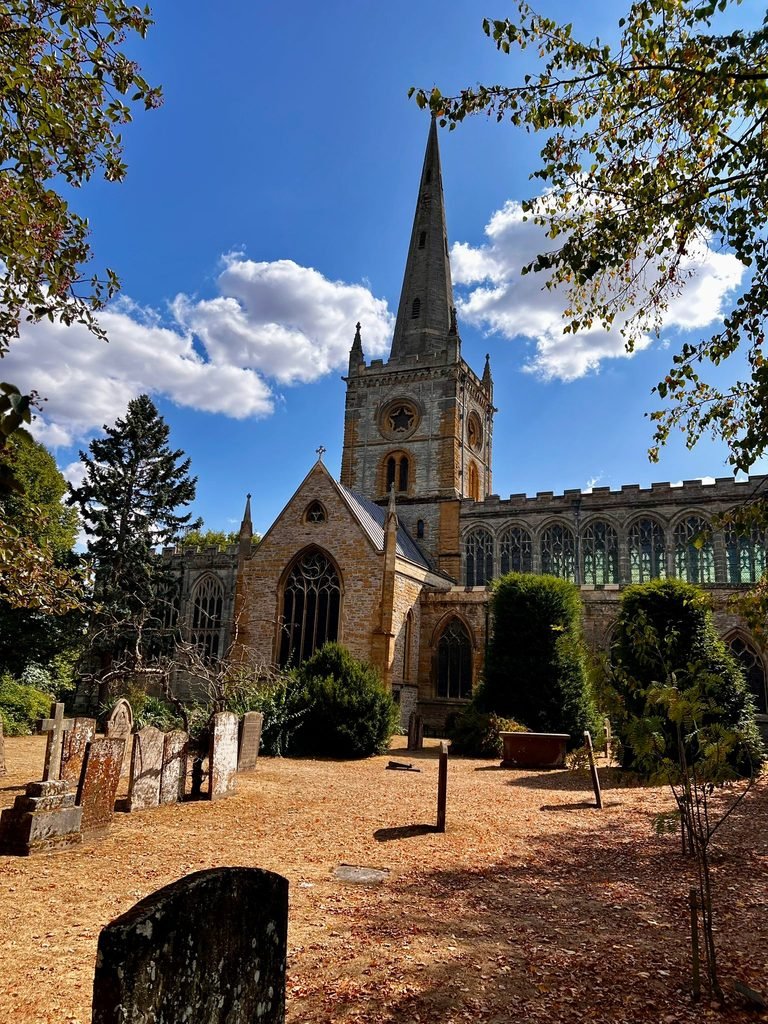
After the busy centre of Stratford, the walk towards Holy Trinity Church felt noticeably calmer. Sitting beside the River Avon and surrounded by trees, it feels almost removed from the Shakespeare shops, crowds and attractions only a short walk away.
Yet this is one of the most important Shakespeare sites in Stratford. Shakespeare was baptised here on 26 April 1564, and after his death on 23 April 1616, he was buried inside the church. His wife Anne Hathaway, daughter Susanna and other members of his family were later buried alongside him.
Shakespeare’s Grave — and a Warning
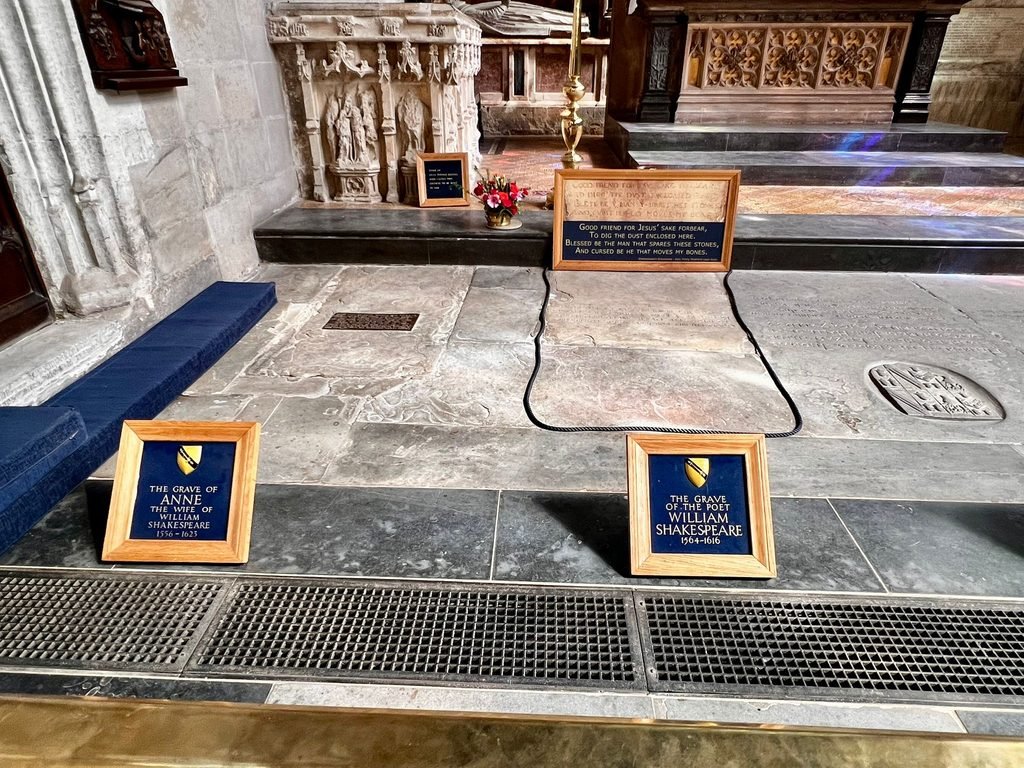
Inside the church, Shakespeare’s grave lies in the chancel beneath a simple stone slab. There is no elaborate tomb covering him. Instead, carved into the stone are four lines that sound considerably more threatening than the average epitaph:
Good friend for Jesus’ sake forbear,
To dig the dust enclosed here.
Blessed be the man that spares these stones,
And cursed be he that moves my bones.
In modern English, the message is essentially: please leave my grave alone — and a curse on anyone who moves my bones. 😆
It sounds wonderfully dramatic for Shakespeare, although we don’t actually know for certain that he wrote the words himself. What the inscription did achieve rather effectively was to warn against disturbing the grave — something that mattered in a period when remains could eventually be removed to make space for new burials.
So… Has Anyone Ever Opened It?
Apparently Shakespeare’s warning has been taken fairly seriously. His grave has never been excavated, and the church has resisted proposals that would disturb it.
Researchers did, however, investigate the grave in 2016 using ground-penetrating radar. The results suggested that Shakespeare was buried relatively shallowly beneath the church floor and, intriguingly, indicated a disturbance around the position where his head should be.
That revived an old story claiming that grave robbers may have stolen Shakespeare’s skull in the eighteenth century. But there is an important distinction between a good mystery and an established fact: the radar cannot prove that his skull is missing, and the grave has not been opened to find out.
A Quieter Stratford Beside the River
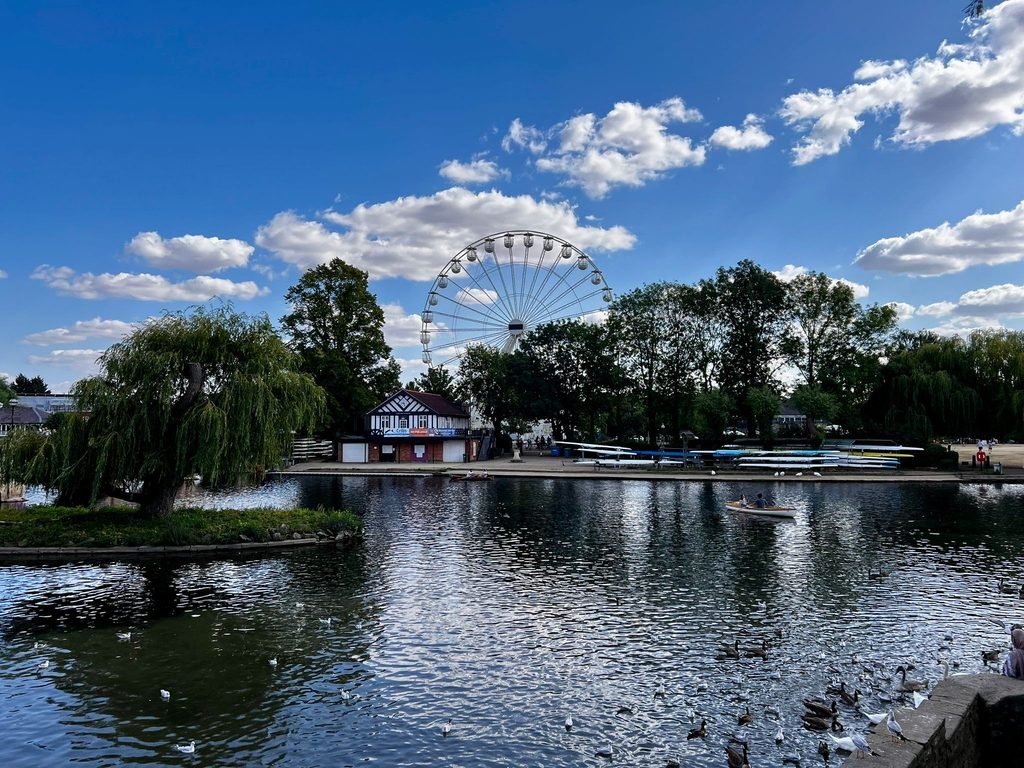
After all the Shakespeare history and the crowds of the town centre, one of my favourite parts of Stratford was simply walking towards the River Avon. The atmosphere changes surprisingly quickly. Bancroft Gardens opens up beside the water, with trees, lawns, boats and plenty of space to stop for a while.
This is where Stratford started to feel less like a major tourist attraction and more like somewhere I could actually slow down and enjoy. The river is still busy in its own way — there are pleasure boats, rowing boats, swans and people everywhere — but it somehow feels much calmer than the streets only a few minutes away.
The River That Gave Stratford Its Name
The Avon has been part of Stratford’s story for far longer than Shakespeare. The town developed around a crossing of the river, and the waterway became important for trade and transport. Today its role is rather more leisurely, but it still runs straight through the identity of the town — quite literally giving Stratford-upon-Avon its name.
Bancroft Gardens also gives you some of the best-known views of modern Stratford, with the river, the Royal Shakespeare Theatre and the recreation grounds all clustered around the waterfront. It is probably the easiest place in town to forget, briefly, just how many Shakespeare souvenirs are being sold a few streets behind you. 😆
What Stratford-upon-Avon Actually Feels Like to Visit
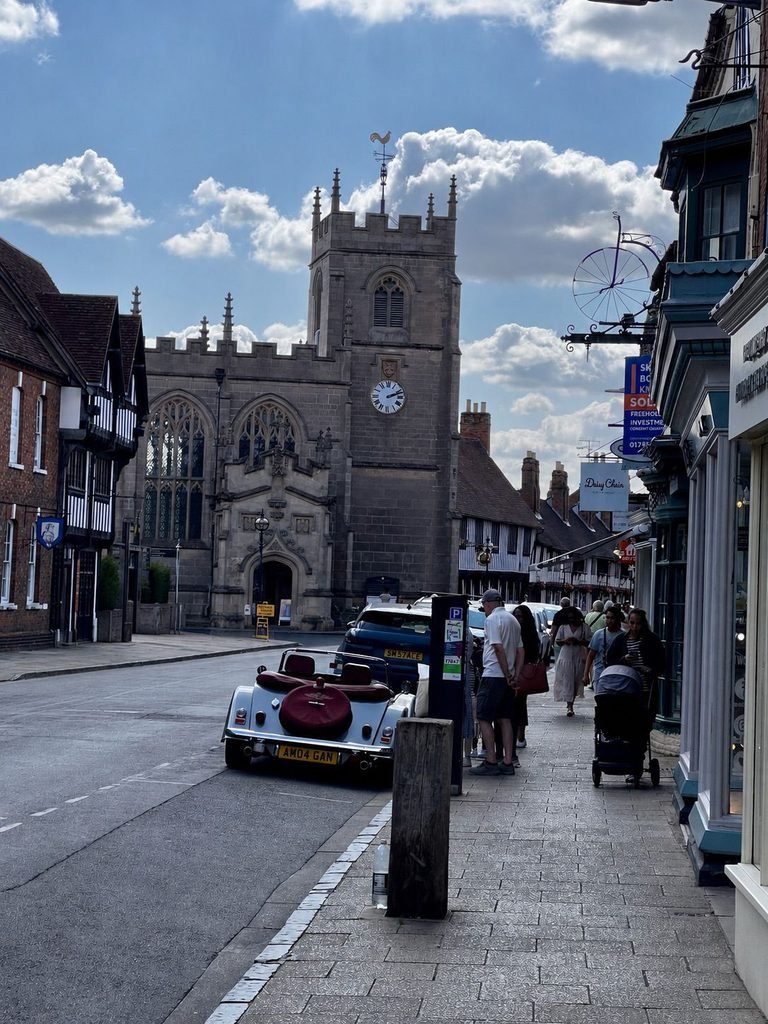
There is no getting around it: Stratford-upon-Avon is busy. At least, it certainly was when I visited. After some of the tiny Cotswolds villages and countryside stops I had been exploring —including Broadway Tower — arriving here was quite a shock. At times the centre felt less like a sleepy historic market town and more like someone had dropped a Shakespeare-themed Oxford Street into Warwickshire. 😆
But once I adjusted to the crowds, I actually started to appreciate the mixture. Stratford isn’t a perfectly preserved historic town where modern life has been carefully hidden from view. Old timber-framed buildings sit alongside cafés, shops, restaurants and hotels, while Shakespeare appears in almost every conceivable form.
And perhaps that is inevitable. Millions of people know Shakespeare’s name, and this is the place where he was born, where his family lived, where he invested his money and where he eventually died and was buried. Stratford hasn’t simply preserved that connection — it has built a substantial visitor economy around it.
Do the Crowds Spoil It?
For me, not really — but they definitely change the experience. If you arrive expecting somewhere like a quiet Cotswolds village, you may be surprised. This is a proper tourist destination, and on a busy day you will be sharing it with a lot of other people.
The trick, I found, was not to spend the entire visit fighting through the busiest streets. Explore the historic centre, see the Shakespeare sites that interest you, and then wander towards Old Town, Holy Trinity Church and the river. Those quieter moments made me appreciate Stratford much more.
Is Stratford-upon-Avon Worth Visiting?
Yes — absolutely, but I would visit it differently now that I know what to expect.
If you are interested in Shakespeare, English history or historic architecture, Stratford is difficult to dismiss. Few famous historical figures have left such a concentration of places connected with their life in one town, and being able to walk from Shakespeare’s Birthplace through streets he would have known to the church where he is buried gives Stratford something genuinely special.
Even if Shakespeare isn’t the main reason you come, there is enough here for a good day out: historic streets, the River Avon, gardens, theatres, restaurants and plenty of places simply to wander.
What I’d Do Differently Next Time
I’d arrive earlier in the morning, before the busiest part of the day, and give myself more time. Stratford turned out to be much larger and more substantial than I had expected, and it isn’t really somewhere I’d treat as a quick half-hour stop between Cotswolds villages.
I’d also spend less time worrying about seeing everything. Pick the Shakespeare sites that genuinely interest you, explore the old streets, walk down to Holy Trinity Church and leave some time for the river. Stratford becomes considerably more enjoyable when you stop treating it as a checklist.
Planning Your Visit to Stratford-upon-Avon
Stratford deserves at least half a day, and I’d allow a full day if you want to go inside several Shakespeare attractions rather than simply explore the town. The historic centre itself is very walkable, with Shakespeare’s Birthplace, New Place, the river and Holy Trinity Church all within a relatively compact area.
Do You Need Tickets?
You can enjoy a surprising amount of Stratford without paying for attractions. Walking the historic streets, exploring Bancroft Gardens and the River Avon, and seeing many of the buildings from outside costs nothing.
If you want to go inside Shakespeare’s Birthplace, however, you need a ticket. In 2026, an adult ticket for Shakespeare’s Birthplace and New Place Gardens costs £25 online or £27 on the door, and tickets are valid for repeat visits for 12 months. The Birthplace uses timed entry, so booking ahead is sensible, particularly during busy periods.
What About Shakespeare’s Grave?
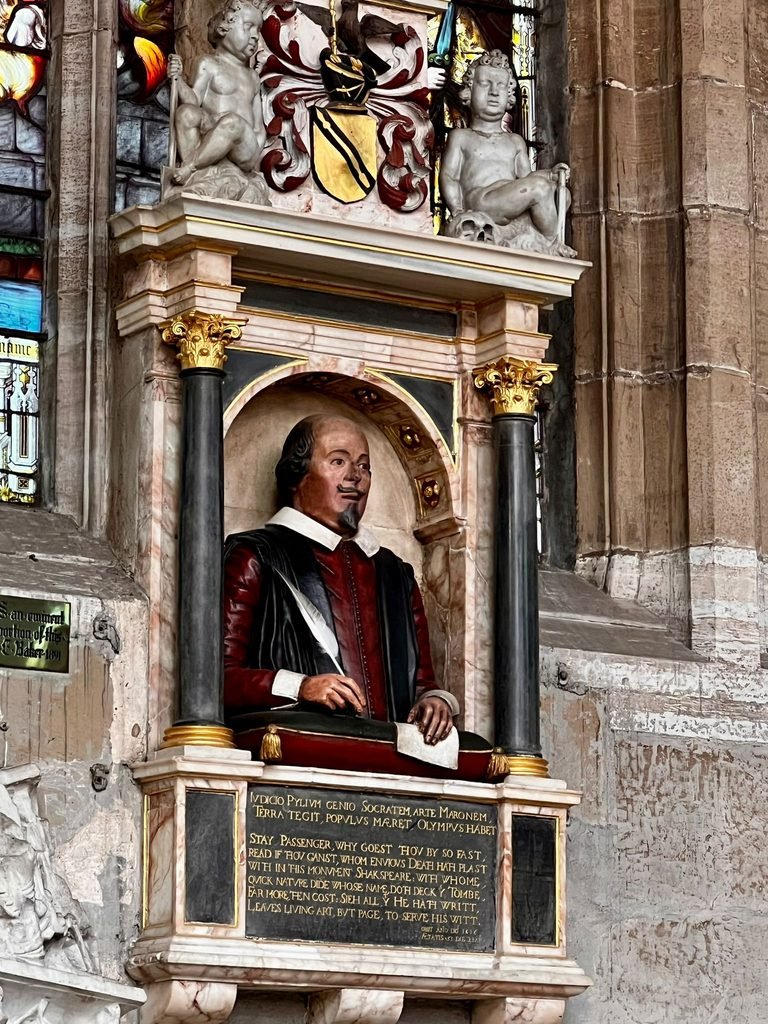
Holy Trinity Church itself is free to enter, but there is a small charge to enter the chancel where Shakespeare’s grave and funerary monument can be seen. When I visited I paid £5, which is still the current adult admission price in 2026. Visitors aged 18 and under pay £1, while preschool children enter free.
The church is still an active place of worship, so visitor access can occasionally change because of services, funerals and other events. If seeing Shakespeare’s grave is important to you, check the church’s current opening information before travelling.
You can check the latest opening times and any planned closures on the Holy Trinity Church visitor page.
Getting There
Stratford-upon-Avon is easy to explore on foot once you arrive. The railway station is around a ten-minute walk from the town centre, and there are several public car parks within walking distance of Shakespeare’s Birthplace.
You can check the latest transport and visitor information on the Shakespeare Birthplace Trust’s journey planner.
My Tips
- Arrive early if you can, especially at weekends and during school holidays.
- Allow half a day minimum; a full day is better if you’re visiting the attractions.
- Pre-book Shakespeare’s Birthplace if going inside is important to you.
- Wear comfortable shoes — Stratford is best explored on foot.
- Don’t stay exclusively around Henley Street and the busiest Shakespeare attractions; walk towards Old Town, Holy Trinity Church and the river.
- Leave yourself some unplanned time. Stratford was much bigger than I expected, and rushing it would have been a mistake.
For current events, attractions and other practical information, the official Stratford-upon-Avon visitor website is also useful when planning a trip.
One More Stop?
Definitely. Just don’t expect a quiet little Shakespeare village.
Stratford-upon-Avon surprised me. It was bigger, busier and considerably more touristy than I had imagined, but underneath all of that is an extraordinary amount of genuine history. You can stand outside the house where Shakespeare grew up, walk streets whose layout goes back to medieval Stratford, follow the river through town and eventually reach the church where his story ended.
Would I go back? Yes. In fact, knowing what I know now, I think I’d enjoy it more the second time. I’d arrive earlier, slow down, choose fewer attractions and spend more time exploring the quieter corners rather than trying to take in everything at once.
Stratford wasn’t quite the place I expected it to be — but perhaps that is exactly what made it worth the stop.